Affini-T Therapeutics' deck is a textbook example of high-stakes biotech fundraising, prioritizing scientific pedigree and infrastructure over traditional business metrics. By focusing on the KRAS G12D and G12V mutations—historically 'undruggable' targets with massive patient populations—the company establishes a clear market need. The deck relies on the reputation of its Scientific Advisory Board, featuring Nobel laureates and pioneers from Fred Hutch and MD Anderson, to de-risk the technical complexity of their TCR discovery platform. With a reported $175M Series B raise in 2022, the presen…
Key takeaways
- The deck targets high-incidence oncogenic driver mutations, specifically KRAS G12D and G12V, which affect hundreds of thousands of patients annually (Slide 7).
- Scientific credibility is anchored by a Scientific Advisory Board (SAB) featuring industry titans like Jim Allison and Phil Greenberg (Slide 10).
- The company utilizes a proprietary TCR discovery platform licensed from the Fred Hutchinson Cancer Center (Slide 13).
- Technical differentiation is explained through a coordinated CD4/CD8 T cell response to prevent exhaustion in the tumor microenvironment (Slide 16).
- Operational maturity is signaled by a 95,000 sq. ft. cGMP clinical and commercial manufacturing facility in Boston (Slide 22).
- The deck omits a specific funding 'ask' or use of proceeds slide, focusing instead on the platform's potential and infrastructure (Slide 24).
- Bi-coastal operations are split between TCR discovery in Seattle and engineering/manufacturing in Boston (Slide 22).
- Market validation is shown by highlighting the lack of approved therapies for major KRAS mutation variants (Slide 7).
Affini-T Therapeutics: Engineering a $175M Series B
Biotech fundraising, particularly in the cell therapy space, operates on a different set of rules than traditional SaaS or consumer tech. In a sector where revenue is often a decade away, the 'product' is the scientific platform and the 'traction' is the pedigree of the team. Affini-T Therapeutics' 2022 deck, presented at the 40th Annual J.P. Morgan Healthcare Conference, is a masterclass in establishing this specific type of credibility. The company successfully raised $175M in a Series B round shortly after this presentation, targeting some of the most difficult mutations in oncology.
Slide 1-3: The Vision and Branding
The deck opens with a clean, high-contrast aesthetic. The title slide (Slide 1) immediately defines the mission: "Unlocking the power of T cells against oncogenic driver mutations." This is a specific, high-value niche. By focusing on "oncogenic drivers," they are signaling to investors that they are targeting the root cause of tumor growth rather than secondary symptoms. The branding is consistent across the opening slides, maintaining a professional, non-confidential status suitable for a large-scale healthcare conference.
Slide 4: The Problem Statement
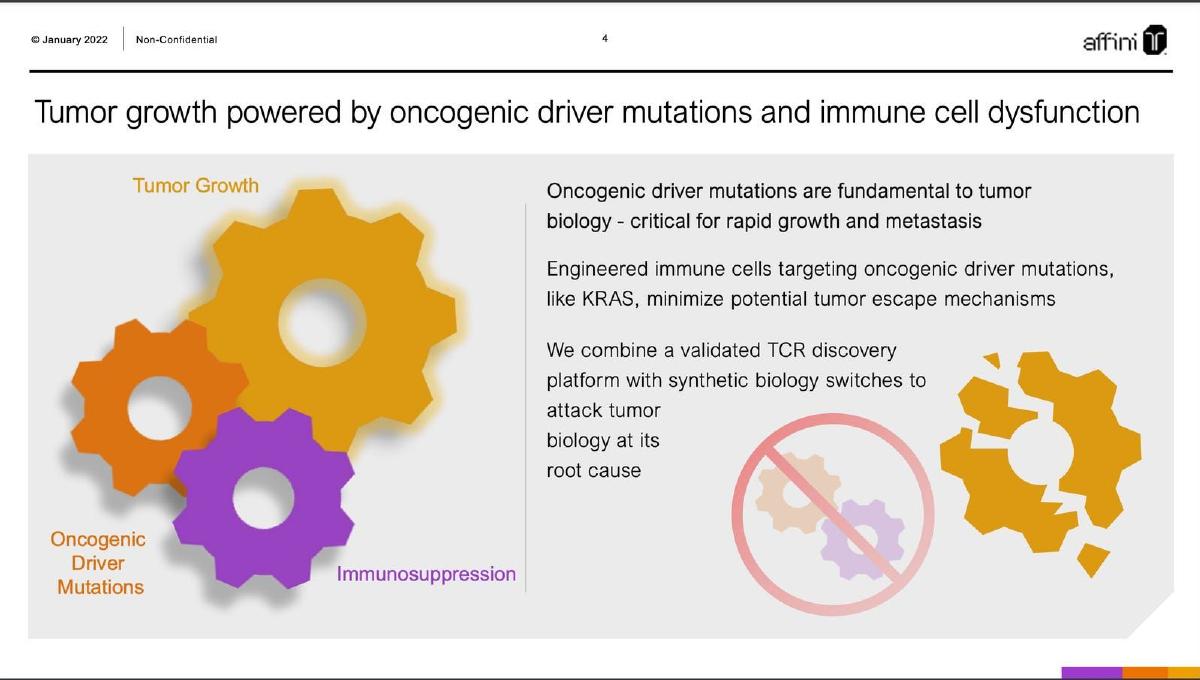
Slide 4 uses a gear metaphor to explain the synergy between tumor growth and immune dysfunction. It identifies two primary hurdles: oncogenic driver mutations (like KRAS) and immunosuppression. The slide explicitly states that their approach combines a "validated TCR discovery platform with synthetic biology switches." This is the first mention of their technical moat—the ability to not just find the target, but to engineer the cell to survive the 'hostile' environment of a solid tumor.
Slide 7: Market Opportunity and the KRAS Challenge
This is one of the most data-dense slides in the deck. It breaks down the prevalence of KRAS G12 mutations, specifically G12V and G12D. The slide highlights a massive gap in the market: while Lumakras (sotorasib) is noted for Cysteine (C) mutations, the slide clearly labels Valine (V) and Aspartic acid (D) mutations as having "No approved therapies." The incidence numbers are staggering: ~128K for KRAS G12D in Colorectal cancer and ~92K in Pancreatic cancer. By quantifying the incidence across Pancreatic, Colorectal, and Lung cancers, Affini-T establishes a multi-billion dollar TAM without ever using the term 'TAM.'
Slide 10: The Scientific Advisory Board (SAB)
In biotech, the SAB slide is often more important than the executive team slide. Slide 10 is a 'who's who' of immunology. Featuring Jim Allison (Nobel Laureate) and Phil Greenberg (a pioneer in TCR therapy), the slide leverages institutional credibility from Fred Hutch, MD Anderson, Harvard, and MIT. For a Series B investor, this slide serves as a massive de-risking mechanism. The message is clear: the most respected minds in the field are betting on this specific approach.
Slide 13: The Discovery Platform
Slide 13 outlines the four-step process: Prioritize, Discover, Engineer, and Treat. It highlights the partnership with Fred Hutch for a "robust and proven TCR discovery platform." The engineering step is crucial, showing the lentiviral engineering of patient T cells to create a coordinated CD4/CD8 response. This slide bridges the gap between the high-level science and the actual manufacturing workflow required to create a therapeutic product.
Slide 16: Technical Differentiation (CD4/CD8 Persistence)
One of the biggest failures in T-cell therapy for solid tumors is "exhaustion"—where the T-cells stop working once they enter the tumor. Slide 16 provides a technical diagram of how Affini-T's engineered cells prevent this. By using CD4 T cells to provide IL-2 signals to CD8 T cells, they "prolong persistence in the hostile TME [Tumor Microenvironment]." This is a direct answer to the most common technical objection an investor would have regarding solid tumor efficacy.
Slide 17-21: The Pipeline
Slide 17 introduces the "Differentiated Pipeline of TCR T Cell Therapies." While the specific pipeline chart is not fully detailed in the provided text, the surrounding context indicates a focus on multiple TCR candidates targeting the mutations identified earlier in the deck. This transition from platform to pipeline is essential for Series B, showing that the company has multiple 'shots on goal.'
Slide 22: Infrastructure and Scale
Perhaps the most impressive slide for a late-stage investor is Slide 22, titled "Building infrastructure to support rapid bi-coastal company growth." It lists four distinct facilities: a Seattle Research Lab, a Boston Interim Lab, a Boston HQ, and a 95,000 sq. ft. cGMP Clinical and Commercial Manufacturing facility. This slide proves that Affini-T is not just a virtual biotech or a lab project; they have the physical capacity to produce their own therapies at scale. The inclusion of "Quality Assurance," "Warehousing," and "Regulatory" functions signals that the company is preparing for clinical trials and eventual commercialization.
What Affini-T Therapeutics Does Well
The deck excels at institutional validation . By repeatedly citing Fred Hutch and MD Anderson, and showcasing a stellar SAB, they bypass the need to prove their basic scientific competence. The market mapping on Slide 7 is also exceptional; it doesn't just say "cancer is a big problem," it identifies specific mutations where there are zero approved therapies, creating a sense of urgency and clear regulatory pathway. Finally, the operational transparency on Slide 22 shows that the $175M they raised was destined for hard assets and manufacturing independence, which is a significant competitive advantage in cell therapy.
What is Missing from the Deck
The most notable omission is clinical data . While the platform is "validated," the deck focuses on the discovery process and engineering rather than specific patient outcomes or Phase 1 trial results. This is typical for a platform-stage biotech but remains a high-risk factor for investors. There is also no financial ask . As a conference deck, it is designed to attract interest rather than close a specific note, so the lack of a "Use of Proceeds" slide is expected but leaves the reader wondering about the specific burn rate and runway. Additionally, there is very little mention of the competitive landscape beyond a brief nod to Lumakras; other TCR-T and CAR-T competitors are not addressed.
Founder Takeaways: How to Pitch a Platform
Lead with Pedigree: If your team or advisors have Nobel prizes or have founded multi-billion dollar biotechs (like Juno, mentioned on Slide 10), make that the center of your pitch. · Quantify the Unmet Need: Don't just list the disease; list the specific mutation and the number of patients who currently have zero options (Slide 7). · Solve the 'Why Now': Affini-T solves the 'exhaustion' problem that hampered previous generations of cell therapy. Identify the technical wall your industry has hit and show exactly how you climb over it (Slide 16). · Show the Factory: For hardware or biotech, showing your manufacturing capacity (Slide 22) is the ultimate proof of maturity. It moves the conversation from "Can this work?" to "Can this be delivered?"
Frequently asked questions
- What is the primary scientific focus of Affini-T Therapeutics?
- Affini-T focuses on engineering T-cells to target oncogenic driver mutations, specifically KRAS and p53, in solid tumors. Their platform combines TCR discovery with synthetic biology switches to overcome immunosuppression in the tumor microenvironment, as detailed on Slide 4 and Slide 16.
- Who are the key scientific figures behind the company?
- The company is guided by a world-class Scientific Advisory Board (SAB) shown on Slide 10. Key members include Nobel laureate Jim Allison, PhD, and scientific co-founders Phil Greenberg, MD, Aude Chapuis, MD, and Tom Schmitt, PhD, all of whom have deep ties to Fred Hutch and MD Anderson.
- How does Affini-T differentiate its cell therapy from competitors?
- Affini-T differentiates itself by leveraging a coordinated CD4/CD8 T cell response. According to Slide 16, this approach uses CD4 T cells to prevent CD8 T cell exhaustion and prolong persistence within the hostile tumor microenvironment, a common failure point for other solid tumor therapies.
- What does the company's operational footprint look like?
- As of the 2022 deck, Affini-T operates four main sites: a research lab in Seattle for TCR discovery, an interim lab in Boston for gene editing, a Boston HQ for management, and a massive 95,000 sq. ft. cGMP manufacturing facility in Boston (Slide 22).
- Does the deck include a financial ask or valuation?
- No. The deck presented at the J.P. Morgan Healthcare Conference focuses on the platform, science, and infrastructure. While Business Insider reported a $175M Series B raise in 2022, the slides themselves do not list a specific dollar amount sought or a company valuation.