Ziyen Inc.'s 2018 investor presentation positions the company as a solution to US foreign oil dependency, framing energy independence as a matter of national security and economic health. The deck highlights that 10.1 million barrels of oil are imported daily, representing a $238 billion drain on the US economy. Ziyen proposes a streamlined model for oil production, gathering, and refining, while simultaneously hinting at a transition toward renewable energy. A significant portion of the pitch focuses on the inefficiencies of the 'Traditional Model,' specifically citing high corporate taxes a…
Key takeaways
- The company frames its mission around achieving 100% energy independence for the USA (Slide 1).
- Ziyen identifies a $238 billion annual loss to foreign economies like Saudi Arabia and OPEC due to oil imports (Slide 2).
- The deck utilizes political quotes from George W. Bush and Barack Obama to emphasize the security risks of foreign oil (Slide 9).
- Ziyen claims to have streamlined processes across production, gathering, and refining, noting that all produced oil has guaranteed buyers (Slide 13).
- The presentation acknowledges a global shift toward renewables but focuses on petroleum for the transportation sector (Slide 17).
- A critique of the 'Traditional Model' highlights a 35% corporate tax rate (noting a drop to 21%) and a lack of tax credits as primary inefficiencies (Slide 21).
- The 'Ziyen Advantage' relies on a technical team with global experience to lower operating and overhead costs (Slide 25).
- The management team features Shane Fraser, an engineer with 21 years at Royal Dutch Shell, and Cindy Foong, an SEC reporting specialist (Slide 29).
Executive Summary and Mission
Slide 1: Title and Mission Statement
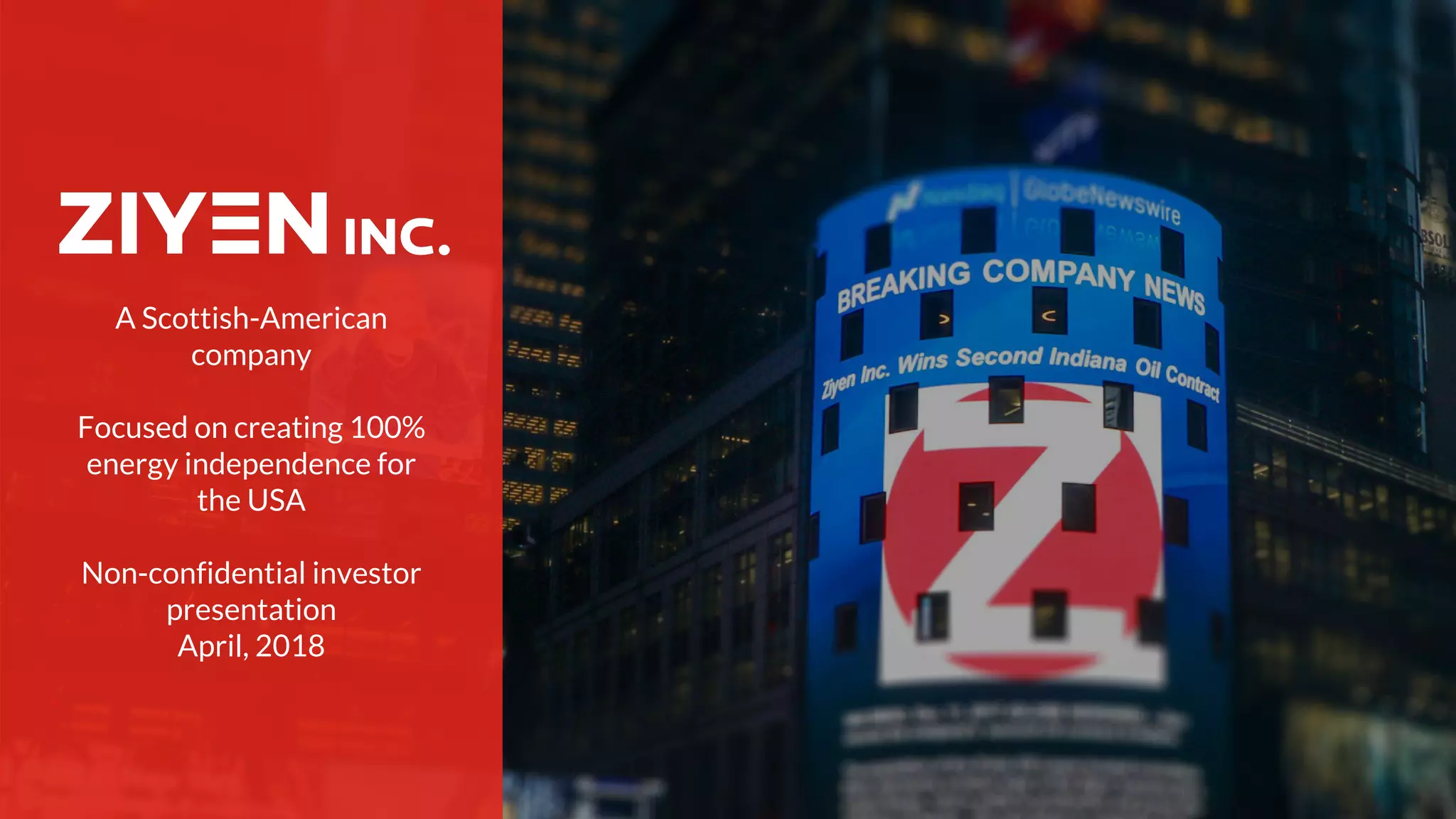
The deck opens with a bold red title slide for Ziyen Inc. , described as a 'Scottish-American company.' The core value proposition is immediately stated: 'Focused on creating 100% energy independence for the USA.' This slide establishes the presentation as a 'Non-confidential investor presentation' dated April 2018. The background image features a digital billboard in what appears to be Times Square, announcing that Ziyen Inc. 'Wins Second Indiana Oil Contract,' providing an immediate, if unverified, sense of momentum.
Slide 2: The Macro Problem
Slide 2 uses a data-heavy approach to frame the problem. It asserts that the US is capable of self-sustainment but that 'big oil is exclusively profit-focused.' The slide lists several key metrics: 10.1M barrels of oil imported daily, $640M in potential daily investment missed by the US economy, and $238B in oil dollars leaving the US for countries like Canada, Saudi Arabia, and other OPEC nations. It also claims that big oil avoids $83B in annual taxes by importing rather than producing domestically. Finally, it notes that only ~50% of potential US oil production is currently utilized, and links foreign oil dependency directly to 'War.'
Slide 9: Geopolitical Context
To reinforce the urgency of the problem, slide 9 pivots to political validation. It features portraits and quotes from both George W. Bush and Barack Obama. Bush is quoted regarding the instability of nations the US depends on for oil, while Obama is quoted describing oil as a 'weapon' used by enemies. By using quotes from both sides of the political aisle, Ziyen attempts to frame energy independence as a non-partisan issue of national security.
Operational Strategy
Slide 13: Streamlined Processes
This slide outlines the company's operational flow across three pillars: Oil Production , Oil Gathering , and Refining . Under production, it mentions oil produced on leases and held in storage. For gathering, it notes the use of trucks or pipelines if the lease is close. The refining section highlights that there are 141 refineries in the US and claims Ziyen Energy has 'already been advised all oil we produce will be purchased and entered into the supply chain.' The slide concludes with the mantra: 'Oil produced in America is consumed in America.'
Slide 17: The Energy Transition
Slide 17 addresses the global shift toward renewable energy. It acknowledges that governments and businesses are examining their environmental footprints. However, it makes a distinction between electricity generation (where renewables are prevalent) and transportation (where petroleum remains dominant). The slide states that Ziyen is 'creating strategies' to convert 'old energy into new energy,' though it provides no specific technical details on how this conversion occurs or what the 'new energy' products are.
Financial and Competitive Positioning
Slide 21: The Traditional Model Critique
Ziyen uses slide 21 to argue that the 'traditional oil and gas model can be dramatically improved.' The slide features a flowchart showing how gross revenue is eroded by variable COGS, fixed operational expenses, and a lack of tax credits. It specifically calls out the corporate tax rate (noting a change from 35% to 21%) and individual shareholder taxes of approximately 30%. The implication is that Ziyen’s model will somehow mitigate these losses, though the slide does not explicitly show the 'Ziyen Model' for comparison.
Slide 25: Competitive Advantage
Titled 'Well positioned vs competition,' this slide introduces the 'Ziyen Advantage.' The primary goals are to ensure 'cheaper production costs' and 'lower operating and overhead costs.' The company relies on its 'technical team' to provide this edge, claiming their experience with the 'biggest operators in the world' makes their in-house capability superior to any 'medium-sized domestic operator in the Basin.' This is a classic 'team-as-a-moat' argument.
Leadership and Team
Slide 29: Management Team
The final slide in this selection introduces two key executives. Shane Fraser , the Oil Intelligence Director, is presented as a highly experienced engineer with 28 years in the field, including 21 years at Royal Dutch Shell. Cindy Foong , the Chief Accounting Officer, is credited with 15 years of experience in taxation and SEC reporting. The focus on SEC reporting and complex transactions suggests the company may be eyeing a public listing or is already operating under strict regulatory oversight.
What Ziyen Inc. Does Well
The deck is highly effective at narrative framing . By tying domestic oil production to national security and economic patriotism, Ziyen elevates a standard commodity business into a mission-driven venture. The use of bipartisan political quotes (Slide 9) is a clever way to broaden investor appeal. Furthermore, the deck does a good job of identifying specific pain points in the traditional industry model, particularly regarding tax inefficiencies and the drain on the US economy (Slide 2 and Slide 21).
The emphasis on a guaranteed supply chain (Slide 13) is another strength. For an oil producer, proving that the product is pre-sold or easily integrated into existing refineries removes a significant layer of market risk for a potential investor. The team slide (Slide 29) also provides strong credibility, specifically citing tenure at a 'Supermajor' like Shell.
What is Missing from the Deck
The most glaring omission in this selection of slides is a clear financial forecast . While the deck critiques the 'Traditional Model,' it does not provide a pro-forma look at Ziyen's expected margins, revenue growth, or break-even points. There is also no specific funding ask or 'Use of Funds' slide included here, leaving the investor unclear on how much capital is needed and what it will be spent on (e.g., acquiring new leases, equipment, or R&D for renewables).
Additionally, the renewable energy strategy (Slide 17) is extremely vague. For a company claiming to convert 'old energy into new energy,' there is a lack of technical roadmap or specific project examples. Finally, while the deck mentions the 'Basin' (Slide 25), it does not specify which basin they are targeting (e.g., Permian, Appalachian, etc.), which is a critical detail for oil and gas investors who need to understand geological risk.
Founder Takeaways: What to Copy
Macro-to-Micro Flow: Start with a massive, undeniable problem (Slide 2) and then position your company as the logical solution. Ziyen moves from $238B in lost economy to their specific production model. · Bipartisan Validation: If your industry is politically sensitive, use quotes or data from multiple perspectives to show that your solution is universally necessary (Slide 9). · Visualizing Inefficiency: The flowchart on Slide 21 is a great way to show exactly where money is 'leaking' out of a traditional business model. Founders should use this to highlight why their new model is financially superior. · Specific Team Pedigree: Don't just list names; list specific years of experience and recognizable company names (Slide 29). Saying '21 years at Shell' is much more powerful than saying 'extensive industry experience.' · Market Certainty: If you have agreements or 'advice' that your product will be purchased, state it clearly (Slide 13). Reducing the 'will anyone buy this?' risk is paramount for early-stage investors.
Frequently asked questions
- What is Ziyen Inc.'s primary business objective?
- According to slide 1, the company is focused on creating 100% energy independence for the USA. It aims to achieve this by increasing domestic oil production and utilizing a streamlined supply chain that ensures oil produced in America is consumed in America, as stated on slide 13.
- How does Ziyen Inc. plan to compete with established oil companies?
- The company plans to launch the 'Ziyen Advantage,' which targets lower operating and overhead costs. Slide 25 notes that their in-house technical team has experience working for the world's largest operators, which they believe gives them a technological edge over medium-sized domestic operators in their target basins.
- What financial inefficiencies does the deck highlight in the oil industry?
- Slide 21 outlines the 'Traditional Model' of oil and gas, which it claims is burdened by high variable COGS, fixed operational expenses, and a lack of tax credits. It specifically mentions that corporate taxes (previously 35%, now 21%) and individual shareholder distribution taxes (~30%) significantly reduce net profit.
- Does Ziyen Inc. have a strategy for renewable energy?
- Yes, slide 17 mentions that Ziyen Energy is 'creating strategies to become environmentally responsible while converting old energy into new energy.' However, the slide also notes that the majority of petroleum is produced for transportation, while renewables currently focus on electricity generation.
- Who are the key members of the management team?
- Slide 29 introduces Shane Fraser, the Oil Intelligence Director, who has 28 years of oilfield engineering experience, including 21 years at Royal Dutch Shell. Also featured is Cindy Foong, Chief Accounting Officer, who has over 15 years of experience in taxation, SEC reporting, and complex oil and gas transactions.