Zingage’s 11-slide pitch deck serves as a masterclass in highlighting market inefficiency to justify a high-value solution. By framing the home care industry as a sector where providers turn away 70% of cases due to manual back-office drudgery, Zingage positions its 'Operator AI' not just as a tool, but as an 'Iron Dome' for providers. The deck leans heavily on impressive traction metrics, including $72M in growth for over 350 providers and a 313% increase in billable hours for users. Supported by top-tier investors like Bessemer Venture Partners and TQ Ventures, the narrative moves from a di…
Key takeaways
- The deck identifies a massive supply-demand gap, stating providers turn away 70% of cases due to capacity constraints (Slide 3).
- Zingage claims to have driven $72M in growth for over 350 home care providers nationally (Slide 5).
- Operational efficiency is a core value prop, citing a 5x increase in caregiver hours managed per back-office operator (Slide 5).
- The platform addresses labor issues directly, reporting a 32% reduction in caregiver turnover (Slide 5).
- A specific case study for Sunny Days In-Home Care shows autonomous resolution of 93% of call-outs and emergencies (Slide 7).
- The company raised $12.5M from notable investors including Bessemer Venture Partners, TQ Ventures, and South Park Commons (Slide 9).
- The team includes experience from high-growth startups like Ramp and Vivian (Slide 9).
- The deck lacks a detailed financial forecast or a specific breakdown of how the $12.5M will be allocated.
Executive Summary: The Iron Dome of Home Care
Zingage’s pitch deck for their $12.5M Seed round is a lean, metric-heavy presentation that focuses on a single, massive pain point: the operational bottleneck in home healthcare. As reported by Business Insider, the company raised this capital in 2024 to scale its AI-powered platform. The deck, consisting of 11 slides, moves quickly from the 'why' (a broken system turning away 70% of demand) to the 'what' (autonomous AI coordination) and finally the 'proof' (millions in generated growth). It is a highly effective example of how to use sector-specific dysfunction to justify a high-valuation seed round.
Slide 1: Title Slide
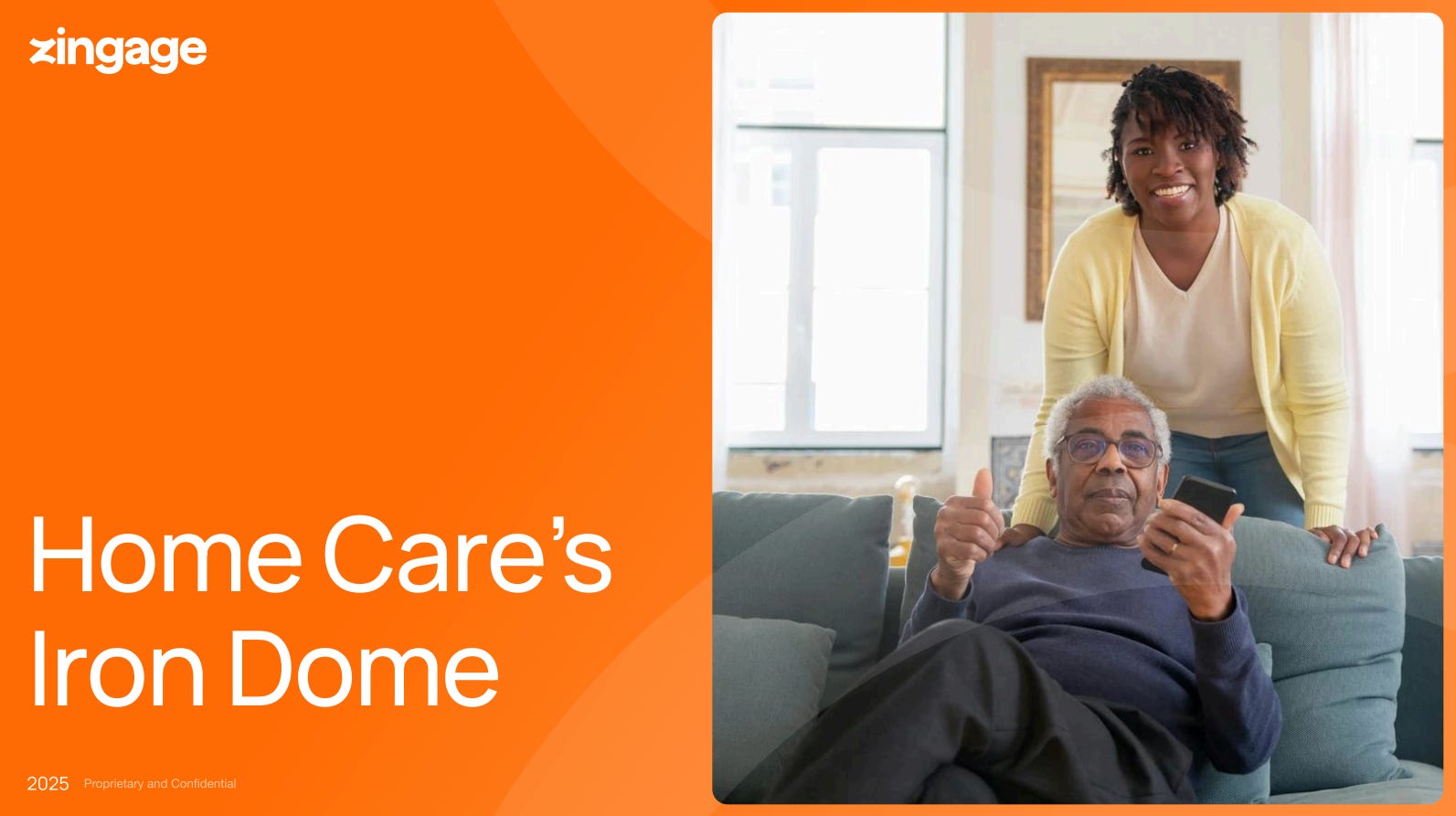
The deck opens with the bold tagline 'Home Care’s Iron Dome.' This metaphor suggests protection, resilience, and a high-tech solution to a constant barrage of operational challenges. The visual features a caregiver and an elderly patient, grounding the high-tech metaphor in the human reality of the industry. The slide is dated 2025 (likely reflecting the forward-looking nature of the raise or a late-2024 preparation) and carries a 'Proprietary and Confidential' footer.
Slide 2: The Mission Statement
Slide 2 defines the company's purpose: 'Automating Home Care Operations to End Drudgery & Drive Growth.' This is a classic 'double-sided' value proposition. It appeals to the empathy of the operator (ending drudgery) while satisfying the greed of the investor (driving growth). It sets the stage for a product that isn't just a utility, but a growth engine.
Slide 3: The Market Gap
This is arguably the most important slide in the deck. It quantifies the 'Total Care Potential' and reveals a staggering inefficiency: providers only serve 20% of their potential. The slide breaks this down into two pillars. First, capacity constraints: 70% of cases are turned away. It cites KFF (2024) data showing 710,000 people on Medicaid waitlists with 40-month wait times. Second, revenue loss: 50%+ of revenue is lost due to manual mismanagement. It lists three killer stats: a 77% annual caregiver turnover rate, a 20% regulatory noncompliance rate, and an 18% caregiver cancellation rate. By citing AARP and KFF, the founders establish immediate credibility.
Slide 4: Product Introduction
Slide 4 introduces 'Zingage Perform' as the first product. While the text provided is brief, it establishes the brand hierarchy. The deck positions this as the foundation upon which the rest of the 'Iron Dome' is built. It signals that the company has moved past the 'idea' phase and has a functional, named product in the market.
Slide 5: Traction and National Scale
Slide 5 is the 'Proof of Life' slide. It claims '$72M in Growth For Over 350 Home Care Providers Nationally.' A map of the US shows 40 select locations, indicating a broad geographic footprint rather than a regional pilot. The metrics on the right are exceptional: a 313% increase in billable hours, a 32% reduction in turnover, and 27,500 new employees hired and trained. The most significant operational metric is the '5x Increase' in the number of caregiver hours managed per back-office operator. This directly addresses the 'capacity constraints' mentioned in Slide 3.
Slide 6: The AI Solution
Slide 6 pivots to the future of the product: 'Zingage Operator AI.' This slide focuses on 'Solving Care Coordination.' By labeling the AI as an 'Operator,' Zingage is positioning the software as a replacement for (or a massive force multiplier for) human staff. This is the core of their 'AI-powered' narrative reported by the publisher.
Slide 7: Case Study - Sunny Days In-Home Care
To ground the abstract claims of Slide 5, Slide 7 provides a specific case study for Sunny Days In-Home Care. It features a quote from CEO John Bennett, stating that his team went from handling 4,000 hours per week to 8,000 hours—effectively doubling capacity—while feeling like they are 'working less.' The hard data points are equally strong: 93% autonomous resolutions for emergencies, 100% higher back-office capacity, and 96% compliance adherence. This slide proves the product works in a real-world, high-stakes environment.
Slide 8: The Team
Slide 8 introduces the team. While the specific names are not detailed in the text provided, the logos and backgrounds are significant. The team includes experience from Ramp (a fintech unicorn known for operational efficiency) and Vivian (a healthcare staffing platform). This combination of fintech-level automation expertise and healthcare-specific domain knowledge is a strong signal for investors.
Slide 9: The Raise and Investors
Slide 9 explicitly states the round: 'We Raised $12.5M to build Home Care’s Iron Dome.' It lists a heavy-hitting roster of investors: Bessemer Venture Partners, TQ Ventures, South Park Commons, and WndrCo. The presence of Bessemer, in particular, suggests a high degree of institutional confidence in the scalability of the technology. The slide repeats the 'death & dysfunction' framing, reminding investors of the high stakes involved in this market.
Slide 10: The Vision
Slide 10 looks toward the horizon: '2035: All Health Care in the Home.' This slide serves to expand the Total Addressable Market (TAM) in the investor's mind. It suggests that while Zingage is starting with home care scheduling and operations, the ultimate goal is to be the operating system for the entire home-based healthcare revolution. It moves the company from a 'niche tool' to a 'platform play.'
Slide 11: Closing
The final slide is a simple branding slide with the Zingage logo and the tagline 'AI Trusted by 400+ Home Care Agencies.' This is a slight increase from the '350+' mentioned on Slide 5, suggesting rapid growth or a different counting method for 'agencies' versus 'providers.' It leaves the investor with a final reminder of the company's market validation.
What Works in This Deck
The 'Supply-Side' Focus: Most healthcare decks focus on the patient. Zingage focuses on the operator. By highlighting that 70% of demand is being rejected, they prove that the market doesn't need more customers; it needs more efficiency. This makes the 'AI' part of the pitch feel like a necessity rather than a buzzword.
Quantifiable Outcomes: The deck is relentless with percentages. 313% growth, 93% autonomous resolution, 5x operator capacity. These aren't vague promises; they are specific benchmarks that an investor can use to model the company's value. The use of a named CEO (John Bennett) and a named agency (Sunny Days) adds a layer of 'un-fudgeable' social proof.
Investor Pedigree: For a Seed round, having Bessemer and TQ Ventures on the slide is a massive shortcut to trust. It tells other investors that the due diligence on the technical stack and the market size has already been performed by some of the best in the business.
What Is Missing
Unit Economics: While the deck shows how much growth they drive for clients , it does not show how Zingage makes money. There is no mention of SaaS pricing, per-caregiver fees, or take-rates on the billable hours they enable. Investors would need to see the LTV/CAC (Lifetime Value to Customer Acquisition Cost) potential to understand the company's own profitability path.
Competitive Landscape: The home care software space is crowded with legacy players like HomeCareHomeBase and ClearCare. Zingage does not include a 'competitor matrix' or a 'why we win' slide against these incumbents. They rely on the 'AI' label to differentiate themselves, but a savvy investor would want to know how they integrate with or replace existing Electronic Health Records (EHRs).
The 'Ask' Specifics: While the slide says they raised $12.5M, it doesn't detail the milestones this capital will hit. How much goes to R&D? How much to sales? What does the team look like 18 months from now? This information might have been in a supplemental document, but its absence in the main deck is notable.
Founder's Playbook: What to Copy
Use 'Negative Metrics' to Define the Problem: Don't just say the market is big. Say how much of the market is being wasted . Zingage’s use of the '70% cases turned away' stat is brilliant because it frames their software as a way to unlock existing money that is already on the table.
The 'Force Multiplier' Metric: If you are building an AI tool, your best metric is how many 'units' one human can now manage compared to before. The '5x Increase in caregiver hours managed per operator' is the quintessential AI pitch metric. It proves the software is doing the work of four additional people.
Case Study as a Slide: Instead of a 'Testimonials' slide with three vague quotes, dedicate a whole slide to one client. Show the 'Before' and 'After' with hard numbers. The Sunny Days slide (Slide 7) is the strongest piece of evidence in the entire deck because it moves from theory to reality.
Conclusion: Zingage’s deck is a high-velocity presentation that succeeds by focusing on operational bottlenecks. It treats AI as a labor-replacement and capacity-expansion tool, which is exactly how enterprise investors want to see AI applied in low-margin, labor-strapped industries like healthcare. By showing that they have already unlocked $72M in growth, they make the $12.5M investment seem like a logical bet on a proven engine.
Frequently asked questions
- What is the primary problem Zingage is solving?
- According to Slide 3, home care providers are currently only serving 20% of their total care potential. The industry is plagued by manual back-office operations, leading to 70% of cases being turned away due to capacity constraints. Zingage aims to automate these operations to end 'drudgery' and unlock this latent revenue.
- How much traction does Zingage show in the deck?
- Slide 5 reports significant traction: $72M in growth for over 350 home care providers across the US. They also claim to have helped hire and train 27,500 new employees and increased billable hours for their clients by 313%.
- What specific AI capabilities does Zingage offer?
- Slide 6 introduces 'Zingage Operator AI,' which focuses on solving care coordination. Slide 7 provides more detail via a case study, showing the AI handles 93% of call-outs and emergencies autonomously and ensures 96% compliance with Medicaid electronic visit verification.
- Who are the investors in Zingage?
- Slide 9 lists several prominent venture capital firms and angel investors, including Bessemer Venture Partners, TQ Ventures, South Park Commons, and WndrCo. The slide also features individuals with backgrounds from Ramp and Vivian.
- Does the deck include a product demo or screenshots?
- The provided slides do not show a detailed UI/UX demo or technical architecture. Slide 4 mentions 'Zingage Perform' and Slide 6 mentions 'Zingage Operator AI,' but the deck focuses more on the outcomes (efficiency gains and revenue growth) than the specific software interface.