Zero Carbon Capital’s deck for their second fund is a highly efficient 9-slide presentation that prioritizes track record and thesis specificity over fluff. The firm targets 'hard-science' solutions in Europe and Israel that address climate problems exceeding 0.5 gigatons of CO2(e) per year. The deck is anchored by a compelling performance slide showing a 9.0x unrealized MOIC for their angel portfolio and a 2.4x MOIC for their first EIS fund. By detailing their specific involvement in portfolio companies—such as taking board seats and leading rounds—they demonstrate a hands-on 'value-add' app…
Key takeaways
- The investment thesis is strictly defined by a 'half gigaton' CO2(e) impact threshold and a focus on hard science (Slide 3).
- The team combines deep technical expertise, featuring two PhDs and a former Google Product Executive (Slide 4).
- Historical performance is the deck's strongest asset, citing a 9.0x MOIC on angel investments and 2.4x on Fund 1 (Slide 5).
- The firm emphasizes lead investor status and board representation across its portfolio to prove active management (Slide 7).
- A detailed case study on NitroFix illustrates their due diligence process, covering carbon impact and scientific review (Slide 6).
- Fund 2 was already partially deployed at the time of the deck, with 6 active investments listed (Slide 8).
- The fund terms are transparently listed, including a £1m GP commitment and a 20% target IRR (Slide 9).
- The deck targets a specific £30m fund size with a final close date of June 2023 (Slide 9).
The Strategic Lean: Zero Carbon Capital’s LP Deck Analysis
Zero Carbon Capital (ZCC) provides a textbook example of how to raise a venture fund by leaning heavily on two pillars: a hyper-specific thesis and a proven track record. This 9-slide deck, used for the third close of their second fund, avoids the common pitfall of over-explaining the 'climate crisis' and instead focuses on the mechanics of how they identify and win deals in the 'hard science' sector.
Slide 1: Title and Mission
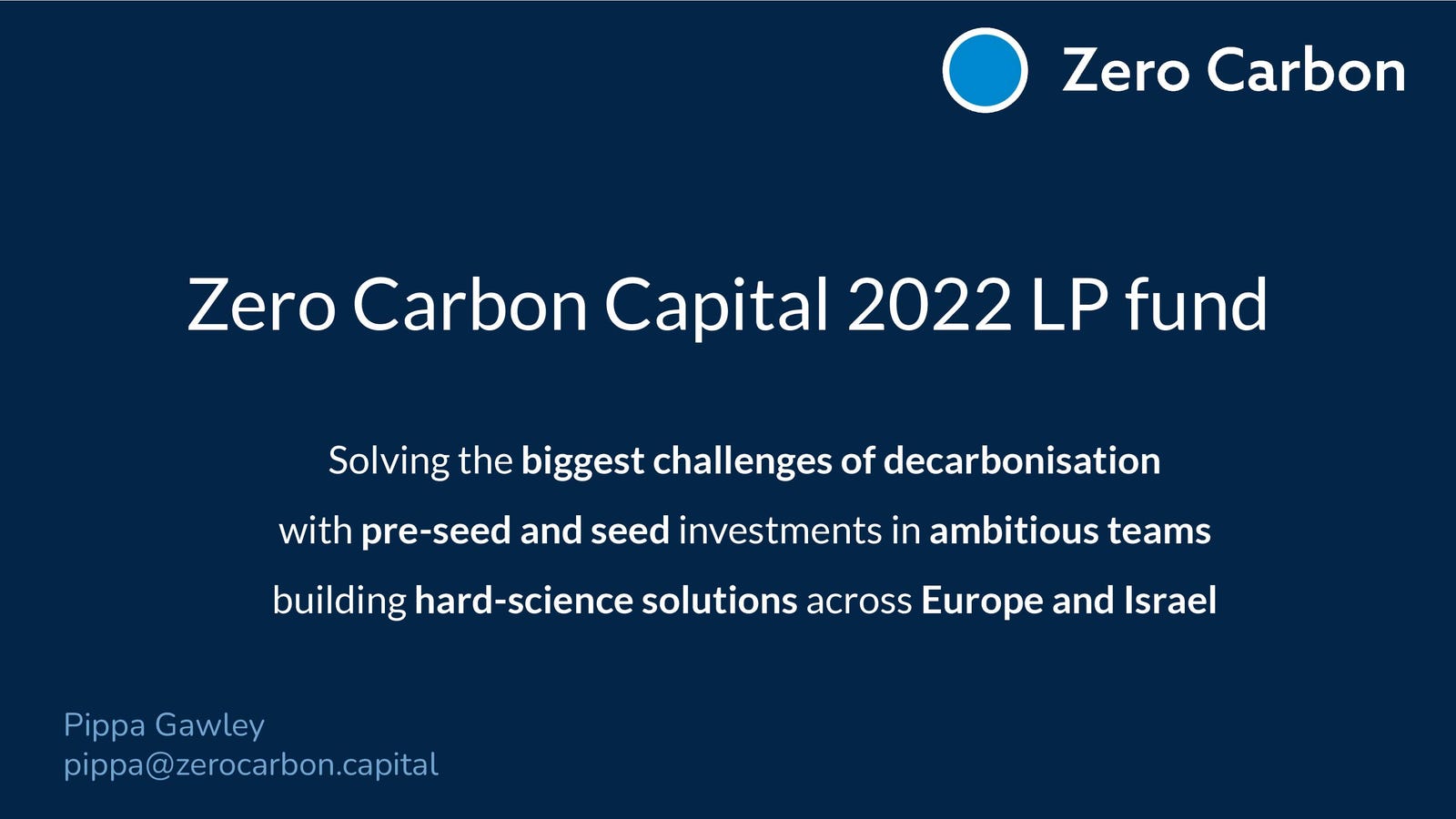
The cover slide is functional and minimalist. It identifies the fund as the 'Zero Carbon Capital 2022 LP fund' and immediately establishes the geographic and stage focus: pre-seed and seed investments in hard-science solutions across Europe and Israel. The inclusion of Pippa Gawley’s contact information establishes the GP-led nature of the fund from the outset.
Slide 2: Regulatory Disclaimer
Slide 2 is a dense, standard legal disclaimer required for financial promotions in the UK. It explicitly mentions Sapphire Capital Partners LLP as the authorized entity and outlines the criteria for 'High Net Worth' and 'Sophisticated' investors. While not a 'pitch' slide, its presence is a mandatory marker of professional fund management in the European regulatory environment.
Slide 3: The 'Half Gigaton' Thesis
Slide 3 defines the investment thesis through a four-circle Venn diagram. The most critical metric here is the 'Biggest problems' quadrant, which specifies 'Unsolved half gigaton CO2(e)/yr problem spaces.' This provides LPs with a clear quantitative filter for deal flow. The other quadrants—Early stage, Hard science, and Geography (Europe and Israel)—further narrow the scope, suggesting a fund that knows exactly what it is looking for and where to find it.
Slide 4: The Core Team
The team slide (Slide 4) balances technical expertise with operational experience. Pippa Gawley is highlighted as a climate tech angel investor with a manufacturing engineering background from Cambridge. Alex Gawley brings 'Big Tech' credibility as a former Product Executive at Google (Gmail & Area 120). The team is rounded out by two PhDs, Dr. Sarah Jones and Dr. Chloe Coates, emphasizing the firm’s ability to vet 'hard science' without relying solely on external consultants. The slide also lists Sapphire, MJ Hudson, and Revena as external partners for management, legal, and scientific advice.
Slide 5: The Track Record
Slide 5 is arguably the most important slide for any emerging manager. It visualizes seven years of experience across three distinct phases: Angel, Fund 1 (EIS), and Fund 2. The data is impressive: a 9.0x unrealized MOIC for the angel portfolio and a 2.4x MOIC for Fund 1. By showing the progression from 2016 to 2024, ZCC demonstrates that their strategy isn't a recent pivot to a hot sector, but a long-term commitment with measurable results.
Slide 6: Due Diligence Case Study
To prove their 'hard science' claims, Slide 6 presents a case study on NitroFix. It breaks down their diligence into four pillars: Carbon impact, Theory of change, Team, and Technology. Notably, it mentions a 'Scientific review' of patents and expert opinions. This slide serves to de-risk the investment process for LPs who may be wary of the technical hurdles inherent in hardware and chemistry-based startups.
Slide 7: Fund 1 Portfolio and Value-Add
Slide 7 provides a status report on Fund 1. It lists seven companies, including IONATE and Echion Technologies. The table is highly effective because it tracks 'Initial investment' stage against 'Since then' progress (e.g., '$11m seed with Lowercarbon'). It also explicitly states whether ZCC took a board seat and acted as the lead investor. This proves they are not just 'following' larger funds but are actively shaping the companies they back.
Slide 8: Fund 2 Early Momentum
Slide 8 shows that Fund 2 is already active, listing six investments including Climate Crop and Repair. This 'off to a strong start' narrative is crucial for a third-close deck, as it shows LPs that their capital will be deployed into an existing, high-quality portfolio rather than a blind pool. The diversity of the 'Activity' column—ranging from 'leak-free hydrogen valves' to 'biological alt-fertiliser'—demonstrates the breadth of their thesis within the climate sector.
Slide 9: Fund Terms and The Ask
The final slide (Slide 9) is a clean summary of the fund's economics. It targets a £30m fund size with a £1m GP commitment (a strong signal of alignment). The terms are standard for the industry: 2% management fee, 20% carry with a 7% hurdle, and a 10-year term. The slide also highlights that £13m had already been closed, naming Isomer Capital and Extantia as anchors, which provides social proof for remaining LPs.
What Zero Carbon Capital Does Well
The deck excels at thesis specificity . Many climate funds use vague language about 'saving the planet,' but ZCC uses a specific metric—the half-gigaton threshold—to define their universe. This quantitative approach appeals to institutional LPs who value disciplined underwriting.
Furthermore, the transparency of the track record on Slide 5 is a major strength. By separating angel investments from institutional fund performance, they provide a full picture of their evolution as investors while maintaining the integrity of their data. The inclusion of 'Lead investor' and 'Board' status on Slides 7 and 8 also counters the common LP concern that small funds are just 'filling out rounds' without having real influence.
What is Missing from the Deck
While the deck is strong on track record, it is light on market macro-trends . There is no slide discussing the broader regulatory tailwinds (such as the Inflation Reduction Act in the US or similar EU initiatives) that might accelerate their portfolio's growth. While LPs in this space likely know the macro story, a slide connecting their specific 'hard science' focus to shifting global policy could have strengthened the 'why now' argument.
Additionally, the deck lacks a detailed pipeline slide . While they show what they have already invested in for Fund 2, they do not show the volume of deals they are currently evaluating. For a fund focused on 'hard science,' demonstrating a robust top-of-funnel pipeline is essential to prove that the 'half-gigaton' filter isn't too restrictive to find 15 more planned investments.
Founder and GP Takeaways
Quantify your impact: If you are a mission-driven fund, don't just state your mission; define the specific threshold a company must meet to be considered (e.g., the half-gigaton rule on Slide 3). · Own your history: Even if your first fund was small or an EIS/Angel syndicate, visualize it clearly. The 9.0x MOIC on Slide 5 is the 'hook' that makes the rest of the deck credible. · Show, don't just tell, your diligence: The case study on Slide 6 is more effective than a list of 'our process' bullet points. It shows the actual documents and scientific reviews the team produces. · Be clear on terms: Slide 9 is a model of clarity. Don't hide your fees or your GP commitment; put them in a simple table so LPs can check their boxes quickly.
Frequently asked questions
- What is the specific investment focus of Zero Carbon Capital?
- Zero Carbon Capital focuses on early-stage (pre-seed and seed) hard-science startups in Europe and Israel. Their primary criterion is that the startup must address a 'half gigaton' CO2(e) per year problem space, ensuring they only back innovations with massive decarbonization potential.
- How does the team demonstrate scientific credibility?
- The core team includes two PhDs: Dr. Sarah Jones (Bioprocess Engineering) and Dr. Chloe Coates (Chemistry). Additionally, the deck lists Revena as a scientific advisor and highlights the team's ability to conduct deep scientific reviews of patents and literature during due diligence.
- What are the financial terms for Fund 2?
- Fund 2 has a target size of £30m with a 10-year term and a 20% target IRR. The management fee is 2% for the first four years (1% thereafter), and the performance fee is 20% with a 7% IRR hurdle. The minimum commitment is £1m.
- What is the firm's historical track record?
- As of the deck's publication, the founders reported a 9.0x unrealized Multiple on Invested Capital (MOIC) for their angel portfolio (2016-2020) and a 2.4x MOIC for their first EIS fund (2020-2022).
- Who are the anchor investors for this fund?
- The deck notes that £13m had already been closed at the time of the third close deck, with Isomer Capital and Extantia explicitly named as anchor investors on the final slide.