The ZenPayroll (Gusto) deck is unique because it functions as a meta-template, providing a structural blueprint for B2B SaaS fundraising rather than just a static presentation. Spanning 16 slides, the deck emphasizes extreme brevity, explicitly advising founders on Slide 2 to keep content to 'less than 10 words per page.' By focusing on high-level categories like 'Massive Market' (Slide 4) and 'Current Pain' (Slide 6), the deck forces founders to articulate their value proposition without the crutch of dense text. While the version analyzed here contains placeholder instructions, it reveals t…
Key takeaways
- The deck explicitly recommends a 'content light' approach with fewer than 10 words per page on Slide 2.
- Slide 5 requires a deep dive into the industry landscape, including existing revenue flows and market dynamics.
- A dedicated 'This is Only Possible Now' slide (Slide 8) focuses on macro-trends and new enabling technologies.
- The template prioritizes 'Current Pain' (Slide 6) to establish the necessity of the product's existence.
- Slide 12, 'Who We Are,' emphasizes relevant previous experiences and specific areas of ownership for each founder.
- The deck includes a specific 'Summary' slide (Slide 13) to reinforce market size and core product insights.
- Fundraising specifics are sequestered to Slide 14, including the amount being raised and current round participants.
- The deck structure is specifically tailored for B2B or SaaS companies, as stated in the Disclaimer on Slide 16.
The Anatomy of a $746M Narrative
ZenPayroll, which later rebranded to Gusto, is often cited as a gold standard for how to pitch a 'boring' back-office solution as a high-growth technology powerhouse. The deck we are analyzing is a 16-slide framework that serves as a masterclass in B2B SaaS storytelling. According to catalogue facts, the company was founded in 2011 and has raised a total of $746,100,000. This deck represents the structural logic used to navigate those early and middle-stage rounds.
Slides 1-2: The Philosophy of Brevity
Slide 1 is a standard title page featuring the original ZenPayroll logo. It includes placeholders for a 2-5 word tagline and a quote from a credible investor. This immediately signals that the company is seeking social proof to validate its entry into the crowded payroll space.
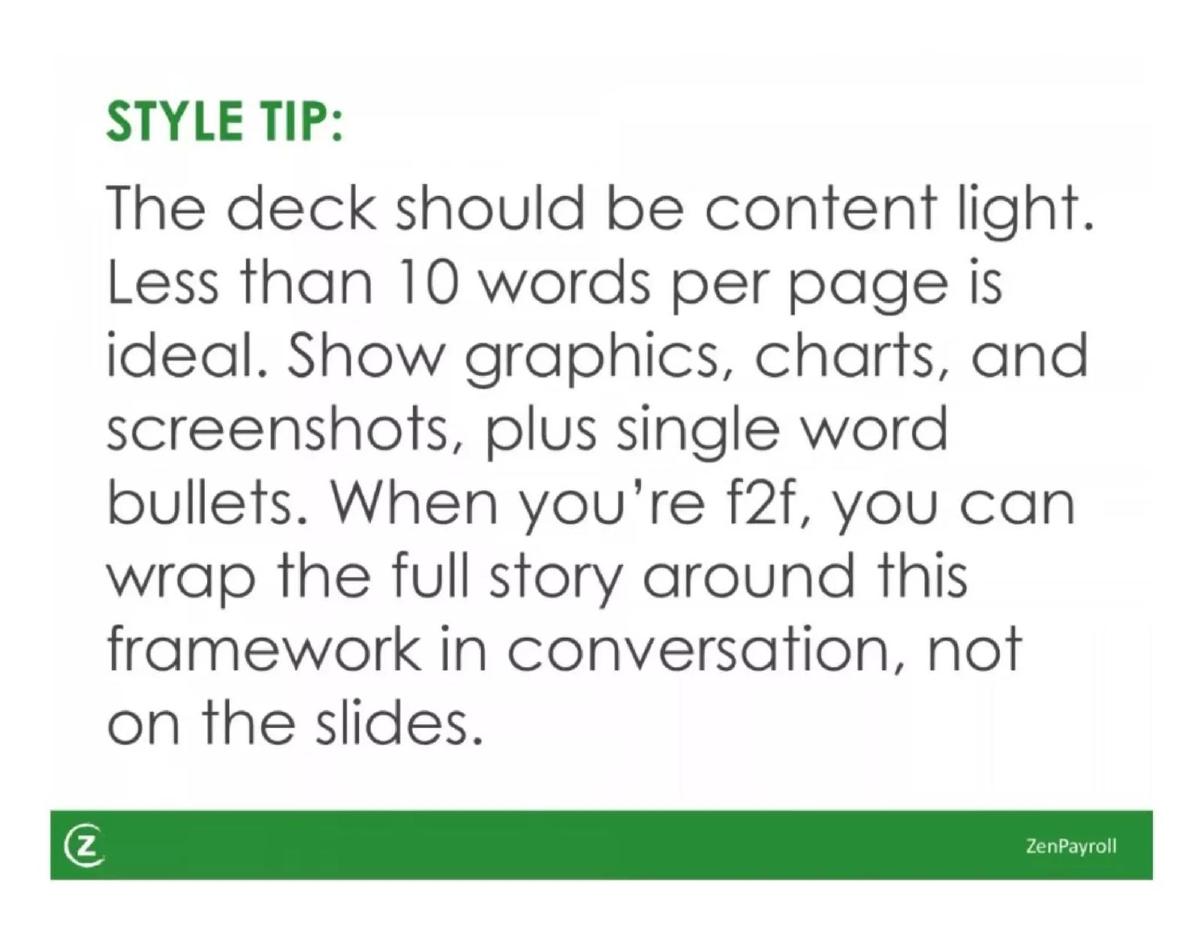
Slide 2 is perhaps the most important slide for any founder to study. Titled 'STYLE TIP,' it explicitly states: 'The deck should be content light. Less than 10 words per page is ideal.' It encourages the use of graphics, charts, and screenshots. This sets the tone for the entire presentation: the slides are a backdrop for the founder's expertise, not a teleprompter. By limiting text, the founder maintains control of the room's attention.
Slides 3-5: Market and Vision
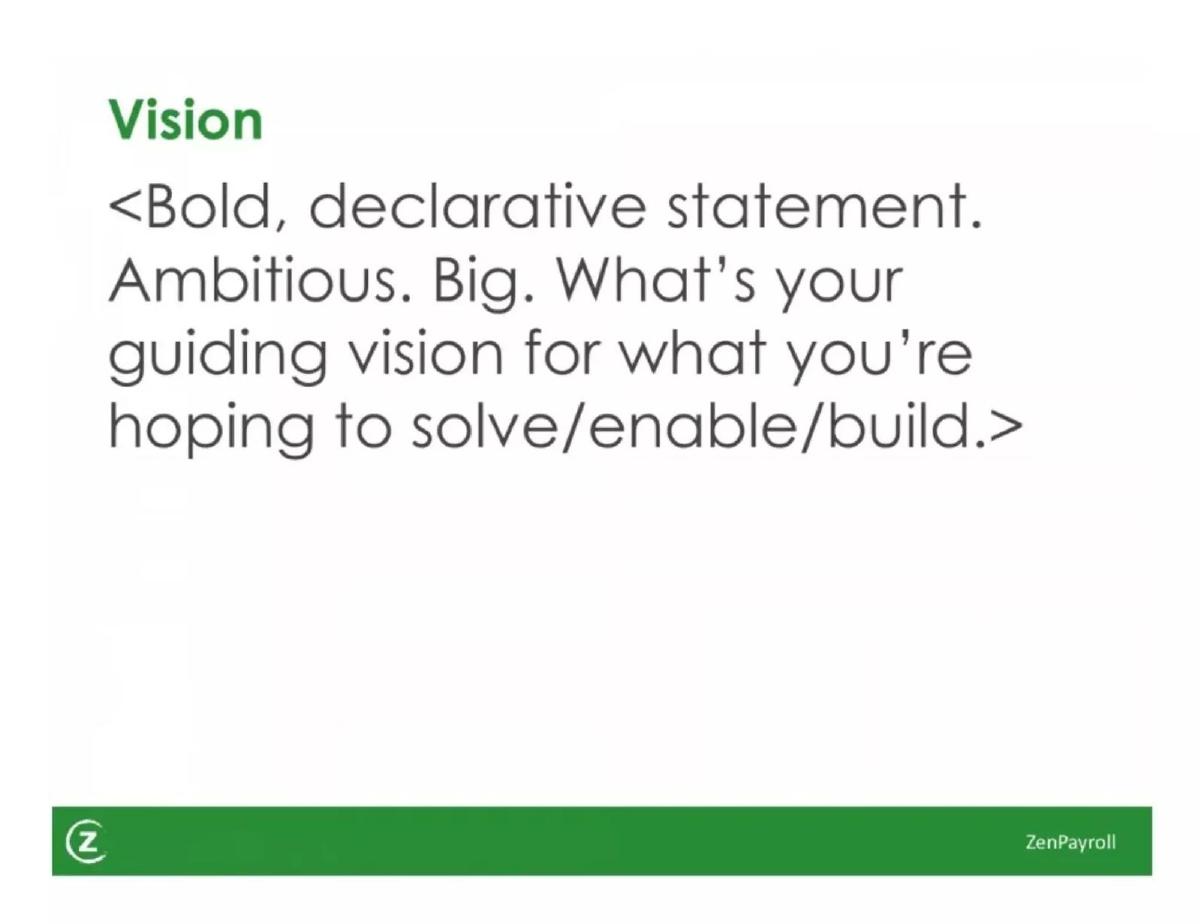
Slide 3 focuses on the 'Vision.' It calls for a bold, declarative statement. For a company like Gusto, this vision likely centered on democratizing sophisticated HR tools for small businesses that were historically underserved by giants like ADP.
Slide 4 , 'Massive Market,' is where the founder is expected to drop the 'Big Number.' The prompt asks for data on market size and existing proof points. In the context of 2011, this would have highlighted the millions of SMEs still using manual spreadsheets or paper checks for payroll.
Slide 5 covers the 'Landscape.' This is a sophisticated take on the competition slide. Instead of just listing names, it asks for 'existing revenue flows' and 'insights on these items.' This suggests that the founder must understand the economics of the industry—how money changes hands—rather than just which features the competitors have.
Slides 6-8: The Problem and the Catalyst
Slide 6 addresses 'Current Pain.' The prompt is blunt: 'Why should your product exist?' This slide is designed to build empathy for the customer (the small business owner) and frustration with the status quo. It sets up the 'gap' that the product will fill.
Slide 7 is the 'Product' slide. It instructs the founder to include key differentiators and screenshots. Crucially, it suggests a 'Break to demo if it’s short.' This indicates that the ZenPayroll team believed their UI/UX was a primary selling point—a 'show, don't tell' moment.
Slide 8 is a critical component of modern pitching: 'This is Only Possible Now.' It asks for macro-trends and new enabling technologies. This is the 'Why Now?' slide. It justifies why a startup can succeed in 2011 where others failed in 2005. For Gusto, this was likely the proliferation of cloud infrastructure and the ability to build deep API integrations with banks and insurance providers.
Slides 9-11: The Business Engine
Slide 9 , 'Traction,' is where the company proves it has a pulse. The prompt asks for usage stats and a roadmap. For an early-stage company, this might be beta user growth; for a later-stage company, it would be ARR and churn metrics.
Slide 10 outlines the 'Business Model.' It asks for short-term and long-term ways to make money. This is vital for a SaaS company to show that while payroll might be the 'wedge,' there are secondary revenue streams like benefits administration, workers' comp, and 401(k) integrations.
Slide 11 is 'Customer Acquisition.' This slide forces the founder to explain their 'Go-To-Market' (GTM) strategy. It isn't enough to have a product; you must have a repeatable way to find customers. The prompt asks for 'Initial set plus over time,' suggesting a need for a scalable distribution fly-wheel.
Slides 12-14: The Team and The Ask
Slide 12 , 'Who We Are,' focuses on the team. It asks for short bios and, importantly, 'areas of ownership/responsibility.' This shows investors that the founding team is not just a group of friends, but a functional unit with clear divisions of labor.
Slide 13 is a 'Summary' slide. It recommends reiterating the market size and core insights. This is the 'closing argument' of the pitch, designed to leave the investor with three to five key takeaways that they can easily repeat to their partners.
Slide 14 is the 'Fundraising' slide. It asks for the amount being raised and the investors already in the round. By placing this at the end, the founder ensures that the valuation and dilution conversation only happens after the value proposition has been fully established.
Slides 15-16: Closing and Context
Slide 15 is a contact slide, repeating the logo, tagline, and the quote from the first slide to create a narrative bookend. Slide 16 is a 'Disclaimer' that notes these slides are 'particularly relevant to a B2B or SaaS company,' acknowledging that the structure is a specific tool for a specific type of business.
What Works in This Deck
The primary strength of this deck is its enforced discipline . By instructing founders to keep text to a minimum (Slide 2), it prevents the 'death by PowerPoint' that kills many pitches. The inclusion of a 'Why Now' slide (Slide 8) is a sophisticated touch that many early-stage founders overlook, yet it is often the deciding factor for VCs looking for a market inflection point. Furthermore, the 'Landscape' slide (Slide 5) encourages a deeper economic analysis of the industry rather than a superficial feature comparison, which demonstrates founder maturity.
What is Missing
While this is a robust framework, there are notable omissions that a modern founder should address. First, there is no Unit Economics slide. In today's market, investors want to see CAC (Customer Acquisition Cost), LTV (Lifetime Value), and payback periods early in the conversation. Second, there is no Regulatory/Compliance slide. For a company handling payroll and taxes, the 'moat' often involves the complexity of dealing with state and federal regulations; this deck treats the product mostly as a software solution rather than a regulated financial service. Finally, there is no Social Proof/Case Study slide beyond the placeholder for an investor quote on the cover. Real-world testimonials from small business owners would have strengthened the 'Current Pain' section.
What a Founder Should Copy
Founders should absolutely copy the narrative flow of this deck. It moves logically from Vision -> Market -> Pain -> Product -> Why Now -> Traction. This is the standard 'venture narrative' for a reason: it builds a logical case for investment. Additionally, the 'Summary' slide (Slide 13) is a tactic every founder should use. It ensures that even if an investor tuned out for five minutes, they leave the meeting with the three most important facts about your business. Lastly, the 'Who We Are' (Slide 12) requirement to list 'areas of ownership' is a brilliant way to demonstrate organizational maturity and reduce 'key person' risk in the eyes of an investor.
Final Verdict: This deck is a blueprint for clarity. It strips away the noise of technical specifications and focuses entirely on the business case for disruption. For a company that eventually raised $746 million, the simplicity of this 16-slide framework is a testament to the power of a clear, well-structured argument over a flashy, over-designed presentation.
Frequently asked questions
- Why does the deck contain placeholder text instead of specific metrics?
- This specific version of the ZenPayroll deck functions as a public-facing template or 'best practice' guide shared by the founders. It outlines the exact narrative flow they used to secure early interest. While the specific numbers are omitted in this version, the structure itself is what the founders credit for their clarity during the $746 million fundraising journey.
- What is the significance of the 'This is Only Possible Now' slide?
- Slide 8 is critical because it answers the 'Why Now?' question that investors prioritize. It forces the founder to identify specific technological or regulatory shifts that make a previously solved problem (like payroll) ripe for disruption. For Gusto, this likely referred to the shift toward cloud-based API integrations and the consumerization of enterprise software.
- How does the deck handle competition?
- Rather than a simple feature-comparison grid, Slide 5 ('Landscape') asks for an analysis of revenue flows and market dynamics. This suggests that Gusto viewed competition not just as other software providers, but as the systemic way money and data moved through the existing, fragmented payroll industry.
- Is the '10 words per page' rule realistic for all startups?
- Slide 2 suggests this as an 'ideal' for face-to-face meetings. The philosophy is that the slides should provide a visual anchor while the founder provides the narrative depth. For a complex product like payroll, this prevents the audience from getting lost in tax compliance details and keeps them focused on the investment thesis.
- What is missing from this 16-slide framework?
- The template lacks a dedicated slide for unit economics (LTV/CAC) or a detailed moats/defensibility section. It relies heavily on the 'Product' and 'Traction' slides to carry the weight of the business's viability. Founders using this template today would likely need to add a slide specifically addressing data security and regulatory moats.