ZewindTV is a proposed smartphone companion app that catches streaming viewers up when they fall asleep or get distracted, pitched in a 16-slide Google Slides deck dated November 2023. The deck has a strong one-liner, an unusually honest survey footnote (225 responses from 20,000 sent) and a genuine cold-start strategy. Its fatal flaw is ordering: the only ask, $50,000 from an angel, sits on slide 15 in the appendix, two slides after 'Questions / Comments'.
Key takeaways
- ZewindTV's 2023 pre-seed deck asks for $50,000, but the number appears only on appendix slide 15, two slides after the closing 'Questions / Comments' slide.
- The deck's market section contradicts itself: slide 5 calls the SAM 70% of TAM while slide 6 calls the same population 75%.
- The market slide header reads '~1.2B Bottom-Up' while the table beneath it computes ~$1.02B, a 17% gap between a title and its own arithmetic.
- ZewindTV discloses that its validation survey drew 225 responses from 20,000 users sent — a 1.1% response rate that most founders would hide, and publishing it is the most credible act in the deck.
- Three of five team boxes are marked TBD, and one box is labelled TBD while also naming a person, which raises more doubt than leaving it blank.
- The B2B licensing model — a per-monthly-active-user fee charged to streaming services — is the deck's biggest idea and carries no stated price anywhere.
- The strongest slide, a three-phase plan for solving the cold start content problem, is slide 16 of 16 inside the appendix.
- No competition slide appears in 16 slides, despite the app competing with Wikipedia, Reddit, YouTube recap channels and streamers' own recap features.
What this deck actually is
This is a 16-slide pre-seed pitch deck for ZewindTV, a proposed smartphone companion app for streaming TV viewers who fall asleep, get distracted, or lose the plot of a show. The file is a Google Slides export titled "pitch-deck-for-URL," dated November 2023, in 720×405 widescreen format. The timeline slide places the deck in Q4 2023, with a private beta website planned for October and a pre-seed pitch scheduled for Q1 2024.
It is genuinely an investor deck, not a company overview or a sales deck. It has a problem slide, a solution slide, a market size slide, a bottom-up market model, survey validation, a business model, a team slide, a timeline, and an appendix with a funding ladder. That structure is more complete than most pre-seed decks that get sent to us.
What it does not have is a live ask on any main slide. The number that matters — $50,000 from an angel investor — appears only in the appendix, on slide 15, inside a diagram, after the "Questions / Comments" closing slide. The deck also has no product, no users, no revenue, and two of five team boxes marked TBD. It is a concept deck asking for a real check, and it hides the check.
Slide-by-slide walkthrough
Slide 1 — Title and one-liner
"The first smartphone app that helps streaming TV users keep up when they're lost." That is a strong one-liner. It names the device (smartphone), the context (streaming TV), the user state (lost), and the job (keep up). A reader who stops after this sentence still knows what the company does, which is the only real test of a title slide.
The weakness is the word "first." First is a claim, and this deck never defends it. There is no competitive slide anywhere in 16 slides — no mention of recap sites, of Wikipedia episode summaries, of the recap features streamers already ship, of YouTube recap channels. Claiming first without naming what you are first ahead of is a claim an investor will test in the first two minutes of the meeting.
Slide 2 — The problem
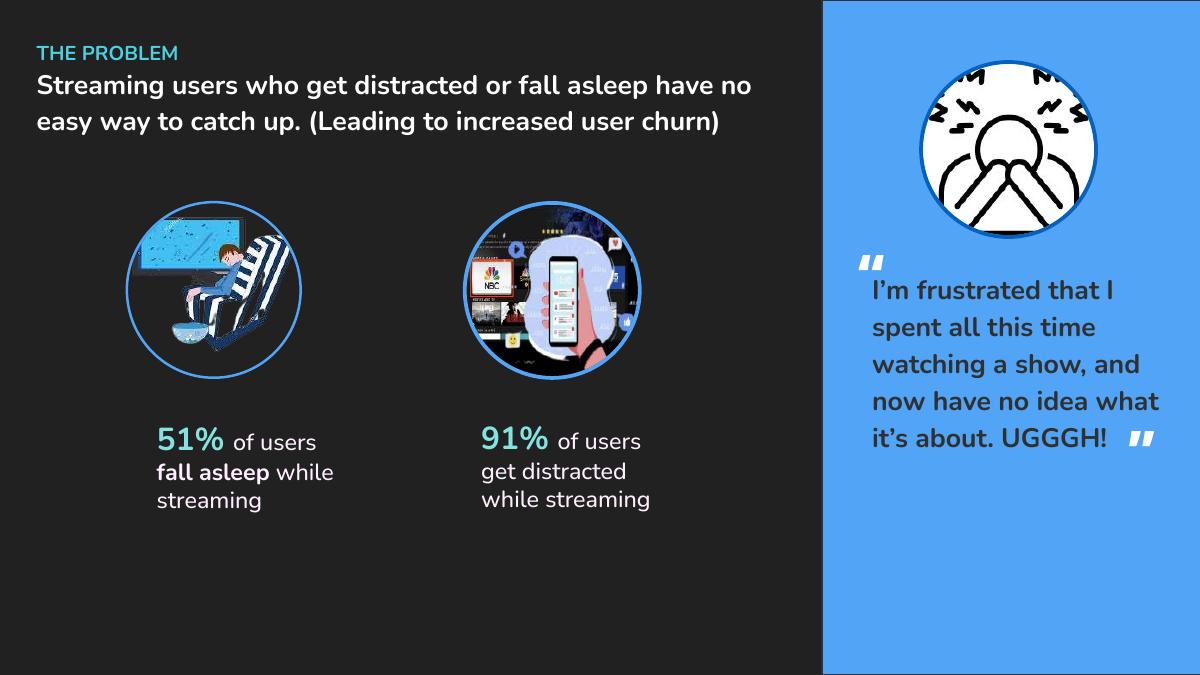
"Streaming users who get distracted or fall asleep have no easy way to catch up. (Leading to increased user churn)" Two statistics sit under it: 51% of users fall asleep while streaming, 91% of users get distracted while streaming. A pull-quote runs down the right: "I'm frustrated that I spent all this time watching a show, and now have no idea what it's about. UGGGH!"
The framing is good and the churn link is the right instinct — it turns a consumer annoyance into a streaming-service business problem, which is where the money is. But neither statistic is sourced on the slide. A 51% and a 91% with no citation and no footnote read as decoration, not evidence, and in a deck that later shows a real survey, leaving these two uncited is a self-inflicted wound.
Slide 3 — Solution
"ZewindTV helps streaming users get back on track when they get distracted or confused, with fun and engaging content that make it easy to pick up where they left off."
This is a restatement of the title slide in longer form. It is the second consecutive slide of prose with no picture of the product. At slide 3 of 16, an investor still has not seen a screen. In a consumer app deck, the screen is the solution slide.
Slide 4 — App features
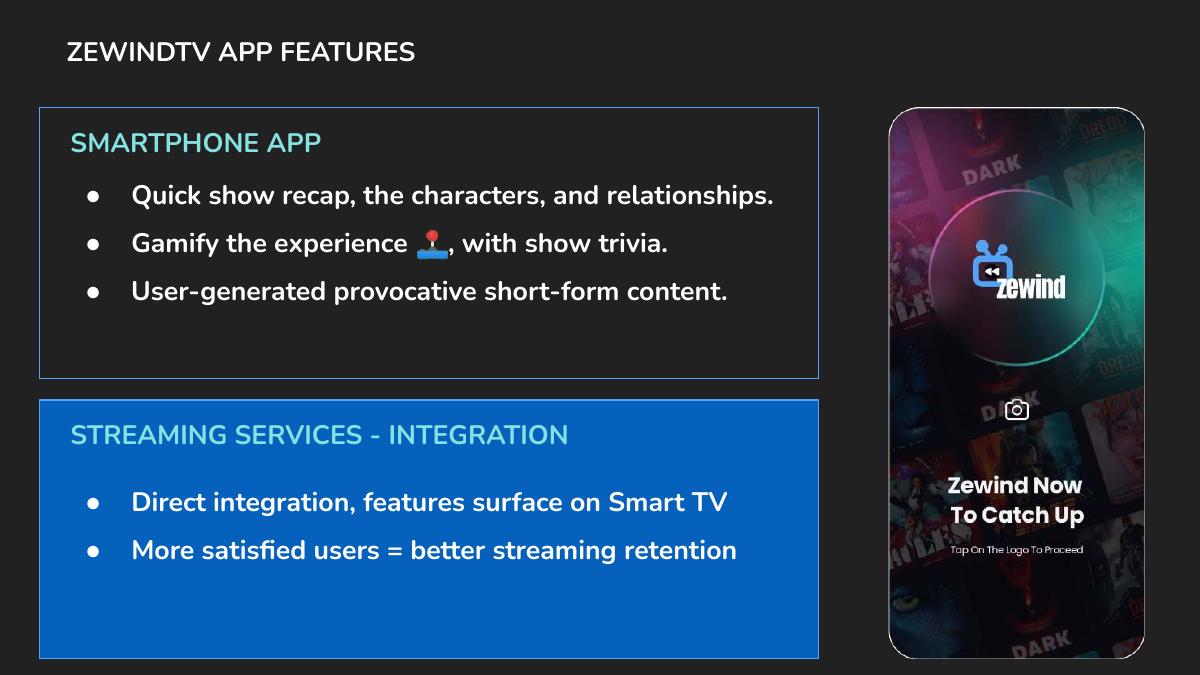
Two blocks. "Smartphone app": quick show recap covering the characters and relationships; gamify the experience with show trivia; user-generated provocative short-form content. "Streaming services — integration": direct integration with features surfacing on smart TV, and "more satisfied users = better streaming retention."
The second block is the most commercially interesting idea in the deck, and it gets two bullets. If ZewindTV can reduce churn for a streaming service, the buyer is not the viewer at $4.99 a month, it is Paramount at a seven-figure licensing fee. That is the whole company, compressed into a sub-bullet on a features slide.
Slide 5 — Market size
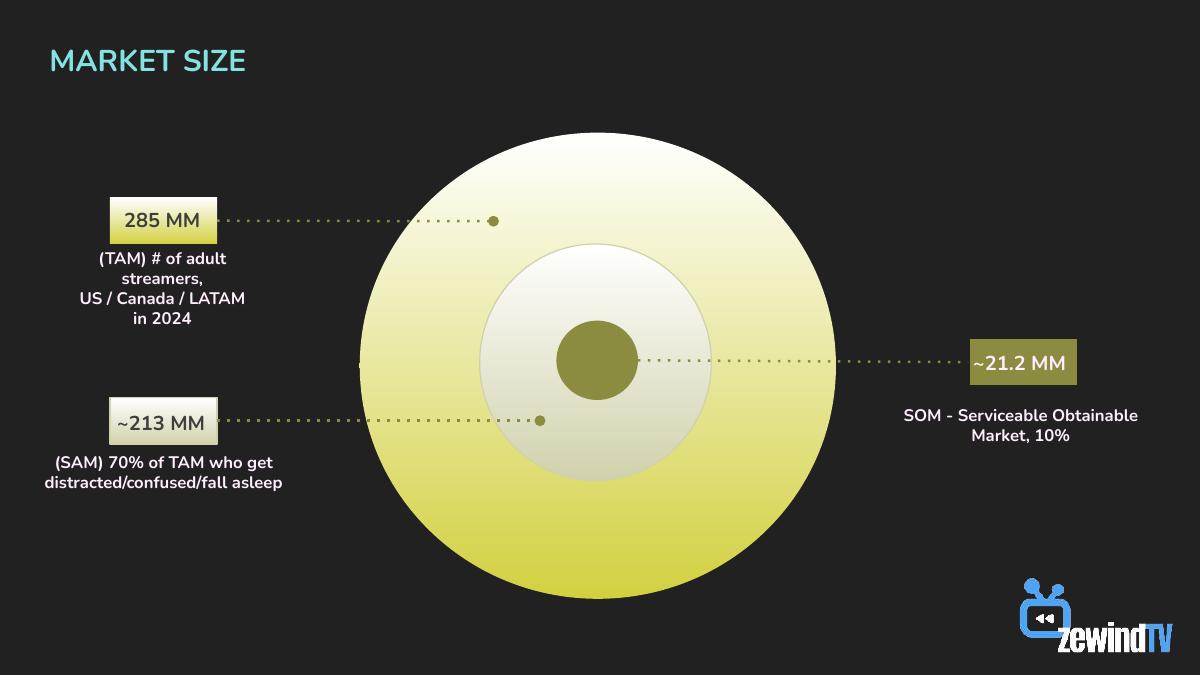
A three-circle TAM/SAM/SOM diagram: TAM of 285 million adult streamers in the US, Canada and LATAM in 2024; SAM of ~213 million, described as "70% of TAM who get distracted/confused/fall asleep"; SOM of ~21.2 million, described as 10%.
Slide 6 — Bottom-up market opportunity
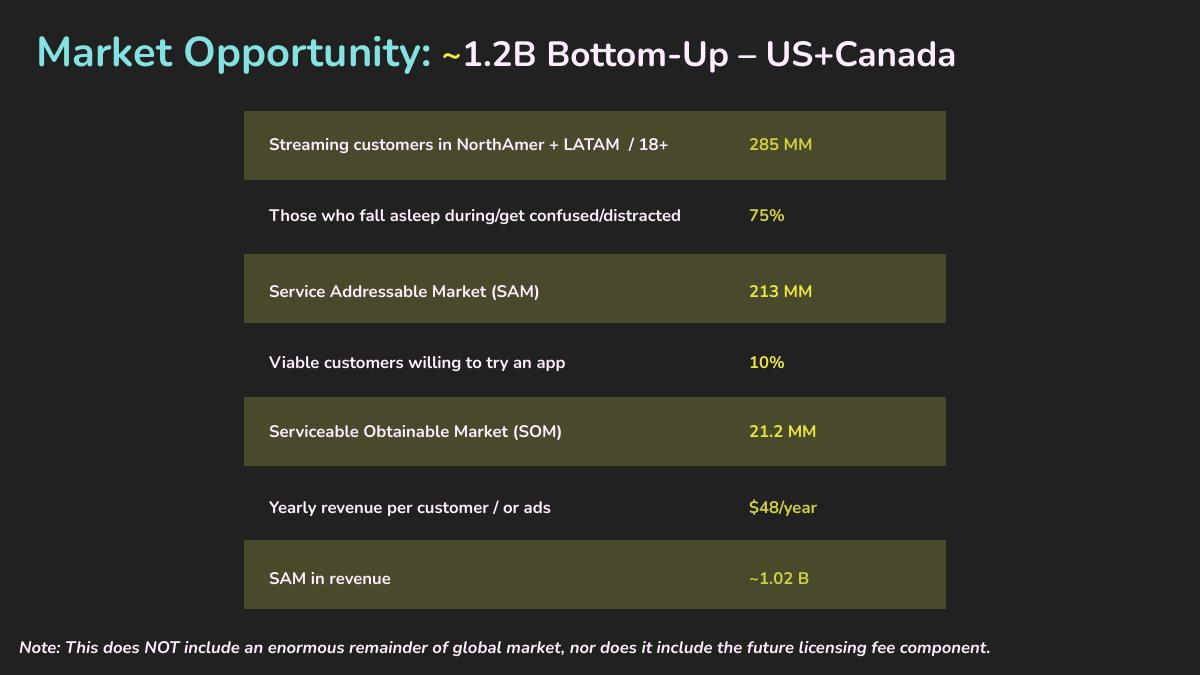
A clean waterfall table: 285MM streaming customers in North America + LATAM aged 18+; 75% who fall asleep, get confused or distracted; SAM of 213MM; 10% viable customers willing to try an app; SOM of 21.2MM; $48 per year per customer in subscription or ads; "SAM in revenue ~1.02B." A footnote adds that this excludes the global market and future licensing revenue.
Two problems, both fatal to the credibility of the section. First, the slide before said 70% and this slide says 75% for the same population. Second, the slide header reads "Market Opportunity: ~1.2B Bottom-Up" while the table it sits above computes ~$1.02B. A partner who spots either mismatch stops reading the numbers and starts auditing them, and no founder wins that meeting.
There is also a labelling error worth fixing: the $1.02B figure is derived from the 21.2MM SOM times $48, which makes it a SOM revenue figure, not "SAM in revenue" as the row is labelled. The math is internally consistent; the labels are not.
Slide 7 — Market validation
The best slide in the deck. It reports original survey data: 78% of users watch on a flat screen; a majority watch TV with their smartphone already in hand; 68% admit to "checking out" while streaming a show, with the joke "the other 32% are lying"; and 55% would consider using such an app. The footnote is the part most founders skip and this founder did not: "Based on survey to 20k users, 225 responses."
Disclosing 225 responses out of 20,000 sent is a 1.1% response rate, and publishing it anyway is the single most credible act in this deck. It tells an investor that the founder does not hide denominators. The caveat is that a 55% stated-intent figure from a self-selected 1.1% is soft evidence of interest and no evidence of willingness to pay, and the deck does not say so.
Slide 8 — The main use case
A near-blank slide with the header "The main use case…" and a visual. This is where the product screens live, and it is slide 8 of 16 — halfway through the deck. The header also undersells it. "The main use case" tells the reader nothing; "You fell asleep in episode 4, here is the 40-second catch-up" would.
Slide 9 — Gamification and social
"Two more useful features — Gamification & Social," again as a visual with a bare header. Trivia and short-form social content are the retention mechanics of the app, and they are presented as an afterthought to the main use case rather than as the reason a user opens the app on a night when they did not fall asleep.
Slide 10 — Business model
Three revenue paths. Free tier: a 30-second video ad each session. Paid tier: $4.99/month for unlimited use. And a MAU license fee charged to the streaming service. Annotations explain the logic: monetise the viewer with ads and subscription, monetise the streaming service with a per-monthly-active-user licensing fee.
The dual model is the right shape for this business, and $4.99 is a defensible consumer price point. What is missing is any number attached to the license fee — no per-MAU rate, no assumed platform size, no example contract value. The deck's biggest revenue idea is the only one with no price on it. There is also a copy error: both the middle and right boxes are titled "PAID TIER (APP)" when the right one is the licensing product.
Slide 11 — Team
Five boxes. Centre: Darren Levy, Co-Founder/CEO/CPO, with 6+ years of product in streaming at Paramount+ and Pluto TV, 20+ years across startups and mid-size companies, engineering plus product plus marketing, BS in Computer Science. Left: TBD, Marketing / Operations, needing a strong content ops lead with entertainment and content ideation. Right: a box headed TBD, then named Javier Olivieri, with 15+ years tech, 5+ years startup experience, AI and ML experience, BS in Engineering. Below: Legal Advisor TBD, and Erica Anenberg, Business Advisor.
The CEO is well matched to the problem — six years of product work inside two streaming platforms is exactly the background that gets a licensing conversation with Paramount taken seriously, and the deck should say that in a sentence instead of leaving it as a bullet. The problem is the TBDs. Three of five boxes are open, including the third box that is simultaneously labelled TBD and filled with a named person, which reads as an unclosed negotiation. At pre-seed an investor is funding the team; showing that most of the team does not exist yet answers the question before it is asked.
Slide 12 — Timeline
Q3 '23: final pitch deck, high-fidelity screenshots (September). Q4 '23: private beta website (October), MVP #1 private beta complete. Q1 '24: pitch to pre-seed investors. Q2 '24: blank.
The dates are specific, which is good. But the first milestone on the roadmap is "final pitch deck," which is a document, not a product, and the Q2 '24 column is empty, so the plan ends at the moment the money would arrive. A timeline should show what the investor's money buys in the two quarters after the raise.
Slide 13 — Questions / Comments
A closing slide with no ask, no contact details, no email address, and no recap of the opportunity. Every forwarded deck ends on this slide, and this one leaves the reader with nothing to act on.
Slide 14 — Appendix divider
Slide 15 — The funding ladder (and the actual ask)
A staged diagram dated Q4/2023. Left: a branded private beta website with 400 signups, pitch deck and pitch video, financials, management team. Then "Angel Investor?" with an "Investment Ask:: $50,000," leading to MVP #1, limited. Then VCs with an "Investment Ask:: $500k to $1M," leading to a full product generating revenue, real installs, real traction, a real business.
This is the most useful slide in the deck and it is two slides past the closing slide. It contains the only ask, the only stated milestone (400 beta signups), and a credible two-step financing plan that matches the stage the company is actually at. It also reveals that the deck's real job is to raise $50,000, not $1M — a fact the first 14 slides never mention. Also, the double colons are a typo repeated twice.
Slide 16 — Cold start problem
Three phases. Phase 1, highly manual and niche: a proof of concept with very limited content — "2 movies, 3 seasons of GOT or xyz" — leveraging movie and content experts for short-form video and summaries. Phase 2, less manual, more UGC and ML: aggressively build out the ML architecture, automate, start scaling, scale down human curation, incentivise community UGC. Phase 3, high UGC and heavy ML with some manual: the end goal, an ML streaming powerhouse, always some human curation for 80/20 content, with a monetised and highly incentivised UGC community.
This is the slide that shows the founder has thought about the hardest part of the business. A recap app is a content company pretending to be a software company: someone has to write the recap of episode 6 before anyone can read it. Naming that as the cold start problem, and staging a path from hand-curated to ML-generated, is exactly what a technical investor wants to hear. It is slide 16 of 16, in an appendix, after the questions slide.
What this deck does better than most startup pitch decks
The one-liner is genuinely good. One sentence, no jargon, complete comprehension. Most pre-seed decks need three slides to say what this deck says in fourteen words. · It publishes its denominator. "Survey to 20k users, 225 responses" is the kind of disclosure most founders quietly delete. Keeping it converts a soft stat into an honest one. · The bottom-up model exists. A stated funnel with each assumption on its own row is far more useful than a single "$1.2B market" number, and it lets an investor argue with a specific line rather than dismiss the whole slide. · The dual business model is the right shape. Consumer subscription for reach, B2B licensing for margin, with the churn-reduction argument connecting them. That is a real strategy, not a monetisation checkbox. · Founder–problem fit is real. Six years of product at Paramount+ and Pluto TV is the correct résumé for a company whose exit path runs through streaming-service integrations. · The cold start problem is named. Very few consumer content decks acknowledge that the product is empty on day one and stage a plan out of it.
Where this deck would fail in an investor meeting
The ask is in the appendix. $50,000 appears on slide 15, after "Questions / Comments." Many investors never open an appendix. Functionally, this deck has no ask. · 70% and 75% describe the same population two slides apart. One of them is wrong, and the reader has no way to know which. · The header says ~1.2B and the table computes ~1.02B. A 17% discrepancy between a slide title and its own arithmetic ends the numeric credibility of the deck. · No competition slide at all. A recap app competes with Wikipedia, Reddit threads, YouTube recap channels, "previously on" segments, and the streamers' own features. Not naming them reads as not having looked. · No traction beyond intent. 400 signups appear as a future milestone on the ladder, not as a current number. There is no waitlist, no beta user count, no LOI from any streaming service. · Three of five team boxes say TBD. And one box is labelled TBD and names a person, which raises more doubt than leaving it blank. · The licensing revenue has no price. The MAU fee is the whole B2B thesis and the deck never states a rate, so the ~$1.02B model rests entirely on the consumer side. · Product screens are two bare-header slides in the middle. Slides 8 and 9 carry the entire product story with headers that explain nothing on their own. · Contact details are absent. No email, no website link on the closing slide, in a deck literally named "pitch-deck-for-URL." · No use of funds. $50,000 buys what, over how long, to reach which milestone? The deck does not say.
Concept deck versus fundable pre-seed deck
Element ZewindTV deck (2023) What a fundable pre-seed deck shows
Ask $50,000, appendix slide 15 On slide 2 or the closing slide, with use of funds
Traction 400 signups as a future milestone Real waitlist, beta users or usage curve today
Market 70% vs 75%; ~1.2B vs ~1.02B One consistent number, defended on one slide
Product Two visual slides with bare headers The core loop shown in three annotated screens by slide 4
Team 3 of 5 boxes TBD Named team, or an explicit hiring plan tied to the raise
Competition Absent Named alternatives, including "do nothing"
B2B revenue MAU fee, no rate A per-MAU price and one modelled platform deal
Cold start Slide 16, appendix Slide 5, as the strategic answer to "why is this hard?"
How you would rebuild this deck in 12 slides
Title + one-liner. Keep it verbatim, drop the word "first," add the URL and an email address. · Problem with sources. Keep the 51% and 91%, put the source under each, and keep the churn sentence as the headline because churn is the buyer's language. · Product, three screens. Promote slide 8 to position 3 and label the screens: what you saw, what you missed, the 40-second catch-up. Show the loop before explaining it. · Own survey. Move slide 7 forward, keep the 225/20k footnote, and add the one number missing: what share said they would pay $4.99, not just "consider." · Cold start. Bring slide 16 out of the appendix. This is the strategy slide, not a footnote. · Business model with a price on both sides. $4.99 consumer, plus a stated per-MAU licensing rate and one worked example against a named platform's subscriber count. · Market, one page, one number. Pick 75% or 70%, fix the header so it matches the arithmetic, and label the output SOM revenue, not SAM revenue. · Competition. A simple grid: streamer-native recaps, Wikipedia and Reddit, YouTube recap creators, doing nothing. Say why an in-app companion beats each. · Why now. Streaming churn is at record highs and platforms are buying retention. That macro argument is implied everywhere in this deck and stated nowhere. · Team. Lead with the Paramount+ and Pluto TV years as distribution access. Convert the TBD boxes into a hiring plan funded by the raise. · Milestones and use of funds. $50,000 → private beta live, 400 signups, MVP #1, one streaming-service conversation opened. Then the $500k–$1M round. · The ask and contact. Named amount, instrument, and email on the last slide the reader sees.
The transferable lesson
ZewindTV's deck has a clear idea, an honest survey, a real founder–problem fit and a sensible two-stage financing plan. It also buries the ask in the appendix, contradicts its own market percentage two slides apart, prints a header that does not match its own table, and shows most of the team as TBD. None of that is a strategy failure. It is an ordering and consistency failure, and ordering and consistency are the two things a founder can fix in an afternoon.
The pattern repeats in almost every deck we tear down: the strongest slide is at the back, the ask is hidden, and one number disagrees with another. Investors do not read decks the way founders write them — they scan for the ask, the traction, and the one number that does not add up. If your best material is behind a slide that says "Questions / Comments," it does not exist.
Before you send yours, find out what an investor sees in the first sixty seconds: which slide carries your argument, where your ask actually lands, and which numbers contradict each other.
Frequently asked questions
- What is ZewindTV?
- ZewindTV is a proposed smartphone companion app for streaming TV viewers. Its pitch is that 51% of viewers fall asleep and 91% get distracted while streaming, so the app provides quick show recaps, character and relationship summaries, trivia and short-form user-generated content to help viewers pick up where they left off. The 2023 deck describes it at concept stage, pre-product.
- Is the ZewindTV deck a real investor pitch deck?
- Yes. The 16-slide file, exported from Google Slides in November 2023, is a pre-seed investor deck: problem, solution, features, market size, bottom-up model, survey validation, business model, team, timeline and an appendix with a funding ladder. The only thing it lacks is a visible ask on a main slide — the $50,000 figure sits in the appendix.
- How much money was ZewindTV raising?
- The appendix shows a two-step plan: $50,000 from an angel investor to fund a private beta website, 400 signups and a limited MVP, followed by a $500,000 to $1,000,000 round from VCs once there is real revenue, real installs and real traction. Neither number appears on any main slide of the deck.
- What is wrong with ZewindTV's market sizing?
- Two things. Slide 5 defines the SAM as 70% of the 285 million TAM, while slide 6 defines the same group as 75%. And slide 6's header claims a '~1.2B' opportunity while the table under it multiplies 21.2 million users by $48 per year to reach ~$1.02B. The figure is also labelled SAM revenue when the math produces SOM revenue.
- Which ZewindTV slides should founders copy?
- Three. The title slide's one-liner — 'the first smartphone app that helps streaming TV users keep up when they're lost' — is complete comprehension in fourteen words. The validation slide publishes its own denominator, 225 responses from 20,000 sent. And the cold start slide stages a path from hand-curated content to ML generation, which is the honest answer to the hardest question about the business.
- What would fix the ZewindTV deck fastest?
- Reordering, not rewriting. Move the $50,000 ask and use of funds onto the closing slide, promote the product screens from slide 8 to slide 3, bring the cold start plan out of the appendix, pick one market percentage and make the header match the table, add a competition slide, and put a per-MAU price on the licensing model. Most of that is an afternoon of work.