Zestful’s seed deck is a study in brevity and clarity, utilizing just 11 slides to secure $1.2M in funding. The core of the pitch rests on a compelling psychological insight: 80% of surveyed employees preferred a lower salary when paired with a robust suite of lifestyle perks. By positioning their product as a payment technology rather than a simple HR tool, Zestful effectively bridges the gap between traditional corporate benefits and modern consumer habits. The deck clearly outlines a three-pronged revenue model—subscriptions, transaction fees, and cash back—while showcasing a team with dee…
Key takeaways
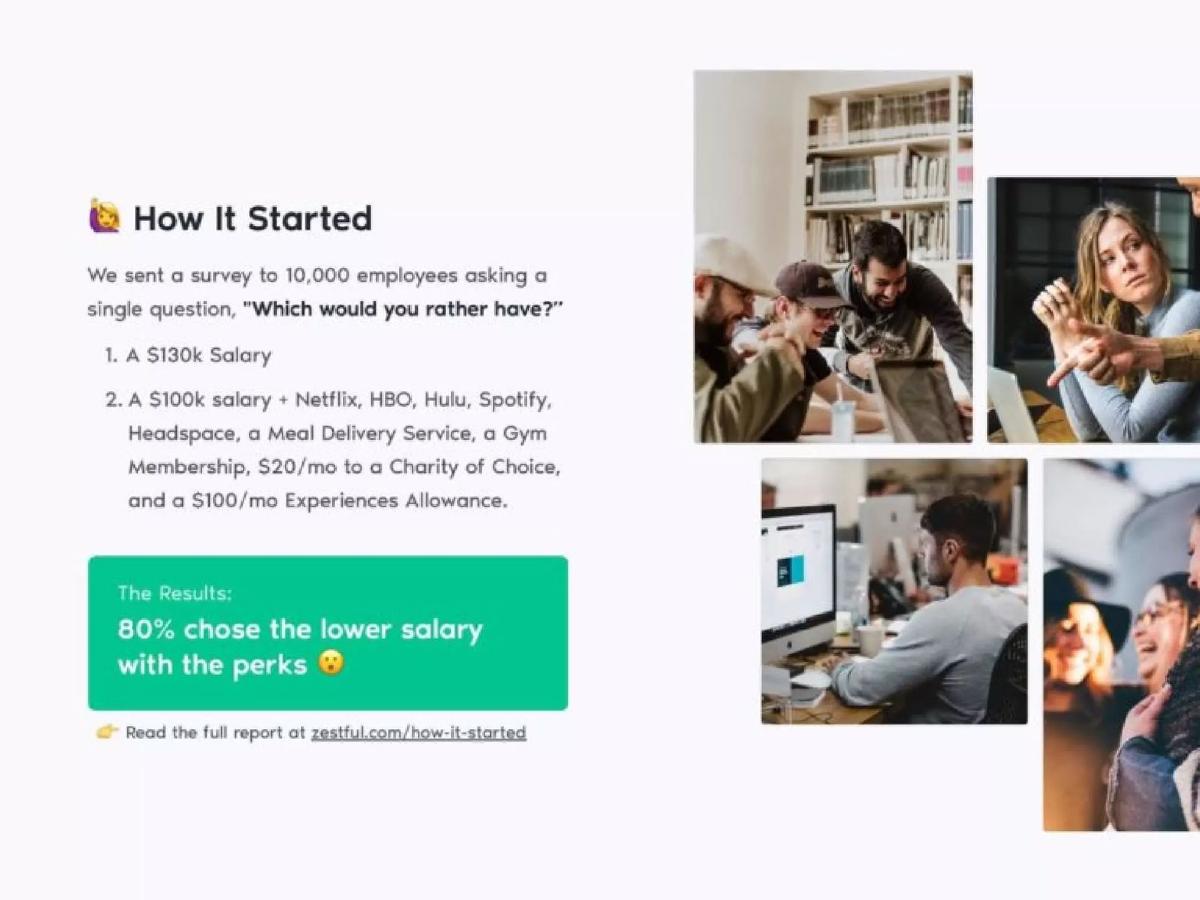
- The deck leads with a powerful survey of 10,000 employees where 80% chose a lower salary with perks over a higher flat salary (Slide 3).
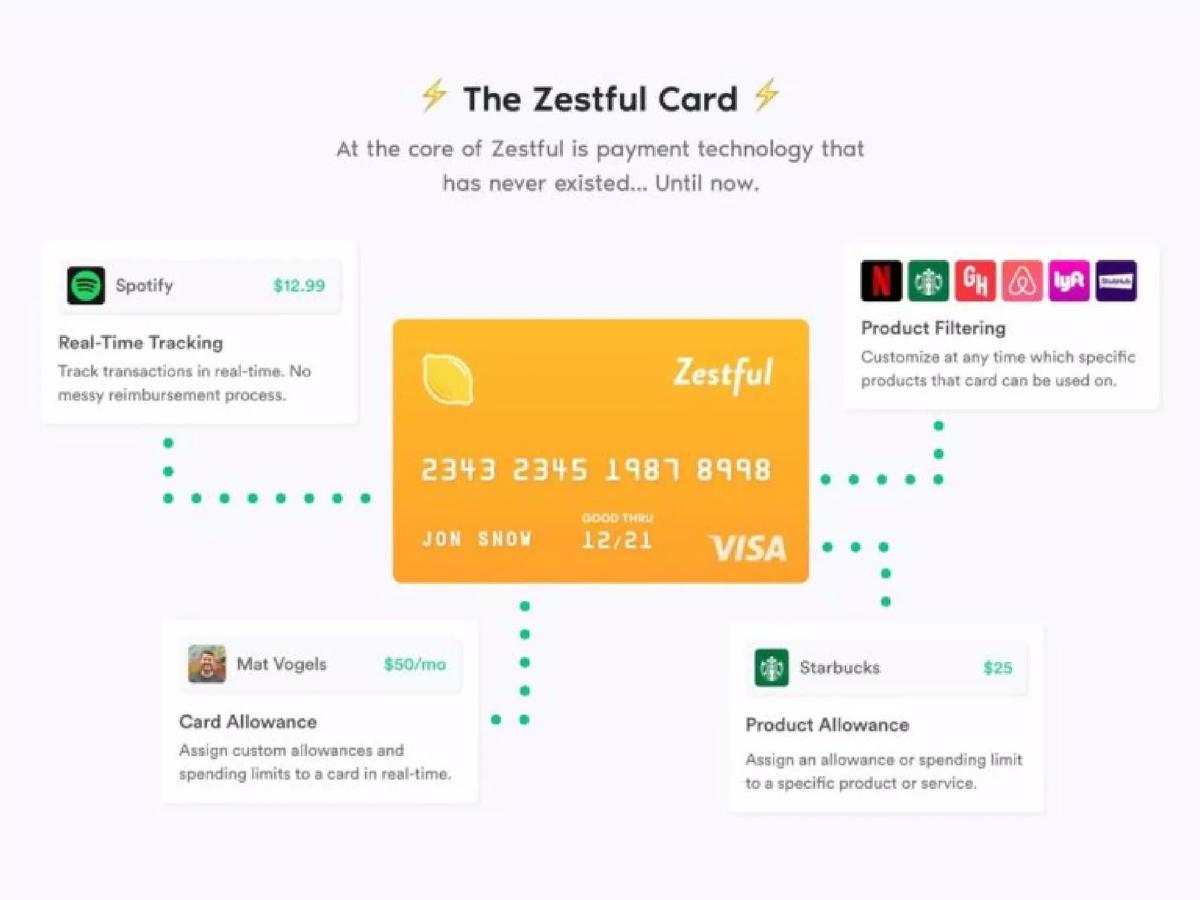
- Zestful defines its product as 'payment technology' that enables real-time tracking and product filtering for employee spending (Slide 2).
- The revenue model is diversified across a $5 monthly subscription per card, a 0.5% transaction fee, and 5-10% cash back from brands (Slide 7).
- The roadmap projects a growth trajectory from 1,000 beta users in Nov 2018 to 30,000 cards and $120k MRR by Q4 2019 (Slide 8).
- The team slide highlights significant pedigree, including a co-creator of GoToMeeting and a Y Combinator W17 affiliation (Slide 9).
- The 'Other Opportunities' slide suggests expansion into co-working spaces, apartment buildings, and universities to increase the TAM (Slide 6).
- The specific ask is for $200k remaining on a $6m cap to expand sales and customer success teams (Slide 10).
- The deck completely omits a dedicated competition slide or a detailed breakdown of unit economics beyond the revenue model.
Introduction: The Psychology of Perks
Zestful’s pitch deck is a lean, 11-slide presentation that successfully secured $1.2M in Seed funding. The company operates in the E-commerce and HR Tech intersection, providing a customizable Visa card that allows employers to give employees specific allowances for lifestyle perks. The deck is notable for its clean aesthetic and its reliance on a single, powerful data point to validate the entire business model: the idea that employees actually prefer perks over raw cash.
Slide 1: Title and Vision
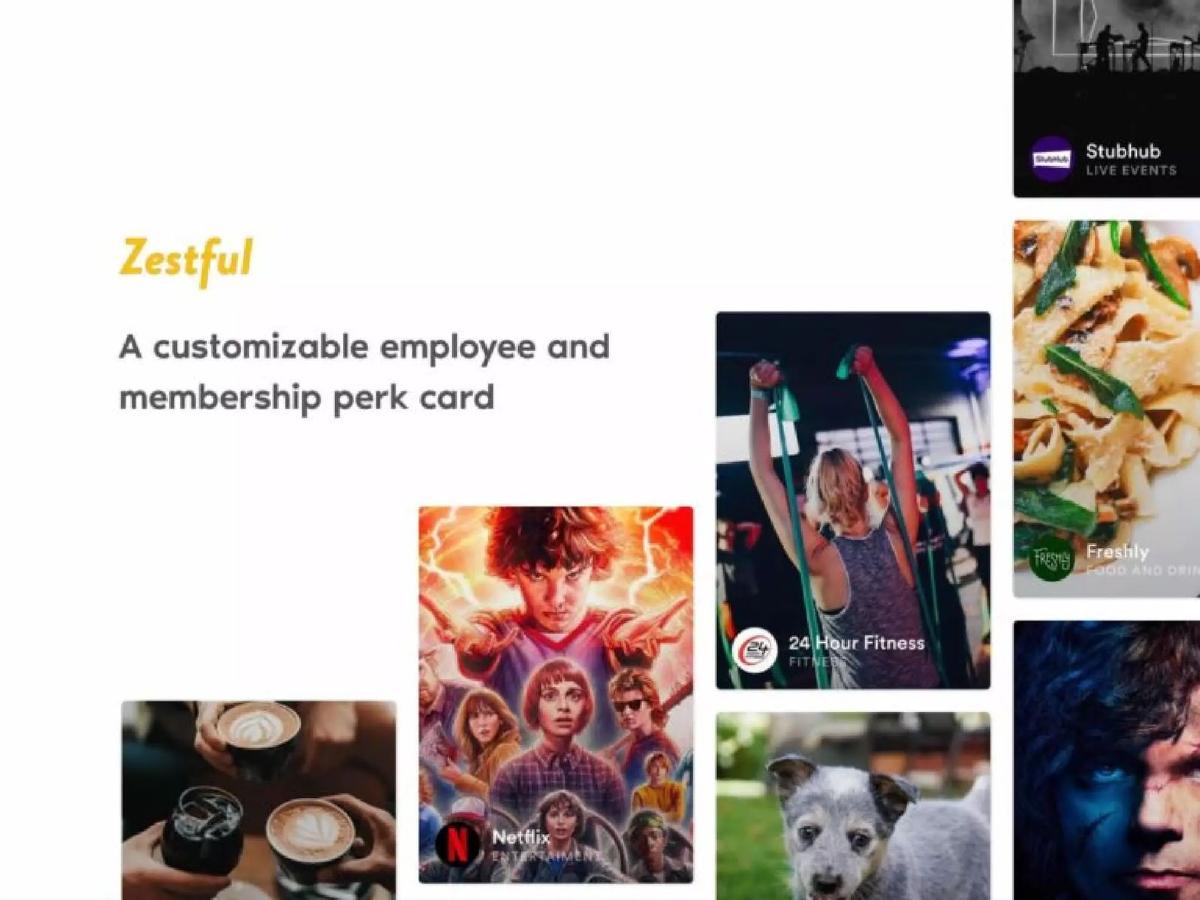
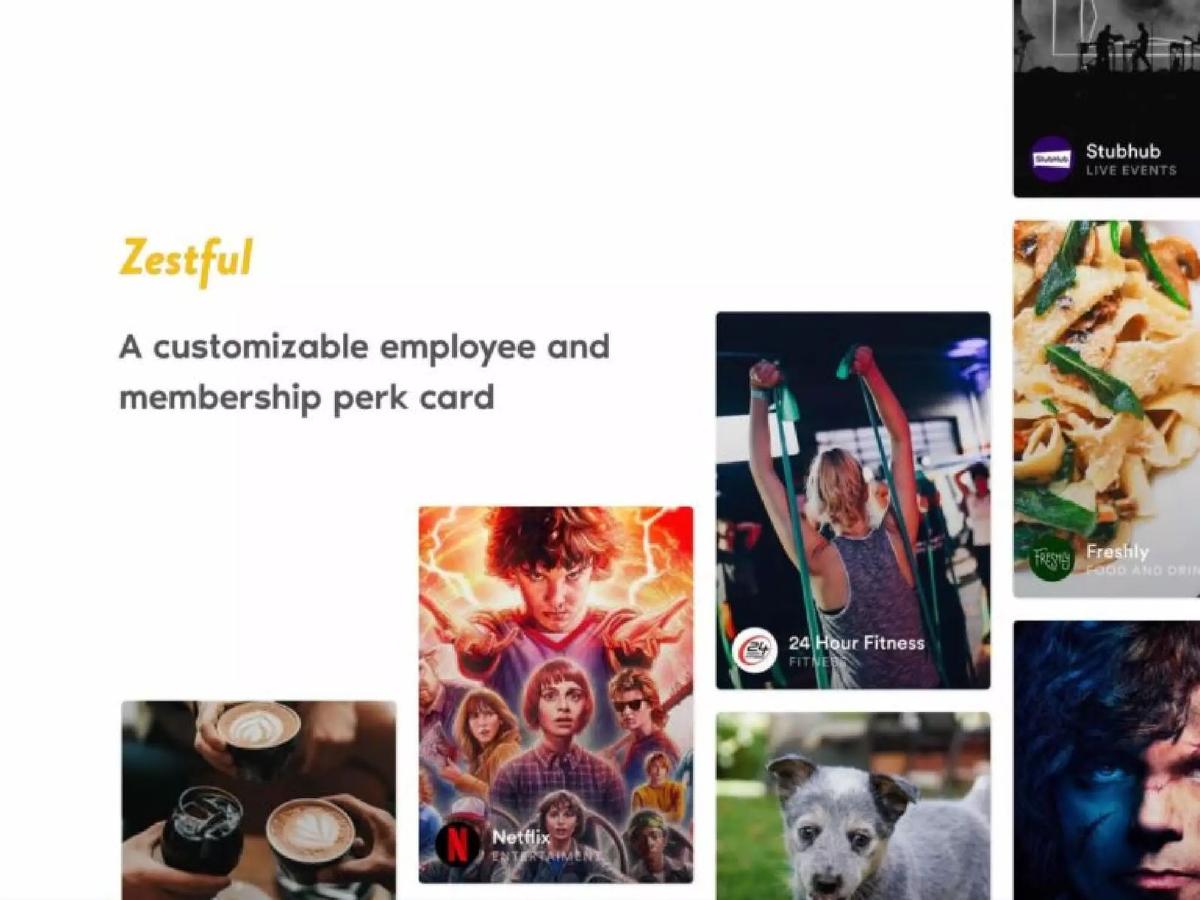
The cover slide is minimalist, featuring the brand name Zestful and a clear one-sentence value proposition: "A customizable employee and membership perk card." To the right, a collage of lifestyle images—coffee, Netflix (Stranger Things), gym workouts, and pets—visually communicates the categories of spending the card facilitates. It immediately anchors the product in the consumer lifestyle space rather than the dry world of corporate expense management.
Slide 2: The Core Technology
Slide 2, titled "The Zestful Card," gets technical quickly but remains accessible. It claims the payment technology "has never existed... Until now." The slide highlights four key features: Real-Time Tracking to eliminate reimbursements, Product Filtering to restrict card use to specific brands (showing icons for Netflix, Starbucks, and Lyft), Card Allowance for monthly spending limits, and Product Allowance for specific service limits. This slide is crucial because it differentiates Zestful from a standard corporate credit card by emphasizing granular control.
Slide 3: The Origin Story and Validation
This is arguably the most important slide in the deck. Titled "How It Started," it details a survey sent to 10,000 employees. The question was simple: would you rather have a $130k salary or a $100k salary plus a specific list of perks (Netflix, HBO, Headspace, Gym, etc.). The result: 80% chose the lower salary with the perks . This provides the "Why Now" and "Why This" for investors, suggesting a massive arbitrage opportunity for employers to increase employee satisfaction while potentially lowering gross salary costs.
Slide 4: Problem and Solution
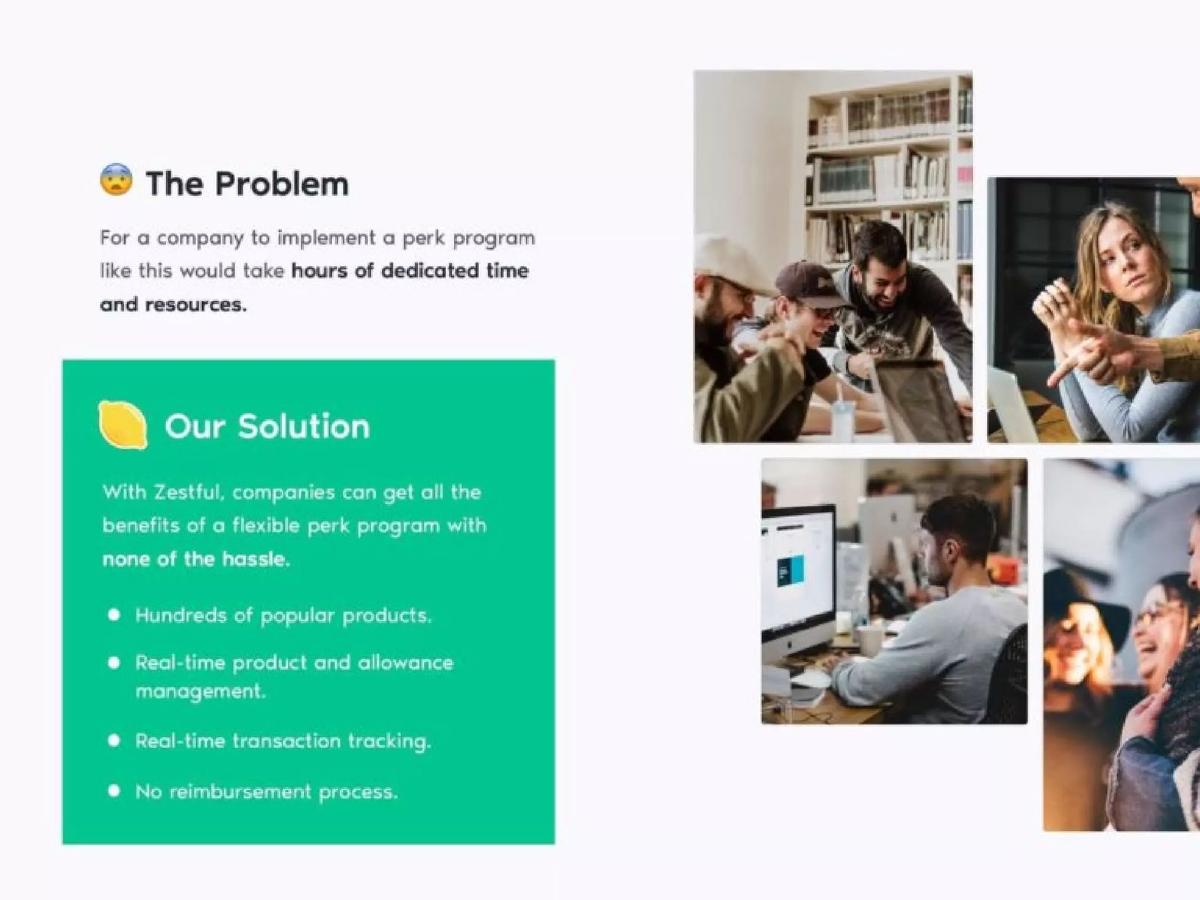
Slide 4 uses emojis to soften the tone but stays focused on the business pain point. The Problem is defined as the "hours of dedicated time and resources" required for a company to manually implement a perk program. The Solution is Zestful’s automated platform, which offers hundreds of products, real-time management, and no reimbursement process. It frames Zestful as a time-saving tool for HR departments.
Slide 5: Brand Partnerships
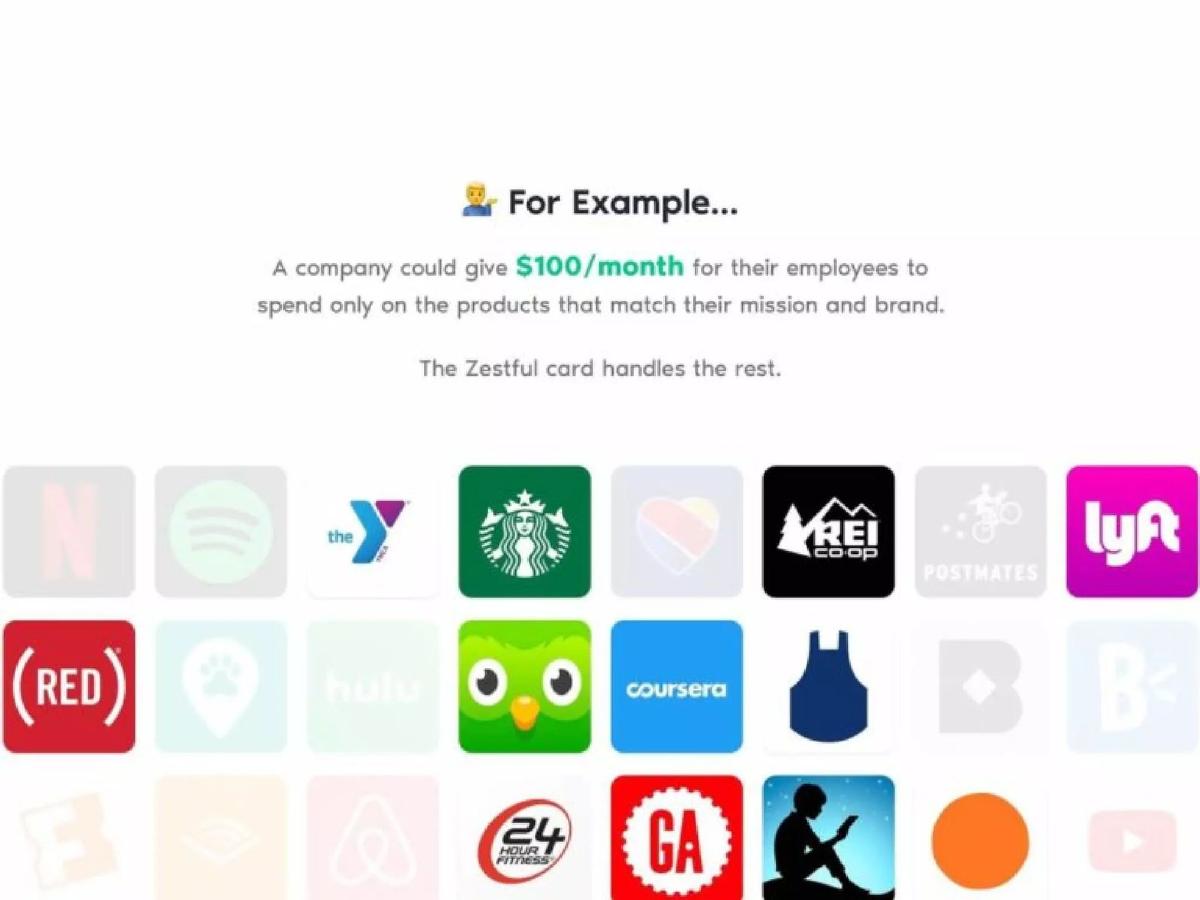
Slide 5, "For Example...", shows a grid of logos including Starbucks, REI, Lyft, Duolingo, and Coursera. It posits a scenario where a company gives $100/month for employees to spend on products that match the company's mission. This slide serves as a visual proof of the ecosystem Zestful is building, showing that the card works with both entertainment and educational services.
Slide 6: Market Expansion
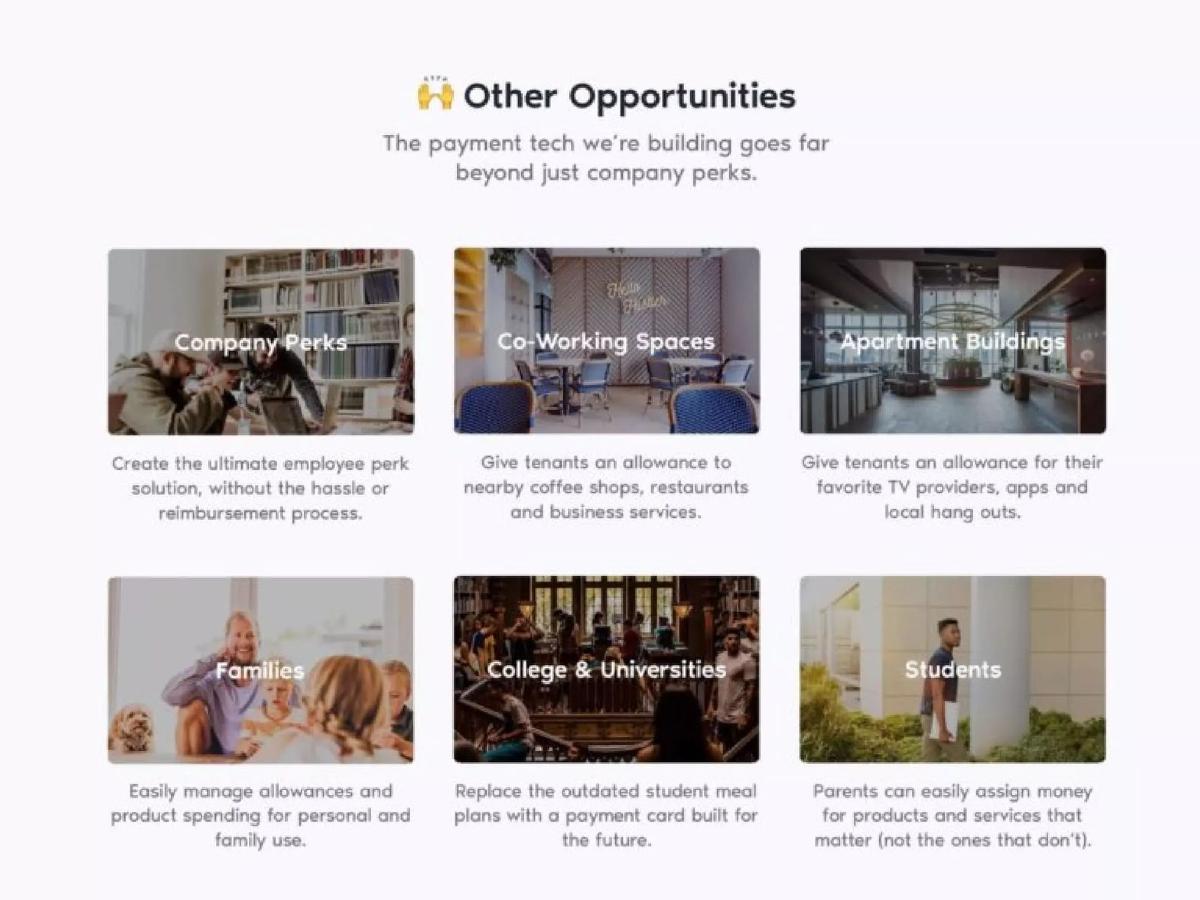
Titled "Other Opportunities," Slide 6 attempts to expand the Total Addressable Market (TAM). It lists five sectors beyond corporate perks: Co-Working Spaces , Apartment Buildings , Families , Colleges & Universities , and Students . For each, it describes a specific use case, such as replacing student meal plans or managing family allowances. This slide tells investors that while they are starting with B2B employee perks, the underlying payment filtering technology is a platform with multiple verticals.
Slide 7: The Revenue Model
Zestful presents a very clear, three-part revenue model on Slide 7. They charge a $5 / card / month subscription fee, a .5% / transaction fee, and earn 5-10% / purchase in cash back from brand partners. This is a robust model because it combines high-margin SaaS revenue with high-volume fintech transaction revenue and affiliate-style marketplace revenue.
Slide 8: Traction and Roadmap
Slide 8, "Where We’re Going," uses a bar chart to show projected growth. It starts with 1,000 employees on a beta list at launch in Nov 2018. It then projects 5K cards ($20k MRR) in Q1 2018 (likely a typo for 2019), 10K cards ($40k MRR) in Q2 2019, and 30K cards ($120k MRR) by Q4 2019. The roadmap includes opening the product to consumers and partnering with banks. The inclusion of specific MRR targets gives investors a clear metric to hold the team accountable to.
Slide 9: The Team
The team slide (Slide 9) is high-pedigree. Mat Vogels (CEO) is noted as an experienced founder and mentor for TechStars and YC companies. Malte Muenke (CTO) is listed as a co-creator of GoToMeeting and former VP of Engineering at Citrix. Max Richman (Head of Engineering) is described as a multi-time founder in the payment space. The slide also prominently features the Y Combinator (W17) logo, which serves as a significant trust signal for seed investors.
Slide 10: The Ask
Slide 10, "What We Need," is direct. It highlights $200k remaining on a $6m cap . It lists three hiring priorities: a sales team to reach every US company, customer success for onboarding, and engineers for "payment tech." This slide is effective because it shows the round is already mostly committed, creating a sense of urgency (FOMO) for the remaining $200k.
Slide 11: Contact
The final slide is a simple "Thank You" with contact information for the CEO and the company website. It maintains the clean, white-space-heavy design language used throughout the deck.
What Works in This Deck
The survey data on Slide 3 is the standout element. Most startups guess at market demand; Zestful presents a specific psychological insight that challenges conventional wisdom about compensation. This makes the deck memorable. Additionally, the Revenue Model (Slide 7) is exceptionally clear. Many early-stage decks hide their pricing or use vague terms like "monetization strategies," but Zestful gives hard numbers for three different streams. Finally, the pedigree of the CTO (co-creator of GoToMeeting) provides the technical credibility necessary to believe they can actually build a custom payment rail.
What Is Missing
The most glaring omission is a Competitor Slide . In the employee benefits space, companies like AnyPerk (now Fond) or traditional corporate card providers like Amex or Brex are obvious threats. The deck does not address how it will defend its position against these incumbents. There is also a lack of Unit Economics . While they show revenue streams, they don't show the cost of customer acquisition (CAC) or the lifetime value (LTV) of a cardholder. Lastly, the Traction Slide (Slide 8) contains a chronological typo (listing Q1 2018 after Nov 2018), which can be a minor red flag regarding attention to detail.
What a Founder Should Copy
Founders should emulate the visual simplicity of this deck. Each slide has one job and very little text. The use of specific icons and logos (Slide 5) makes the product feel real and integrated into the modern web. More importantly, the "Other Opportunities" slide (Slide 6) is a great way to show a massive vision without losing focus on the initial go-to-market strategy. It tells the investor: "We are starting here, but the technology allows us to go there." Finally, the explicit mention of the valuation cap on the ask slide (Slide 10) is a bold but effective way to filter for investors who are comfortable with those terms, saving time for both parties.
Frequently asked questions
- How does Zestful justify the shift from salary to perks?
- Zestful uses a proprietary survey of 10,000 employees as its primary evidence. According to Slide 3, when offered a choice between a $130k salary or a $100k salary plus a specific bundle of perks (Netflix, gym, meal delivery, etc.), 80% of respondents chose the lower salary with perks. This data point frames the product not just as a 'nice-to-have' benefit, but as a fundamental shift in how employees value total compensation.
- What is the core technology behind the Zestful card?
- Slide 2 explains that the core is payment technology allowing for real-time tracking and product filtering. Unlike traditional corporate cards, Zestful allows employers to restrict spending to specific brands or categories (e.g., Spotify, Starbucks, Airbnb) and assign custom allowances in real-time. This eliminates the 'messy reimbursement process' typically associated with employee expenses.
- What are the primary revenue streams for the company?
- As detailed on Slide 7, Zestful employs a triple-threat revenue model. First, a SaaS-style monthly subscription of $5 per card. Second, a fintech-style 0.5% fee on every transaction. Third, a marketplace-style cash back arrangement where partner brands offer 5-10% back on purchases made through the card. This suggests the company captures value from the employer, the payment rail, and the merchant.
- Who is the target audience beyond corporate employees?
- Slide 6, 'Other Opportunities,' outlines a vision for the technology to serve co-working spaces (coffee/business service allowances), apartment buildings (TV and app allowances for tenants), and universities (replacing outdated student meal plans). This indicates the founders view their payment filtering tech as a horizontal platform for any organization that manages distributed spending for a community.
- What was the specific funding goal mentioned in the deck?
- Slide 10 states the company was seeking to fill the remaining '$200k' of a round with a '$6m cap.' The funds were earmarked for three specific areas: a sales team to expand US market reach, customer success to handle onboarding, and additional engineers to continue building the payment infrastructure. This level of specificity in the 'ask' slide is a hallmark of a late-stage seed round.