Rever’s 12-slide deck is lean, visually driven, and highly focused on the 'enthusiast' experience. Eschewing dense text, the founders used high-quality lifestyle photography to establish an emotional connection with the motorcycle market before hitting investors with hard growth data. The deck highlights a massive $64B U.S. market opportunity and impressive traction, including 500,000 registered users and a 10x YoY growth rate. While it lacks a formal 'Ask' slide and detailed financial projections, it compensates with strong social proof through partnerships with major industry players like B…
Key takeaways
- The deck identifies a massive total addressable market of 230 million riders worldwide on Slide 6.
- Rever demonstrates significant traction with 500,000 registered users and 10x year-over-year growth on Slide 8.
- The business model relies on a $5.99/month consumer subscription and strategic industry partnerships shown on Slide 10.
- User engagement is high, with an average of 2.5 hours spent in-app per month as noted on Slide 9.
- The founders emphasize their industry 'insider' status, citing roles at Microsoft, Red Bull, and the Motorcycle Industry Council on Slide 7.
- The deck lacks a specific 'Ask' slide, omitting the amount of capital being raised or the intended use of funds.
- Social proof is a core pillar of the deck, featuring logos from BMW, Honda, Harley-Davidson, and Bosch on Slide 10.
- The problem is framed emotionally, contrasting 'sucking' traffic with the freedom of riding on Slides 2 and 3.
The Narrative: From Utility to Community
Rever’s pitch deck is a classic example of 'lifestyle' venture capital. It doesn't start with a spreadsheet; it starts with a feeling. By the time an investor reaches the data on Slide 8, they have already been sold on the romance of the open road. This is a strategic choice for niche social platforms: you must first prove the 'why' of the community before the 'how' of the technology.
Slides 1-4: The Emotional Hook
Slide 1 is a collage of motorcycle culture. It establishes the brand immediately as 'The World’s Largest Motorcycling Community.' The contact information for the founders and their AngelList handle are tucked in the top right corner, signaling that this is a live fundraising document.
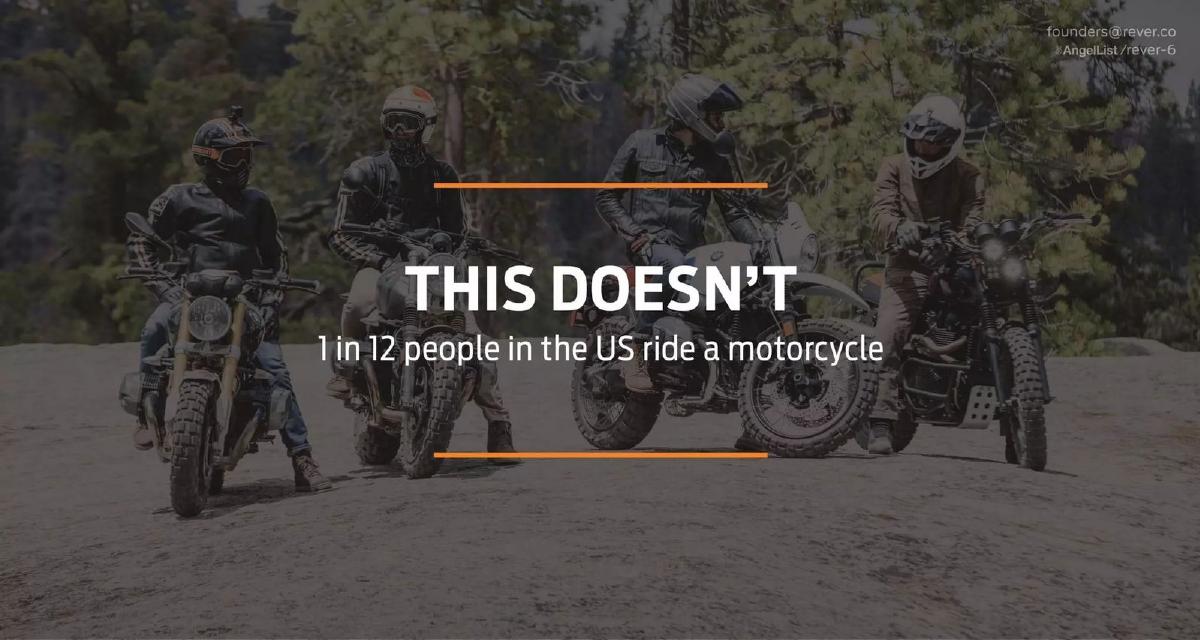
Slide 2 and Slide 3 use a 'Contrast' framework. Slide 2 shows a gridlocked highway with the text 'THIS SUCKS.' Slide 4 shows a group of riders in a scenic, off-road setting with the text 'THIS DOESN’T.' This is a visceral way to define the target audience. Slide 3 also introduces the first hard stat: '1 in 12 people in the US ride a motorcycle,' establishing the scale of the subculture.
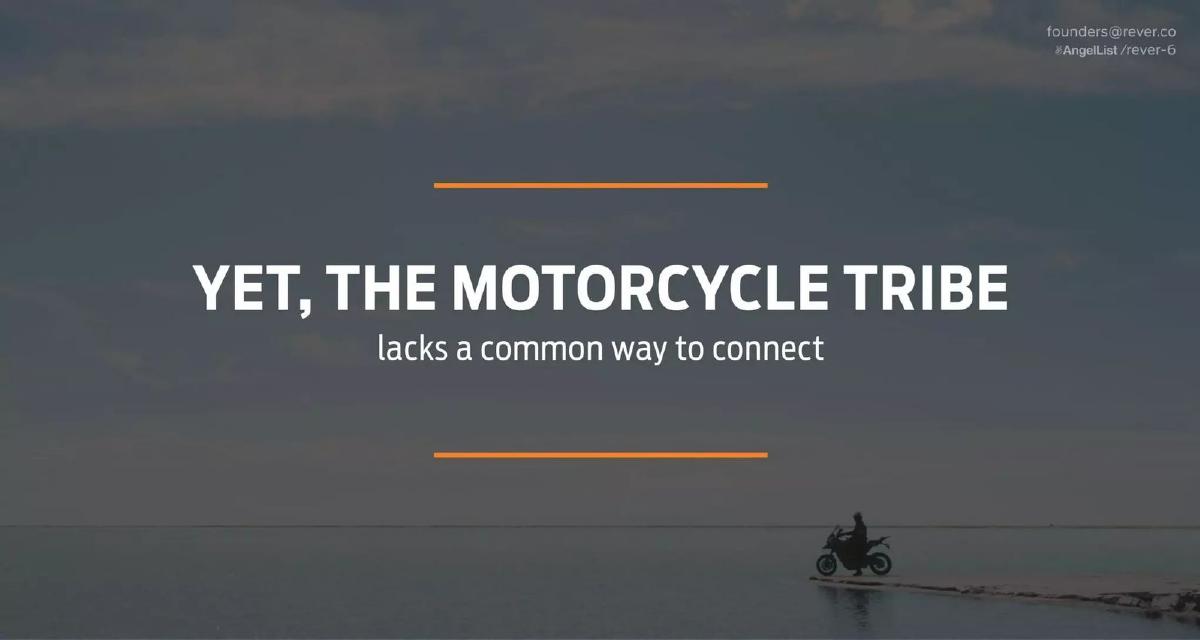
Slide 4 defines the core problem: 'YET, THE MOTORCYCLE TRIBE lacks a common way to connect.' This is the 'Why Now' and 'Why Us' moment. It suggests that while the community is large, it is fragmented and underserved by general-purpose social or navigation tools.
Slides 5-6: The Solution and Market Size
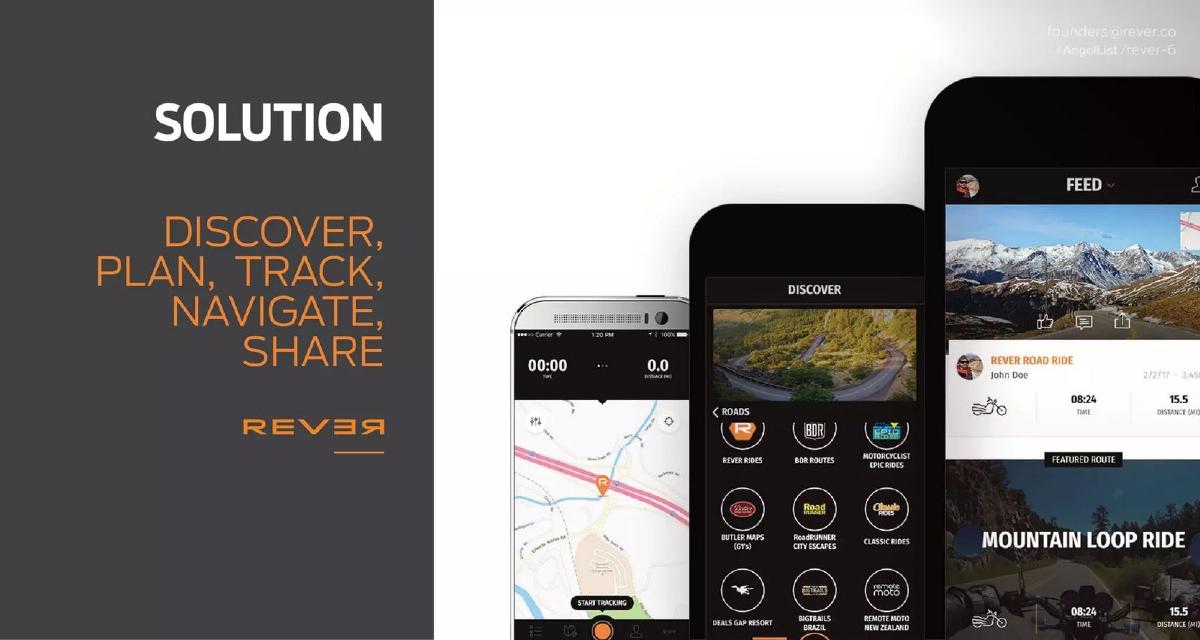
Slide 5 introduces the product. The tagline 'DISCOVER, PLAN, TRACK, NAVIGATE, SHARE' covers the entire user journey. The slide features three mobile mockups showing a tracking interface, a discovery menu with branded 'BDR Routes' and 'Butler Maps,' and a social feed. This confirms the app is a hybrid of Strava (tracking/sharing) and Waze (navigation) specifically for bikes.
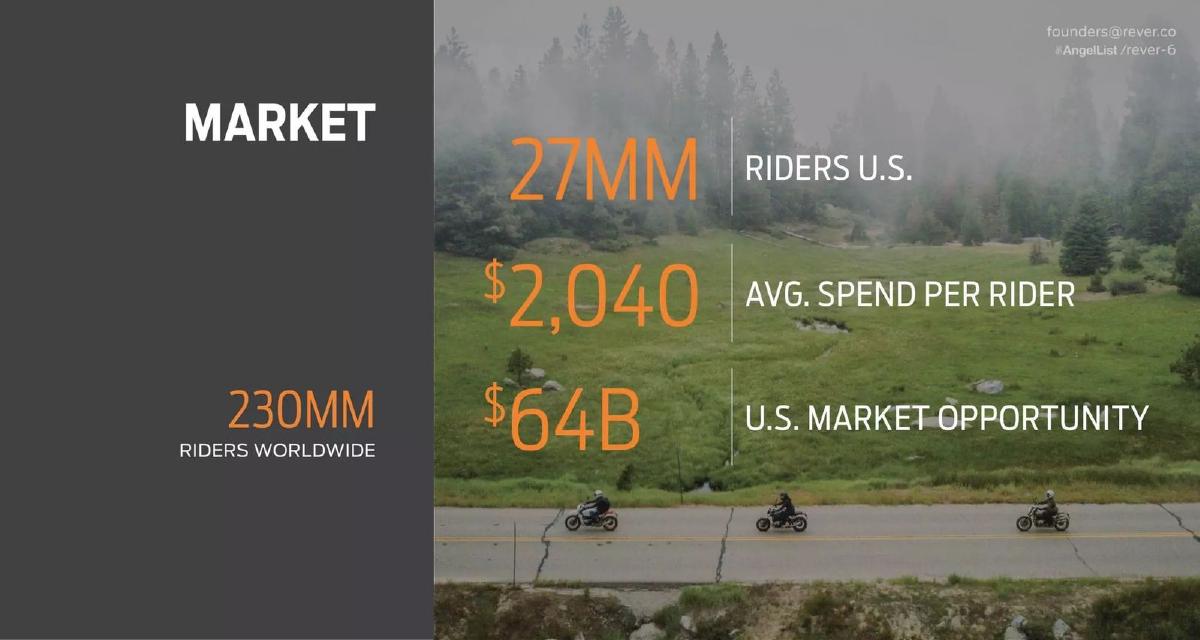
Slide 6 addresses the 'Market.' It breaks down the opportunity into three numbers: 27 million riders in the U.S., an average spend of $2,040 per rider, and a total U.S. market opportunity of $64 billion. It also notes a global audience of 230 million riders. This slide is critical because it moves the conversation from a 'niche hobby' to a 'massive industry.'
Slides 7-9: Team and Traction
Slide 7 introduces founders Mark Roebke and Justin Bradshaw. The photography continues the lifestyle theme—both are in riding gear. The slide highlights their 'insider' status with logos from Microsoft, Vail Resorts, Red Bull, and the Motorcycle Industry Council. This tells investors that the founders have both the technical chops and the industry connections to execute.
Slide 8 is the 'Traction' slide, and it is the strongest in the deck. It claims 10x year-over-year user growth, 500,000 registered users, and a 30% Monthly Active User (MAU) rate in the U.S. For a 2015-era startup, these are high-performing metrics that justify a 'Later' stage designation (as noted in the catalogue facts).
Slide 9 dives deeper into engagement. 75 million kilometers have been tracked. The average U.S. rider is doing 9 rides per month and spending 2.5 hours in the app. These metrics are designed to prove 'stickiness'—that Rever isn't just a utility used once a year, but a daily or weekly habit.
Slides 10-12: Business Model and Vision
Slide 10 outlines the 'Business Model.' It is split between 'Consumer' ($5.99/month for premium features like offline maps and safety alerts) and 'Partners.' The partner section is a 'Who's Who' of the motorcycle world: Honda, BMW, Bosch, Arai, Harley-Davidson, Suzuki, KTM, Cycle World, and Dunlop. This level of industry buy-in is a massive de-risking signal for investors.
Slide 11 is a vision slide titled 'REVERLUTION.' It focuses on 'Community, Connectivity, Data' and highlights partnerships with Bosch, BRP, and BMW Motorrad. This suggests the company’s long-term play is not just an app, but a data layer integrated into the motorcycles themselves.
Slide 12 is the closing slide. It features the call to action 'RIDE WITH US' and provides the website, phone number, and social handles. Notably, there is no 'Ask' slide in this deck—no mention of the $2.9 million target or how the money will be spent.
What Works in This Deck
Visual Consistency: The use of high-quality, full-bleed photography creates a professional and aspirational brand image. · Traction-First Data: Slide 8 uses large, bold fonts for the most impressive numbers (10x growth, 500k users), making them impossible to miss. · Industry Credibility: The 'Partners' slide (Slide 10) provides instant validation. Seeing Harley-Davidson and BMW logos next to a startup's name suggests the product has already been vetted by the market leaders. · Simple Problem/Solution: The deck doesn't get bogged down in technical jargon. It frames the problem as a lack of connection and the solution as a way to 'Discover, Plan, Track, Navigate, and Share.'
What is Missing
The Ask: There is no slide detailing how much money is being raised, the valuation, or the milestones the company intends to hit with the new capital. · Competitive Landscape: The deck ignores competitors. While Rever is niche, investors would likely ask how they defend against Google Maps adding 'winding road' features or established players like EatSleepRIDE. · Financial Projections: There is no mention of current revenue or future projections. While we see the $5.99 price point, we don't know the conversion rate from free to paid users. · Unit Economics: There is no data on Customer Acquisition Cost (CAC) or Lifetime Value (LTV), which are standard requirements for 'Later' stage decks.
What a Founder Should Copy
The 'Contrast' Opening: Using 'This Sucks' vs. 'This Doesn't' is a powerful way to quickly align the investor with the user's pain point. · Founder-Market Fit: If you are building for a niche, show yourself in the environment. The founders appearing in their riding gear on Slide 7 reinforces that they are building for themselves and their peers. · Logo Soup: If you have partnerships, use the logos. They are the most efficient form of social proof available in a pitch deck. · Engagement over Downloads: Slide 9's focus on 'Hours in App' and 'Rides per Month' is much more valuable than just showing total downloads. It proves the product is useful.
Frequently asked questions
- How much did Rever raise with this deck?
- According to the catalogue facts, Rever raised $2,900,000 in 2015. Interestingly, the deck itself does not include a slide stating the specific 'Ask' or the terms of the round, which is common in decks used for initial conversations or those shared on platforms like AngelList where the terms are listed separately.
- What is Rever's primary revenue model?
- Rever utilizes a dual-revenue strategy. As shown on Slide 10, they charge consumers a $5.99 monthly subscription fee for premium features like curated ride content, offline maps, and safety alerts. Simultaneously, they maintain a B2B 'Partners' side, working with major motorcycle brands like BMW, Honda, and Suzuki.
- What are the key engagement metrics for Rever?
- The deck highlights deep user engagement on Slide 9, reporting 75 million kilometers tracked on the platform. The average U.S. rider completes 9 rides per month and spends 2.5 hours inside the app monthly, indicating that the tool is a recurring part of the user's hobby.
- Who are the founders and what is their background?
- The founders are Mark Roebke and Justin Bradshaw. Slide 7 details their experience: Roebke is a tech entrepreneur and Founder Institute mentor with a successful exit, having worked at Microsoft and Vail Resorts. Bradshaw is an entrepreneur and Motorcycle Industry Council Board Member with experience at Red Bull.
- Is there a competitor analysis in the deck?
- No. The deck completely omits a competitive landscape slide. Instead of comparing features against other GPS or social apps, Rever focuses on the 'unmet need' of the 'Motorcycle Tribe' to connect, positioning themselves as the only dedicated solution for this specific community.