Reveel’s 10-slide pre-seed deck is a masterclass in visual storytelling for a technical problem. By framing the current state of on-chain accounting as a 'forensic' task, the company justifies its existence as a necessary financial layer for Web3 collaboration. The deck successfully highlights early traction with high-profile artists like Aluna and partnerships with labels like Venice, proving immediate utility. However, it is notably light on business model specifics, omitting a dedicated slide for unit economics or a detailed breakdown of the $1.3M ask. Instead, it relies on the 'rockstar t…
Key takeaways
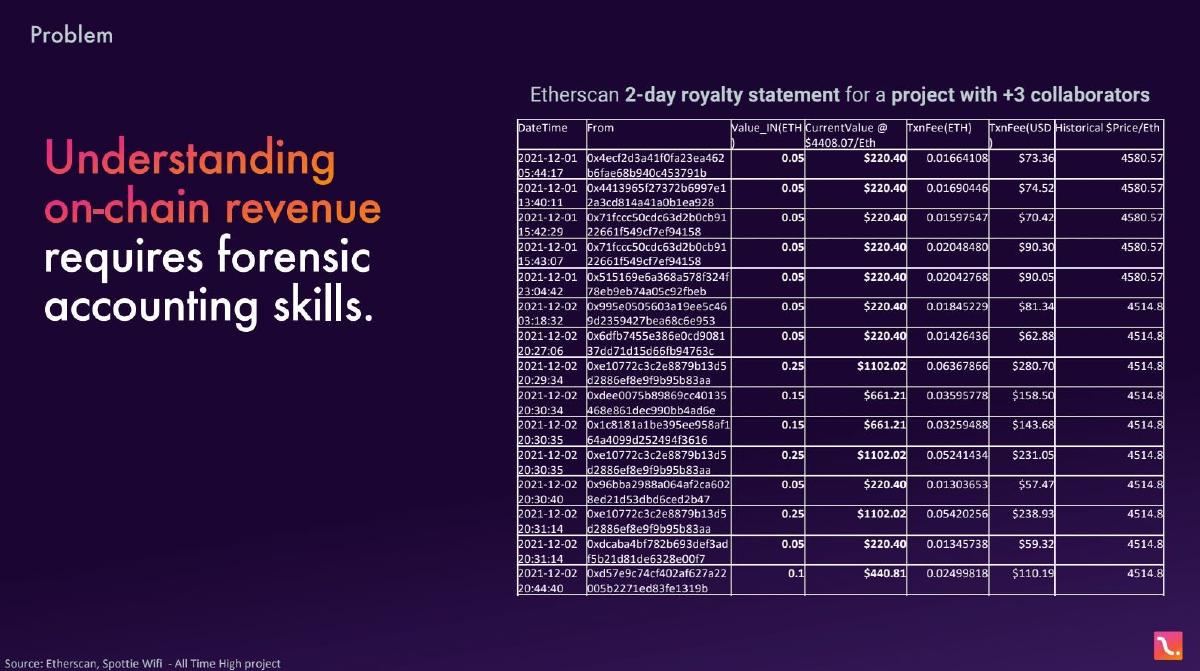
- The deck defines the problem as a lack of transparency, stating on slide 3 that understanding on-chain revenue currently requires 'forensic accounting skills.'
- Reveel positions itself as a dual-threat solution on slide 4, offering both a Revenue Share Protocol and On-chain Revenue Analytics.
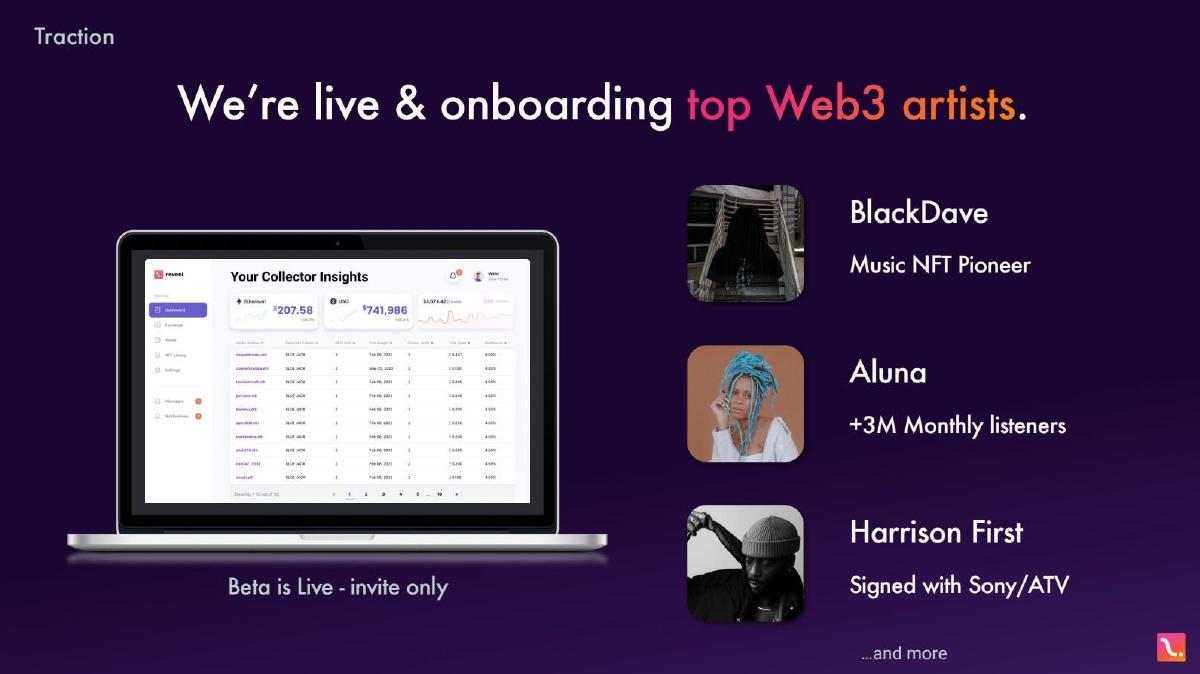
- Early traction is validated on slide 5 through partnerships with artists like Aluna, who has over 3 million monthly listeners.
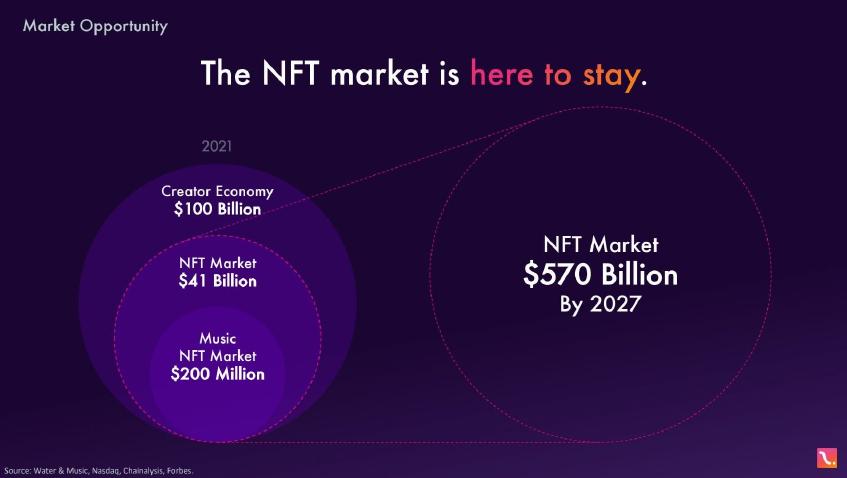
- The market opportunity slide (Slide 7) projects the NFT market to reach $570 billion by 2027, up from $41 billion in 2021.
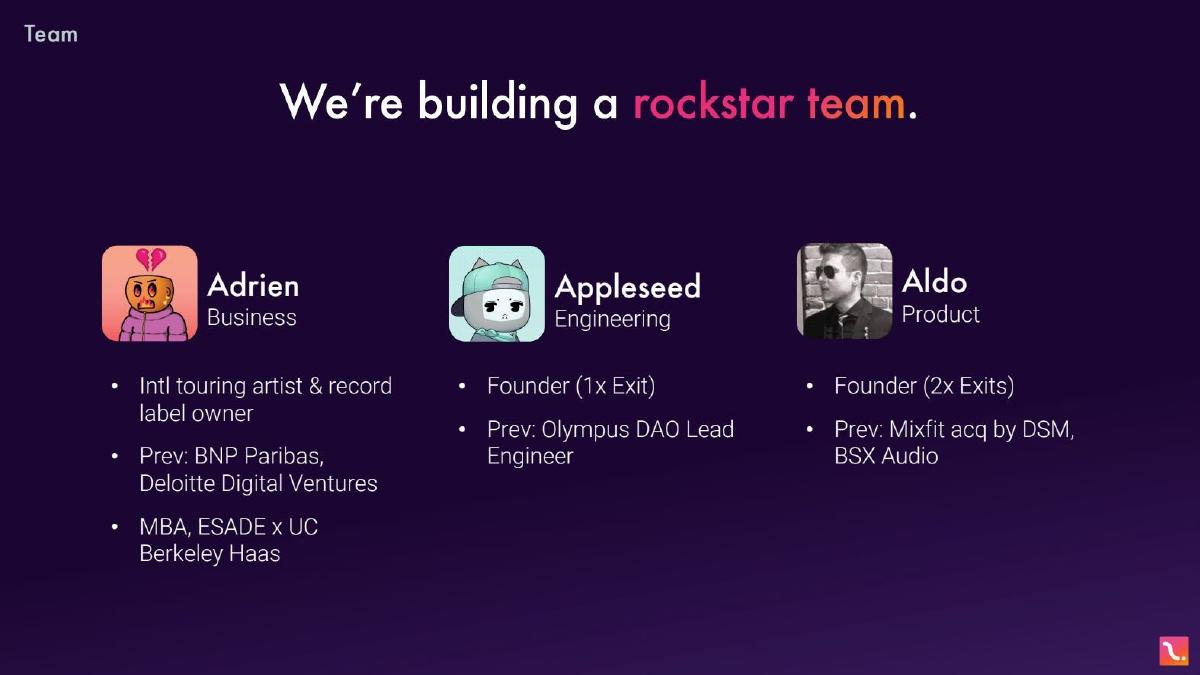
- The team slide (Slide 8) emphasizes founder experience, noting three combined exits and a lead engineer from Olympus DAO.
- The roadmap on slide 9 outlines a transition from a simple tool to a 'Financial OS' including tax prep and revenue advances.
- The deck completely omits a revenue model or pricing structure, though slide 9 mentions activating the revenue model as a future step.
- There is no specific 'Ask' slide detailing how the $1.3M reported by Business Insider will be allocated.
The Hook: Defining the Financial Stack
Reveel opens its deck with a clear, minimalist title slide (Slide 1) that establishes its category: "The Financial Stack for Web3 Collaboration." This is a high-level positioning statement that suggests the company isn't just a tool, but a foundational layer for the decentralized economy. By using the term "Financial Stack," they signal to investors that they are building infrastructure, which typically commands higher valuations than consumer-facing applications.
Slide 2: Contextualizing Shared Income
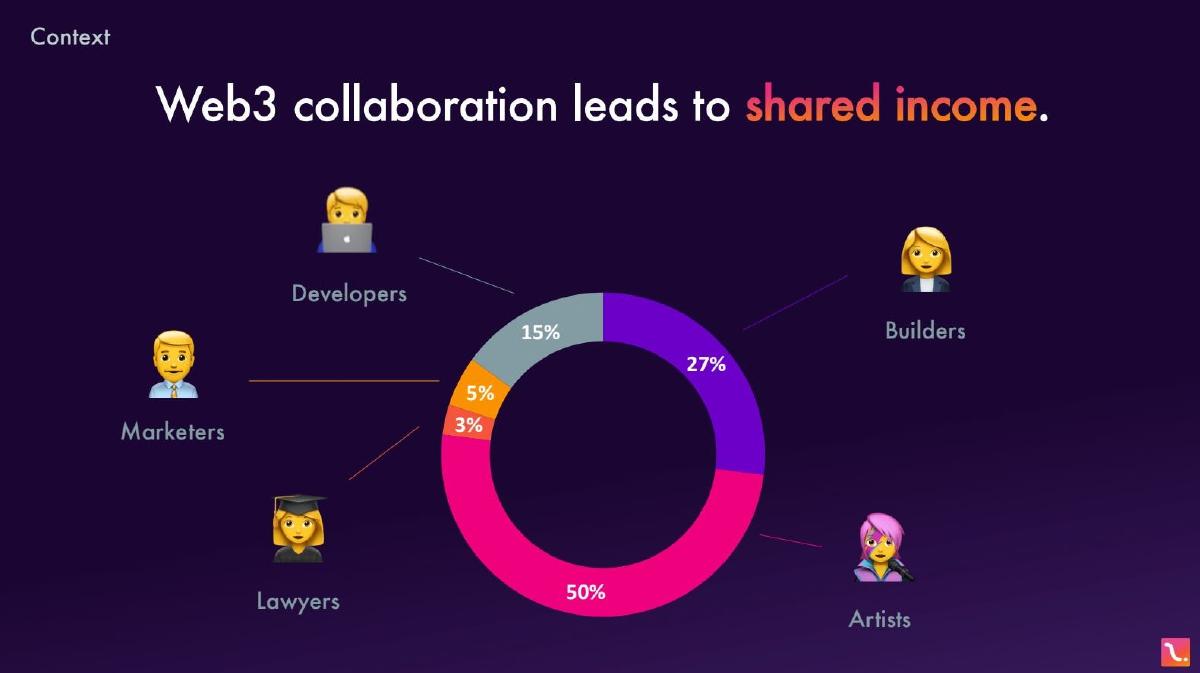
Slide 2 provides the "Why Now" by illustrating the collaborative nature of Web3. It uses a donut chart to show how income is distributed among various stakeholders: 50% to Artists, 27% to Builders, 15% to Developers, 5% to Marketers, and 3% to Lawyers. This slide serves to prove that Web3 projects are rarely solo endeavors; they are multi-party collaborations that require a way to handle "shared income." It sets the stage for the administrative nightmare that follows.
Slide 3: The "Forensic Accounting" Problem
Slide 3 is perhaps the most effective slide in the deck. It contrasts the clean design of the previous slides with a messy, dense screenshot of an Etherscan royalty statement. The headline, "Understanding on-chain revenue requires forensic accounting skills," perfectly captures the pain point. It shows raw hex addresses, ETH values, and transaction fees, highlighting how difficult it is for a non-technical artist or marketer to know if they have been paid correctly. This creates an immediate "aha" moment for any investor who has ever tried to read a block explorer.
Slide 4: The Two-Pronged Solution
On Slide 4, Reveel introduces its product as the antidote to the Etherscan mess. The solution is split into two components: a "Revenue Share Protocol" and "On-chain Revenue Analytics." The slide features two laptop mockups showing a clean, intuitive UI. The left screen shows a "Revenue Path" where users can add collaborators (e.g., Joey Miles at 50%, Sam Martin at 30%) with a simple visual split. The right screen shows a dashboard for "Total Earnings," providing the transparency that was missing on the previous slide. This slide effectively communicates that Reveel is both the plumbing (the protocol) and the interface (the analytics).
Slide 5 & 6: Proving Traction through Influence
Traction slides in pre-seed decks are often weak, but Reveel leverages social proof effectively. Slide 5 highlights that the beta is live and invite-only, featuring specific "Music NFT Pioneers" like BlackDave and Aluna. Mentioning Aluna’s "+3M Monthly listeners" provides a sense of scale that transcends the crypto niche. Slide 6 expands this traction to broader categories: NFT Revenue, Metaverse Shows, and Web3 Labels. By listing logos like Venice and Nvak Collective, Reveel demonstrates that they are already integrated into the existing ecosystem of Web3 music and art.
Slide 7: The Macro Opportunity
Slide 7 addresses the market size. It uses a nested circle diagram to show the relationship between the Creator Economy ($100 Billion), the NFT Market ($41 Billion in 2021), and the Music NFT Market ($200 Million). The "big bet" is represented by a massive dashed circle projecting the NFT Market to reach $570 Billion by 2027. While these figures are sourced from external reports (Water & Music, Nasdaq, Forbes), they serve to tell the investor that even a small slice of this growing pie represents a significant opportunity.
Slide 8: The "Rockstar" Team
The team slide is a critical component of this $1.3M raise. Reveel highlights three key leaders. Adrien brings the domain expertise as an international touring artist and label owner, combined with corporate pedigree from BNP Paribas and Deloitte. Appleseed provides the technical "street cred" as the former Lead Engineer for Olympus DAO—a major name in DeFi history—and a founder with one exit. Aldo rounds out the trio with product experience and two exits. This combination of industry knowledge, crypto-native engineering, and entrepreneurial success significantly de-risks the investment.
Slide 9: The Roadmap to an OS
Slide 9 outlines the future. It shows that the company has already completed artist partnering and beta rollout. The next steps are opening the platform to all creators, activating a revenue model, and expanding to multi-chain deployment with a token launch. The final stage is the most ambitious: adding "advanced features" like revenue advances and tax prep. This indicates that Reveel’s ultimate goal is to become the "Financial OS for Web3 Teams," moving from a simple utility to a comprehensive business management suite.
What Works in This Deck
Visual Contrast: The use of the Etherscan screenshot on Slide 3 is a brilliant way to visualize a technical problem. It makes the "Solution" slide that follows feel like a relief, which is exactly how a product should be presented.
Social Proof: Instead of showing vague growth charts, Reveel shows real people and real brands. In the creator economy, who you work with is often more important than how many users you have, and Reveel has secured high-signal early adopters.
Clear Positioning: The deck never wavers from its identity as a "Financial Stack." Every slide reinforces the idea of managing, tracking, and sharing income, which keeps the narrative tight and focused.
What Is Missing from the Deck
Revenue Model: The most glaring omission is how the company actually makes money. While Slide 9 mentions "activate revenue model" as a future step, there is no mention of take rates, subscription fees, or protocol fees. For a $1.3M pre-seed, investors usually want to see at least a hypothesis for monetization.
The Ask: The deck does not include a slide detailing the funding round. According to publisher-reported facts, the company raised $1.3M, but the deck itself does not state the amount, the valuation, or how the funds will be used (e.g., hiring more engineers, marketing, etc.).
Competitive Landscape: There is no mention of other split-payment protocols or crypto-accounting tools. Acknowledging competitors and explaining why Reveel’s "Financial Stack" approach is superior would have strengthened the case for their defensibility.
What Founders Should Copy
The Problem Statement: Founders building technical products should copy the way Reveel translated a complex backend issue (on-chain data legibility) into a relatable human problem (needing "forensic accounting skills").
The Roadmap Structure: The roadmap on Slide 9 is excellent because it clearly distinguishes between what is "Done" and what is "Future." This builds credibility by showing that the team can execute on its promises before asking for money to build the next phase.
Minimalist Design: The deck uses a consistent color palette and avoids clutter. By letting the product mockups and the team's credentials speak for themselves, the deck feels professional and high-end, matching the "Financial Stack" branding.
Frequently asked questions
- What is the core problem Reveel is solving?
- Reveel addresses the complexity of managing shared income in Web3. As shown on slide 3, current on-chain revenue data is presented in raw Etherscan logs, which are difficult to parse. This makes it nearly impossible for collaborators—like artists, producers, and marketers—to track their fair share of royalties without manual, error-prone accounting.
- How does Reveel plan to make money?
- The deck does not explicitly state a current revenue model. However, slide 9 indicates that 'activating the revenue model' is the third step in their roadmap, following the open platform launch. Potential future revenue streams mentioned include 'revenue advances' and 'tax prep' as part of their advanced feature set.
- Who are the key members of the Reveel team?
- The team consists of Adrien (Business), an international touring artist and record label owner with an MBA; Appleseed (Engineering), a founder with one exit and former Lead Engineer at Olympus DAO; and Aldo (Product), a founder with two exits whose previous company was acquired by DSM.
- What kind of traction has Reveel achieved so far?
- According to slides 5 and 6, Reveel is in a live, invite-only beta. They have onboarded 'top Web3 artists' including Aluna (3M+ monthly listeners) and Harrison First (signed with Sony/ATV). They also list partnerships with Web3 labels such as Venice, Nvak Collective, and ChillRx.
- What is the long-term vision for the product?
- Reveel aims to evolve from a revenue tracking and splits tool into a comprehensive 'Financial OS for Web3 Teams.' As detailed on slide 9, this includes multi-chain deployment, a token launch, and advanced financial services like team management and tax preparation.