Restream’s 14-slide Series A deck is a masterclass in demonstrating market dominance through high-volume usage metrics. By 2020, the company was facilitating 8 million monthly broadcasts and reaching 600 million monthly views. The deck effectively uses a 'Declaration' slide to set a bold vision for a $100 billion market before diving into a simple technical explanation of their multi-streaming middleware. While the deck is light on specific financial projections or a detailed 'Ask' slide, the sheer scale of their user base—including 2 million businesses and organizations—and their support for…
Key takeaways
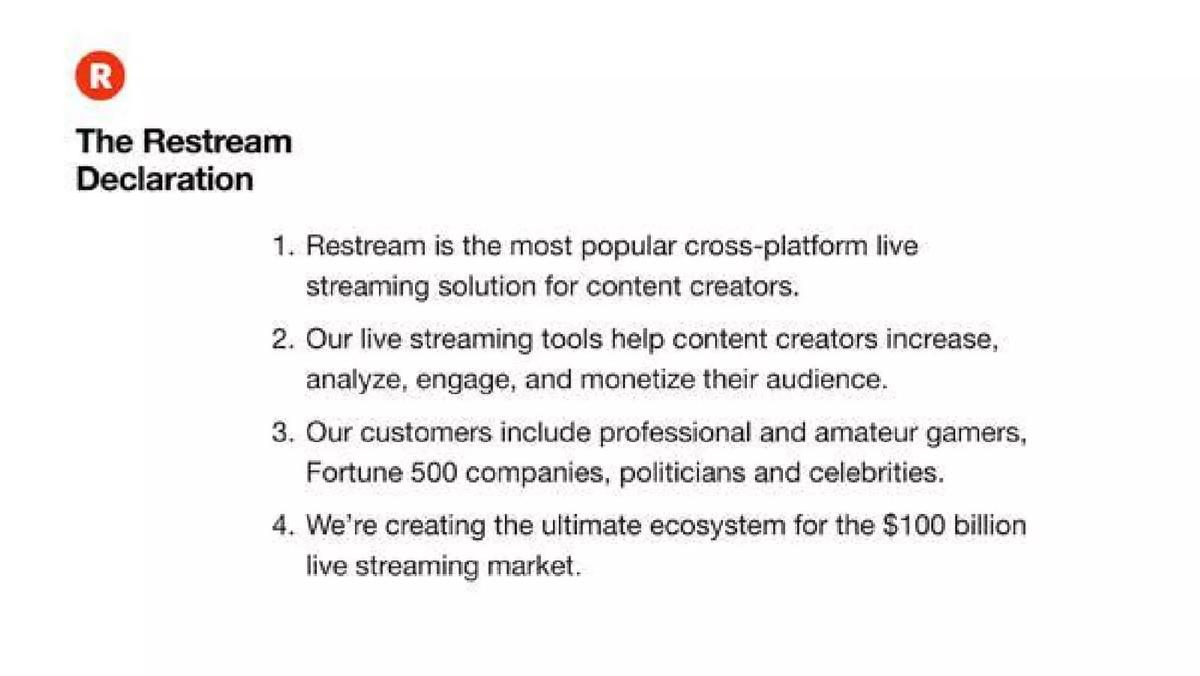
- The deck leads with a 'Restream Declaration' that frames the company as the ultimate ecosystem for a $100 billion market (Slide 2).
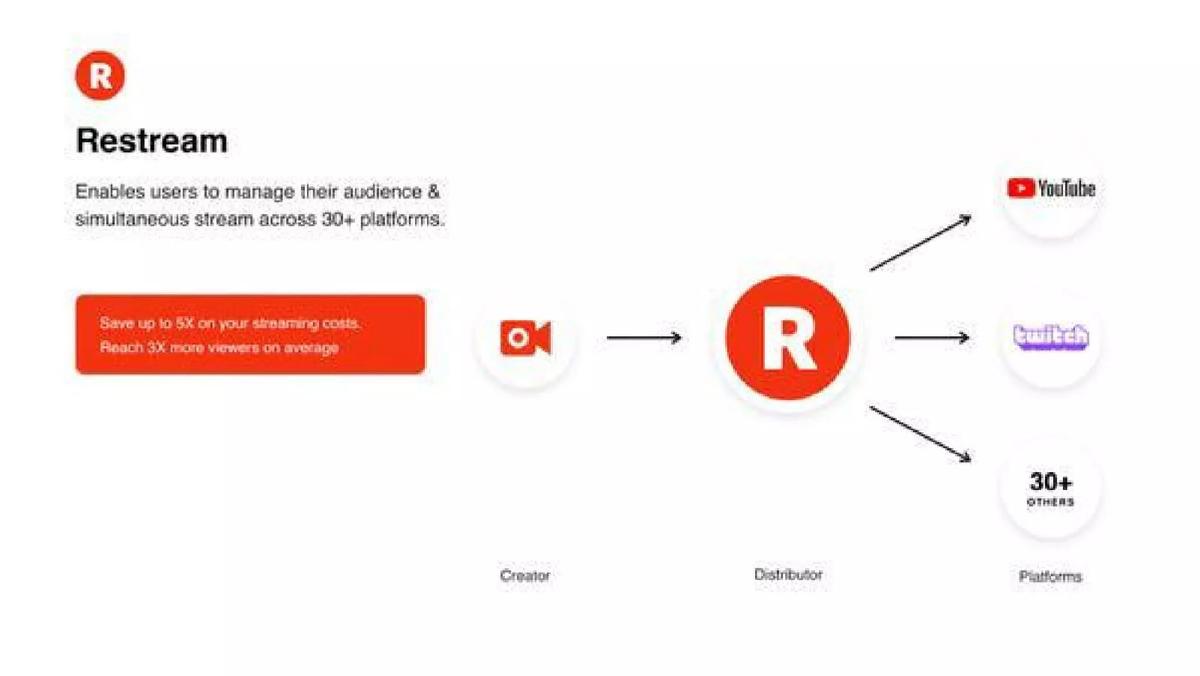
- A simple distribution diagram illustrates the core value proposition: one creator inputting to Restream and distributing to 30+ platforms (Slide 4).
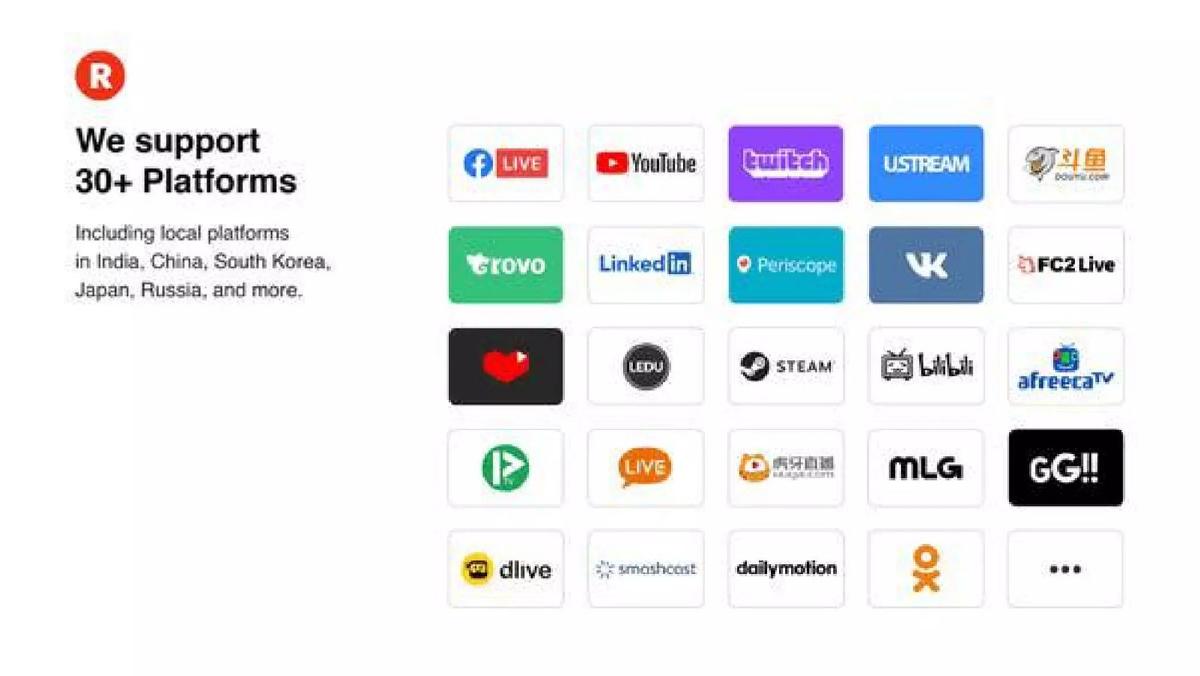
- The platform supports over 30 platforms including regional giants in India, China, South Korea, Japan, and Russia (Slide 5).
- Restream presents a clear six-tier pricing model ranging from $0 to a custom Enterprise 'On request' tier (Slide 7).
- Growth is visualized through two hockey-stick charts showing 'Total Creator Community' and 'Paid Subscribers' from 2016 to 2020 (Slide 8).
- The scale is massive: 8M monthly broadcasts, 600M monthly views, and 7B monthly watched minutes (Slide 9).
- The customer logo wall includes high-profile entities like Microsoft, Google, the World Health Organization, and the Biden Harris campaign (Slide 10).
- Global reach is emphasized with a heat map showing viewers in 80+ countries and rapid growth in Asia and Russia (Slide 11).
The Infrastructure of the Live Streaming Boom
Restream’s pitch deck is a concise, 14-slide presentation that focuses heavily on traction and the 'ecosystem' play. Founded in 2015 and headquartered in Austin, Texas, the company positioned itself during its Series A raise as the essential middleware for the $100 billion live streaming market. The deck is notable for its clean aesthetic and its reliance on massive usage figures to prove product-market fit.
Slides 1-2: The Vision and the Declaration
The deck opens with a bold red title slide (Slide 1) calling Restream "The ultimate live streaming ecosystem." This is immediately followed by 'The Restream Declaration' (Slide 2). This slide is an effective executive summary, stating that Restream is the most popular cross-platform solution, helps creators monetize, serves everyone from gamers to Fortune 500 companies, and is targeting a $100 billion market. By leading with a 'Declaration,' the founders set a confident tone before showing a single product feature.
Slides 3-5: Problem, Solution, and Platform Reach
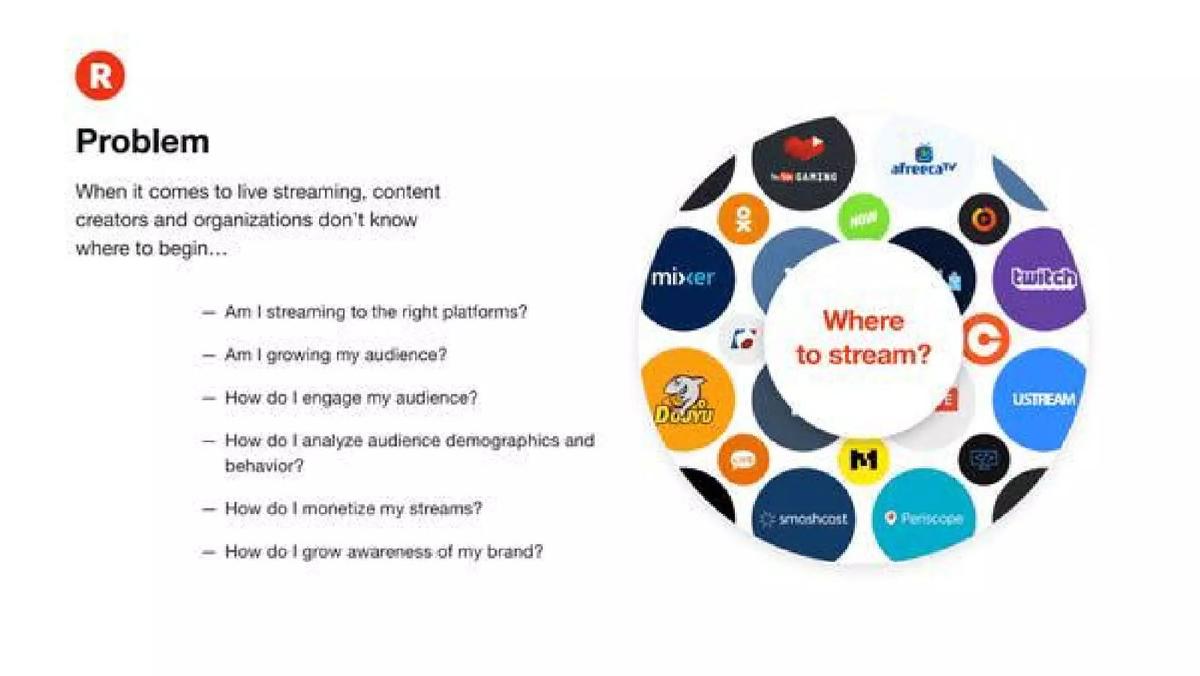
Slide 3 identifies the 'Problem' as a series of questions creators ask: "Where to stream?", "How do I engage?", and "How do I monetize?" The visual is a cluster of platform logos surrounding a central question mark. Slide 4 provides the 'Solution' with a simple flow diagram. It shows a 'Creator' sending one stream to the 'Distributor' (Restream), which then pushes it out to YouTube, Twitch, and '30+ Others.' This slide also includes a high-impact callout: "Save up to 5X on your streaming costs. Reach 3X more viewers on average."
Slide 5 reinforces the '30+ Platforms' claim by showing a grid of logos. This is a crucial slide for a Series A deck because it demonstrates the technical moats and partnerships already in place. By mentioning local platforms in India, China, and Russia, Restream signals that its addressable market is truly global, not just limited to Western platforms like Twitch.
Slides 6-7: Product Suite and Monetization
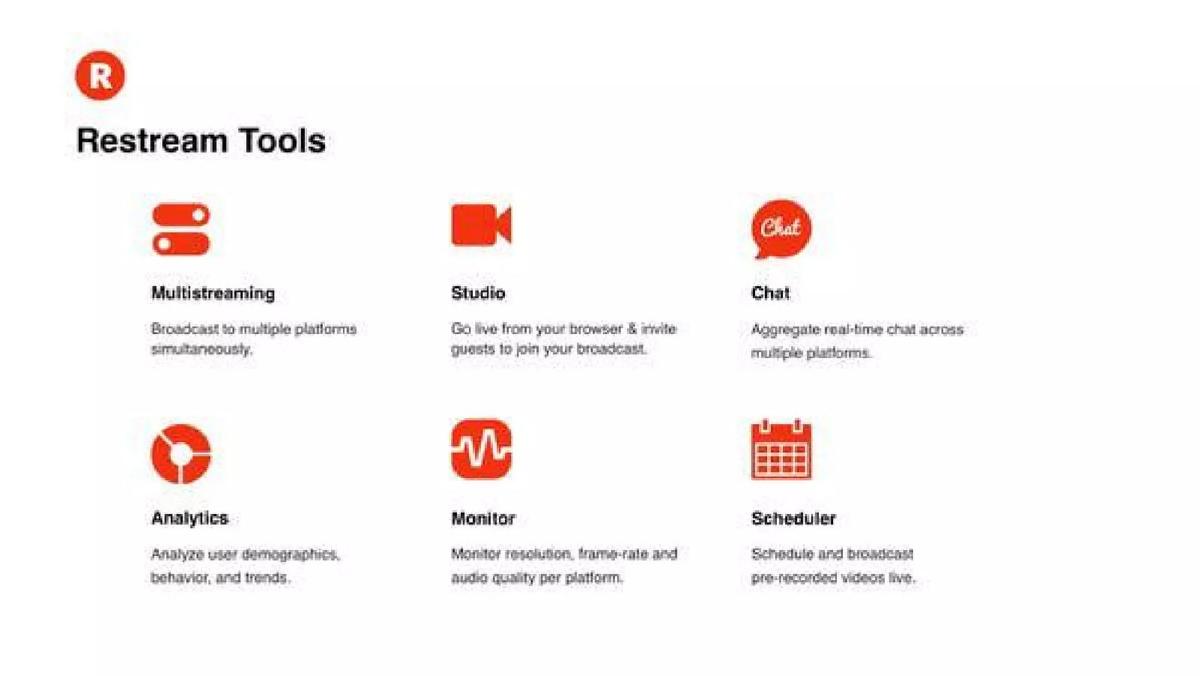
Slide 6 breaks down 'Restream Tools' into six categories: Multistreaming, Studio (browser-based broadcasting), Chat (aggregated real-time chat), Analytics, Monitor (technical quality tracking), and Scheduler (broadcasting pre-recorded video). This shows that Restream has moved beyond a simple 'pass-through' service into a full-featured creator suite.
Slide 7 is the 'Pricing' slide. It is rare to see a full pricing table in a pitch deck, but here it serves to prove that the business model is mature. With tiers ranging from $0 to $299/month and an Enterprise 'On request' option, Restream demonstrates it has a strategy for every segment of the market. The 'Professional' $49/mo tier is highlighted as the recommended option, suggesting a strong mid-market focus.
Slides 8-11: Traction and Global Scale
The 'Traction' section begins on Slide 8 with two charts: 'Total Creator Community' and 'Paid Subscribers.' Both show steep, exponential growth from January 2016 to August 2020. While the Y-axis lacks specific numbers, the shape of the curve is the primary takeaway. Slide 9, 'Restream by the numbers,' provides the missing scale: 8M monthly broadcasts, 600M monthly views, and 7B monthly watched minutes. These are massive numbers that move the company out of 'startup' territory and into 'market leader' territory.
Slide 10 is a 'Social Proof' slide, showcasing logos of over 2 million businesses and organizations. The inclusion of the 'Biden Harris' campaign alongside 'Microsoft,' 'Google,' and 'World Health Organization' shows the platform's versatility across politics, tech, and healthcare. Slide 11 uses a world map to highlight 'International Growth,' specifically calling out mature markets in the US and Russia, and emerging markets in South America and Southeast Asia.
Slides 12-14: The Team and Investors
Slide 12 introduces the founders, Alexander Khuda and Andrew Surzhynskyi. The descriptions emphasize their technical backgrounds and previous entrepreneurial experience. Slide 13 shows '50 other fantastic team members & investors,' featuring a grid of headshots and a logo wall of VC firms including Insight Partners and Silver Lake (implied by logos). The deck concludes on Slide 14 with a simple 'Thank you' on a red background.
What Works in this Deck
Massive Social Proof: The combination of Slide 9 (usage metrics) and Slide 10 (customer logos) is incredibly powerful. When a company can claim 7 billion minutes of content watched per month, the risk for an investor shifts from 'will this work?' to 'how big can this get?'
Global Perspective: Many US-based startups ignore international markets in their early decks. Restream leans into it, showing they are already dominant in Russia and growing in Asia. This suggests a much larger TAM than a US-only competitor.
Clear Product-Led Growth: The pricing slide (Slide 7) and the tool breakdown (Slide 6) show a very clear product-led growth (PLG) motion. Investors love PLG because it implies lower customer acquisition costs (CAC) as users self-serve into higher tiers.
What is Missing
The 'Ask' Slide: This deck does not explicitly state how much money they are raising or what they intend to do with the capital. While this information is often shared in a separate document or during the meeting, its omission in the deck leaves the narrative somewhat open-ended.
Unit Economics: While we see the pricing tiers, we don't see the LTV (Lifetime Value), CAC (Customer Acquisition Cost), or churn rates. For a Series A, these metrics are usually expected to prove the efficiency of the growth shown on Slide 8.
Competitive Landscape: The deck assumes Restream is the 'ultimate ecosystem' but doesn't address competitors like Streamyard (which was later acquired by Hopin) or OBS plugins. A slide addressing why Restream wins against these alternatives would have strengthened the 'moat' argument.
What a Founder Should Copy
The 'Declaration' Format: Instead of a boring 'Executive Summary,' use a 'Declaration' to state your company's core beliefs and market position. It creates a sense of inevitability.
Simple Architecture Diagrams: Slide 4 is a perfect example of how to explain a complex technical product. One input, one hub, many outputs. If you can't explain your product in three circles and four arrows, it's too complicated for a deck.
High-Impact Numbers: If you have big numbers, don't hide them in paragraphs. Use the Slide 9 format: huge font, minimal text, and clear labels. Make the scale the hero of the slide.
Frequently asked questions
- What is the core problem Restream solves according to the deck?
- According to Slide 3, content creators face a fragmented landscape where they don't know where to begin, how to grow or engage an audience, how to analyze demographics, or how to monetize. Restream acts as the central hub to solve these distribution and management headaches.
- How does Restream quantify its market impact?
- Restream uses three primary 'by the numbers' metrics on Slide 9: 8 million monthly broadcasts, 600 million monthly views, and 7 billion monthly watched minutes. This demonstrates that they aren't just a tool, but a high-traffic infrastructure layer.
- What does the pricing strategy look like?
- Slide 7 outlines a sophisticated SaaS ladder. It starts with a Free tier, moving through Standard ($19/mo), Professional ($49/mo), Premium ($99/mo), and Business ($299/mo), ending with an Enterprise tier. This shows a clear path from amateur creators to large-scale corporate users.
- Who are the founders and what is their background?
- Slide 12 introduces Alexander Khuda (CEO) and Andrew Surzhynskyi (CTO). Khuda is described as a serial entrepreneur with a successful exit, while Surzhynskyi is a full-stack developer. Both graduated from the National Technical University of Ukraine.
- Which platforms does Restream support?
- Slide 5 displays a wide array of logos including Facebook Live, YouTube, Twitch, LinkedIn, and Steam. It specifically highlights local platforms in international markets like Dlive, AfreecaTV, and Bilibili, emphasizing their global compatibility.