Pinecone’s 2022 Series A deck is a highly technical yet accessible narrative that successfully argues for the necessity of a new infrastructure category: the vector database. Raising $28M, the company leans heavily on the pedigree of its founding team—led by Edo Liberty, former Head of Amazon AI Labs—to establish immediate credibility. The deck moves from a historical critique of keyword search to a future-facing vision where 80% of data is complex and requires ML-driven indexing. While it lacks traditional financial tables or detailed revenue projections, it compensates with a clear Product-…
Key takeaways
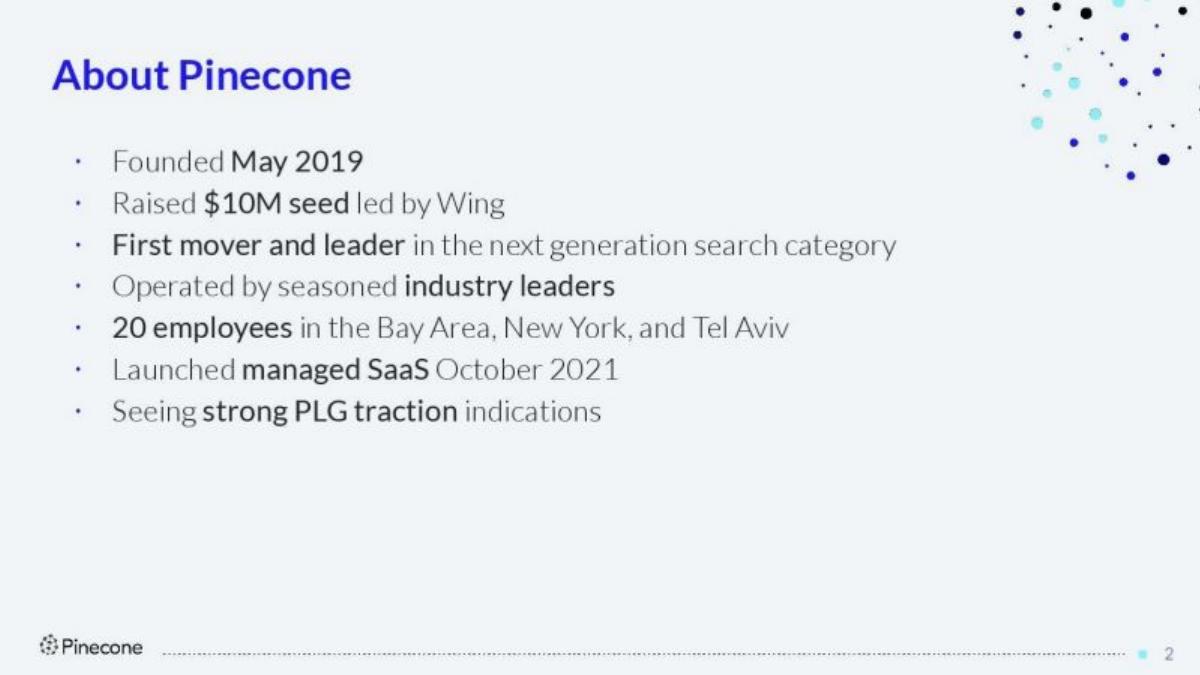
- The company positions itself as a 'first mover and leader' in the next-generation search category (Slide 2).
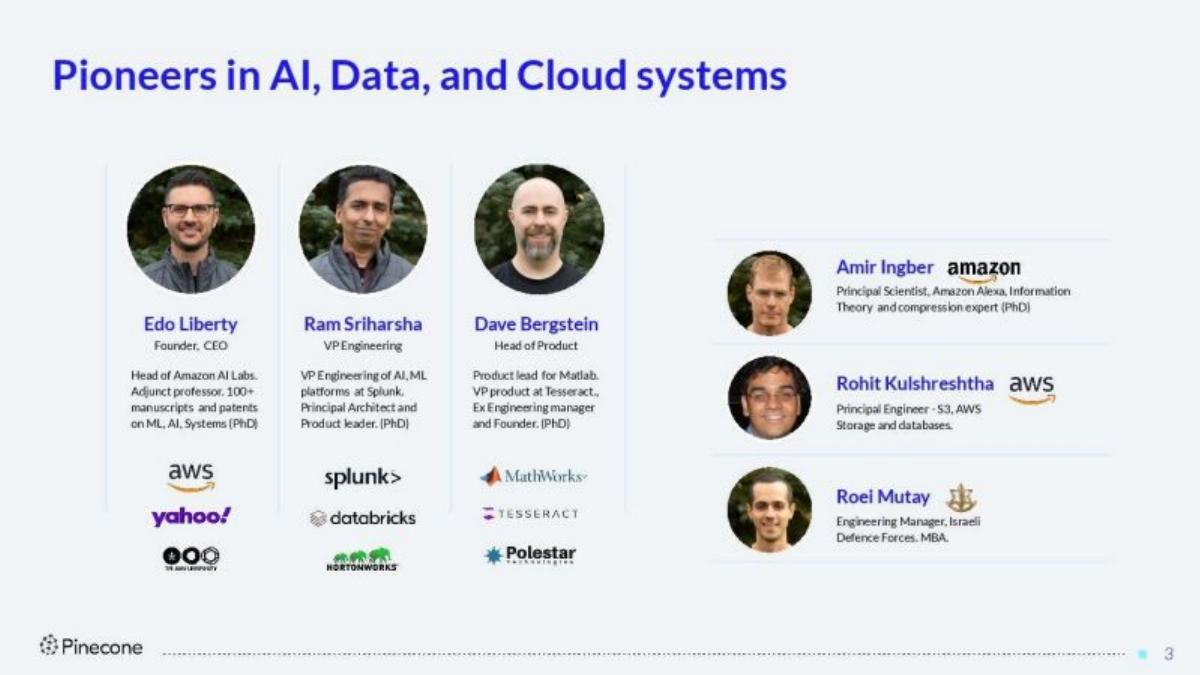
- Founding team pedigree is a central pillar, featuring leaders from Amazon AI Labs, Splunk, and AWS (Slide 3).
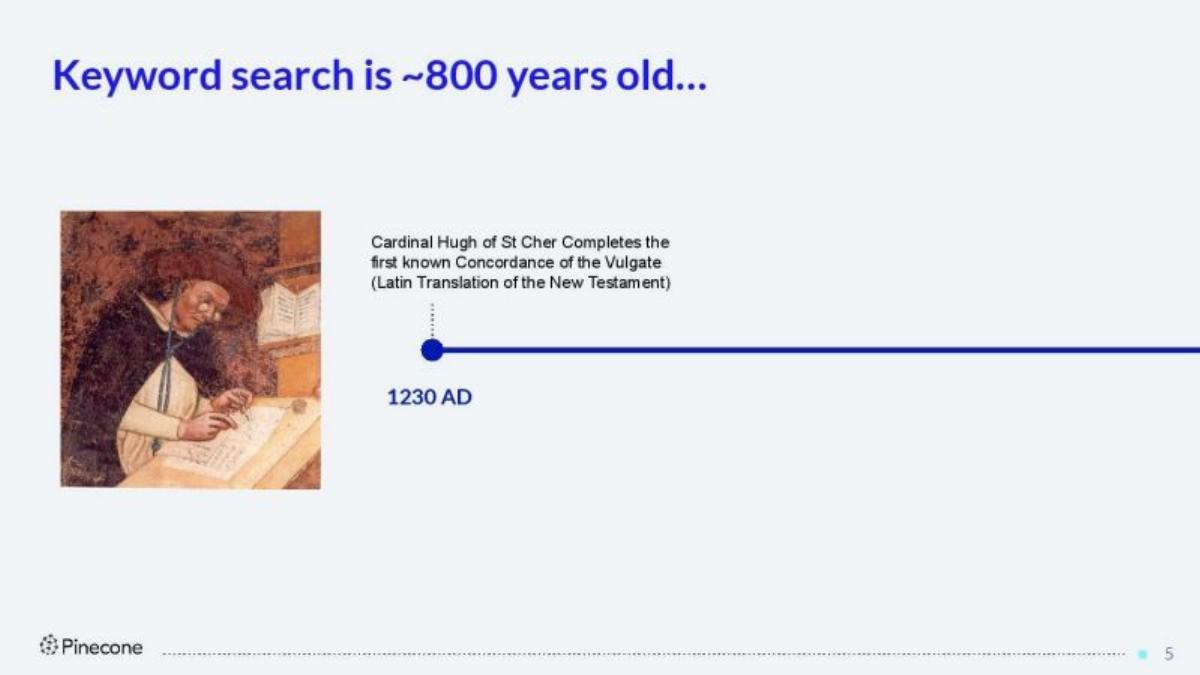
- The problem is framed through a historical lens, noting that keyword search concepts date back to 1230 AD (Slide 5).
- The market opportunity is driven by the shift toward 'complex data,' which is projected to make up 80% of world data by 2025 (Slide 7).
- Pinecone defines its product as the essential bridge between ML models (like BERT) and applications (Slide 10).
- The business model is built on a usage-based pricing structure driven by a PLG motion (Slide 14).
- A single case study with Expel demonstrates a $100k/year saving and a reduction of 0.5 SRE headcount (Slide 16).
- The 'Ask' is framed as 'Top investments in Q1-Q2 2022,' focusing on team building and community creation (Slide 17).
Pinecone Series A Teardown: The Infrastructure Play for the AI Revolution
Pinecone’s Series A deck is a textbook example of how to pitch a deep-tech infrastructure product. In 2022, before the generative AI explosion became mainstream, Pinecone was already laying the groundwork for the 'Vector Database' as a standalone category. This teardown examines how they used team pedigree and a clear architectural vision to secure $28M.
Slides 1-4: The Credibility Foundation
Slide 1: Title The deck opens with the tagline 'Search Like You Mean It.' It is simple and focuses on the end-user benefit rather than the underlying math. The visual of a 3D vector space immediately signals that this is not traditional, flat-file search.
Slide 2: About Pinecone This is a 'traction at a glance' slide. It notes the company was founded in May 2019 and had already raised a $10M seed round. Crucially, it mentions 20 employees across the Bay Area, New York, and Tel Aviv, and the launch of their managed SaaS in October 2021. The phrase 'strong PLG traction indications' is a soft way of saying they have users but perhaps aren't ready to share hard revenue numbers yet.
Slide 3: Pioneers in AI, Data, and Cloud systems This is arguably the most important slide in a Series A deck for a technical product. The logos—Amazon, AWS, Splunk, Databricks, Yahoo, and MathWorks—do the heavy lifting. CEO Edo Liberty’s background as Head of Amazon AI Labs provides the 'founder-market fit' required for a venture-scale infrastructure play. The inclusion of PhDs and specific technical roles (e.g., 'Information Theory and compression expert') signals that the 'moat' is the team's specialized knowledge.
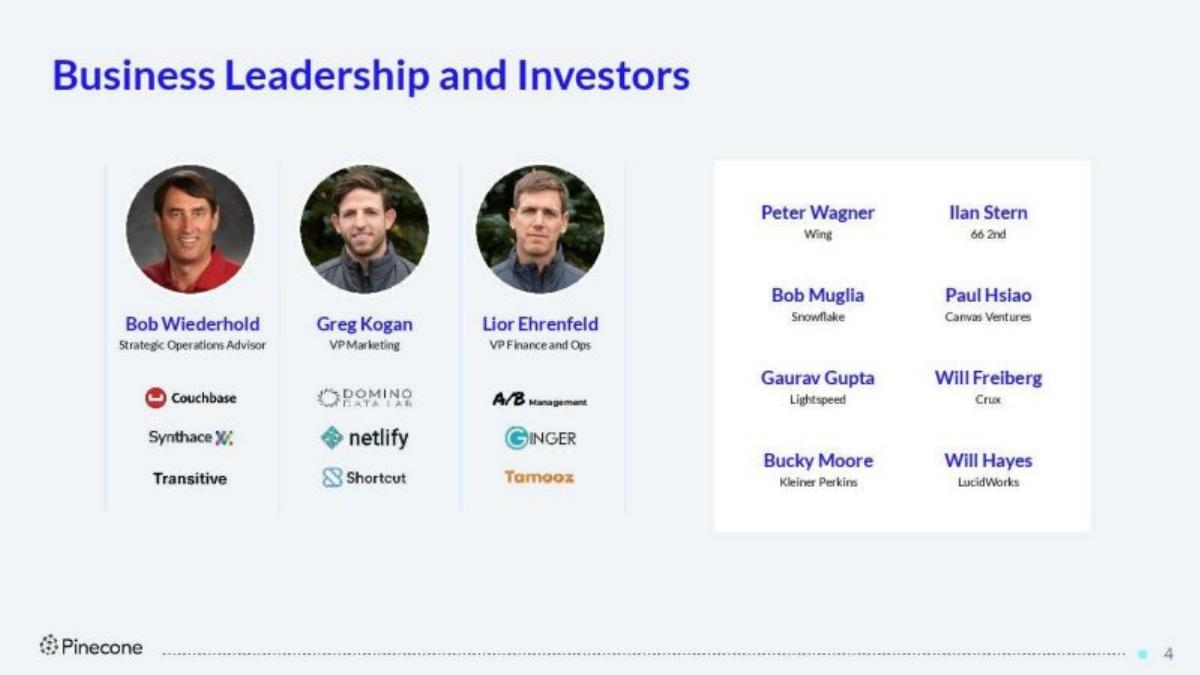
Slide 4: Business Leadership and Investors Pinecone rounds out the team section by showing they have 'adults in the room' for operations and marketing, alongside a list of high-profile individual investors and VCs like Wing, Lightspeed, and Kleiner Perkins. Mentioning Bob Muglia (former CEO of Snowflake) as an investor is a strategic signal that Pinecone aims to be the 'Snowflake for vectors.'
Slides 5-7: The Problem—Keyword Search is Ancient
Slide 5: Keyword search is ~800 years old... Pinecone uses a clever historical hook. By citing Cardinal Hugh of St Cher in 1230 AD, they frame current search technology (keywords) as an archaic relic. This creates a psychological gap between 'what is' and 'what should be.'
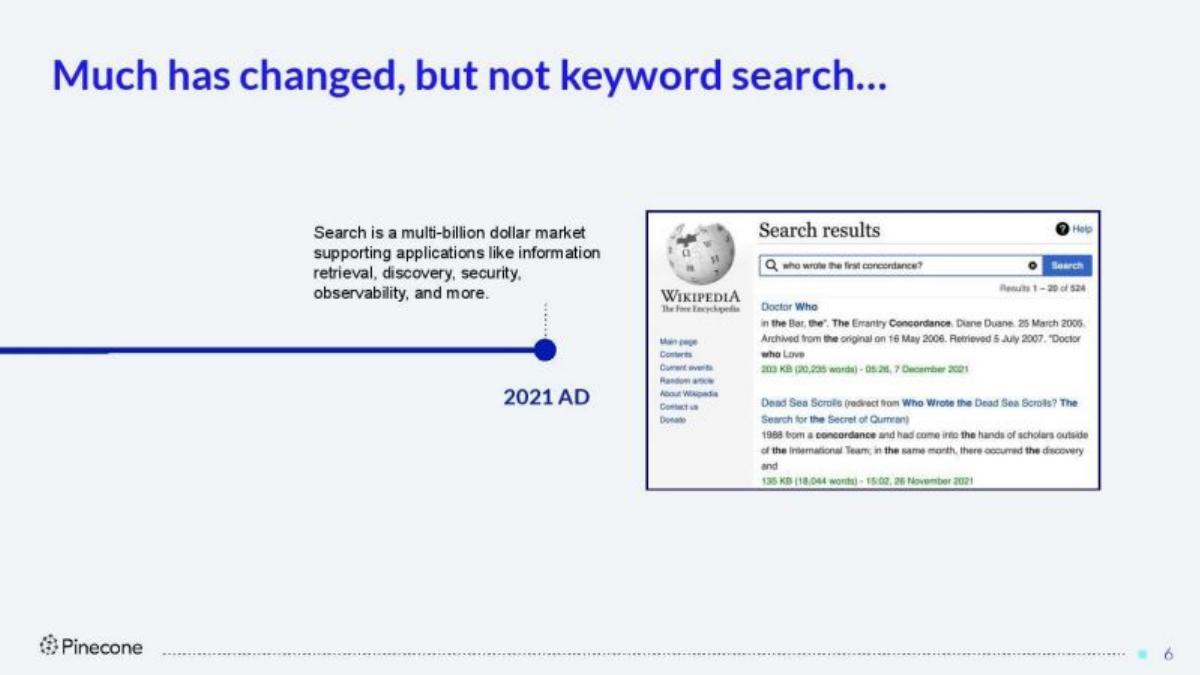
Slide 6: Much has changed, but not keyword search... The timeline jumps to 2021, showing a Wikipedia search. The point is clear: while the internet has scaled, the way we find information hasn't fundamentally evolved. It still relies on matching strings of text.
Slide 7: 80% of the world’s data will be complex by 2025 This is the 'Why Now?' slide. The shift from structured data (tables) to complex data (images, video, audio, logs, sensor data) creates a technical bottleneck. Traditional databases cannot 'search' a video file or a protein sequence using keywords. This slide justifies the need for a new type of index.
Slides 8-11: The Solution—The Rise of Vector Search
Slide 8: A new generation of search technology has emerged This slide introduces the technical workflow: Complex Data → ML Transformation → Vector Data → Application. It positions Pinecone not as a replacement for the whole stack, but as the critical 'Vector Data' layer that makes the rest of the stack work.
Slide 9: It’s already driving the leading search applications To prove this isn't science fiction, Pinecone points to Google, Amazon, and Facebook. By quoting their engineering leads, Pinecone validates that 'Vector search is key' and 'drives almost all feed ranking.' This is a classic 'sell the pickaxe to the miners' strategy—the giants have built this internally; Pinecone will provide it to everyone else.
Slide 10: In fact, this will be the new standard! This slide uses a 'Star history' graph of GitHub repositories (Druid, Faiss, BERT) to show the explosion of developer interest in the components of vector search. It visualizes the 'Vector Index' (e.g., Faiss) as the foundation of the stack.
Slide 11: New data infrastructure is needed — a vector database. This is the 'Category Creation' moment. Pinecone moves from talking about 'vector search' (a feature) to a 'vector database' (a category). They place their logo inside the hexagon, claiming ownership of this new infrastructure requirement.
Slides 12-16: The Product and Business Model
Slide 12: Pinecone’s SaaS Vector Database Finally, we see the product. The key value props are: 10x hardware cost reduction, horizontal scaling to billions of vectors, and a '100% Hands off' managed service. This addresses the pain points of developers who don't want to manage complex distributed systems themselves.
Slide 13: Target Market Pinecone estimates the 'Search infrastructure' market at $9B with 30%+ growth. However, the slide visually suggests they can eat into adjacent markets like ML & Analytics ($24B) and Security ($17B). This is an ambitious TAM (Total Addressable Market) slide that avoids the 'top-down' percentage trap by listing specific, massive sub-sectors.
Slide 14: Product Led Growth - GTM Strategy The Go-To-Market (GTM) slide is clean. It shows a funnel starting with a 'Free Tier' that leads to 'Inside Sales' (Standard) and eventually 'Enterprise Sales' (Dedicated). The mention of 'Usage based pricing' is critical—it aligns Pinecone’s revenue growth with the customer’s data growth.
Slide 15: PLG - User Funnel This slide breaks down the developer journey: Opt-in → Signup → Activated User → Weekly Active User → Daily Active User. It shows that Pinecone is thinking like a modern SaaS company, focusing on 'Activation' and 'Build/Deploy' cycles rather than just lead generation.
Slide 16: Customer success story The Expel case study is the 'proof in the pudding.' It highlights a 4-week conversion cycle and quantifiable savings: ~$100k/year and 1/2 SRE (Site Reliability Engineer) headcount. For a Series A investor, this proves that the product has a clear ROI and a repeatable sales motion.
Slides 17-19: The Ask and Conclusion
Slide 17: Top investments in Q1-Q2 2022 Instead of a dollar amount (which is often omitted in shared decks for regulatory or strategic reasons), Pinecone lists their priorities: building Customer Success and Sales teams, creating a community, and improving the core offering's scale and cost. This tells investors exactly how the capital will be deployed.
Slide 18-19: Closing The deck ends with the logo and the 3D vector graphic. It is professional, consistent, and avoids the clutter of a 'Q&A' or 'Thank You' slide.
What Pinecone’s Deck Does Well
Category Creation: They don't just say they are a 'better database.' They argue that a 'Vector Database' is a new, necessary category for the AI era. · Team Pedigree: They lead with their strengths. In infrastructure, the 'who' is often as important as the 'what.' · Logical Flow: The deck moves perfectly from History (Problem) → Trend (Why Now) → Tech (How) → Product (Solution) → Business (GTM). · Quantified ROI: The Expel slide is a masterclass in showing value. Saving half an engineer's salary is a very tangible benefit for a CTO.
What is Missing from the Pinecone Deck
Financials: There are no charts showing MRR (Monthly Recurring Revenue) growth, churn rates, or CAC (Customer Acquisition Cost). While 'strong PLG traction' is mentioned, the lack of a 'hockey stick' revenue graph suggests they were raising on the strength of the product and team rather than massive existing revenue. · Competitive Landscape: The deck mentions Google and Facebook as examples of the tech in use, but it doesn't mention other startups or open-source alternatives (like Milvus or Weaviate). Investors would certainly ask how Pinecone wins against open-source. · Unit Economics: There is no mention of gross margins. For a managed SaaS that handles 'billions of vectors,' the cost of goods sold (COGS) is a significant factor.
What Founders Should Copy
The 'Why Now' Slide: Slide 7 is perfect. It uses a single, bold statistic ('80% of data will be complex') to create urgency. · The Historical Context: Using the 1230 AD reference (Slide 5) is a great way to make a boring technical topic memorable. · The Stack Diagram: Slide 10 shows exactly where the company fits in the user's existing workflow. This reduces the 'perceived risk' of adoption. · The Usage-Based GTM: If you are building infrastructure, copy the Slide 14 layout. It clearly explains how you get from a free user to an enterprise contract.
Frequently asked questions
- How much did Pinecone raise with this deck?
- According to the catalogue facts, Pinecone raised $28M in a Series A round in 2022. The deck itself references a prior $10M seed round led by Wing on Slide 2, but the $28M figure is the outcome of the fundraising effort associated with this presentation.
- What is Pinecone's core value proposition?
- Pinecone provides a managed SaaS vector database. As shown on Slide 12, this includes high-performance vector search, horizontal scaling to billions of vectors, and a 10x hardware cost reduction compared to traditional methods. It is designed to handle the 'complex data' that keyword search cannot index effectively.
- Who are the key people behind Pinecone?
- The team is exceptionally high-pedigree. CEO Edo Liberty was the Head of Amazon AI Labs. VP Engineering Ram Sriharsha came from Splunk and Databricks, and Head of Product Dave Bergstein was a product lead for Matlab. Other team members have backgrounds at AWS, Yahoo, and the Israeli Defence Forces (Slide 3).
- What is Pinecone's go-to-market strategy?
- Pinecone utilizes a Product-Led Growth (PLG) strategy. As detailed on Slide 14, this involves a 'Free Tier' to attract developers, followed by an 'Inside Sales' motion for a 'Standard' tier, and 'Enterprise Sales' for a 'Dedicated' tier. All paid tiers operate on usage-based pricing.
- How does Pinecone define its target market?
- Slide 13 identifies 'Search Infrastructure' as a $9B market with 30%+ YoY growth. However, it positions itself as the underlying layer for multiple massive sectors, including ML & Analytics ($24B), Security ($17B), and Observability ($17B), suggesting its total addressable market is a composite of these segments.