Pikkpack presents a compelling case for a niche consumer product: high-quality leather shoes delivered in a flat-packed, DIY format. The deck, dated September 2014, relies heavily on the success of its Kickstarter campaign, which raised $20,108 from 198 backers against a $17,000 goal. The narrative is built around design innovation and logistics efficiency, specifically how flat-packaging reduces storage and transportation costs. However, the deck is notably thin on business fundamentals. It lacks a market size analysis (TAM/SAM/SOM), detailed unit economics, a clear revenue model beyond dire…
Key takeaways
- The company successfully validated its concept via Kickstarter in May 2014, raising $20,108 (Slide 4).
- The core value proposition centers on flat-packaging to save on materials, transportation, and storage costs (Slide 2).
- Pikkpack positions itself against established brands like TOMS and Patagonia by emphasizing DIY and conscious design (Slide 6).
- The startup has achieved significant press coverage from major design and business publications including Fast Company and Designboom (Slide 10).
- The deck identifies a four-person founding team covering design, marketing, business development, and operations (Slide 8).
- There is a total absence of financial projections, burn rate, or specific funding requirements in the provided slides.
- The product is marketed as an 'experience' where the customer becomes part of the manufacturing process (Slide 2).
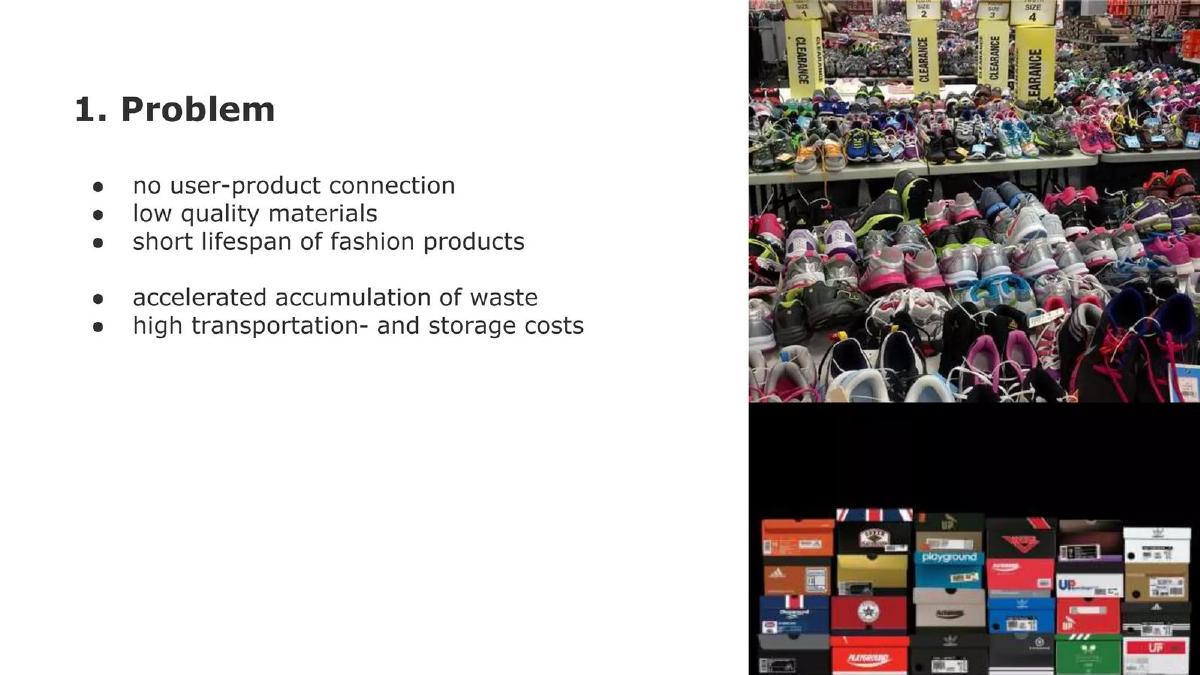
- The deck lacks a formal 'Problem' slide, jumping straight from the title to the 'Solution' (Slide 2).
Pikkpack Pitch Deck Analysis
Pikkpack’s pitch deck, dated September 4, 2014, is a product-centric presentation that focuses on the novelty of flat-packed leather footwear. The deck is visually driven, reflecting the company's design-heavy origins in Budapest, Hungary. While it succeeds in explaining the 'what' and 'how' of the product, it leaves significant gaps regarding the 'how much' and 'what next' of the business.
Slide 1: Title Slide
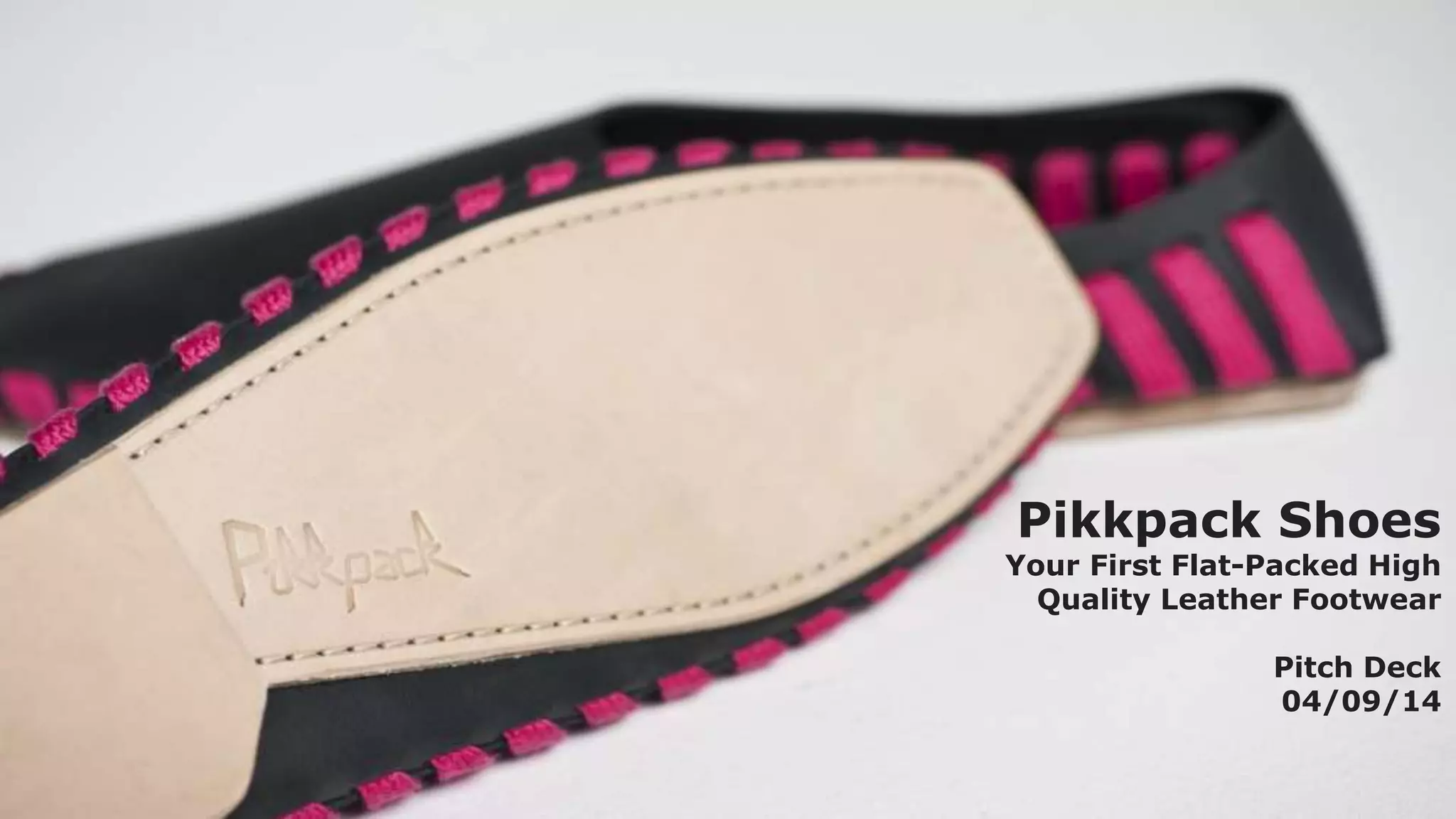
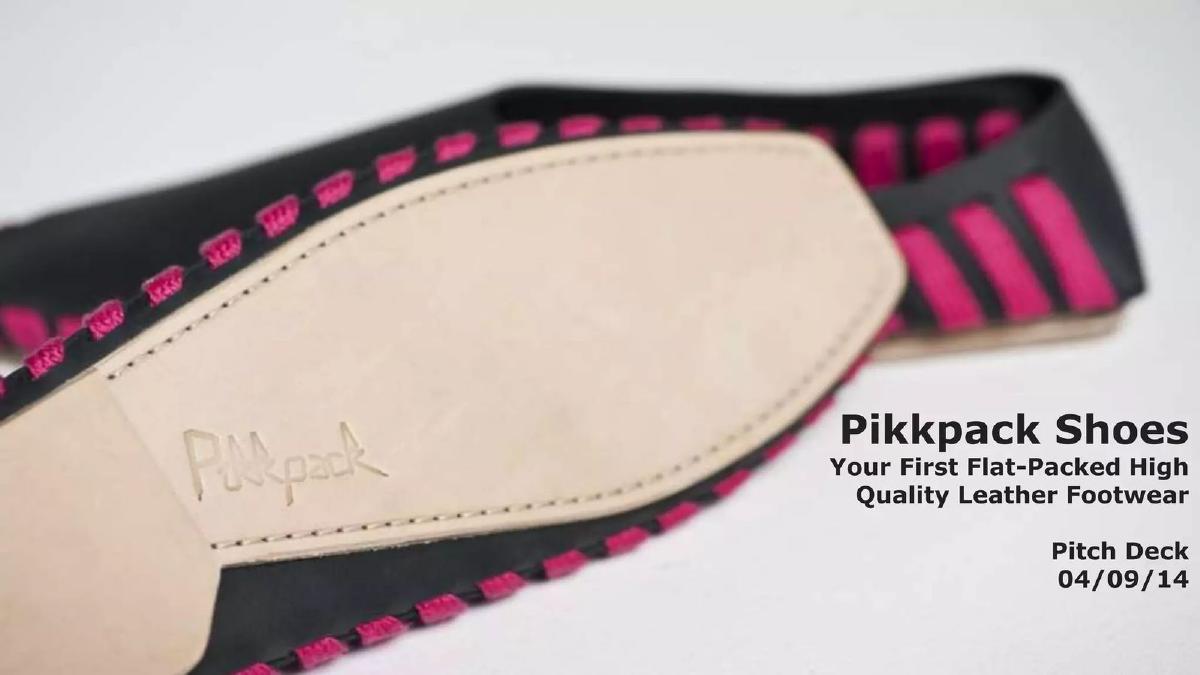
The title slide establishes the brand identity immediately. It features a high-resolution close-up of the product, highlighting the leather texture and the distinctive pink stitching. The tagline, "Your First Flat-Packed High Quality Leather Footwear," clearly defines the category. The date (04/09/14) indicates this deck was produced shortly after their initial crowdfunding success.
Slide 2: The Solution
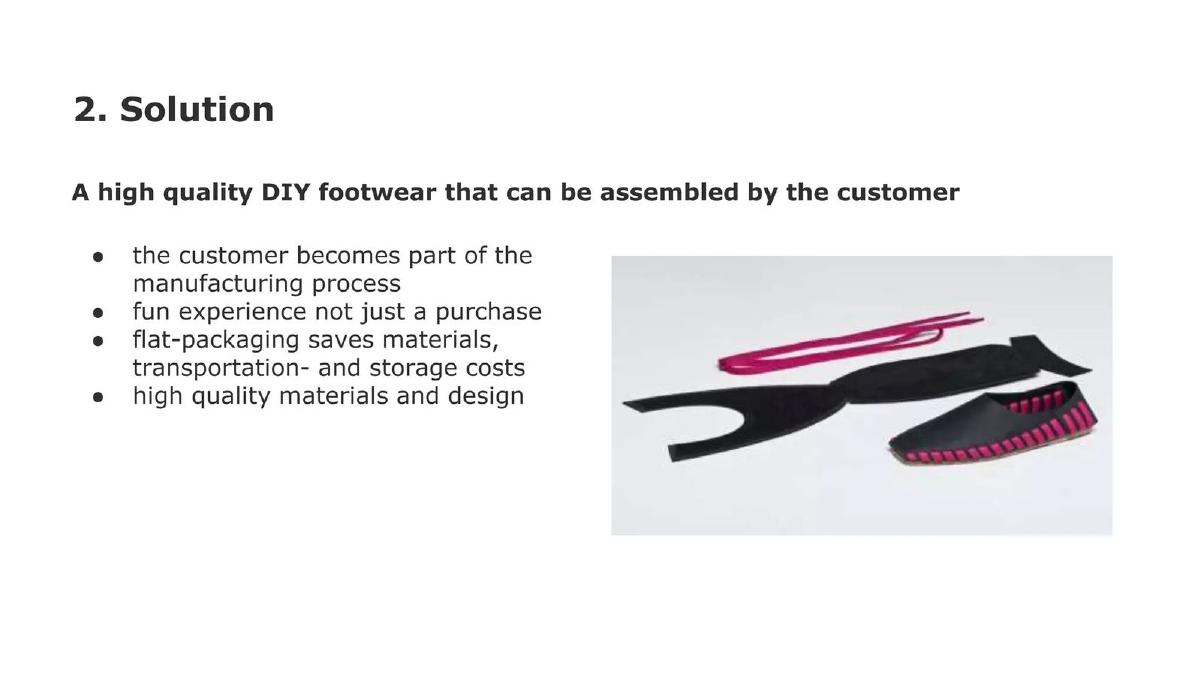
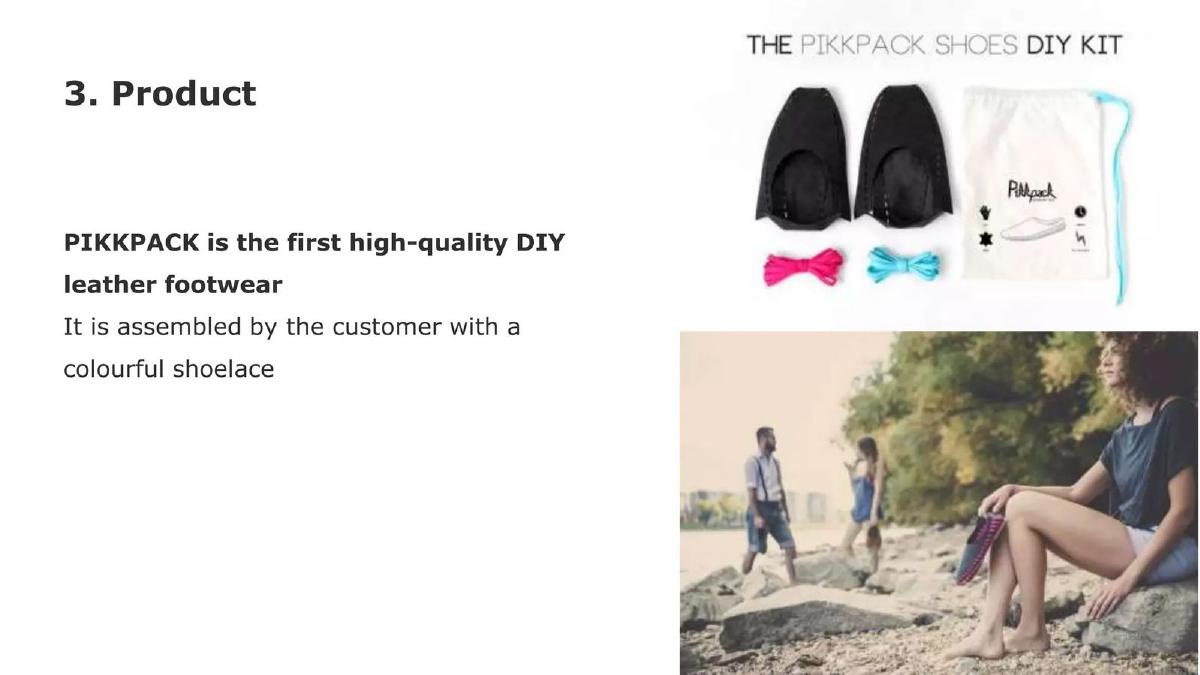
Interestingly, the deck skips a dedicated 'Problem' slide and moves directly to Slide 2: Solution. It defines the product as "high quality DIY footwear that can be assembled by the customer." The slide lists four key benefits: customer involvement in manufacturing, a fun experience, cost savings via flat-packaging, and high-quality design. The visual shows the shoe in its unassembled state alongside the finished product, effectively communicating the DIY aspect.
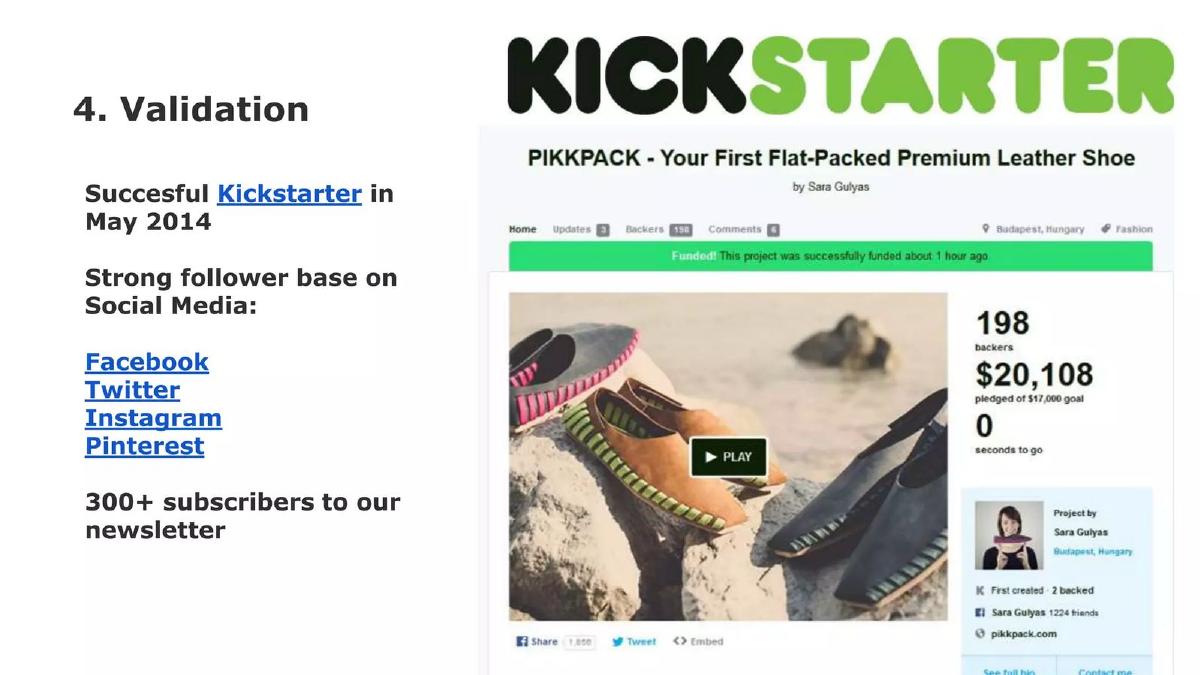
Slide 4: Validation
Slide 4 is the strongest evidence of product-market fit. It showcases the successful Kickstarter campaign from May 2014. The slide includes a screenshot of the Kickstarter page showing 198 backers and $20,108 pledged, exceeding the $17,000 goal. It also mentions a "strong follower base" on social media and "300+ subscribers" to their newsletter. For a seed-stage consumer brand, this level of early traction is essential to prove that people will actually pay for a DIY shoe.
Slide 6: Competition & Competitive Advantages
This slide uses a hub-and-spoke visual to compare Pikkpack to other brands. It categorizes competitors by their primary draw: DIY (Patagonia), Customizable (Urshuz), Design (Tieks), and Conscious Statement (TOMS). By placing Pikkpack in the center, the founders suggest their product captures all these elements simultaneously. However, the slide lacks a traditional feature-comparison matrix, which would more clearly define their technical or price advantages over these incumbents.
Slide 8: Team
Slide 8 introduces the four co-founders. The team appears well-balanced on paper, with dedicated leads for Design (Sara Gulyas), Marketing (Hanna Halasz), Business Development (Andras Balogh), and Operations (Callie Wheeler). The use of professional headshots lends credibility, but the slide would be improved by including one-sentence bios for each member to highlight relevant past successes or education.
Slide 10: Publicity
The 'Publicity' slide is a standard "logo soup" featuring recognizable names like Fast Company, Designboom, and PSFK. The inclusion of a specific quote from Fast Company—"Instead of buying yet another pair of Toms this summer, perhaps you order an envelope with a leather shoe upper..."—is a powerful endorsement. It reinforces the competitive positioning mentioned earlier in the deck and proves the brand has "earned media" potential.
Slide 13: Contact Information
The final slide provides direct contact emails for Sara and Hanna, along with the company website and social media handles. The background image shows a person (presumably a founder or customer) in a workshop setting, which reinforces the artisanal, DIY brand image. It is a standard, functional closing slide.
What Works in This Deck
Visual Communication: The deck does an excellent job of showing, not just telling. The photography clearly explains the flat-pack concept, which could otherwise be difficult to visualize. The branding is consistent, using a clean aesthetic that matches the product's design language.
Social Proof: By leading with Kickstarter results and following up with major press logos, the founders demonstrate that there is an existing audience and media interest. This reduces the perceived risk for an investor regarding brand-building and initial customer acquisition.
Logistical Logic: The mention of saving on "transportation- and storage costs" (Slide 2) is a vital business point. In the footwear industry, shipping air (in shoeboxes) is a major expense. Highlighting the efficiency of flat-packaging speaks to the potential for better margins compared to traditional footwear brands.
What is Missing
The Financial Ask: The most significant omission is the lack of a funding request. There is no information on how much money the company is looking for, the valuation they are seeking, or what the milestones for the next 18 months look like. Without this, the deck feels more like a brand lookbook than a fundraising tool.
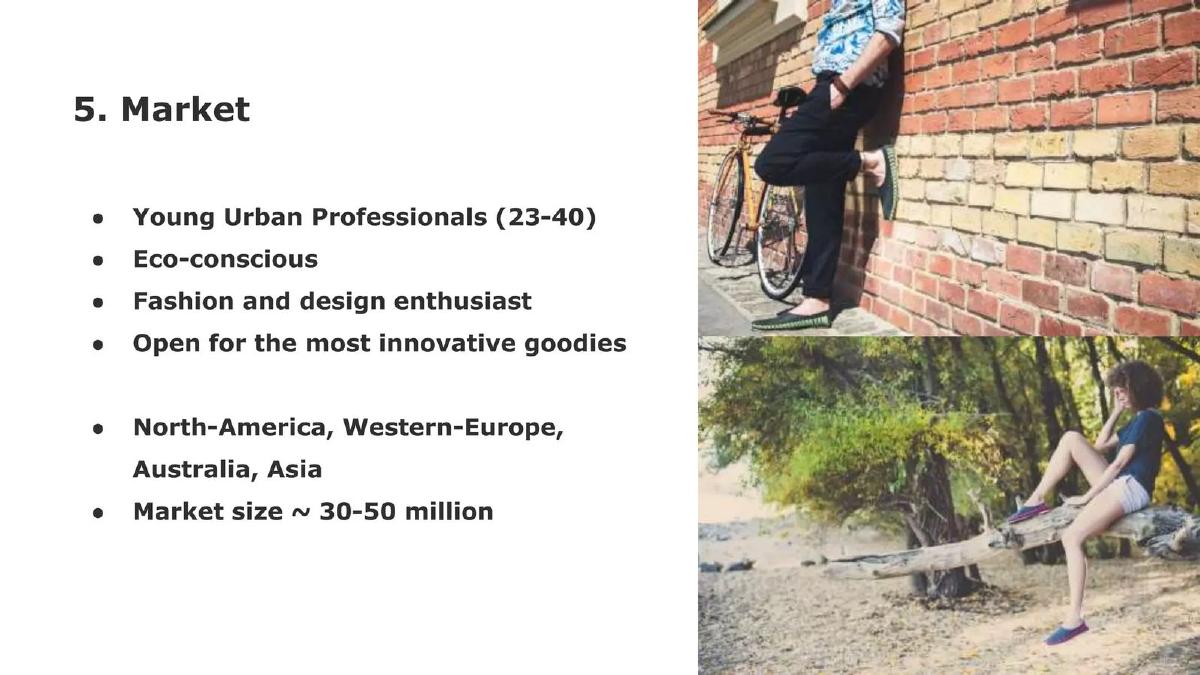
Market Size: There is no mention of the Total Addressable Market (TAM). Investors need to know if this is a $10 million niche business or a $1 billion global opportunity. The deck fails to quantify the size of the DIY or sustainable fashion markets.
Unit Economics: While the deck mentions cost savings from flat-packing, it does not provide the actual numbers. What is the Cost of Goods Sold (COGS)? What is the retail price? What is the Customer Acquisition Cost (CAC)? Without these metrics, it is impossible to evaluate the scalability of the business model.
The 'Problem' Slide: While the solution is clear, the deck doesn't explicitly state the problem it is solving. Is it the environmental impact of traditional shoe manufacturing? The high cost of premium leather goods? The lack of personalization in mass-market fashion? Defining the pain point would make the solution more compelling.
Founder's Playbook: What to Copy
Use Crowdfunding as Traction: If you have a physical product, a successful Kickstarter or Indiegogo campaign is the best way to prove demand. Pikkpack correctly uses these figures as the centerpiece of their validation slide (Slide 4). · Leverage Press Quotes: Don't just show logos; show what the press said. The Fast Company quote on Slide 10 is more effective than the logo alone because it frames the product within a competitive context. · Highlight Operational Efficiencies: If your product design leads to lower shipping or storage costs, make that a prominent part of your value proposition. Pikkpack correctly identifies this as a key advantage of their flat-pack model (Slide 2). · Keep it Visual: For consumer products, high-quality imagery is non-negotiable. Pikkpack uses large, clear photos that let the product speak for itself, which is essential for a design-led startup.
Frequently asked questions
- What is the primary business model for Pikkpack?
- Based on the deck, Pikkpack operates a direct-to-consumer (DTC) model selling DIY footwear kits. The product is flat-packed, which the company claims reduces overhead in shipping and storage. While the deck doesn't explicitly detail wholesale or retail strategies, the emphasis on their website and social media following suggests a digital-first approach to sales.
- How did Pikkpack validate its market demand?
- Market validation was achieved through a Kickstarter campaign in May 2014. According to slide 4, the project was successfully funded with $20,108 pledged by 198 backers, surpassing its $17,000 goal. They also cite a newsletter subscriber base of over 300 people and a presence across four major social media platforms.
- Who are Pikkpack's main competitors?
- Slide 6 identifies several competitors across different categories. These include established brands like TOMS (conscious statement) and Patagonia (DIY/outdoor), as well as niche footwear companies like Urshuz (customizable), Tieks (design), and Mahabis. Pikkpack attempts to position itself at the intersection of DIY, design, and conscious consumerism.
- What is missing from the Pikkpack pitch deck?
- The deck is missing critical investment data. There are no slides covering total addressable market (TAM), unit economics (CAC/LTV), revenue projections, or a specific 'Ask' detailing how much capital is being raised and how it will be deployed. It also lacks a clear roadmap for future product lines or scaling operations.
- What is the background of the founding team?
- Slide 8 introduces four co-founders: Sara Gulyas (Designer), Hanna Halasz (Marketing Specialist), Andras Balogh (Business Development), and Callie Wheeler (Operations Manager). While their titles are clear, the deck does not provide their professional histories, previous exits, or specific industry experience, which is a common omission in early-stage creative decks.