Pickle's pitch deck, dating from May 2015, presents a mobile application designed for 'competitive selfies.' The core loop involves users challenging friends to specific photo prompts, such as 'most crossed eyes,' with the community voting on winners. The deck leans heavily on early prototype traction, reporting 26,000 downloads and 5.2 million votes cast in the first month. The founders seek $600,000 to launch 'Pickle 2.0,' aiming for 100,000 monthly users and $200,000 in monthly revenue by the end of 2015. While the deck excels at demonstrating engagement and viral potential, it relies on i…
Key takeaways
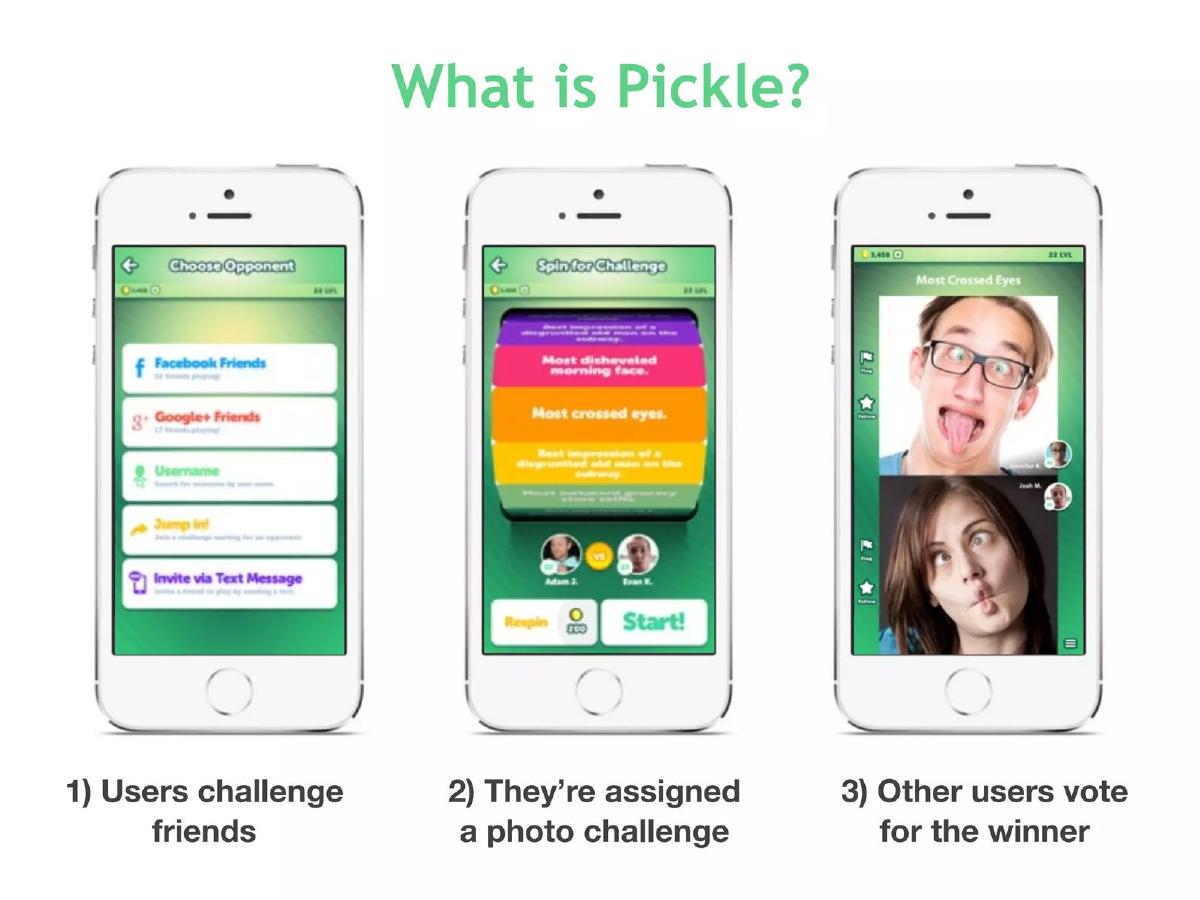
- The app's core mechanic is a three-step process: challenge friends, complete a photo prompt, and community voting (Slide 2).
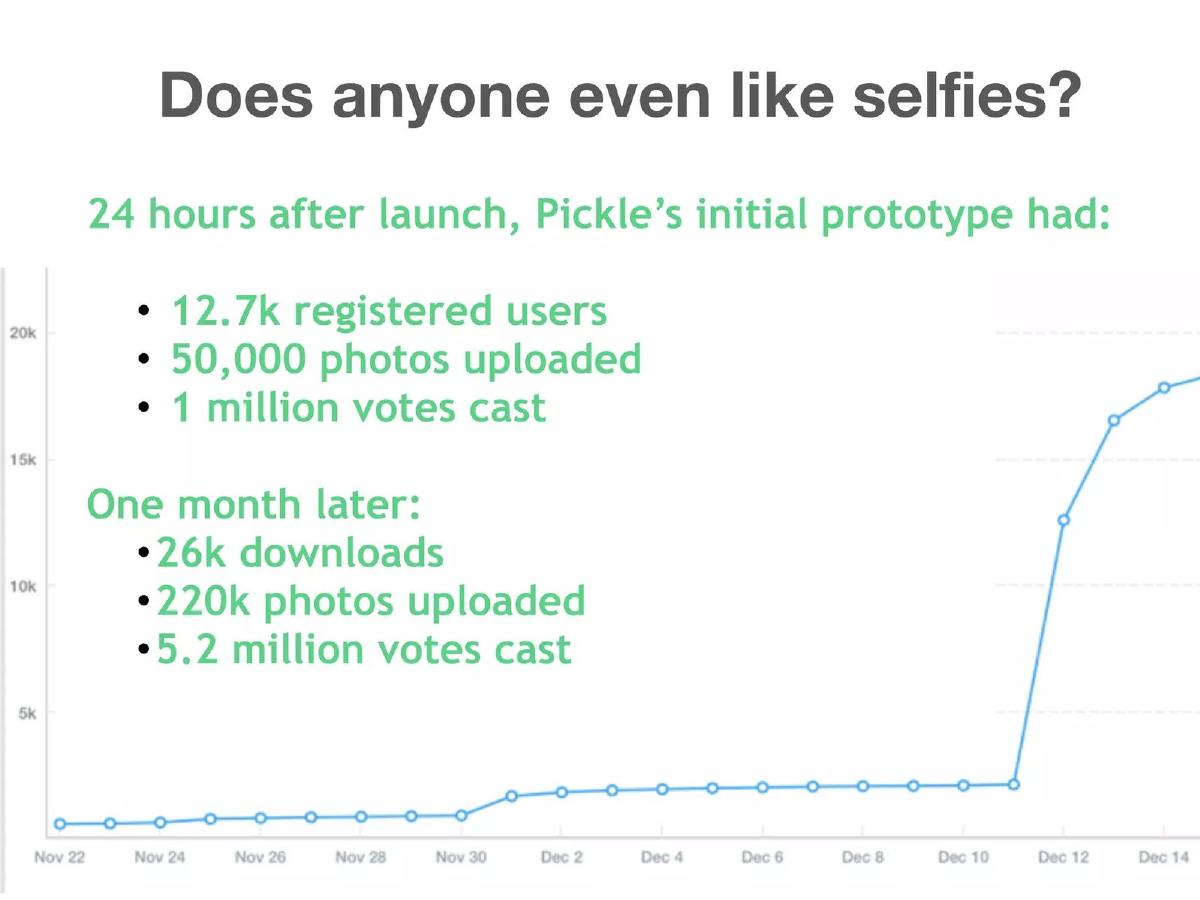
- Early traction was significant, with 5.2 million votes cast and 220,000 photos uploaded within the first month (Slide 3).
- The company had already raised $135,000 in funding prior to this $600,000 round (Slide 4).
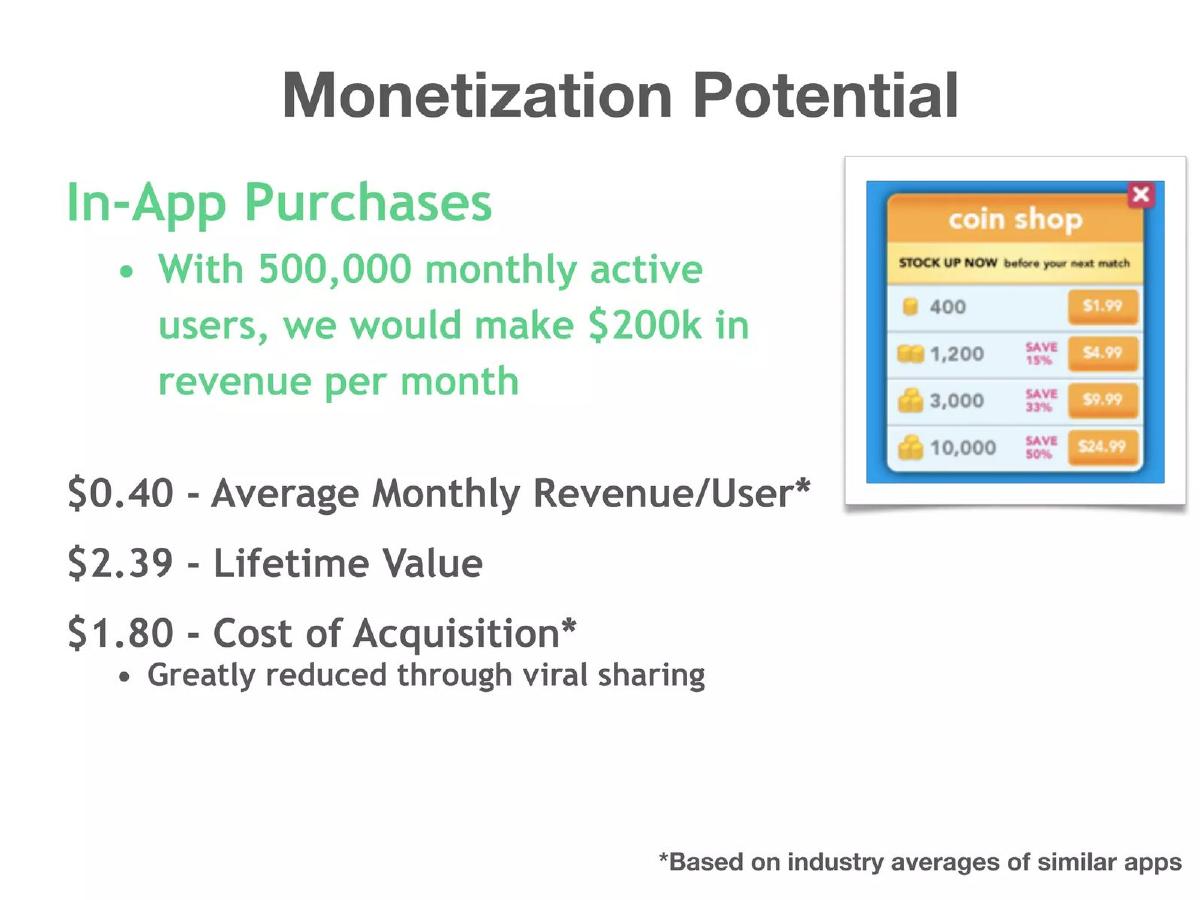
- Monetization projections are based on industry averages, estimating $0.40 average monthly revenue per user (Slide 5).
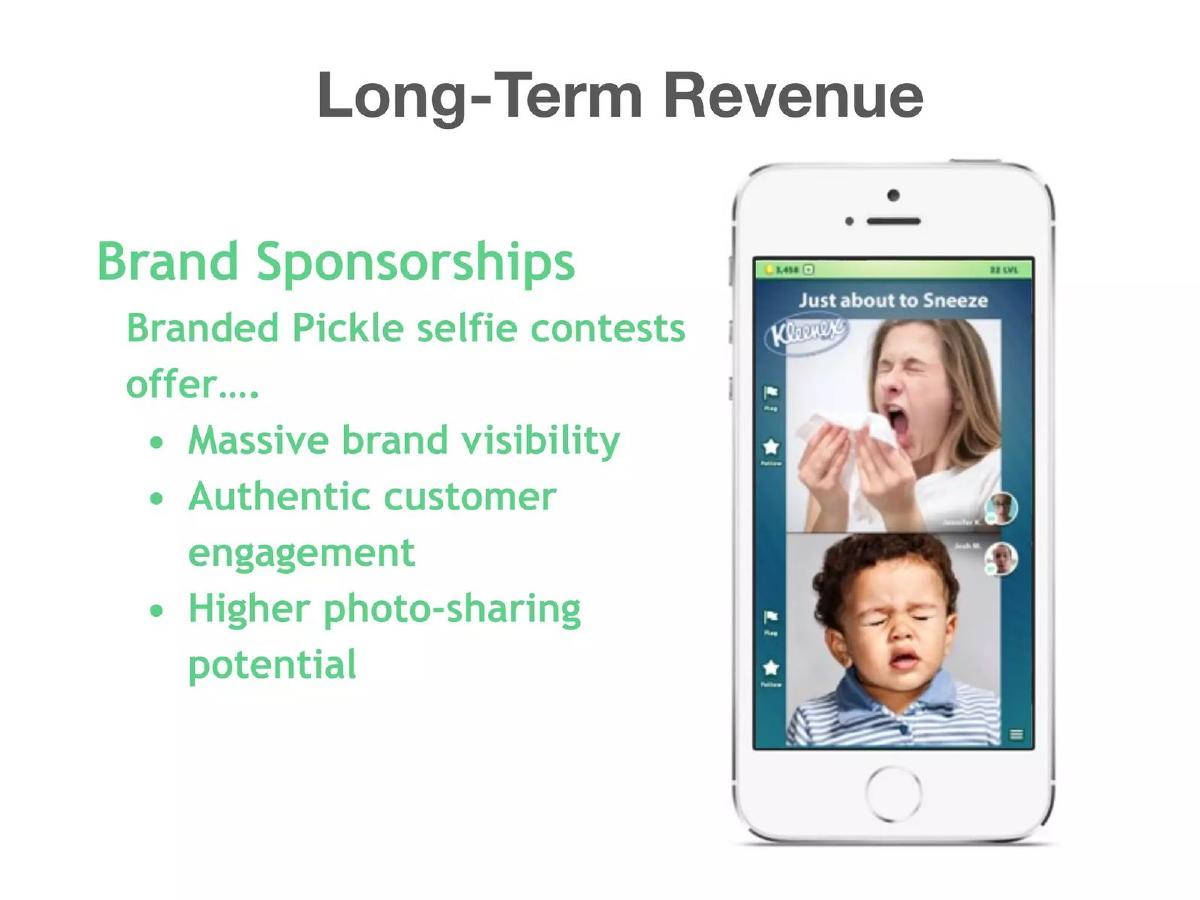
- The team plans to use brand sponsorships, such as branded selfie contests, as a long-term revenue stream (Slide 6).
- The founding team includes a CEO with two previous CEO positions and a CTO with four years of development experience (Slide 7).
- Advisors include the founder of Thumb and an early Facebook engineer (Slide 8).
- The $600,000 ask is tied to a specific timeline aiming for 100,000 monthly users by August 2015 (Slide 9).
Pickle Pitch Deck Analysis
The Pickle pitch deck from May 2015 is a classic example of a 'traction-first' social app deck. At a time when selfie culture was peaking, Pickle sought to gamify the experience. The deck is concise, totaling 10 slides, and focuses heavily on user engagement metrics from a prototype phase to justify a $600,000 seed round.
Slide 1: Title Slide
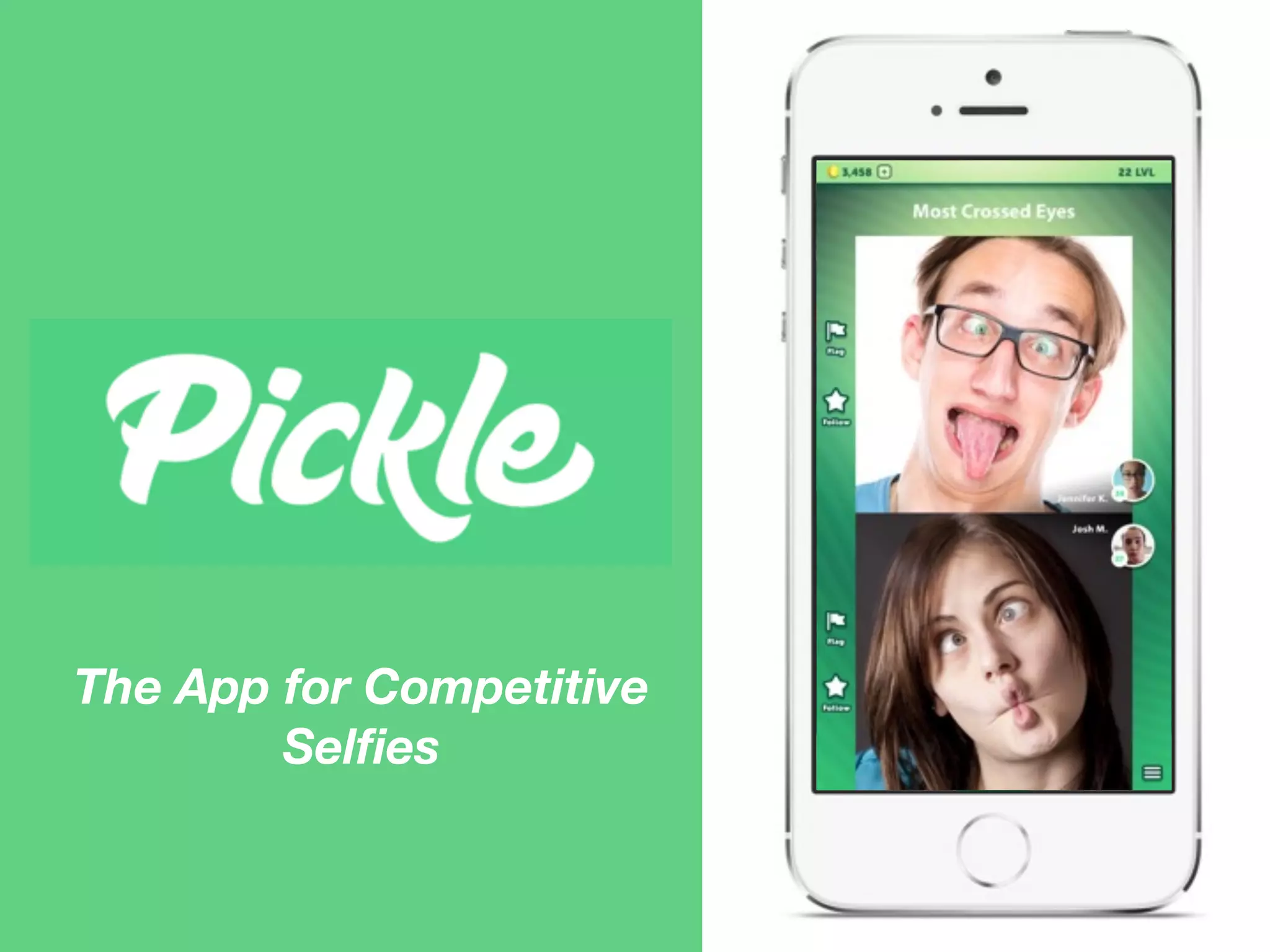
The cover slide is minimalist, featuring the Pickle logo in a friendly, rounded script font against a green background. The subtitle, "The App for Competitive Selfies," immediately defines the product category. The right side of the slide shows a high-fidelity mockup of the app on an iPhone 5-era device, displaying a 'Most Crossed Eyes' challenge. This is an effective start as it shows the product in action immediately.
Slide 2: What is Pickle?
This slide breaks down the user journey into three simple steps: 1) Users challenge friends , 2) They're assigned a photo challenge , and 3) Other users vote for the winner . The use of three phone mockups showing different screens—friend selection, the 'spin for challenge' wheel, and the voting interface—makes the mechanics clear. It positions the app as a social game rather than just a photo-sharing tool.
Slide 3: Traction and Engagement
Slide 3 addresses the question, "Does anyone even like selfies?" with hard data. The founders report that 24 hours after launch, the prototype had 12.7k registered users and 1 million votes cast . One month later, the numbers scaled to 26k downloads and 5.2 million votes cast . A line graph shows a sharp spike in growth around December 12th. This is the strongest slide in the deck, demonstrating that the core loop (voting) is highly addictive.
Slide 4: Current Status and Strategy
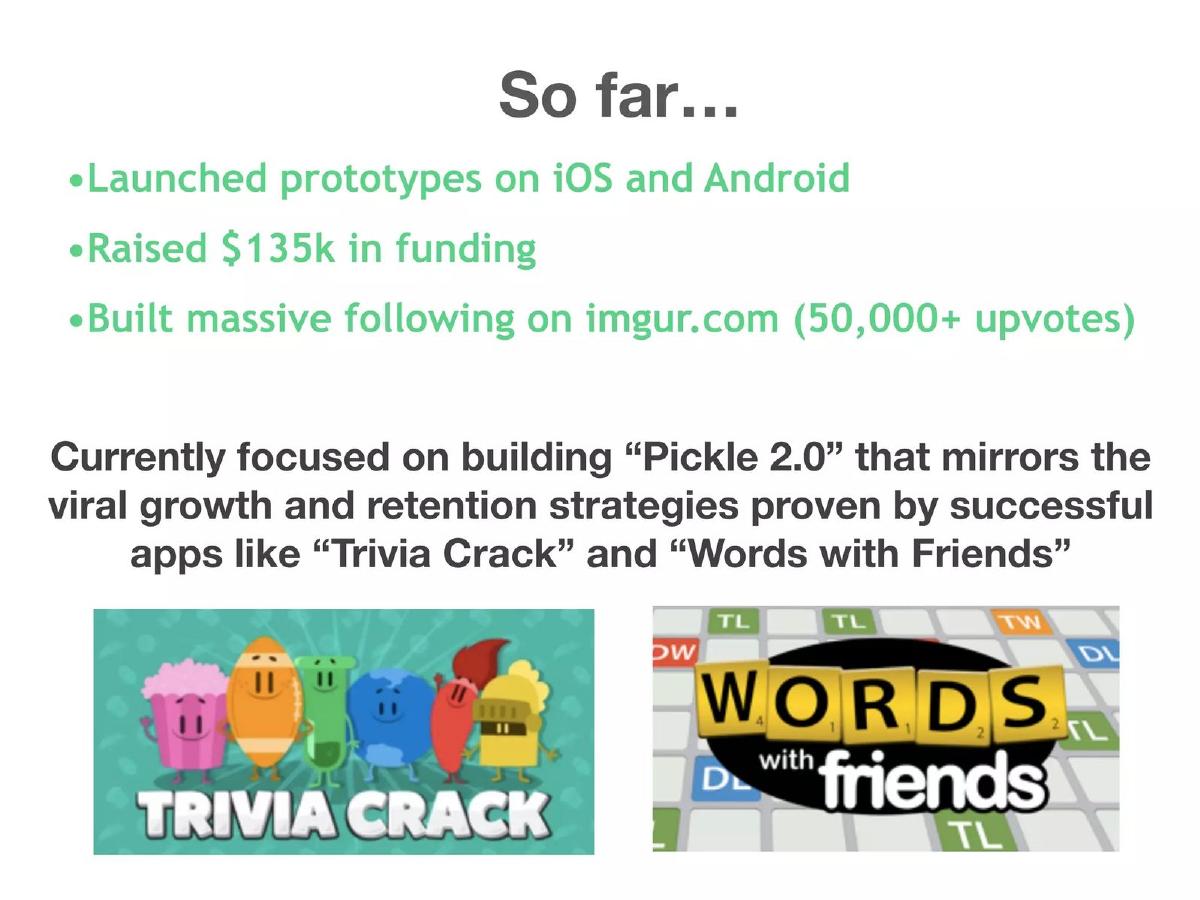
Under the heading "So far..." , the deck notes that prototypes have launched on both iOS and Android and that the company has already raised $135k in funding . An interesting metric included is a "massive following on imgur.com (50,000+ upvotes)," which suggests a successful organic marketing test. The slide explicitly states the goal is to build 'Pickle 2.0' by mirroring the viral strategies of "Trivia Crack" and "Words with Friends."
Slide 5: Monetization Potential
This slide introduces the business model. It projects that with 500,000 monthly active users , the app would generate $200k in revenue per month . It lists an Average Monthly Revenue/User of $0.40 , a Lifetime Value (LTV) of $2.39 , and a Cost of Acquisition (CAC) of $1.80 . Crucially, a footnote states these are "Based on industry averages of similar apps," meaning these are not yet proven by Pickle's own operations.
Slide 6: Long-Term Revenue
Beyond in-app purchases, the deck proposes Brand Sponsorships . The concept is 'Branded Pickle selfie contests,' which would offer brands visibility and engagement. An example mockup shows a 'Kleenex' branded challenge for 'Just about to Sneeze.' This demonstrates a secondary, B2B revenue stream that leverages the app's high engagement for advertising.
Slide 7: The Team
The team slide features four members. Evan Katz (CEO) is noted for being in his 3rd CEO position with a copywriting background. Morgan Steffy (CTO) has 4 years of development and design experience. Chris Anderson (iOS Development) is described as a database expert with 8 years of experience, and Adam Jones (Lead Designer) is cited as a game theory expert with 10 years of experience. The team appears balanced between product, engineering, and design.
Slide 8: Advisors
The advisor list adds significant credibility. Dan Kurani (CEO of Thumb) is highlighted for growing a similar app to 1.5 million users. Joel Seligstein is listed as an early Facebook engineer and an existing investor in Pickle. Jay Zalowitz is credited as a technical expert in viral growth. Having an early Facebook engineer as an investor is a strong signal for a social app.
Slide 9: The Ask and Roadmap
Pickle is "Raising Round of $600,000." The slide provides a timeline for the remainder of 2015: launching 'Pickle 2.0' in June, reaching 100,000 monthly users and implementing in-app purchases by August, and hitting $200k monthly revenue and two brand pilots by December. The milestones are ambitious but clearly defined.
Slide 10: Contact and Social Proof
The final slide provides contact information and social media handles. It includes a series of user-generated 'ugly' selfies to reinforce the fun nature of the app. It also features a quote from KillerStartups: "It's like Snapchat, but better." This is the only mention of a competitor in the entire deck.
What Pickle Does Well
The deck is exceptionally strong at demonstrating engagement density . By highlighting that 26,000 users cast 5.2 million votes, the founders prove that their users aren't just downloading the app—they are actively participating. The ratio of 200 votes per user per month is a compelling metric for a social gaming platform. Additionally, the clear three-step explanation of the product (Slide 2) ensures that any investor, regardless of their familiarity with selfie culture, understands the mechanics immediately.
What is Missing from the Pickle Deck
The most glaring omission is a competitive landscape analysis . In 2015, the social photo space was incredibly crowded with Instagram, Snapchat, and various 'challenge' apps. Pickle mentions Snapchat only in a quote on the final slide, failing to explain how they will defend their niche against these giants. Furthermore, the financial projections are purely hypothetical . Using 'industry averages' for CAC and LTV is a common pitfall; investors would prefer to see how the $135k already raised was used to test these specific unit economics for Pickle itself. Finally, there is no mention of Market Size (TAM) , leaving investors to guess the total addressable audience for 'competitive selfies.'
Founder Takeaways: What to Copy
Focus on Engagement Ratios: Don't just show downloads. Show the ratio of actions to users (e.g., votes per user). This proves the product is 'sticky.' · Visual Product Walkthrough: Use Slide 2's approach of mapping the user journey to specific app screens. It eliminates confusion about how the product works. · Strategic Advisor Selection: Pickle chose advisors who had specifically built or scaled similar social products (Thumb, Facebook). This suggests the founders know exactly what expertise they lack. · Branded Content Mockups: If you plan to sell to brands, show a mockup of what that looks like (Slide 6). It makes a theoretical revenue stream feel tangible.
Frequently asked questions
- What is the primary value proposition of Pickle?
- Pickle positions itself as 'The App for Competitive Selfies.' It transforms the passive act of taking selfies into a social game where users compete against friends based on specific prompts, and the broader community acts as the judge through a voting system.
- How does Pickle plan to make money?
- The deck outlines two main revenue streams: in-app purchases and brand sponsorships. In-app purchases involve a 'coin shop' where users can buy currency for the game. Brand sponsorships would involve companies paying for branded selfie contests to gain visibility and engagement.
- What kind of traction did the prototype achieve?
- According to Slide 3, the initial prototype saw 12.7k registered users and 1 million votes cast within 24 hours. One month later, these figures grew to 26k downloads, 220k photos uploaded, and 5.2 million votes cast, indicating high user engagement.
- Who are the key people involved in the project?
- The team is led by CEO Evan Katz and CTO Morgan Steffy. They are supported by iOS developer Chris Anderson and Lead Designer Adam Jones. Notable advisors include Dan Kurani (Founder of Thumb) and Joel Seligstein (early Facebook engineer).
- What are the biggest risks or omissions in this deck?
- The deck lacks a formal market analysis and a competitive landscape slide. Furthermore, the financial metrics like LTV ($2.39) and CAC ($1.80) are noted as being based on 'industry averages' rather than the company's own data, which is a significant risk for investors.