Phospholutions addresses the global inefficiency of phosphorus fertilizer, where up to 90% of conventional product is wasted. Their core product, RhizoSorb, utilizes anionic exchange capacity to release nutrients based on plant demand rather than environmental triggers. The deck is notable for its granular focus on unit economics, demonstrating how the product increases margins for retailers (from $100 to $150 per ton) and reduces costs for farmers (by ~10% per acre). While the deck heavily redacts its forward-looking financial forecasts and specific use of proceeds, it provides robust trial…
Key takeaways
- Conventional phosphorus fertilizer waste is cited at 90%, creating a massive inefficiency for the $70B+ global market (Slide 1, 2).
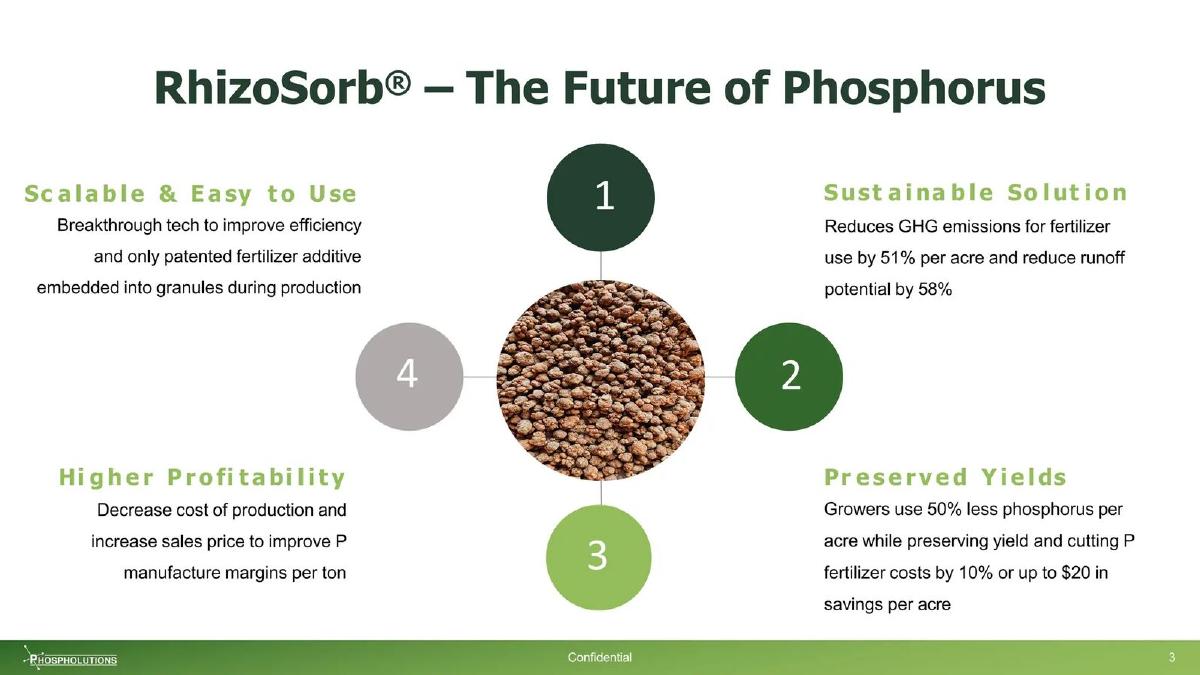
- RhizoSorb claims to reduce greenhouse gas emissions by 51% per acre and runoff potential by 58% (Slide 3).
- Trial data across 200 locations in 14 states shows yield increases of +3 to +5 bushels per acre despite using 50% less phosphorus (Slide 5).
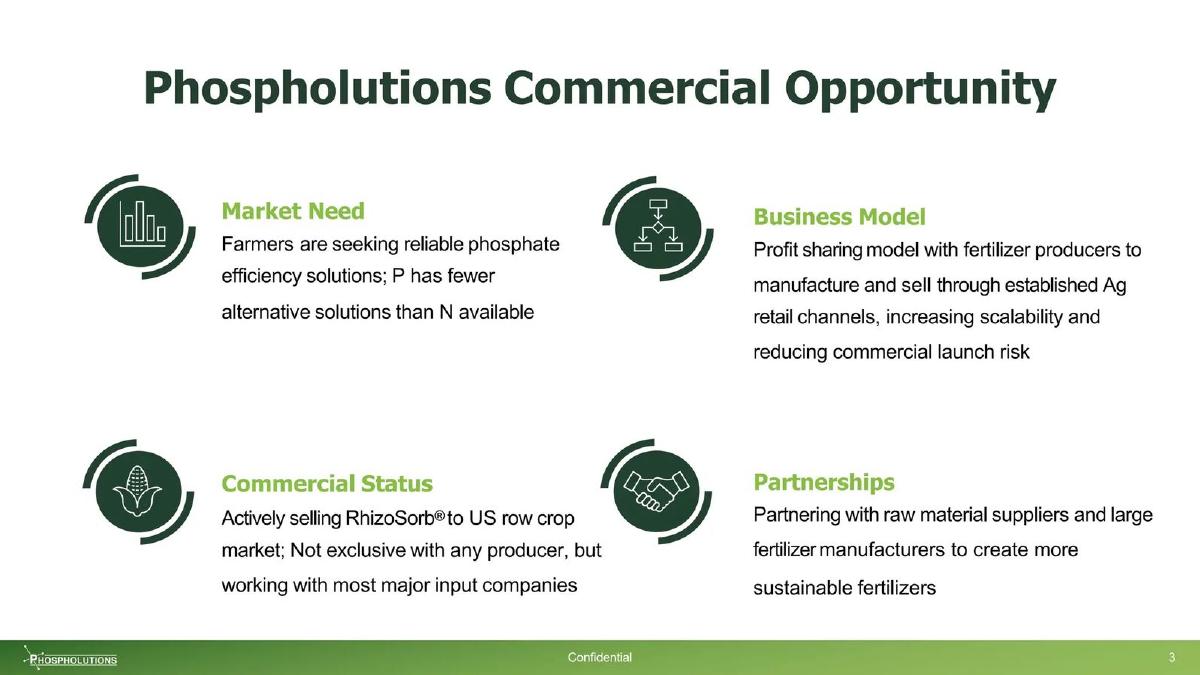
- The business model uses profit-sharing with producers to avoid the risks of a solo commercial launch (Slide 3).
- Retailer margins are projected to increase from $100 per ton for standard MAP to $150 per ton for RhizoSorb (Slide 8).
- The company raised a $10.3M Series A in 2021 and sought a $9M bridge to a $30M Series B (Slide 12).
- Strategic milestones include producing 250 tons for a 2023 demo program and selling 5,000 tons for Spring 2024 delivery (Slide 11).
- The team slide identifies a significant 'Open Position' for VP of Research & Development, indicating a gap in senior technical leadership at the time of the deck (Slide 16).
Executive Summary: A Science-First Approach to AgTech
Phospholutions presents a 21-slide deck that is a masterclass in addressing the specific pain points of a commodity-driven industry. The company targets the $70 billion phosphorus fertilizer market, which is plagued by extreme inefficiency and environmental degradation. By focusing on the unit economics for every player in the value chain—from the manufacturer to the retailer to the farmer—Phospholutions builds a case for a sustainable solution that doesn't require a financial sacrifice.
Slides 1-2: The Macro Problem and Market Opportunity
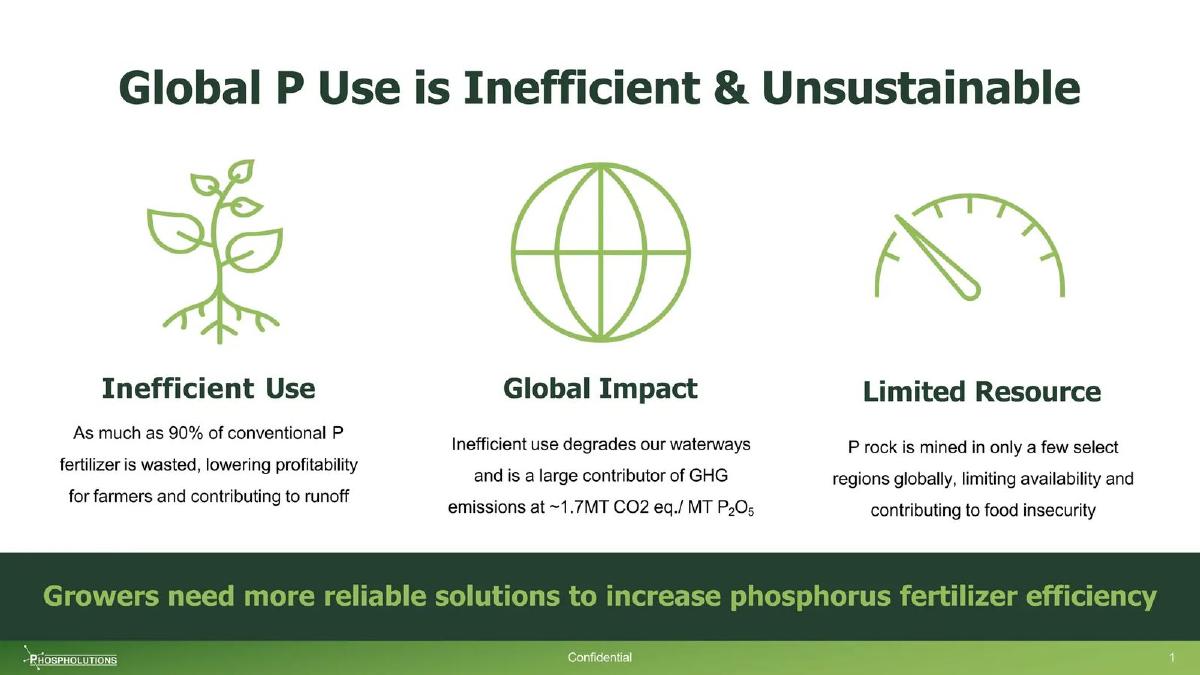
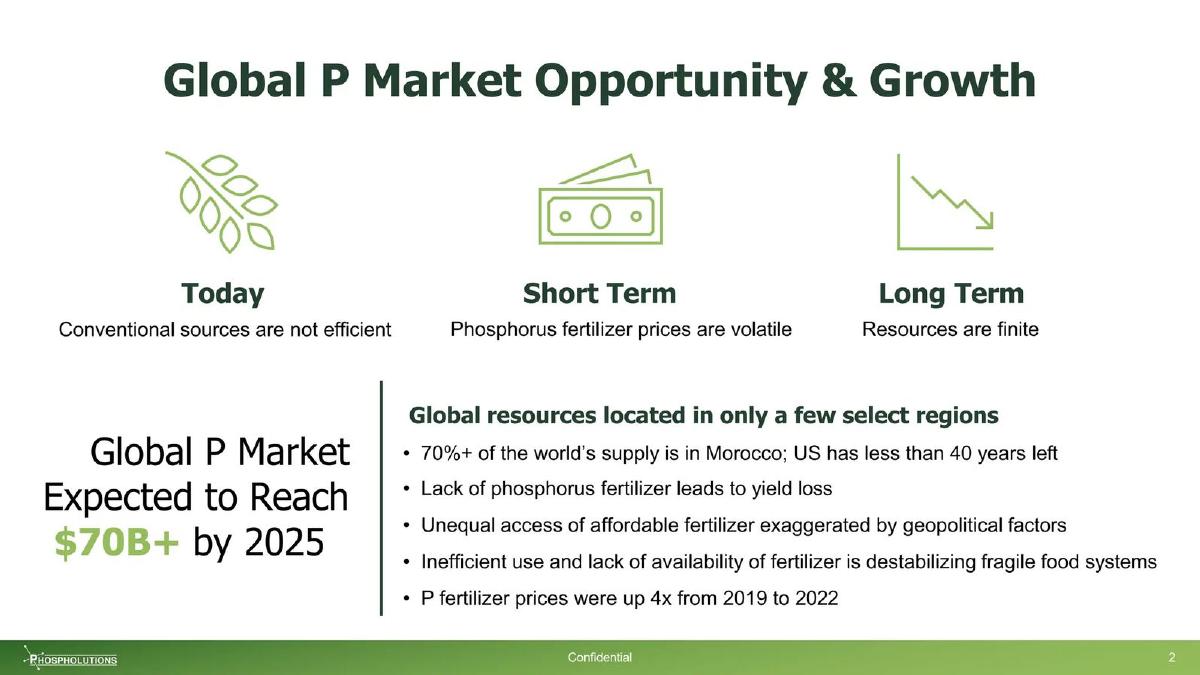
The deck opens by defining a stark reality: 90% of conventional phosphorus (P) fertilizer is wasted. This inefficiency isn't just an environmental hazard; it is a direct hit to farmer profitability. Slide 2 quantifies the market, projecting it to reach $70B+ by 2025. Crucially, it highlights the geopolitical risk, noting that 70% of the world's supply is in Morocco and the US has less than 40 years of reserves left. This framing elevates the product from a 'nice-to-have' green additive to a strategic necessity for food security.
Slides 3-4: The RhizoSorb Solution
Slide 3 introduces the commercial opportunity, emphasizing a profit-sharing model with fertilizer producers. This is a vital strategic choice; by not competing with the giants, Phospholutions reduces its commercial launch risk. Slide 4 provides the technical value proposition for RhizoSorb. It claims a 51% reduction in GHG emissions and a 58% reduction in runoff potential. The 'Preserved Yields' section is the most important for the end-user, stating that growers can use 50% less phosphorus while saving up to $20 per acre.
Slides 5-6: Validation Through Data
AgTech investors demand field data, and Slide 5 delivers. It shows results from 200 trial locations across 14 states. The bar charts for corn and soybean yields are clear: RhizoSorb with a 50% P reduction consistently beats the Grower Standard Practice (GSP) by 1 to 5 bushels per acre. Slide 6 connects these results to Global Sustainability Impact, aligning the company with UN Sustainable Development Goals like Zero Hunger and Climate Action. The mention of a study by the New Zealand Plant and Food Research Institute adds third-party credibility to their leaching and runoff claims.
Slides 7-10: Competitive Landscape and Unit Economics
Slide 7 uses a standard feature matrix to compare RhizoSorb against competitors like Trivar and Avail. RhizoSorb is the only product marked as having 'Upstream Production' integration and 'Plant Driven Release.' Slides 8 and 9 are perhaps the strongest in the deck. They break down the 'Value Proposition to Grower and Channel' with specific dollar amounts. For example, Slide 8 shows that while RhizoSorb costs more per ton ($1299 vs $951 for MAP), the lower use rate results in a lower cost per acre ($66.90 vs $73.23). Slide 9 shows how the manufacturer can achieve an 8% COGS reduction by decreasing ammonia and phosphoric acid costs, even when including the cost of the RhizoSorb additive.
Slides 11-15: Strategy and Fundraising
The Go-to-Market strategy on Slide 11 is granular, listing immediate actions like producing 250 tons for a 2023 demo program. Slide 12 provides the funding history and future 'Ask.' It shows a clear progression from a $1.5M Seed in 2019 to a planned $30M Series B in 2024. However, Slides 13, 14, and 15—covering Short-Term Objectives, 5-Year Forecast, and Use of Proceeds—are entirely redacted in this version of the deck. This is a common practice for public versions of decks, but it leaves the reader unable to evaluate the company's projected burn rate or revenue growth targets.
Slides 16-18: Team and Backers
The team slide (Slide 16) shows a structured organization, though it notably lists the VP of R&D as an 'Open Position.' This is a significant detail for a science-heavy company. The investor slide (Slide 17) is impressive, featuring industry heavyweights like Ospraie Ag Science, Bunge, and UPL. Having strategic investors from the fertilizer and grain handling space validates the company's partnership-heavy business model.
What Works in This Deck
Granular Unit Economics: The deck doesn't just say 'we save money.' It shows exactly how a retailer makes $50 more per ton while the farmer saves $6.33 per acre. This level of detail is rare and highly persuasive. · Extensive Field Trials: Moving from lab to 200 field locations is a massive hurdle in AgTech. Demonstrating this scale of testing removes a significant portion of the 'tech risk' for investors. · Strategic Alignment: By positioning themselves as partners to existing P manufacturers rather than disruptors, they show a realistic path to global scale.
What is Missing
Financial Forecasts: Due to redactions on Slides 13-15, there is no visibility into the company's revenue history or future projections. We don't know if they are currently generating $100k or $10M in annual revenue. · IP Depth: While the deck mentions 'patented technology,' it doesn't elaborate on the strength or breadth of the patent portfolio, which is the primary moat for a chemical additive company. · R&D Leadership: The 'Open Position' for VP of R&D suggests a potential gap in the executive team at a critical juncture of commercialization.
Founder Takeaways
Target the Whole Value Chain: If your product requires a middleman (like a retailer) to sell less volume, you must prove they will make more profit per unit. Phospholutions does this perfectly on Slide 8. · Use 'Spotlights': Highlighting a specific high-performance region (like the Iowa Spotlight on Slide 5) helps make broad data sets feel more tangible and relatable to specific geographic markets. · Align with Strategics: For capital-intensive industries like agriculture or chemicals, having logos like Bunge and UPL on your investor slide is worth more than almost any other metric.
Frequently asked questions
- What is the core technology behind RhizoSorb?
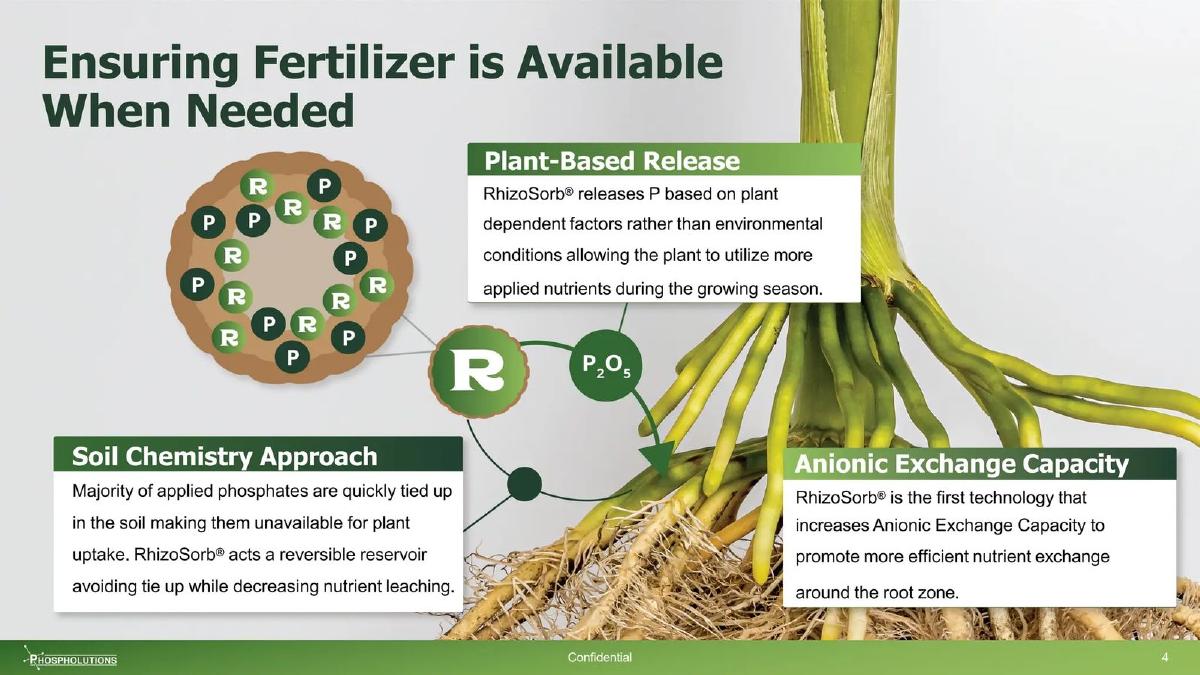
- RhizoSorb is a patented fertilizer additive embedded into granules during production. It utilizes a soil chemistry approach called Anionic Exchange Capacity. Unlike traditional fertilizers that are often tied up in soil or leached away, RhizoSorb acts as a reversible reservoir, releasing phosphorus based on plant-dependent factors rather than environmental conditions. This ensures the nutrient is available exactly when the plant needs it.
- How does Phospholutions prove its product works to skeptical farmers?
- The deck relies on extensive field trial data rather than lab simulations. Slide 5 highlights testing across 200 trial locations in 14 states. It specifically calls out an 'Iowa Spotlight' where the product had a 92% success rate across 31 sites. The data shows that even with a 50% reduction in phosphorus, corn yields increased by 3-5 bushels per acre compared to grower standard practices.
- What is the financial incentive for fertilizer retailers to switch?
- Retailers are often hesitant to sell products that require lower volume, but Phospholutions addresses this by increasing the margin per ton. According to Slide 8, while a retailer moves 33% less product per acre, their margin per ton increases from $100 to $150. This keeps the margin per acre flat for the retailer while providing a 10% cost saving to the farmer, creating a win-win scenario.
- What is the company's manufacturing and distribution strategy?
- Phospholutions avoids the 'build it and they will come' trap by partnering with large phosphate producers. They use a profit-sharing model where the additive is integrated into the manufacturer's existing production lines. This allows Phospholutions to scale without building its own factories, leveraging established Ag retail channels to reach the market.
- What are the funding requirements mentioned in the deck?
- The deck outlines a multi-stage funding path. Following a $10.3M Series A in 2021 and a $5.3M convertible note in 2022, the company was raising a $9M bridge to provide runway for commercial milestones. This was intended to lead into a $30M Series B in 2024, with the ultimate goal of reaching profitability by 2026.