PetMates is a 10-slide pitch deck from July 2015 that proposes a social networking platform for pet owners, specifically targeting the Argentine market. The deck uses the 'Tinder for pets' analogy to describe its core functionality: helping owners find breed partners for their animals. Beyond matching, the company aims to build a community for finding caregivers and shelter rescues. While the deck provides specific market data for Argentina—citing a US$ 29 million annual expenditure on pet accessories—it lacks critical financial projections, user traction metrics, and a specific funding ask.…
Key takeaways
- The company positions itself as 'Like a tinder for pets' to simplify the explanation of its core matching service (Slide 2).
- The primary problem identified is the lack of a 'quick, simple and direct way' for pet owners to find specific breed partners (Slide 3).
- The deck focuses exclusively on the Argentine market, noting it ranks second in Latin America for pet accessory spending (Slide 7).
- Market data cites that US$ 29 million is spent annually on pet accessories in Argentina (Slide 7).
- The revenue model is split between a '+Plus version' subscription for VIP users and advertising/sales for industry service providers (Slide 8).
- The team consists of four members covering Product, Android/iOS development, Business Development, and Design/UX (Slide 9).
- The deck entirely omits a 'Fundraising Ask' slide, leaving investors without knowledge of the capital required or the valuation (Slides 1-10).
- There are no traction metrics, user numbers, or growth charts included in the presentation (Slides 1-10).
PetMates Slide-by-Slide Teardown
Slide 1: Title Slide
The deck opens with the PetMates logo: a stylized white dog with a black spot over its eye, partially overlapping a pink heart. The branding is friendly and clearly indicates a focus on animals and affection. There is no tagline or date on this specific slide, though the final slide indicates a July 2015 timeframe.
Slide 2: The Pitch
This slide serves as the 'High Concept Pitch.' It uses the phrase "Find your best friend’s mate" and explicitly clarifies the concept with the parenthetical "(Like a tinder for pets)" . This is a classic 2015-era pitching technique, anchoring a new concept to a well-known successful app to immediately communicate the user interface and core utility.
Slide 3: Problem / Needs
The problem is defined through three bullet points. First, it identifies the difficulty of finding specific breed partners for pets. Second, it claims there is no community encompassing a range of "complementary solutions" for pet owners. Third, it mentions that entering the "world of pets" is tedious for newcomers who currently rely on "rudimentary forums." The slide identifies a fragmentation in the market and a lack of modern user experience.
Slide 4: Product / Service
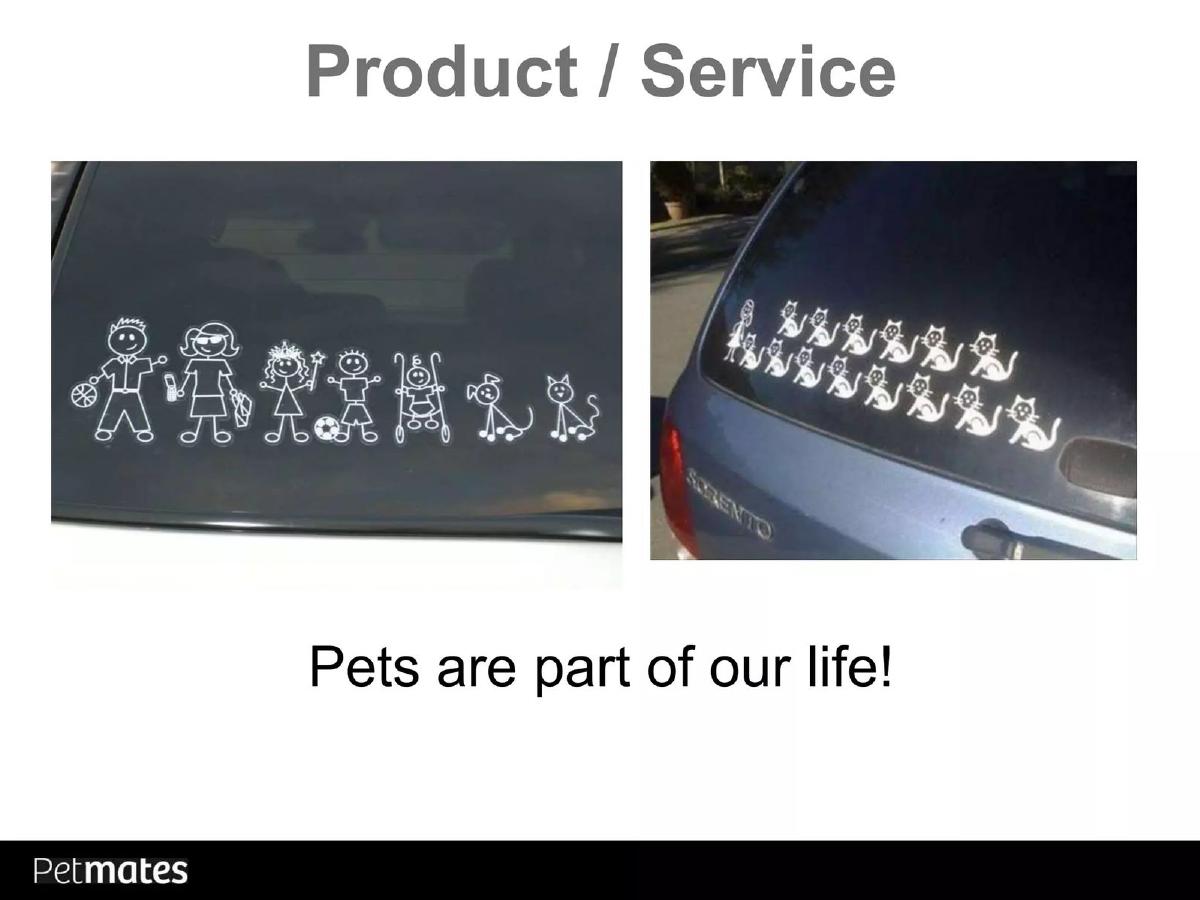
This slide is purely visual, showing two images of car window stickers. One shows a traditional human family with a dog and cat; the other shows a woman with a large number of cats. The text "Pets are part of our life!" is the only copy. While it reinforces the emotional connection owners have with pets, it fails to show the actual product interface or app mockups, which is a significant missed opportunity to demonstrate the 'Tinder for pets' functionality mentioned earlier.
Slide 5: Value Proposition
The value proposition expands the scope of the app beyond just breeding. It lists: "Find the perfect partner of your pet," "Meet new friends," and "A new community where you could: Find caregivers confidence, Find a new friend in a shelter animal rescue, Stay tuned in pet's world." The phrasing is slightly awkward ("Find caregivers confidence"), but it suggests a pivot from a pure dating app for dogs to a broader social utility for pet care and adoption.
Slide 6: Competition
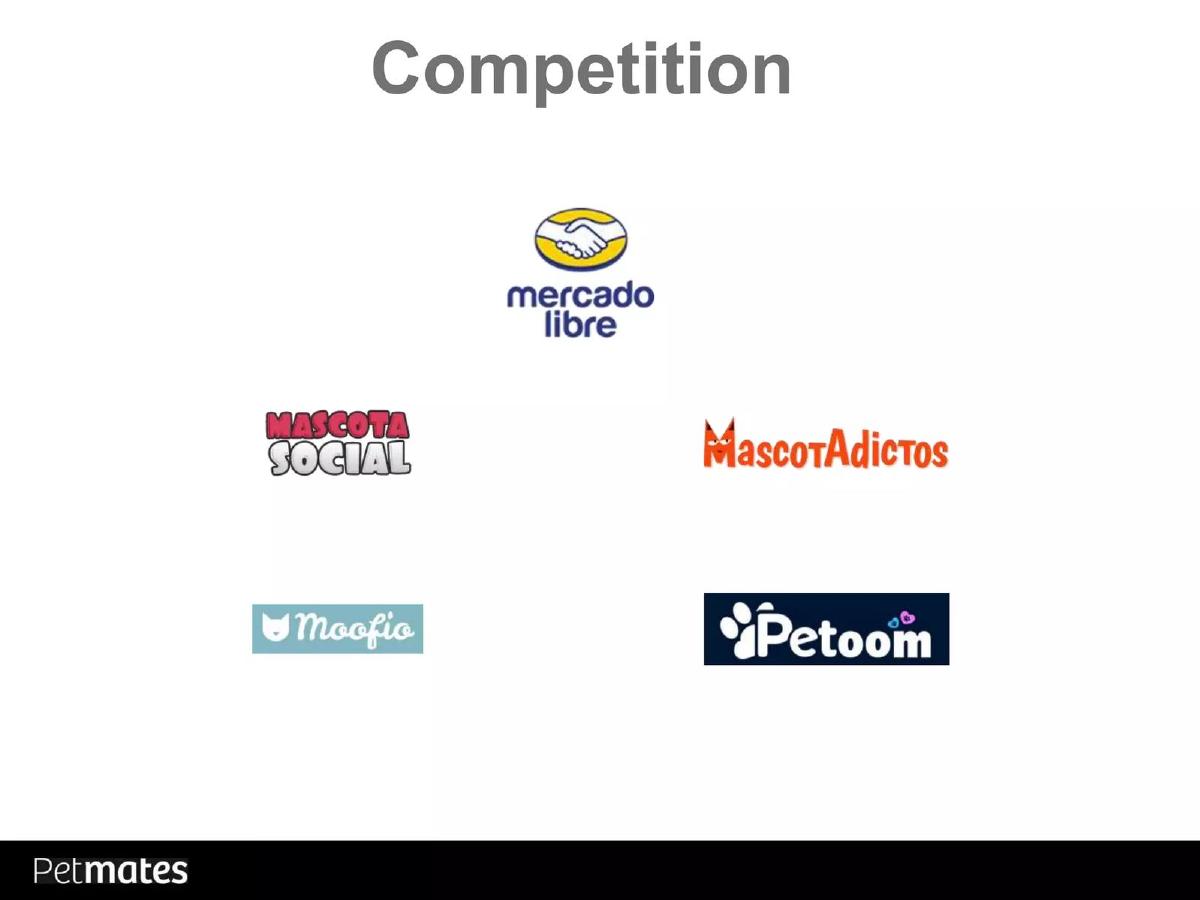
The competition slide displays five logos: Mercado Libre, Mascota Social, MascotAdictos, Moofio, and Petoom. Mercado Libre is the most significant name here, as it is the dominant e-commerce player in Latin America. The inclusion of these logos acknowledges that others are in the space, but the slide lacks a 'Magic Quadrant' or a checklist to show how PetMates differentiates itself from these established players.
Slide 7: Market Opportunity
This is the most data-heavy slide in the deck. It focuses exclusively on Argentina. Key figures include: US$ 29 million annual expenditure on pet accessories (ranking second in Latin America) and 7 million Argentine households buying pet food. It also notes that buyers in modern channels (Hypermarkets/Supermarkets) tend to be "younger and higher socioeconomic level." This helps define the target demographic for the app. The sources cited are El Economista and Euromonitor International.
Slide 8: Revenue Model
The revenue model is straightforward but lacks detail. It proposes a "+Plus version: Subscription for VIP users" and "Ads & Sales" targeting veterinarians, pet shops, and accessory companies. There are no price points, projected conversion rates, or estimates of Average Revenue Per User (ARPU) provided.
Slide 9: Team
The team slide lists four members with their roles and LinkedIn icons: Andres (Product & Front-end), Diego (Android and iOS developer), Juan (Business Development), and Greta (Design & UX). The team appears to be a complete 'builder' unit with design, development, and business functions covered, though no previous company experience or specific pedigree is mentioned.
Slide 10: Conclusion and Contact
The final slide provides a URL (petmat.es) and an email address. It is dated July 2015 . Notably, this slide does not include a call to action or a summary of the investment opportunity.
What PetMates Does Well
The deck is concise and follows a logical flow. The use of the 'Tinder for pets' analogy is an effective way to immediately explain the user experience without needing complex diagrams. By focusing specifically on the Argentine market and providing localized data from reputable sources like Euromonitor, the founders demonstrate that they have researched their immediate surroundings rather than just quoting global pet industry figures which are often too broad to be useful for a seed-stage startup.
The team composition is also a strength. Having both a dedicated mobile developer (Diego) and a front-end/product lead (Andres) suggests that the technical execution of the app was handled in-house, which is a positive signal for investors compared to teams that outsource their MVP development.
What is Missing from the PetMates Deck
The most glaring omission is Traction . By July 2015, if the app was live, investors would expect to see download numbers, active user counts, or at the very least, a waitlist size. Without these, it is impossible to tell if the 'Tinder for pets' concept actually resonated with the market.
Furthermore, there is no Financial Ask . A pitch deck is a fundraising tool, yet this deck never mentions how much capital is being sought, what the valuation expectations are, or how the funds will be allocated (e.g., 50% marketing, 30% engineering). There is also no Roadmap ; we see what the app wants to be, but not the timeline for adding features like the 'caregiver' or 'shelter' components mentioned in the value proposition.
Finally, the Product slide is very weak. Showing car stickers instead of app screenshots makes it difficult for an investor to visualize the user journey. In a 'Tinder for X' pitch, the UI is the product, and it should be front and center.
What Other Founders Should Copy
Founders should emulate the Market Specificity seen on Slide 7. If you are launching in a specific region (like Argentina), do not just use global TAM (Total Addressable Market) numbers. Using local currency or local expenditure data shows a much higher level of founder intent and market understanding.
The High Concept Pitch on Slide 2 is also a good template. While 'Tinder for X' is now a cliché, the format of [Actionable Sentence] + [Well-known Reference] remains one of the fastest ways to get an investor to understand a consumer social product. It reduces the cognitive load required to understand the business model, allowing the investor to focus on the market data and the team.
Frequently asked questions
- What is the primary product offered by PetMates?
- PetMates is a social platform designed to help pet owners find partners for their pets, specifically for breeding purposes. The deck describes it as 'Tinder for pets.' Additionally, it aims to be a community hub where users can find pet caregivers, connect with animal shelters, and stay updated on general pet-related news and information.
- Which geographic market does PetMates target?
- The deck focuses specifically on Argentina. It highlights that Argentina has the second-highest expenditure on pet accessories in Latin America, with an annual market value of US$ 29 million. It also notes that approximately 7 million Argentine households purchase pet food, with a trend toward younger, higher-socioeconomic buyers in modern retail channels.
- How does PetMates plan to generate revenue?
- The revenue model is two-fold. First, it proposes a '+Plus version' which is a subscription service for 'VIP users.' Second, it plans to generate income through 'Ads & Sales' targeting professional entities such as veterinarians, pet shops, and companies selling pet food and accessories.
- Who are the competitors listed in the deck?
- Slide 6 identifies five competitors: Mercado Libre (a major Latin American e-commerce platform), Mascota Social, MascotAdictos, Moofio, and Petoom. The deck does not provide a feature-by-feature comparison or a competitive matrix, but simply displays their logos to acknowledge the existing landscape.
- What critical information is missing from the PetMates deck?
- The deck lacks several standard components required for a professional fundraise. It does not include any traction data (current users or downloads), financial projections (burn rate or revenue targets), or a specific 'Ask' (how much money they are raising and what the milestones are). It also lacks a clear roadmap for product development.