Peupil is a community-focused social application aiming to solve the fragmentation of interest-based networking by consolidating features like group discussions, mentorship, and content monetization into a single platform. The deck identifies a significant market opportunity in India, citing 250 million social media users and a growing mobile user base. While the solution is ambitious—incorporating everything from video calls to offline meetups—the deck lacks a team slide, leaving the founders' identities and qualifications unknown. The financial ask is highly specific, requesting Rs 9,80,000…
Key takeaways
- The platform aims to enable users to discover and express interests through 'ultra-specific communities' (Slide 6).
- The deck identifies a total population of 1,347 million in India with 250 million social media users as the core market (Slide 11).
- Revenue models are highly diversified, including review-based ads, affiliate commissions, and future freemium subscriptions (Slide 9).
- The roadmap targets a growth trajectory from 5,000 downloads in June 2018 to 2 million users by December 2019 (Slide 13).
- Monthly operational costs are calculated at Rs 9,80,000, with a total requirement of Rs 58,80,000 through December 2018 (Slide 14).
- The marketing strategy includes unconventional tactics like sending 200 people to a cricket match wearing branded tees (Slide 15).
- Slide 2 is a placeholder titled 'Team' but contains no names, photos, or biographies.
- The competitive landscape slide compares Peupil against giants like Facebook, LinkedIn, and Pinterest, citing specific monthly active user counts for each (Slide 12).
Peupil Pitch Deck Teardown
Slide 1: Title Slide
The deck opens with the company name 'Peupil' and the tagline 'connecting interest and passion.' It defines the core value proposition as enabling people to 'discover, develop and express their interest and passions by connecting people around their own interest by building community.' The slide includes a 'Confidential Property of Peupil' footer, which persists throughout the deck.
Slide 2: Team (Omission)
Slide 2 is titled Team but is completely blank. There are no names, titles, photos, or descriptions of the founding team or advisors. This is a critical omission for a fundraising document, as investor confidence often relies heavily on the pedigree and experience of the founders.
Slide 3: Current Problem
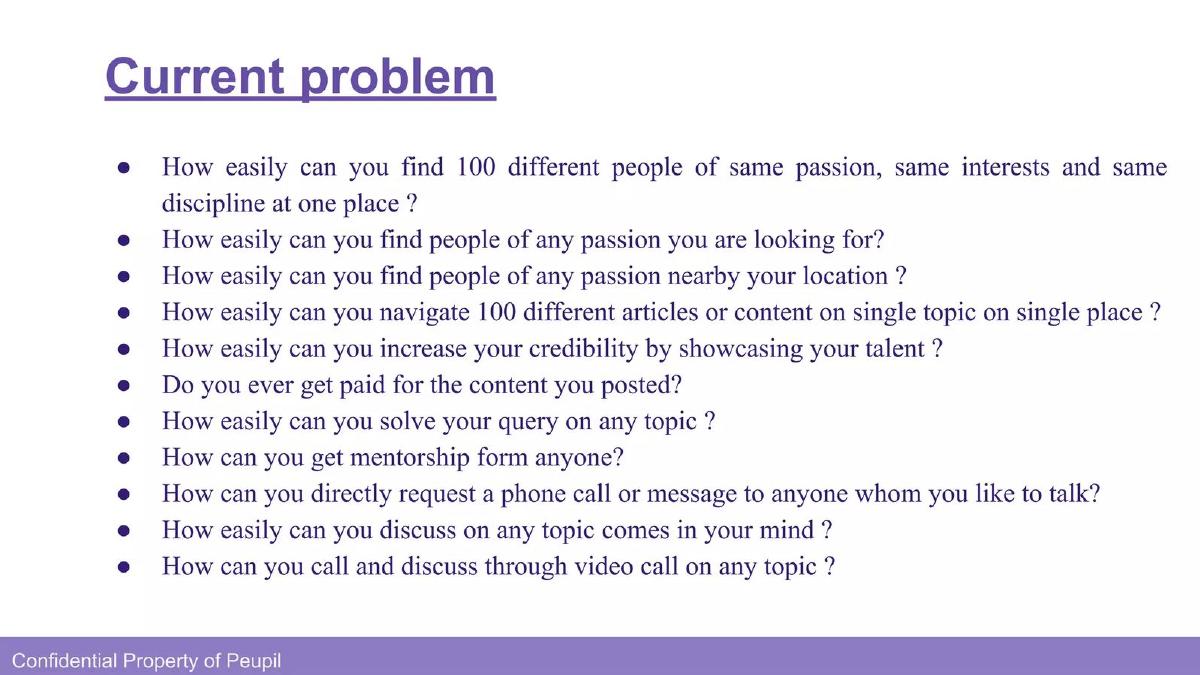
This slide uses a series of eleven bulleted questions to frame the problem. Key pain points include the difficulty of finding '100 different people of same passion' in one place, the inability to easily navigate content on a single topic, and the lack of monetization for user-generated content. It also asks, 'How can you get mentorship form anyone?' and 'How can you call and discuss through video call on any topic?'
Slide 4: Example Scenario
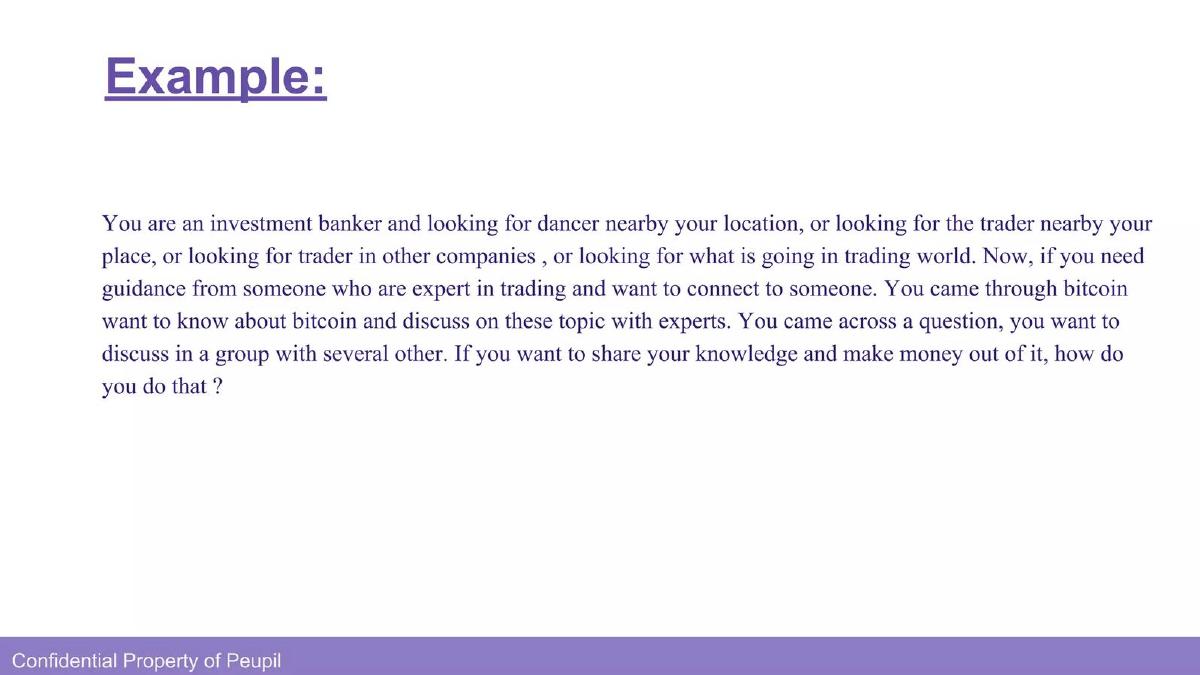
The deck provides a narrative example involving an investment banker looking for a dancer or a trader nearby. It posits a situation where a user wants to learn about bitcoin from experts, discuss it in a group, and potentially 'make money out of it.' The slide ends with the question: 'how do you do that?'
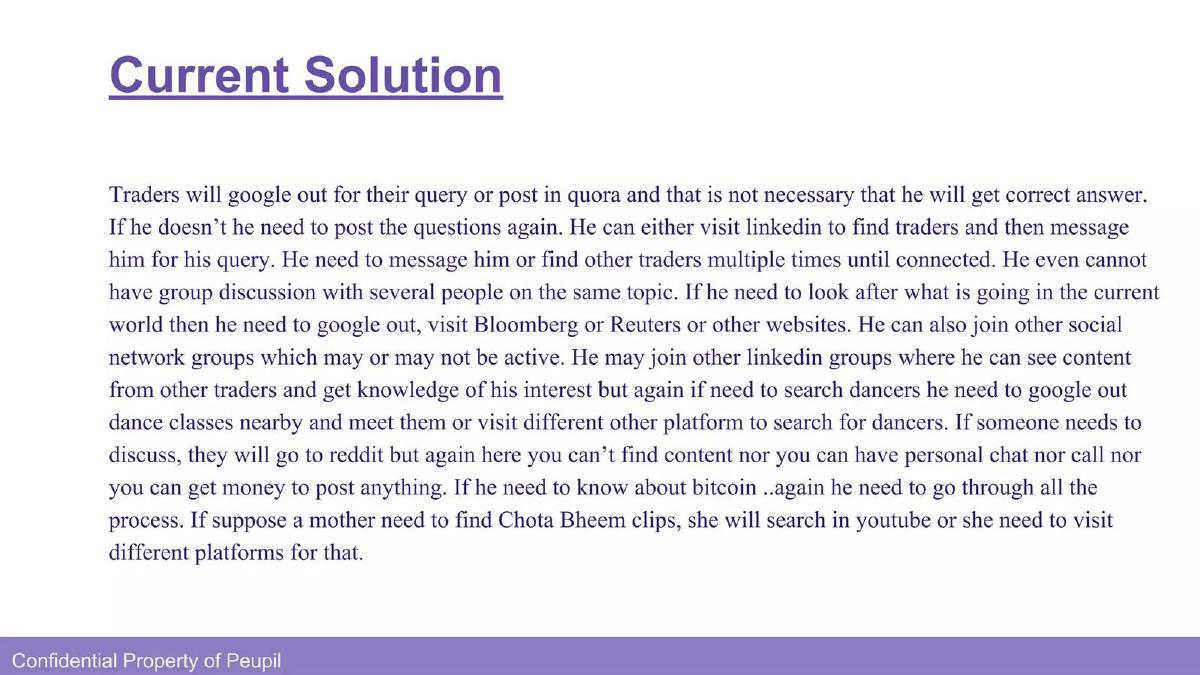
Slide 5: Current Solution (Competitive Analysis)
This slide critiques existing platforms. It mentions that Google and Quora may not provide correct answers, LinkedIn requires multiple messages to connect, and Reddit lacks personal chat or monetization features. It also notes that a mother looking for 'Chota Bheem clips' would have to visit different platforms like YouTube , suggesting a lack of centralized interest-based hubs.
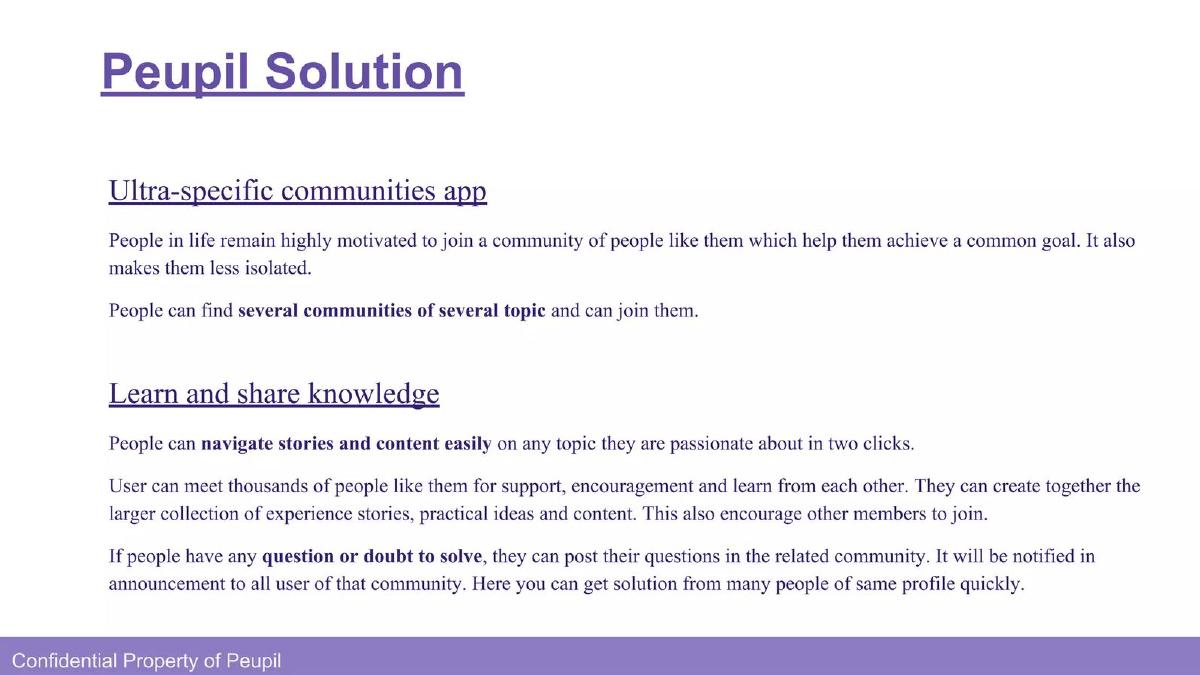
Slide 6 & 7: Peupil Solution
The solution is described as an 'Ultra-specific communities app.' Key features listed include:
Navigating stories and content in 'two clicks.' · Building credibility through ratings and reviews from community members. · Connecting with people based on 'speciality, profession, discipline, skills' and location. · Direct communication via chat, phone calls, live charts, and group video calls. · Monetization through 'Get Reward,' where users earn based on views and ratings.
Slide 8: App Mockups
Slide 8 displays four mobile app screens. The UI uses a purple color palette. The screens show a 'My Peupil' feed with suggested communities, a community description page with a 'Join' button, a group discussion view with user reviews, and a 'List view' vs 'Map View' for finding users by distance (e.g., '2.0 KM', '0.9 KM'). The mockups use placeholder 'Lorem ipsum' text for descriptions.
Slide 9 & 10: Business Model
The revenue strategy is highly fragmented, listing ten different potential streams:
Community based: Branded communities for companies. · Question based: Paid market research (e.g., 'which product you prefer most in HUL etc'). · Rating based: Companies paying for higher ratings. · Review based: Users writing reviews on advertisements. · Pay per click/views: Standard ad model. · Freemium: Subscription fees to create or join communities. · Affiliate commission: Redirecting users to company websites. · Direct Announcement campaigns: Featured announcements. · Sponsored content: Trending section placements. · Analytics: Selling user insights to job firms.
Slide 10 notes that the amount charged will 'totally depend on number of users on the application.'
Slide 11: Market Size
The deck focuses on the Indian market. It cites a total population of 1,347 million, with 462 million internet users and 250 million social media users. A bar chart titled 'SOCAIL MEDIA USER FROM 2015-2022' (sic) projects growth from 142.23 million in 2015 to 370.77 million in 2022. It also breaks down social media users by age, with the 18-24 group representing the largest segment at ~39%.
Slide 12: Competitive Landscape
This slide places Peupil at the end of a flow originating from 'USER.' It lists several competitors with specific Monthly Active User (MAU) counts:
Facebook: 240 million · Pinterest: 70 million · Instagram: 59 million · LinkedIn: 45 million · Quora: 40 million · Tumblr: 10 million · Roposo: 5 million · Hello: 35 Thousand · Mook (in Hindi script): 20 Thousand
The slide concludes: 'There is no app in India which provide all features like Peupil at one place.'
Slide 13: Roadmap
A table outlines the timeline from April 2018 to December 2020. Key milestones include:
June '18: Beta launch, targeting 5,000 downloads. · July '18: Version 2.0 launch, targeting 10,000 downloads. · Aug-Dec '18: Target to reach 1,00,000 users. · Jan-Dec '20: Target to reach 2 million users with '~1 lakh downloads' per month.
Slide 14: Financial Requirement
The deck provides a granular monthly budget totaling Rs 9,80,000 . The largest expense is 10 content writers at Rs 30,000 each (Total Rs 3,00,000). Other costs include Rs 2,00,000 for advertisement and Rs 40,000 for the two founders. The slide states that Rs 58,80,000 is required through December 2018 and claims that a company with 5 million active users can generate 'approx. 10 Cr revenue.'
Slide 15: Marketing Strategy
The strategy includes twelve points, ranging from digital to physical tactics:
Tie-ups with YouTuber celebrity managers. · Visiting 100 colleges in India. · Pamphlet distribution near colleges and companies. · Newspaper, radio, and 'mouth publicity.' · 'Send 200 people to a cricket match wearing our Tees.' · Creating a viral dance video featuring people over 50.
Slide 16: Closing Slide
The final slide is a blank white page with the purple footer 'Confidential Property of Peupil.' It contains no contact information or call to action.
What Peupil Does Well
The deck is very specific about its target market (India) and provides concrete data points regarding internet penetration and social media usage in that region. The financial requirement slide is unusually detailed for an early-stage deck, breaking down headcount by role and specific monthly salaries, which gives a clear picture of how the founders intend to deploy capital. The inclusion of mobile mockups (Slide 8) helps visualize the 'List' and 'Map' views, which are central to their 'nearby' connection value proposition.
What is Missing from the Peupil Deck
The most glaring omission is the Team slide . While Slide 2 exists as a header, it contains no information. Investors cannot evaluate the 'who' behind the 'what.' Additionally, the deck lacks any traction data . While the roadmap suggests a June 2018 launch, there is no indication if the beta phase actually commenced or if these are purely hypothetical projections. The Business Model is overly complex; listing ten different revenue streams for a pre-launch app can signal a lack of focus. Finally, there is no Contact Information on the final slide, making it difficult for an interested party to follow up.
What Founders Can Copy
Founders can learn from the Roadmap (Slide 13) and Financial Requirement (Slide 14) structure. Instead of asking for a lump sum without explanation, Peupil breaks down exactly how many people they need to hire and what the monthly burn will be. The use of a narrative 'Example' (Slide 4) is also a strong way to illustrate a complex product, though it should be paired with a more concise problem statement. The competitive landscape slide (Slide 12) is effective because it uses specific MAU numbers to show the scale of the platforms they are competing against, rather than just listing logos.
Frequently asked questions
- What is the primary problem Peupil aims to solve?
- According to Slide 3, Peupil addresses the difficulty of finding large groups of people (e.g., 100 individuals) with the same passion, interest, and discipline in one place. It highlights the friction in current solutions like Google, Quora, and LinkedIn, where users must navigate multiple platforms to find specific content, mentorship, or monetization opportunities for their expertise.
- How does Peupil plan to generate revenue?
- Slides 9 and 10 detail a complex monetization strategy. This includes charging companies for reviews and ratings, pay-per-click advertising, affiliate commissions, and 'Direct Announcement campaigns.' They also propose a future freemium model where users pay to create or join communities, and analytics services for job firms based on user insights.
- What are the projected user growth milestones?
- Slide 13 outlines an aggressive roadmap starting with a beta launch in June 2018 targeting 5,000 downloads. By July 2018, they aim for 10,000 downloads with a full feature launch. The ultimate goal stated is to reach 2 million users by December 2019, with monthly download targets scaling up to 1 lakh (100,000) per month.
- What is the specific financial request in the deck?
- Slide 14 requests a monthly budget of Rs 9,80,000. This covers a 20-person team: 10 content writers, 2 full-stack developers, 2 strategy/marketing leads, 2 digital marketers, 2 designers, and 2 founders. The deck states a total requirement of Rs 58,80,000 to sustain operations through December 2018.
- Who is the team behind Peupil?
- The deck fails to provide this information. Slide 2 is titled 'Team' but is entirely blank. While Slide 14 mentions 'Founder and Cofounder' in the budget table (allocated Rs 20,000 each per month), no names, professional backgrounds, or contact details are included anywhere in the 16-slide presentation.