Phenom, a 500 Startups Batch 16 company, utilized a highly visual, 14-slide deck to secure $728,000 in pre-seed funding. The deck eschews dense text for large-scale imagery and bold metrics, focusing on the emotional journey of the youth athlete. It positions the platform not just as a social network, but as a market intelligence tool for major sports brands like Nike, Adidas, and Under Armour. While the deck is light on traditional financial projections and competitive analysis, it leans heavily on the pedigree of its team—including a CTO with two exits—and early traction with a $30,000 part…
Key takeaways
- The deck uses a minimalist aesthetic with high-contrast visuals to mirror the premium feel of athletic brands (Slide 1).
- Phenom defines its core value proposition as providing 'digital identity' for every young athlete globally (Slide 2).
- The 'Problem' is framed through nostalgia, showing the limitations of physical sports scrapbooks and yearbooks (Slides 3-4).
- The product is designed to satisfy three specific psychological needs: looking cool, being recognized, and winning (Slide 5).
- A bold '80K' figure is used to signal early user traction, though the specific metric (DAU, MAU, or total signups) is not defined on the slide (Slide 6).
- The platform integrates brand affinity directly into user profiles, tracking 'Top Brands' like Nike and Adidas (Slide 7).
- Early monetization and validation are proven through a $30,000 partnership with Wilson (Slide 10).
- The team slide emphasizes technical and industry experience, highlighting a CTO with a 'Last Exit to Twitter' (Slide 11).
The Minimalist Power of Phenom
Phenom’s pitch deck is a study in the 'less is more' philosophy of startup fundraising. Spanning only 14 slides, the deck relies on high-quality imagery and extremely sparse text to convey a sense of premium brand identity. As a 500 Startups Batch 16 company, Phenom was pitching a vision where young athletes become the ultimate brand evangelists. The deck is designed to be presented rather than read, serving as a visual backdrop for a founder-led narrative.
The Vision and the Problem (Slides 1-4)
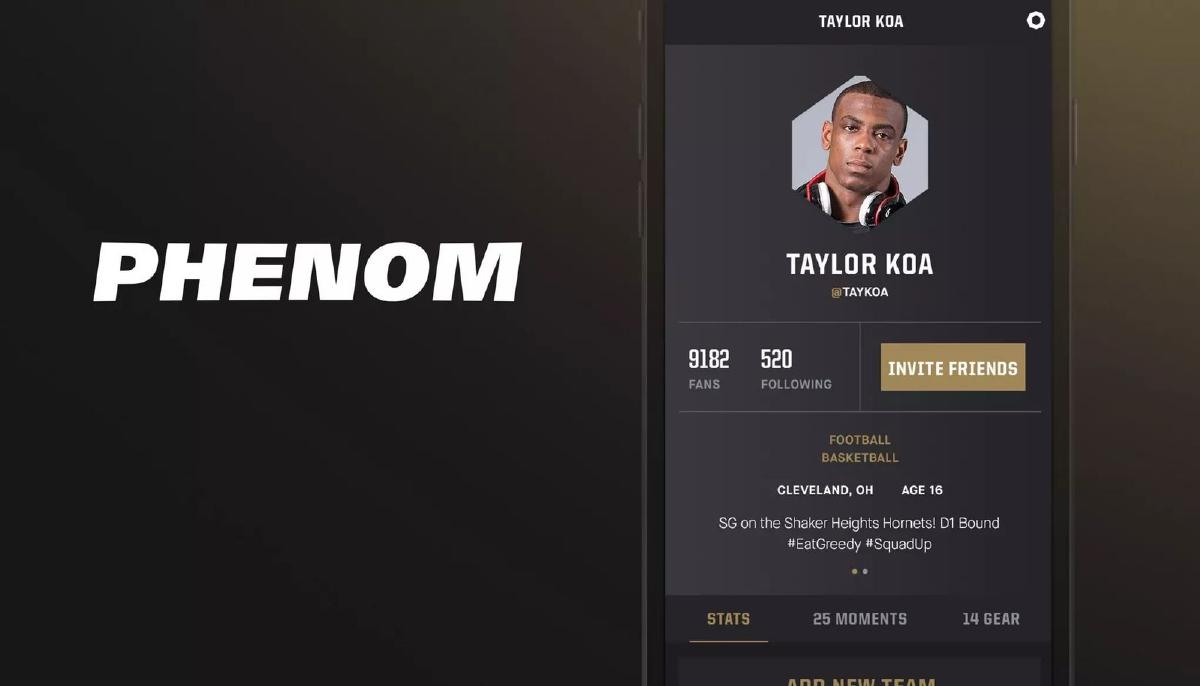
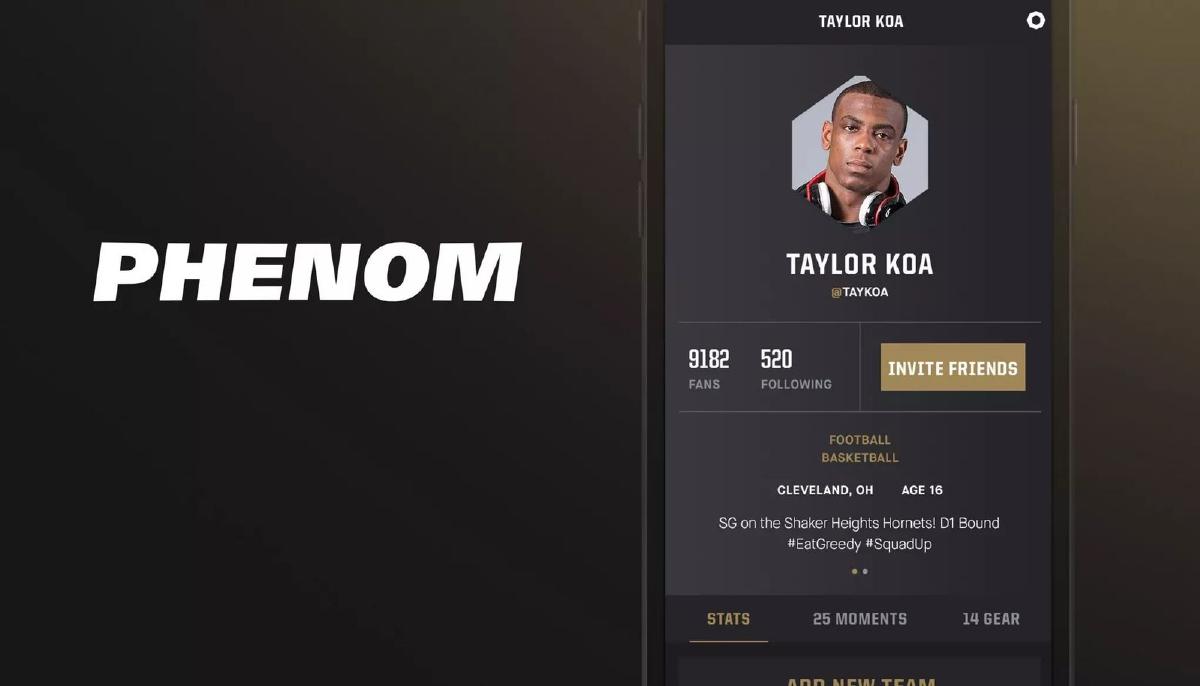
Slide 1 serves as the title card, featuring the Phenom logo alongside a mobile UI mockup of an athlete profile for 'Taylor Koa.' The design is dark, sleek, and uses a gold-and-white color palette that evokes high-end sports apparel brands. This immediately signals to the investor that the company understands the aesthetic of its target market.
Slide 2 delivers the mission statement: 'PHENOM IS THE DIGITAL IDENTITY FOR EVERY YOUNG ATHLETE IN THE WORLD.' By using the term 'digital identity' rather than 'social network,' the company elevates its purpose from a mere utility to a fundamental piece of an athlete's life.
Slides 3 and 4 address the 'Problem' through visual storytelling. Instead of a list of bullet points, Phenom uses photos of physical scrapbooks and old baseball cards. Slide 3 shows a child’s baseball scrapbook from 1997, and Slide 4 shows newspaper clippings and printed photos of a high school athlete. The implication is clear: the current way young athletes preserve their legacy is analog, fragmented, and outdated. The deck suggests that these physical artifacts are the precursors to what Phenom will become in the digital age.
The Solution and Psychological Drivers (Slide 5)
Slide 5 acts as the bridge between the problem and the product. It states, 'PHENOM GIVES YOUNG ATHLETES EVERYTHING THEY CRAVE.' It then lists three core pillars: LOOK COOL , BE RECOGNIZED , and WIN . This slide is critical because it identifies the psychological triggers of the Gen Z and Gen Alpha athlete. It moves beyond 'features' to focus on 'benefits' and emotional outcomes.
Traction and Product Interface (Slides 6-9)
Slide 6 is a 'big number' slide, displaying only '80K' in a large, blocky font against a gold background. In a pre-seed context, this likely refers to registered users or a specific engagement milestone. The lack of context on the slide forces the audience to listen to the presenter for the explanation, a common tactic in high-stakes pitches.
Slide 7 provides a deep dive into the product's UI. It shows two screens of the Taylor Koa profile. The left screen displays stats (fans, following, location, age, and bio). The right screen, titled '14 GEAR,' is the most important for the business model. It shows a 'Top Brands' chart (Nike, Adidas, UA) and a grid of specific products the athlete uses, such as Nike cleats and Riddell helmets. This slide demonstrates how Phenom captures intent and brand affinity data that is otherwise invisible to manufacturers.
Slide 8 shows the content creation flow. An athlete can upload a photo, tag it with a category (e.g., 'Gaming'), tag the gear they are 'rocking,' and even include the music they are 'jamming to' (e.g., Tupac's 'Hail Mary'). This illustrates the 'evangelism' mentioned in the company's self-description; every post becomes a multi-layered advertisement for the brands the athlete loves.
Slide 9 presents another milestone: '300K.' Given the progression from 80K, this likely represents a secondary growth metric, such as total 'moments' shared or a later user milestone reached during the program.
Validation and Team (Slides 10-11)
Slide 10 is the deck's 'proof of concept' for monetization. It features a large '$30K' next to the Wilson logo. This single slide validates that major sports brands are willing to pay to access Phenom’s community and data. It answers the 'who will pay for this?' question without needing a complex revenue table.
Slide 11 introduces the team. The pedigree here is significant for a pre-seed round. CEO Brian Verne is linked to IMG , a global leader in sports and media. CTO Clay Zug is highlighted for having '2 Exits' with his 'Last Exit to Twitter,' providing the technical credibility needed for a social platform. President Mike Eppich brings professional sports experience from the Cleveland Indians . The inclusion of a Data Science and Product Manager from Rocket Fuel and VentureBeat (Ishaan Sutaria) reinforces the idea that Phenom is a data company as much as a social one.
The Close (Slides 12-14)
Slide 12 is a transition slide with the text 'WHY THIS, WHY US, WHY NOW.' This is a standard prompt for the founder to deliver the closing argument regarding market timing and the team's unique ability to execute.
Slide 13 provides contact information for Brian Verne, including his email and phone number. Slide 14 ends on the company's stylized 'P' logo. Notably, the deck ends without a specific 'Ask' slide detailing the amount of money being raised or the intended use of funds. This suggests the deck was used as a teaser or as part of a demo day presentation where the 'Ask' was delivered verbally or in a follow-up document.
What Works
The visual consistency of the deck is its strongest asset. By using a dark theme and athletic typography, Phenom makes itself look like a partner to Nike or Adidas rather than a scrappy software startup. The use of 'Taylor Koa' as a recurring persona throughout the UI slides helps investors visualize the actual user journey. Furthermore, the decision to highlight the Wilson partnership so prominently (Slide 10) provides immediate commercial validation that offsets the lack of detailed financial slides.
What is Missing
From a traditional analyst's perspective, this deck is missing several 'Hard' data points. There is no Competitive Landscape slide; it is unclear how Phenom views its position relative to Instagram, Hudl, or MaxPreps. There are no Financial Projections or Unit Economics . While '80K' and '300K' are impressive numbers, the deck does not explain the cost of acquiring those users (CAC) or their retention rates. Finally, the absence of an Ask Slide is a significant omission for a fundraising document, as it leaves the investor guessing about the round's terms and the company's runway.
What a Founder Should Copy
Founders should emulate Phenom’s use of emotional anchors . The transition from the old scrapbook (Slide 3) to the digital profile (Slide 7) is a perfect example of showing, not telling, the evolution of a market. Additionally, the 'Team Slide' (Slide 11) is excellently executed; it uses recognizable logos (IMG, Indians, Twitter) to borrow authority, which is crucial in the early stages when the company's own brand is still unknown. Finally, the focus on 'Psychological Craving' (Slide 5) is a smart way to frame a value proposition, as it explains the 'why' behind user behavior more effectively than a list of technical features.
Frequently asked questions
- What is Phenom's primary business model based on the deck?
- While the deck does not have a dedicated business model slide, it implies a B2B data and marketing play. Slide 7 shows the platform tracking 'Top Brands' for individual athletes, and Slide 10 highlights a $30,000 deal with Wilson. The catalogue listing confirms it is a market intelligence platform for brands to reach young audiences and gather consumer feedback.
- How does Phenom differentiate itself from general social media like Instagram?
- Phenom differentiates by focusing specifically on the 'athletic identity.' Slide 7 and 8 show features tailored to sports, such as tagging specific gear (cleats, gloves, helmets) and displaying athletic stats. It positions itself as a vertical social network where the 'gear' is as important as the 'moment,' creating a structured data set for sports brands.
- What level of traction had the company achieved at the time of this pitch?
- The deck highlights two primary traction points. Slide 6 displays the number '80K' and Slide 9 displays '300K.' Based on the sequence, these likely refer to user milestones or engagement metrics. Additionally, Slide 10 explicitly mentions a $30,000 partnership with Wilson, indicating the platform had already begun generating revenue from major industry players.
- Who are the key members of the Phenom leadership team?
- The team (Slide 11) includes CEO Brian Verne (formerly of IMG), CTO Clay Zug (who has two exits, the last to Twitter), and President Mike Eppich (formerly with the Cleveland Indians). The team is rounded out by Isom Durm (Full-Stack Engineer) and Ishaan Sutaria (Data Science and Product Manager, formerly of Rocket Fuel and VentureBeat).
- What are the most significant omissions in this pitch deck?
- The deck is missing several standard venture components: there is no slide detailing the specific 'Ask' (amount of capital sought), no five-year financial projection, no unit economics (CAC/LTV), and no competitive matrix. It relies almost entirely on brand identity, team pedigree, and high-level traction numbers to build its case.