Nevermined's 13-slide pitch deck focuses on the friction inherent in B2B data sharing and proposes a decentralized infrastructure to solve it. By positioning itself as a 'Collaborative Computing Platform,' the company moves beyond simple data marketplaces to focus on secure, compliant interaction between data suppliers and users. The deck is notable for its heavy reliance on market statistics—citing a €3 trillion annual economic value for the data economy—and a concrete InsurTech use case that projects $300M in net-new revenue. While the deck lacks a formal team slide or a detailed breakdown…
Key takeaways
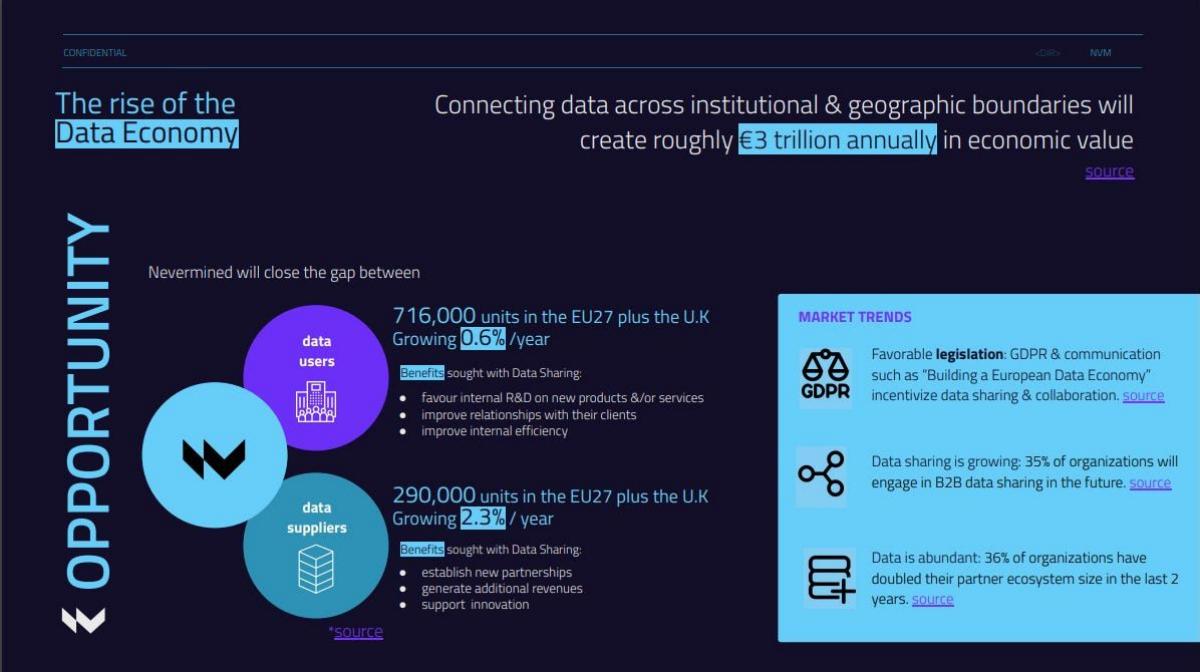
- The deck identifies a €3 trillion annual economic value created by connecting data across institutional and geographic boundaries on slide 7.
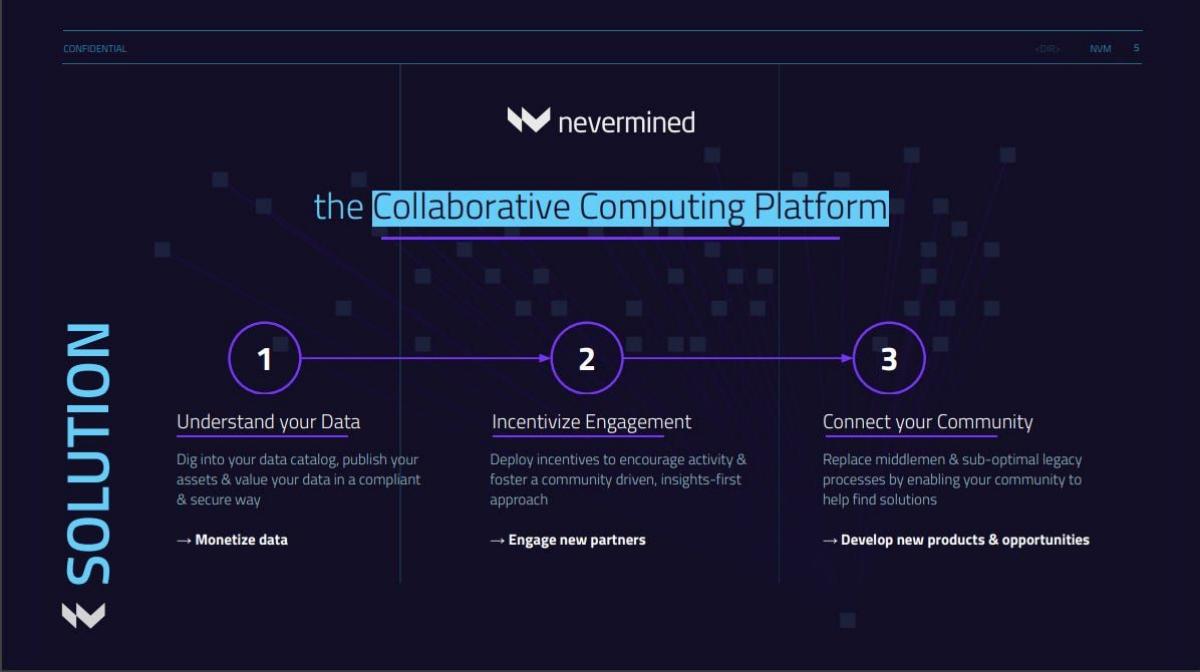
- Nevermined defines itself as a 'Collaborative Computing Platform' designed to help organizations understand, incentivize, and connect data communities on slide 5.
- Market sizing is specific to the EU27 and UK, identifying 716,000 data user units and 290,000 data supplier units on slide 7.
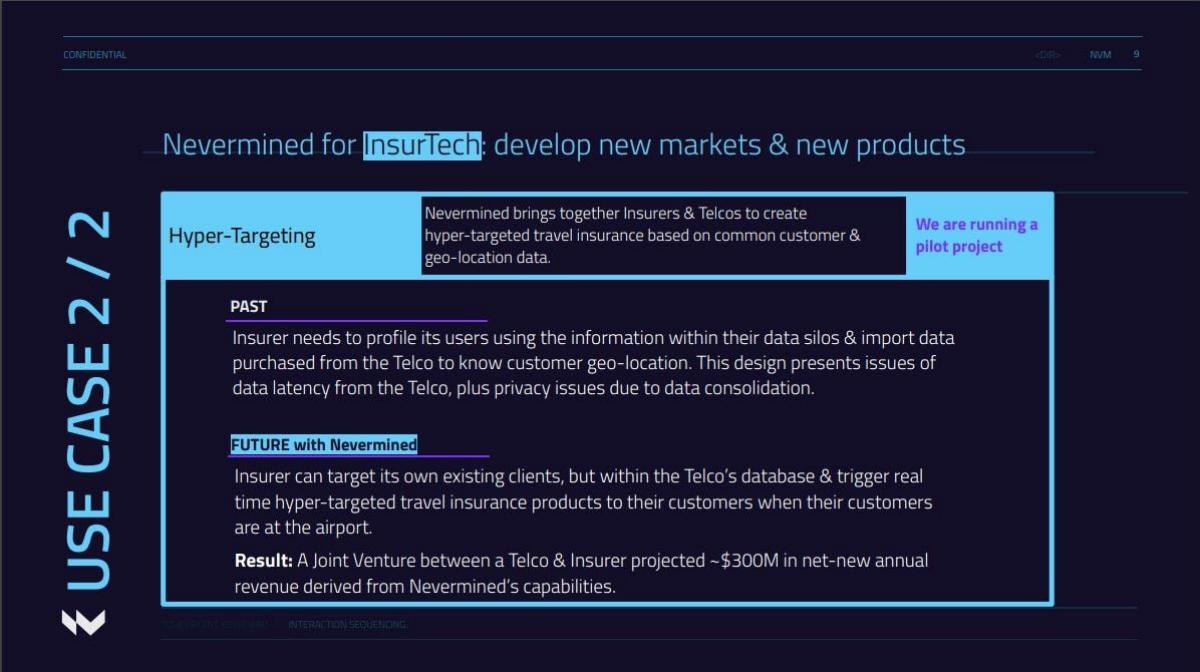
- A detailed InsurTech use case on slide 9 highlights a pilot project projecting $300M in net-new annual revenue through hyper-targeted travel insurance.
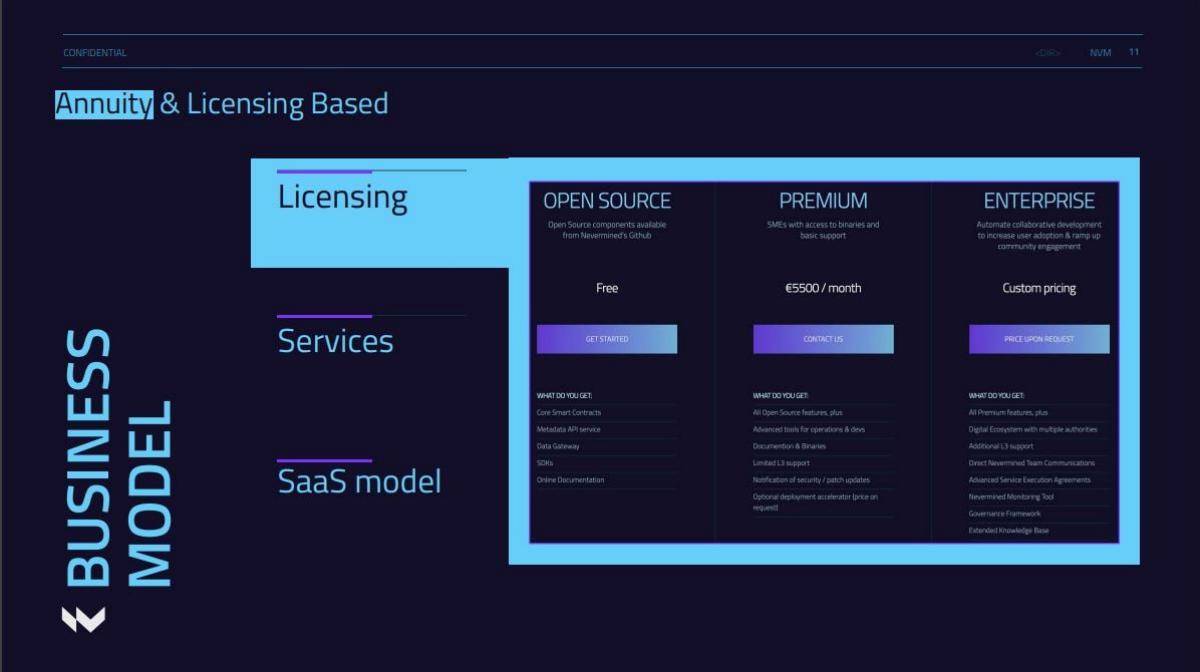
- The business model is explicitly tiered, featuring a 'Premium' SME tier priced at €5,500 per month on slide 11.
- The platform aims to solve data latency and privacy issues by allowing computation to happen within a partner's database rather than through data consolidation as shown on slide 9.
- The deck utilizes a high-contrast, 'terminal-style' aesthetic that reinforces its identity as a technical infrastructure provider.
- Despite raising $3M, the provided slides omit a specific 'Ask' breakdown or a slide dedicated to the founding team's credentials.
The Infrastructure of the Data Economy
Nevermined’s pitch deck is a study in technical positioning. In a market often cluttered with vague Web3 promises, this deck attempts to ground itself in the 'Data Economy'—a term it uses to bridge the gap between decentralized technology and traditional enterprise needs. As reported by Business Insider, the company raised a $3M Seed round in 2023. The deck consists of 13 slides, though only a selection of core content slides were made available for this teardown. The visual identity is dark, technical, and minimalist, signaling that this is a product for developers and data architects rather than generalist business users.
Slide 1: Title and Branding
The opening slide establishes the brand identity. It is sparse, featuring the Nevermined logo and a 'Seed Round' designation. The background contains faint, terminal-like text and directory structures, which immediately communicates that the company operates in the infrastructure or developer tools space. There is no tagline here, which is a missed opportunity to define the value proposition in the first five seconds, but the 'Confidential' and 'NVM 1' markers give it a professional, institutional feel.
Slide 3: The Vision
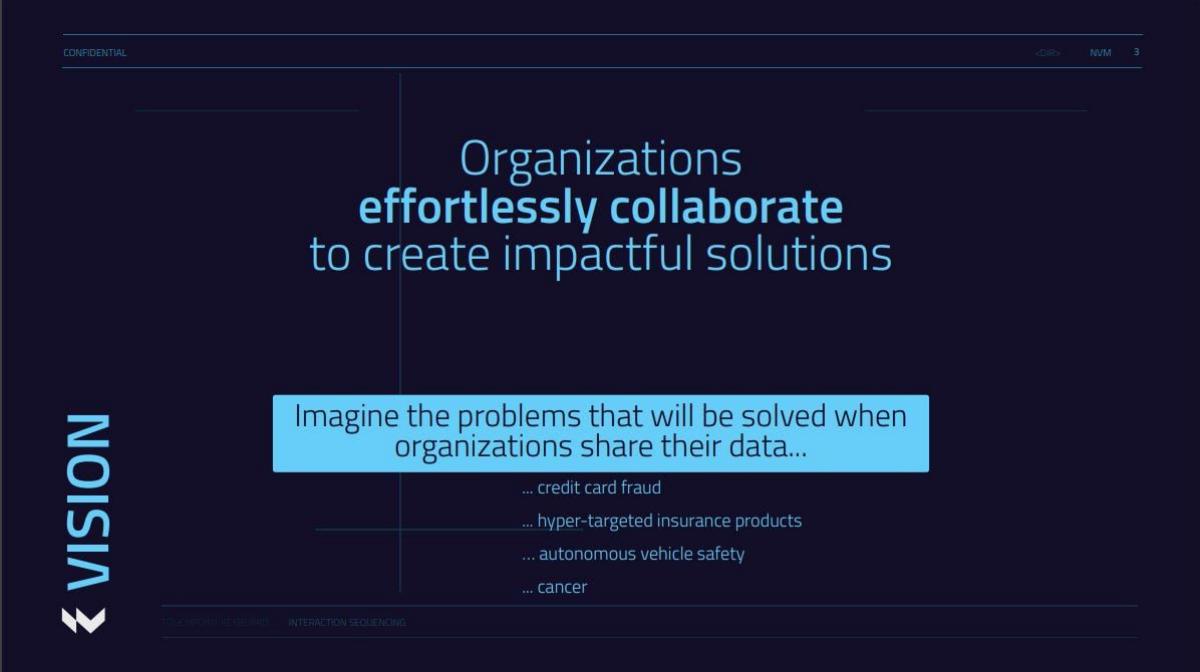
Slide 3 moves directly into the 'Vision.' The headline states: "Organizations effortlessly collaborate to create impactful solutions." Below this, a call to action asks the reader to imagine the problems solved when organizations share data. It lists four high-stakes categories: credit card fraud, hyper-targeted insurance products, autonomous vehicle safety, and cancer. By linking their technical infrastructure to these massive societal and economic challenges, Nevermined attempts to elevate the importance of their middleware from a 'nice-to-have' tool to a critical enabler of global progress.
Slide 5: The Solution
On slide 5, Nevermined defines itself as "the Collaborative Computing Platform." This is a strategic choice of words; it suggests that the platform isn't just about moving data, but about performing computation on that data in a shared environment. The solution is broken down into three steps:
1. Understand your Data: Dig into catalogs and publish assets in a compliant way to 'Monetize data.' · 2. Incentivize Engagement: Deploy incentives to foster a community-driven approach to 'Engage new partners.' · 3. Connect your Community: Replace legacy processes to 'Develop new products & opportunities.'
This slide is effective because it maps technical features directly to business outcomes (monetization, partnership, and product development).
Slide 7: The Opportunity
This is the 'heavy lifter' slide of the deck. It quantifies the market with significant detail. It claims that connecting data across boundaries will create "roughly €3 trillion annually in economic value." The slide further segments the market into 'data users' (716,000 units in EU27 + UK, growing at 0.6%/year) and 'data suppliers' (290,000 units in EU27 + UK, growing at 2.3%/year). By citing specific sources for these figures, Nevermined builds credibility. The 'Market Trends' sidebar reinforces the urgency, noting that 35% of organizations will engage in B2B data sharing and that GDPR legislation is actually a 'favorable' tailwind because it incentivizes structured, compliant collaboration.
Slide 9: Use Case - InsurTech
Abstract infrastructure decks often fail because investors can't visualize the end product. Nevermined solves this on slide 9 with a specific InsurTech example. It describes a 'Past' scenario where data latency and privacy issues prevent insurers from knowing customer locations in real-time. The 'Future with Nevermined' allows an insurer to trigger hyper-targeted products (like travel insurance at an airport) by running computation within a Telco's database without actually consolidating the data. The most compelling figure on this slide is the "Result: A Joint Venture between a Telco & Insurer projected ~$300M in net-new annual revenue." This provides a concrete ROI narrative that justifies a $3M investment.
Slide 11: Business Model
Nevermined presents a very clear, traditional SaaS-style pricing table on slide 11. This is refreshing for a Web3-adjacent company, as it avoids complex tokenomics in favor of recognizable revenue streams:
Open Source: Free, available on GitHub. · Premium: €5,500 / month for SMEs, including binaries, basic support, and advanced tools. · Enterprise: Custom pricing for automated development and full governance frameworks.
The inclusion of a specific price point (€5,500) for the Premium tier suggests that the company has already tested its pricing or has a clear understanding of its target customer's willingness to pay.
Slide 13: Conclusion
The deck ends on slide 13 with a simple 'Thanks' and contact information. Like the opening slide, it maintains the technical, terminal-style aesthetic. It includes a direct email for 'don@nevermined.io' and the company website. While it lacks a final 'visionary' parting thought, it stays consistent with the deck's overall 'no-nonsense' tone.
What Nevermined Does Well
The deck is exceptionally strong at market quantification. By focusing on the EU27 and UK specifically, the founders show they aren't just chasing a global 'TAM' (Total Addressable Market) that is too broad to be meaningful. Instead, they identify specific 'units' of data suppliers and users. This level of granularity is rare in Seed decks and likely helped convince investors of the founders' operational maturity.
Furthermore, the use of a 'Past vs. Future' comparison in the use case slide (Slide 9) is a masterclass in explaining complex middleware. It identifies a specific pain point (data latency and privacy issues) and shows exactly how the product removes that friction to generate revenue. The $300M revenue projection for the pilot project gives the investor a 'North Star' for what success looks like at scale.
What is Missing from the Deck
The most glaring omission in the provided slides is the Team Slide . In a Seed round, the 'Who' is often more important than the 'What.' Investors need to know if the founders have the technical pedigree to build a 'Collaborative Computing Platform' and the enterprise experience to sell into Telcos and Insurers. Without this, the deck relies entirely on the strength of the idea and the market data.
Additionally, there is no Competition Slide . The data management and Web3 infrastructure space is crowded with players like Ocean Protocol or Snowflake (on the centralized side). Nevermined does not explicitly state how it differentiates itself from these incumbents or other startups. Finally, the Ask Slide is missing. A pitch deck is a fundraising tool; failing to state how much is being raised and what the milestones are for that capital (e.g., 'Hire 5 engineers,' 'Close 3 more pilots') leaves the narrative unfinished.
Lessons for Founders
Founders building complex, 'under-the-hood' technology should take note of Nevermined's approach to use cases. Do not just describe what your API does; describe the $300M business opportunity that your API enables. By focusing on the economic output of the technology rather than the technical input , you make the investment case much easier for a non-technical VC to digest.
Another takeaway is the 'Favorable Legislation' argument on slide 7. Many founders view regulation (like GDPR) as a hurdle. Nevermined flips this, positioning regulation as a catalyst that forces companies to use their secure, compliant platform. If your industry is heavily regulated, look for ways to position those rules as a moat for your business rather than a barrier to entry.
Frequently asked questions
- What is the primary problem Nevermined is trying to solve?
- Nevermined addresses the friction in the 'Data Economy.' According to slide 7, organizations struggle to share data across institutional and geographic boundaries due to privacy concerns, data latency, and lack of incentives. The deck argues that solving these issues can unlock roughly €3 trillion in annual economic value by bridging the gap between data users and data suppliers.
- How does Nevermined monetize its platform?
- The company employs a three-tier licensing and services model detailed on slide 11. This includes a 'Free' Open Source tier for GitHub components, a 'Premium' tier for SMEs at €5,500 per month including advanced tools and binaries, and a 'Custom' Enterprise tier for automated collaborative development and extended support.
- What specific industry use cases does the deck highlight?
- Slide 9 focuses on InsurTech, specifically a pilot project involving a joint venture between a Telco and an Insurer. The goal is to use real-time geo-location data to trigger hyper-targeted travel insurance offers when customers are at the airport, without the privacy risks of traditional data consolidation.
- What market data does Nevermined use to justify its opportunity?
- The deck cites that 35% of organizations will engage in B2B data sharing in the future and 36% have already doubled their partner ecosystem size in the last two years (slide 7). It also notes that the data supplier market in the EU27 and UK is growing at 2.3% per year.
- Is there a clear call to action or funding request in the deck?
- While the publisher reports a $3M Seed round was raised, the slides provided do not include a specific 'Ask' slide detailing how the funds will be allocated. The deck concludes on slide 13 with a simple 'Thanks' and contact information for 'don@nevermined.io'.