Netmaker, the WireGuard-based virtual networking platform from Gravitl, Inc., pitched investors and press with a 14-page deck built around a ten-year thesis and 10,000 devices in production use. It is one of the strongest open-source traction decks in this library — deployment-first metrics, a third-party ranking with a real citation, and a named comparison against Tailscale. It is also not a fundraising deck: every revenue number is redacted, there is no ask, no conversion evidence, and the final page is blank.
Key takeaways
- Netmaker's 14-page deck (Gravitl, Inc., copyright 2021, traction data from Q1 2022) pitches a WireGuard-based platform for connecting devices across cloud, data center, IoT and edge environments.
- Slide 3 states a falsifiable ten-year thesis — that network infrastructure will be virtualized with simple overlay networks and no company will own networking hardware — which is the deck's strongest and cheapest asset.
- The traction slide reports over 10,000 devices in active use, 1,400+ production platforms, 50% month-over-month growth sustained for six months, 1,000 community members and 5,500 GitHub stars.
- The most flattering claim on the deck — #3 fastest-growing startup on GitHub in Q1 2022 — is the only one carrying a footnoted external source, a Runa Capital ROSS index URL.
- Every commercial number is redacted: SMB annual spend, enterprise annual spend and the end-of-2023 MRR target based on 150 SMBs plus 5 enterprises are all blacked out in this version of the file.
- The competition slide names Tailscale, Aviatrix and Nebula directly and scores Netmaker as winning all four rows, including kernel WireGuard use and greater than 90% of unencrypted connection speed.
- The go-to-market slide lists three phases of product features across 2021 to 2023 but contains no distribution motion for converting 1,400 self-hosted production platforms into paying customers.
- There is no ask slide, no use of funds and no contact details — the 14th and final page of the PDF is completely blank.
What this deck actually is
This is a 14-page investor pitch deck for Netmaker, the WireGuard-based virtual networking platform built by Gravitl, Inc. The PDF's own title is "Netmaker Deck - TechCrunch", the footer on almost every slide reads "Copyright © 2021 by GRAVITL, Inc.", and the traction slide cites a Runa Capital ROSS index ranking from Q1 2022. So the honest classification is: a 2021-authored deck refreshed with early-2022 traction numbers, used for press and investor conversations at the open-source-with-momentum stage.
That matters, because it explains the deck's shape. It is not a fundraising document in the classic sense — there is no ask slide, no round size, no valuation, no use of funds, and no cap table. The financial model slide has its actual numbers redacted. What you get instead is a thirteen-slide argument that a category is broken, that an open-source project has already proven demand for the fix, and that the fix has a commercial path. For a developer-tools company with 5,500 GitHub stars and 50% month-over-month growth, that is a defensible choice — but it is also the deck's single biggest structural gap, and we will come back to it.
The deck is also unusually disciplined. Thirteen content slides, one blank page at the end, almost no filler, no stock-photo mood boards, no template debris. Compared with most decks in this teardown library, Netmaker's is closer to a technical memo than a sales brochure. It reads like it was written by engineers who resented having to make slides, which — given the founders' background — it almost certainly was.
Slide-by-slide walkthrough
Slide 1 — Title: "next-gen networking"
The cover carries three things: the Netmaker mark, the phrase "next-gen networking", and the Gravitl copyright line. Nothing else. No tagline explaining what the product does, no date, no round, no contact details.
"Next-gen networking" is a positioning statement that could belong to a hundred companies. It tells an investor the category but not the wedge. The deck recovers on slide 4, where the actual one-liner lives — but a cover slide is the one page guaranteed to be seen, screenshotted and forwarded, and this one carries no information a reader could repeat to a colleague. The cheapest fix in the entire deck is moving the slide-4 sentence up to the cover.
Slide 2 — Problem: "Modern networking is fundamentally flawed"
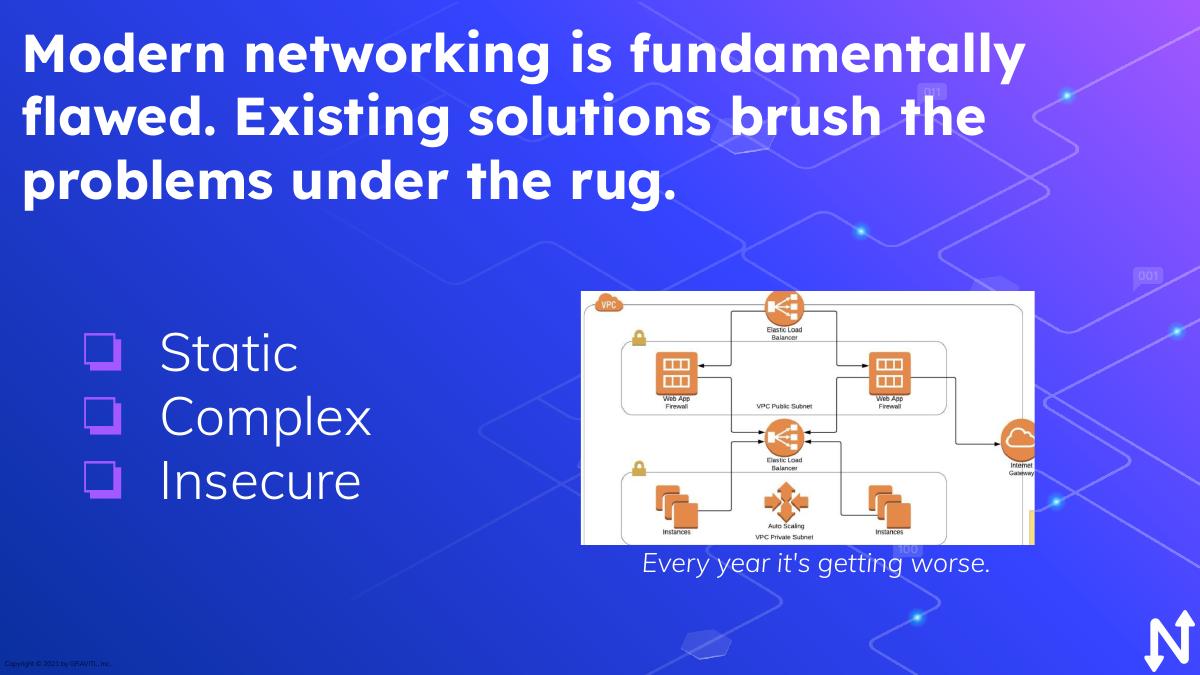
The problem slide states that modern networking is fundamentally flawed and that existing solutions brush the problems under the rug, then lists three failure modes as checkboxes: Static , Complex , Insecure . It closes with "Every year it's getting worse."
Three words is aggressive compression, and for a technical audience it works — anyone who has hand-managed VPN concentrators, firewall rules and site-to-site tunnels fills in the detail themselves. For a generalist investor it does not work at all. There is no dollar figure attached to the pain, no named victim, no "the average enterprise runs X overlapping network tools and spends Y on them." The slide asserts a problem rather than sizing it. If a non-technical partner is in the room, this is the slide where the deck loses them, and every subsequent slide is then being evaluated on faith.
Slide 3 — Thesis: the ten-year view
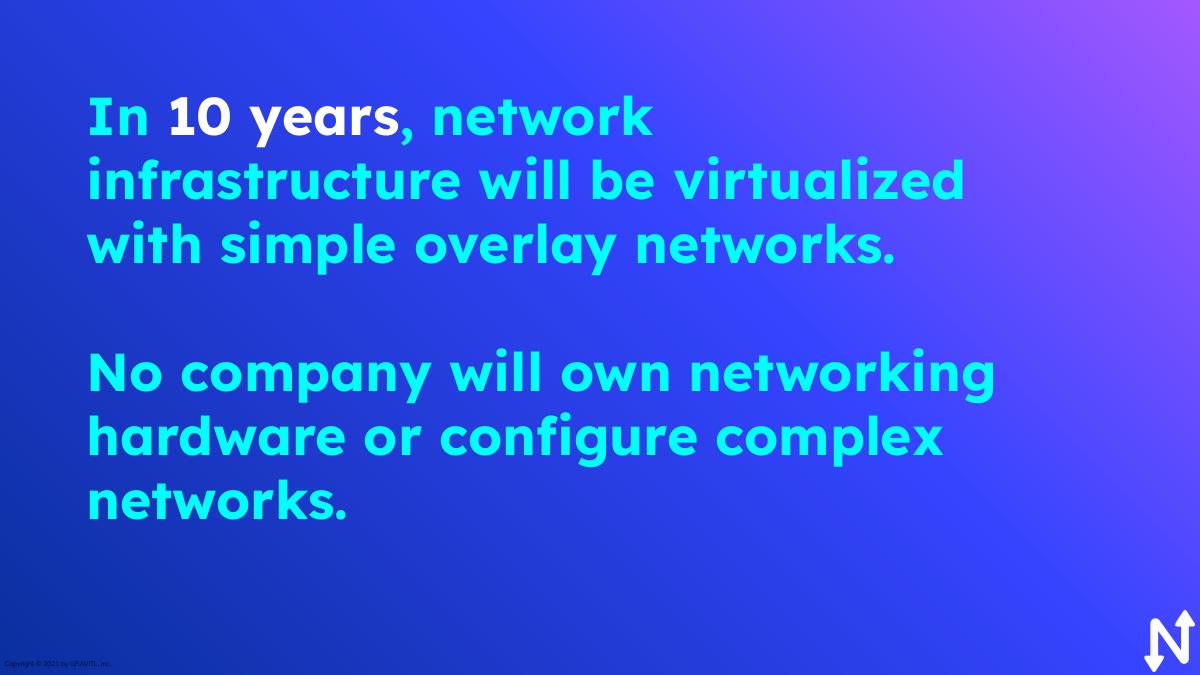
"In 10 years, network infrastructure will be virtualized with simple overlay networks. No company will own networking hardware or configure complex networks."
This is the best slide in the deck, and it is almost never present in the decks we tear down. It is a falsifiable prediction about the world, stated without hedging, that the company is a direct bet on. Investors are in the business of buying a view of the future at a discount, and this slide hands them one in two sentences. If you believe the prediction, Netmaker's whole roadmap becomes obvious; if you do not, you should pass early and everyone's time is saved.
Founders reading this should note what it costs: nothing. One slide, no data, no design. It is pure conviction, and it is the reason a fourteen-page deck with no ask still reads as serious.
Slide 4 — Solution: what Netmaker does
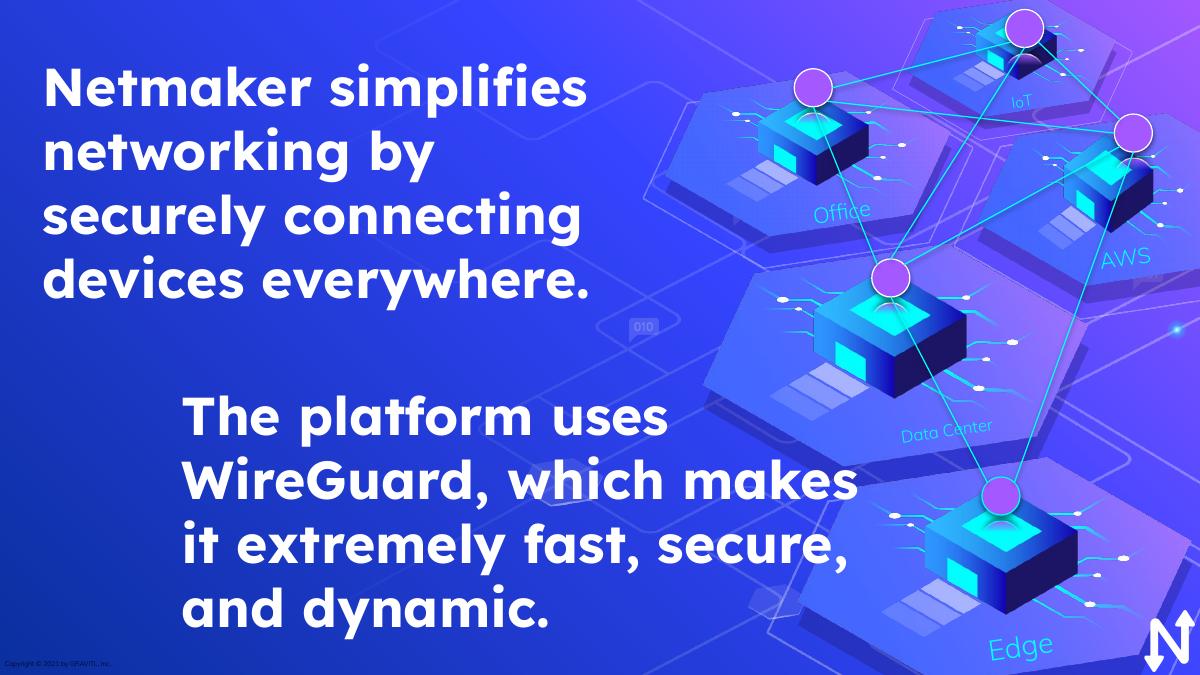
"Netmaker simplifies networking by securely connecting devices everywhere. The platform uses WireGuard, which makes it extremely fast, secure, and dynamic." The right-hand diagram shows the environments being connected: IoT, Office, AWS, Data Center, Edge.
This is the sentence that should have been on the cover. It does three jobs in twenty words: it names the outcome (connect devices everywhere), the mechanism (WireGuard), and the differentiators (fast, secure, dynamic). Naming WireGuard specifically is a deliberate credibility move — in 2021 and 2022, "built on WireGuard" was itself a signal to infrastructure buyers and investors, in the way "built on Postgres" or "built on Kubernetes" was in adjacent categories. The five-environment diagram does the rest of the work, showing scope without a paragraph of prose.
Slide 5 — Market: $3.6B
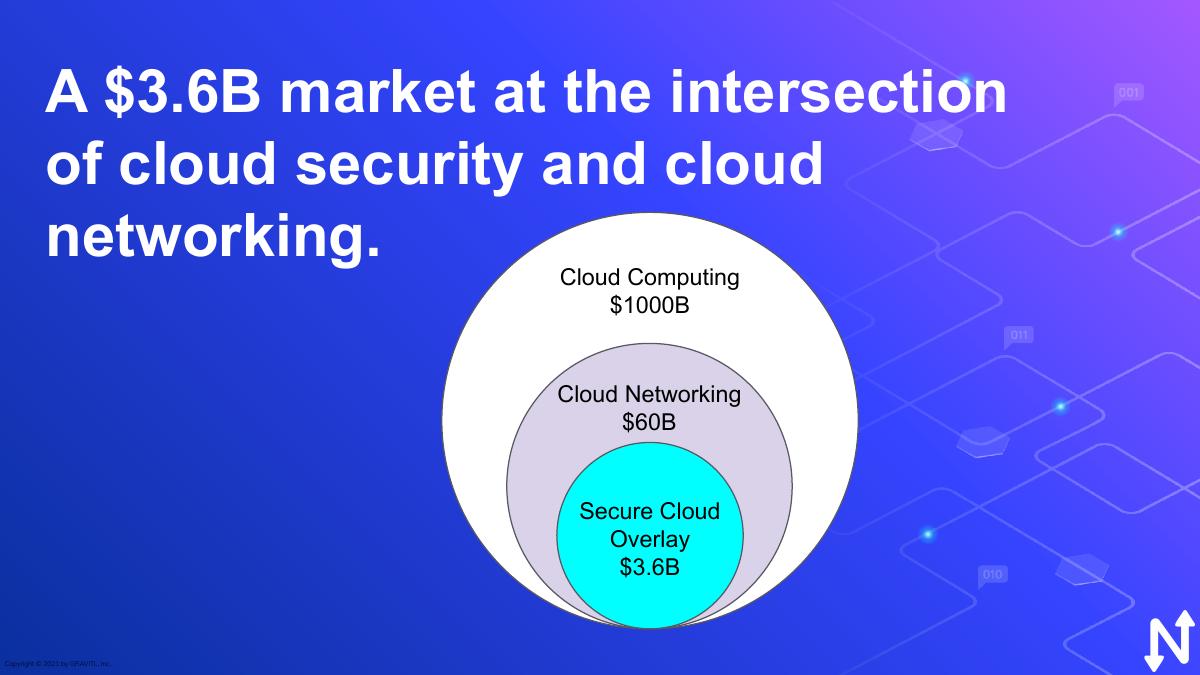
A nested-circle diagram: Cloud Computing at $1,000B, Cloud Networking at $60B, and Secure Cloud Overlay at $3.6B, described as "a $3.6B market at the intersection of cloud security and cloud networking."
The structure is right — the deck narrows from a vanity number to a serviceable one and reports the small figure as its market, rather than claiming the trillion. That is more honest than the vast majority of market slides. What is missing is provenance. There is no analyst source, no date, no methodology note for how $3.6B was derived from $60B. In a room with a partner who covers infrastructure, an unsourced TAM triangle is treated as decoration, not evidence. A single footnote citation would have converted this from a nice graphic into a defensible claim, and the deck already proves it knows how to cite sources — slide 8 has a proper footnote to Runa Capital.
Slide 6 — Product: the platform
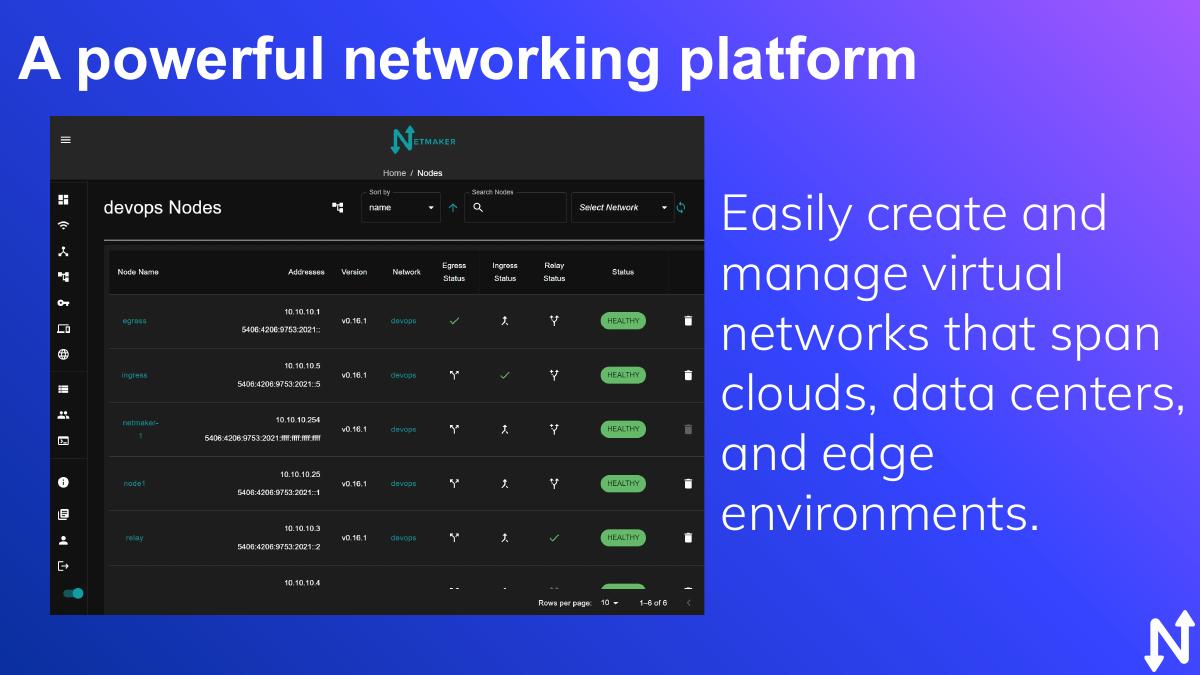
"Easily create and manage virtual networks that span clouds, data centers, and edge environments," alongside a screenshot of the actual Netmaker admin UI showing nodes and network configuration.
Real product screenshots on slide 6 of 14 is a strong signal. There is no "coming soon", no mockup, no Figma render — the software exists and the deck shows it. In a teardown library full of pre-product decks that bury an MVP in an appendix, Netmaker puts the working thing in the first half. The only criticism is scale: it is one screenshot of a list view. The most impressive part of the product is what happens after you add a node, and that is not shown.
Slide 7 — How it works
Four steps: (1) Admin manages networks via UI, (2) machines added with keys, (3) "machines kept in sync by magic", (4) client devices hook in via gateway.
"By magic" is a joke, and it is the right joke — it signals that the founders know the audience does not need the control-plane internals in a pitch. But it is also the deck's most expensive omission dressed up as charm. Step 3 is the company. The sync layer is where the defensibility, the difficulty and the eventual enterprise pricing live. A technical due-diligence reader will circle that word. Keeping the joke on the slide and adding one line underneath — what the sync mechanism actually is, and why it is hard to copy — would have cost nothing and answered the only question a sophisticated investor has after this page.
Slide 8 — Traction: 10,000 devices
The strongest data slide in the deck. In active use on over 10,000 devices, with: 1,400+ production platforms, 50% month-over-month growth for six months, 1,000 community members, 5,500 GitHub stars, and #3 fastest-growing startup on GitHub in Q1 2022 — footnoted to Runa Capital's ROSS index with the full URL. A growth chart of production platforms sits alongside.
This slide is a masterclass in open-source traction reporting for three reasons. First, it leads with deployment (10,000 devices, 1,400 production platforms) rather than vanity engagement — stars are listed fourth, not first. Second, the growth claim is bounded and specific: 50% MoM for six months , not "growing fast". Third, and most importantly, the most flattering claim on the page is the only one with an external citation. Ranking #3 on a third-party index is exactly the sort of number a founder would be tempted to state without a source; sourcing it makes every other unsourced number on the slide more believable by association.
What it does not have: a single revenue figure, a paying customer, or a named logo. That is defensible at this stage — the business model slide says the paid product does not exist yet — but it means the deck is asking the investor to underwrite conversion, and nothing on this page speaks to conversion.
Slide 9 — Business model: open core
"Open Core Model." Current: source-available, self-hosted platform, focused on adoption and promoting the 1.0 release. Next: a closed-source Pro version, with SMB and enterprise annual spend figures — both redacted in this version of the deck — and a redacted MRR target by end of 2023 based on 150 SMBs plus 5 enterprises.
The strategy is legible and standard for the category: build adoption free, monetise the operational features enterprises cannot do without. The customer-count math is also usefully concrete — 150 SMBs and 5 enterprises is a target a board can track quarterly, and it implicitly tells you the shape of the business (volume self-serve plus a handful of large contracts).
But the numbers are redacted, and this is the moment the deck stops being a fundraising document. Price per seat, contract value and target MRR are the three inputs an investor needs to judge whether 10,000 devices can become a venture-scale business. Redaction is understandable for a press-circulated version — the file is literally named "Netmaker Deck - TechCrunch" — and founders should copy the practice of maintaining a public variant. What they should not copy is treating the redacted version as the fundraising version.
Slide 10 — Go to market: three phases
A timeline across 2021, 2022 and 2023 with a "We are here" marker. Phase 1, Start Free: build community and iterate. Phase 2, Add Enterprise: redundancy, metrics, user ACLs. Phase 3, Go SaaS: backups, network backbone.
The "We are here" marker is a small thing that does a lot of work — it converts a plan into a status report and tells the reader exactly how much of the plan is evidence and how much is intention. The three phases also map cleanly onto the open-core model on the previous slide, which is more internal consistency than most decks manage.
What is absent is distribution. Every item in phases 2 and 3 is a product feature. There is no channel, no motion, no pricing experiment, no answer to how 1,400 self-hosted production platforms are identified, contacted and converted. For a bottom-up open-source company that is the single hardest question, and the go-to-market slide does not attempt it.
Slide 11 — Roadmap: two years by quarter
The densest page in the deck. 2022 is mapped quarter by quarter: v0.10–v0.12 with message queue, access control lists and binary packaging in Q1; v0.13–v0.14 with IPv6 networks and a client GUI in Q2; enterprise beta with user access controls, network metrics and failover networks in Q3; a 1.0 release and client proxy in Q4. 2023 covers a SaaS beta and release, Kubernetes integrations, a C client for IoT, client and server refactors, a 2.0 release, and a redacted MRR target.
This is a build plan, and it is a genuinely credible one — versioned, sequenced, and consistent with an open-source project that ships every few weeks. It is also the wrong level of detail for a fourteen-slide investor deck. Twelve months of point releases is diligence-appendix material; what an investor takes from this page is "the founders are organised", which slide 8 already established. The roadmap earns its place only if each phase is tied to a commercial milestone, and here only the final item — the redacted 2023 MRR figure — attempts that.
Slide 12 — Competition: the feature matrix
A comparison table against Tailscale, Aviatrix and Nebula across four rows: creates mesh VPNs, uses kernel WireGuard, configures for infrastructure, and greater than 90% of the speed of direct unencrypted connections. Netmaker is the only column with a full set of checks.
Naming Tailscale directly is the right call — in 2022 no infrastructure investor would have sat through this deck without asking about Tailscale, so answering before being asked keeps control of the narrative. The chosen axes are also genuinely differentiating rather than self-serving: kernel WireGuard versus userspace, and infrastructure configuration versus device-to-device connectivity, are the two real technical distinctions in that category.
The predictable weakness is that it is a founder-scored table where the founder wins every row. There is no axis on which a competitor is better — no ease of setup, no managed hosting, no funding or customer scale. Any table where you win 4-0 invites the reader to find the fifth row you left out. Adding one row you lose, and explaining why it does not matter yet, would make the other four rows credible.
Slide 13 — Team: technical co-founders
Two founders, Alex and Dillon, with three shared bullets: worked together at IBM, managed teams for multi-cloud and Kubernetes, helped secure millions in deals.
The founder-market fit argument is right — the pair have worked together, they come from exactly the multi-cloud and Kubernetes world the product serves, and the third bullet quietly pre-empts the "can engineers sell?" objection. As the second-to-last slide, following a traction page and a competition page, it lands well.
What is missing is everything specific. No surnames on the slide text, no titles, no LinkedIn links, no years at IBM, no team size beyond the two of them, and no advisors. "Helped secure millions in deals" is the kind of claim that gets much stronger with a single number or a named account. An investor who wants to reference-check this team has to leave the deck to do it.
Slide 14 — Blank
The final page is empty. No thank-you, no contact details, no email address, no calendar link, no repository URL. For a deck built to be forwarded — and one whose filename says it went to press — ending on a blank page is the most straightforwardly fixable error in the file. The reader who has just been convinced by slide 8 has nowhere to go.
What this deck does better than most startup pitch decks
It states a falsifiable ten-year thesis. Slide 3 makes a specific prediction about how network infrastructure will look in a decade. Most decks describe a product; this one describes a world and then positions the product inside it. · It leads traction with deployment, not vanity. 10,000 devices and 1,400 production platforms come before 5,500 GitHub stars. Ordering those metrics correctly signals that the founders know which one an investor should weight. · It cites its most flattering claim. The "#3 fastest growing startup on GitHub" line carries a footnote and a live URL to Runa Capital's index. Sourcing the number you most want believed is the cheapest credibility purchase in deck-making. · It bounds its growth claim. "50% MoM growth for six months" is specific in both rate and duration. "Growing fast" and "hockey stick" are what most decks put here. · It shows the real product on slide 6. Actual admin UI, not a mockup, in the first half of the deck. · It names its biggest competitor. Putting Tailscale in a table rather than waiting to be asked keeps the framing with the founder. · It reports the small market number. The nested circles narrow from $1,000B to $60B to $3.6B, and the headline claims the $3.6B. · It marks where the company actually is. "We are here" on the go-to-market timeline separates evidence from intention in one label. · It is short and free of filler. Thirteen content slides, no stock photography, no mission-statement page, no team-values slide.
Where this deck would fail in an investor meeting
There is no ask. No round size, no valuation, no use of funds, no runway, no milestones the money buys. A deck without an ask cannot close a meeting; it can only start one. · The revenue numbers are redacted. SMB price, enterprise price and target MRR are all blacked out. Without them, an investor cannot model whether 150 SMBs plus 5 enterprises is a seed-stage business or a Series A one. · There is no revenue and no conversion evidence. 1,400 production platforms is impressive adoption, but nothing in the deck shows that any of them will pay, or that any have been asked. · The market number is unsourced. $3.6B appears with no analyst, no year and no derivation, on the one slide where a citation would have mattered as much as it did on slide 8. · The problem slide is three words. Static, complex, insecure works for engineers and fails for generalists. No cost of the problem, no named sufferer. · Go to market is a feature list. Redundancy, metrics and ACLs are product; they are not a distribution motion, a pricing experiment or a sales plan. · "Kept in sync by magic" hides the defensibility. The one technical claim that determines whether this is a moat or a wrapper is the one sentence the deck declines to make. · The competition table is 4-0. Winning every row invites the reader to invent the row you omitted. · The team slide has no surnames, titles or links. Two first names and three shared bullets is not enough for an investor to reference the founders. · The deck ends on a blank page. No contact, no repository link, no next step at the exact moment attention is highest.
Open-source traction deck vs. a fundraising deck
Element What the Netmaker deck does What a fundraising deck needs
Thesis Explicit ten-year prediction (slide 3) Same — this is the part to keep verbatim
Traction 10,000 devices, 1,400 platforms, 50% MoM, cited index rank Same, plus conversion: paid pilots, waitlist for Pro, design partners
Revenue model Open core described, all prices redacted Named price points, ACV, and the assumptions behind the MRR target
Market $3.6B nested circles, unsourced Same structure with an analyst citation and a bottom-up cross-check
Go to market Three product phases across three years Distribution motion: how self-hosters are identified and converted
Roadmap Two years of point releases by quarter Four commercial milestones; the release list moves to the data room
Team Two first names, three shared bullets Full names, titles, tenure, links, key hires the round funds
Ask Absent Amount, instrument, use of funds, and what it proves by when
Close Blank final page Contact, repo link, and a single next action
How you would rebuild this deck without losing what makes it good
Move the slide-4 sentence to the cover. "Netmaker securely connects devices everywhere, on WireGuard" beats "next-gen networking" on the one page everybody reads. · Keep slide 3 exactly as it is. The ten-year thesis is the deck's spine. Do not soften it, do not hedge it, do not add a second paragraph. · Give the problem slide a cost. Keep static, complex, insecure as the headline, then add one line quantifying what those three words cost a mid-sized engineering org per year. · Footnote the market slide. The deck already demonstrates on slide 8 that it knows how to cite. Apply the same standard to $3.6B and add a bottom-up cross-check from device counts and price per device. · Unredact the model for the investor version. Maintain two files: a press version with prices removed, and a fundraising version with SMB price, enterprise ACV, the MRR target, and the conversion rate assumed from 1,400 production platforms to 150 paying SMBs. · Add a conversion slide after traction. Even at pre-revenue: number of Pro waitlist signups, inbound enterprise enquiries, design partners named or anonymised. This is the slide the deck most needs and does not have. · Replace the roadmap page with four commercial milestones. Enterprise beta, first paid contract, SaaS launch, target ARR. Move the version-by-version release plan to the data room where diligence readers will actually use it. · Say what the magic is. One sentence on the sync mechanism, in the founders' own words, and why it is hard to replicate. Keep the joke as the headline. · Add a losing row to the competition table. Concede one axis to Tailscale, then explain why it does not decide the outcome for infrastructure buyers. · Rebuild the team slide with specifics. Full names, titles, years at IBM, one concrete deal figure behind "helped secure millions", and links. · Use the blank page. Ask slide: amount, instrument, use of funds, milestones. Then contact details and the GitHub URL.
The transferable lesson
Netmaker's deck is the rare case where the argument is stronger than the packaging. The thesis slide, the deployment-first traction page, and the cited third-party ranking are all things most founders never think to do, and they are the reason a fourteen-page file with a blank ending still reads as a serious company. Almost everything else the deck is missing — the ask, the prices, the conversion evidence, the distribution plan — is missing not because the founders lacked the information, but because the deck was built to be forwarded rather than to close a round.
That is the trap worth naming. A press deck and a fundraising deck look identical until an investor tries to make a decision with one. If your deck has real traction and no ask, no pricing and no conversion path, you have built an excellent introduction and no closing document — and the meeting ends with "keep us posted" instead of a term sheet.
The test to run on your own deck is simple: hand it to someone who has never heard of your company and ask them to state, in one sentence each, what you sell, who pays, how much, how many are paying now, and what you are asking for. Netmaker's deck answers the first question brilliantly and cannot answer the last three. Most decks are the reverse — a confident ask sitting on top of an argument nobody can repeat. You need both, and the only way to find out which half you are missing is to have your deck read the way an investor reads it, slide by slide, before you send it.
Frequently asked questions
- What is Netmaker?
- Netmaker is a virtual networking platform built by Gravitl, Inc. that uses WireGuard to securely connect devices across clouds, data centers, offices, IoT deployments and edge environments. Administrators create and manage overlay networks through a web UI, add machines with keys, and connect client devices through gateways. At the time of this deck it was source-available and self-hosted, with over 10,000 devices in active use.
- Is the Netmaker deck a real investor pitch deck?
- It is a real 14-page deck from Gravitl, Inc., though the PDF's internal title is 'Netmaker Deck - TechCrunch', suggesting it circulated for press as well as investors. It contains problem, thesis, solution, market, product, traction, business model, go-to-market, roadmap, competition and team slides, but no ask slide and no unredacted pricing, so it functions as an introduction rather than a closing fundraising document.
- What traction does the Netmaker pitch deck show?
- Slide 8 reports over 10,000 devices in active use, 1,400+ production platforms, 50% month-over-month growth sustained for six months, 1,000 community members and 5,500 GitHub stars, plus a ranking as the #3 fastest-growing startup on GitHub in Q1 2022 footnoted to Runa Capital's ROSS index. There is no revenue figure and no named customer anywhere in the deck.
- How does Netmaker compare itself to Tailscale?
- Slide 12 is a feature matrix against Tailscale, Aviatrix and Nebula with four rows: creates mesh VPNs, uses kernel WireGuard, configures for infrastructure, and delivers over 90% of the speed of direct unencrypted connections. Netmaker is scored as the only product satisfying all four. Naming the category leader directly is a strength, but winning every row makes the table read as founder-scored.
- Which slides should founders copy from this deck?
- Three of them. Slide 3, the ten-year thesis, states a falsifiable prediction about the world and costs nothing to produce. Slide 8 orders traction correctly by leading with deployment counts before GitHub stars, bounds its growth claim in both rate and duration, and cites its most impressive number. Slide 10 marks 'We are here' on the timeline, separating evidence from intention in a single label.
- What is missing from the Netmaker pitch deck?
- The ask is the biggest gap: no round size, valuation, use of funds or runway. Every pricing figure and the MRR target are redacted. There is no conversion evidence linking 1,400 self-hosted production platforms to future paying customers, the $3.6B market figure has no source, the go-to-market slide lists product features instead of a distribution motion, and the final page is blank with no contact details.