Quaise Energy’s pitch deck is a masterclass in technical storytelling for hard-tech startups. By framing the global energy crisis not just as a carbon problem, but as a scalability and power density problem, the company positions its millimeter-wave drilling technology as the missing link for net-zero goals. The deck effectively bridges the gap between high-level climate targets and granular engineering solutions, such as vitrified well walls and gyrotron-guided waves. While the deck lacks a traditional team slide or detailed unit economics in the provided selection, it successfully communica…
Key takeaways
- The deck frames geothermal potential as a 100x scalability play, targeting depths of 20 km to reach the entire world population (Slide 5).
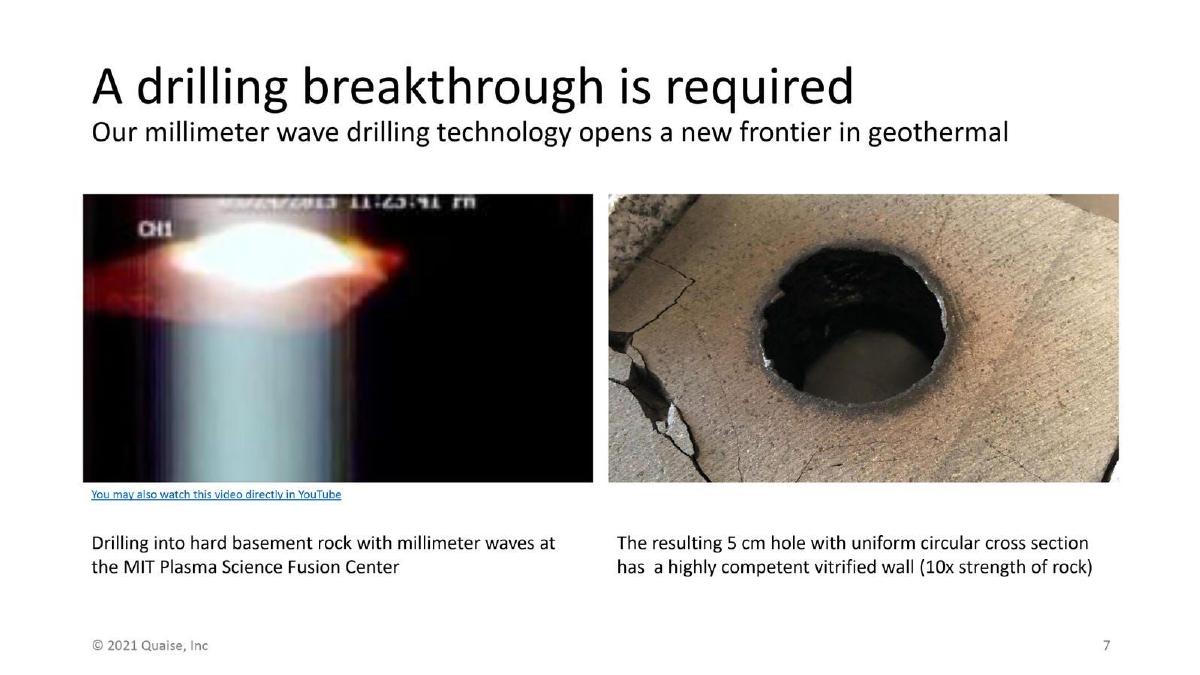
- Technical proof is provided through images of a 5 cm hole in hard basement rock drilled at the MIT Plasma Science Fusion Center (Slide 7).
- The technology claims to create a vitrified wall that is 10x the strength of the surrounding rock (Slide 7).
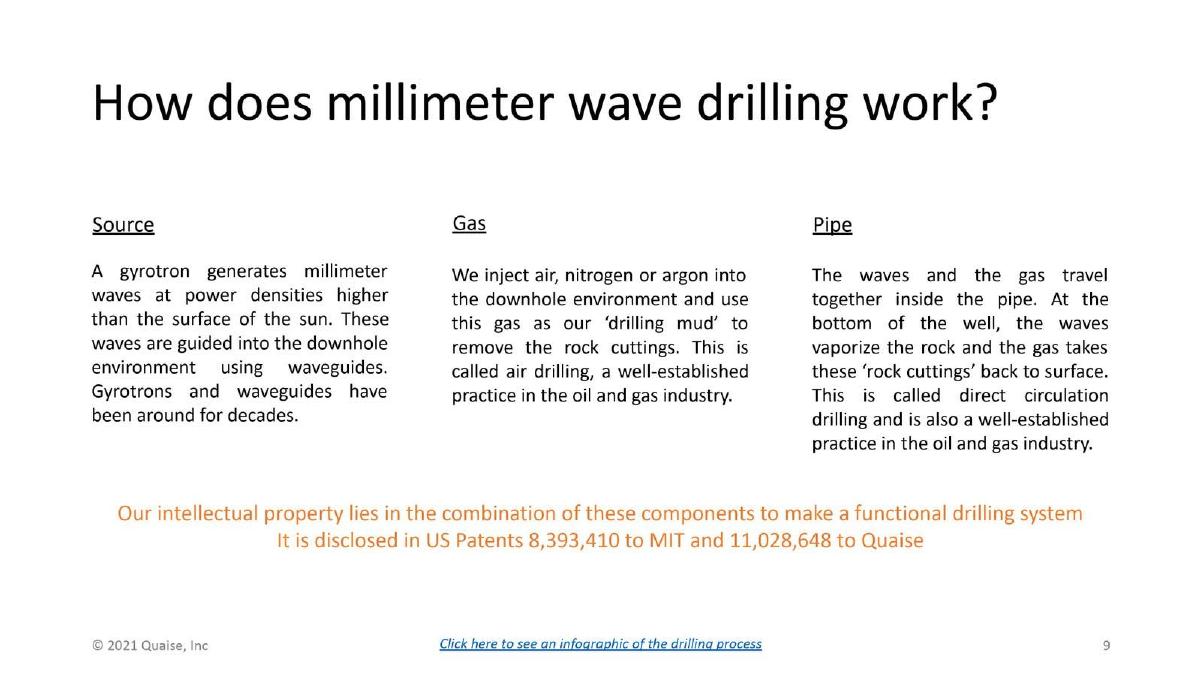
- The business model leverages existing oil and gas industry practices, specifically air drilling and direct circulation drilling (Slide 9).
- Intellectual property is anchored in two specific patents: US 8,393,410 (MIT) and 11,028,648 (Quaise) (Slide 9).
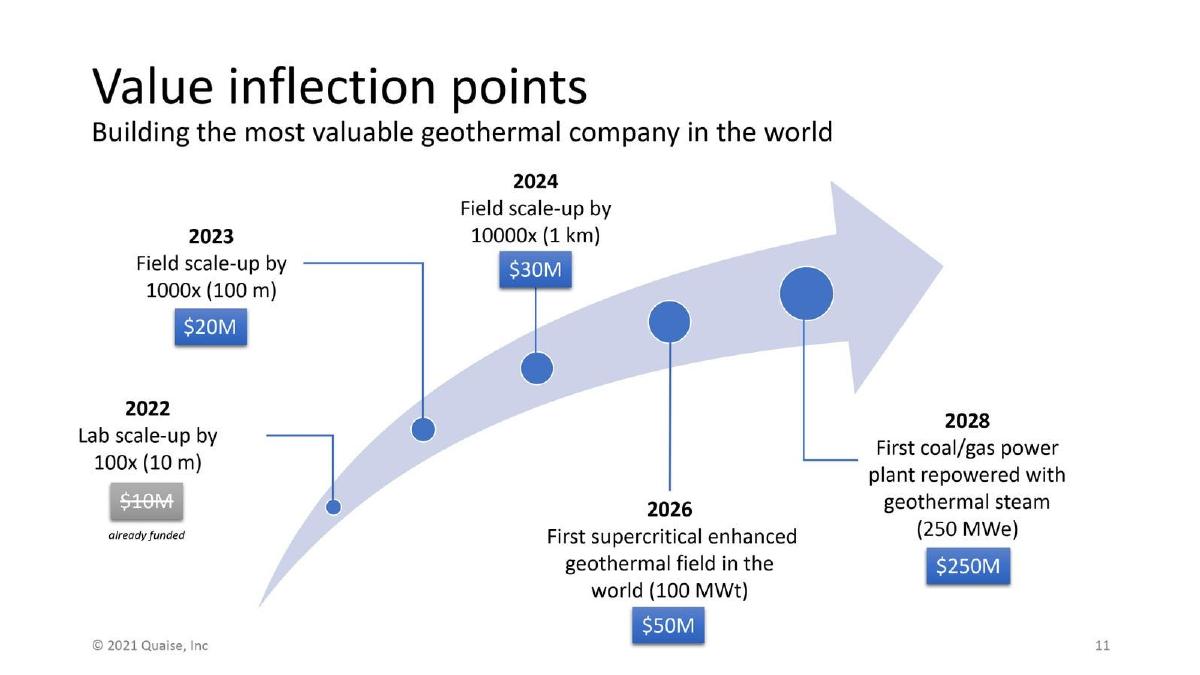
- The roadmap outlines a clear capital requirement path, starting with $10M for lab scale-up and peaking at $250M for the first repowered power plant (Slide 11).
- The ultimate goal is 1 TW of geothermal capacity by 2050, which would eliminate half a Gigaton of CO2 emissions annually (Slide 13).
- The deck omits a dedicated team slide, competitive landscape analysis, and specific financial projections beyond milestone funding needs.
Introduction: The Quest for Deep Geothermal
Quaise Energy is a North American energy company that emerged with a bold promise: to unlock the heat of the earth at depths previously unreachable by conventional mechanical drilling. As reported by Business Insider, the company raised a $52M Series A in 2022 to advance its millimeter-wave drilling technology. This teardown examines the 15-slide deck used to communicate that vision to investors.
Slide 1: Title Slide
The deck opens with a minimalist title slide: Scaling Geothermal: An essential primary energy source to reach net zero . It introduces Carlos Araque, Founder and CEO, and establishes the company's branding. The subtitle immediately frames the company not just as a drilling firm, but as a critical player in the global climate transition.
Slide 3: The Problem Statement
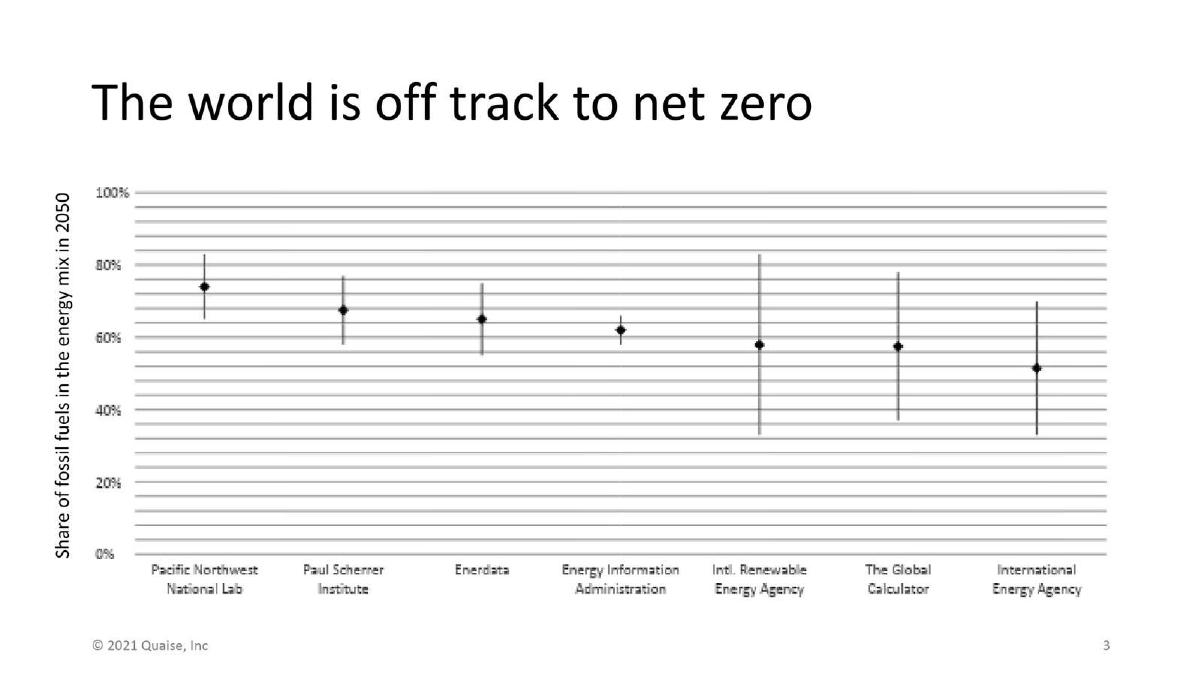
Slide 3, titled The world is off track to net zero , uses a data-heavy chart showing the projected share of fossil fuels in the energy mix in 2050 across various institutions (Pacific Northwest National Lab, IEA, etc.). Most projections hover between 50% and 80%, illustrating a massive gap between current trajectories and climate goals. This slide establishes the urgency and the market opportunity for a new, scalable primary energy source.
Slide 5: The Opportunity
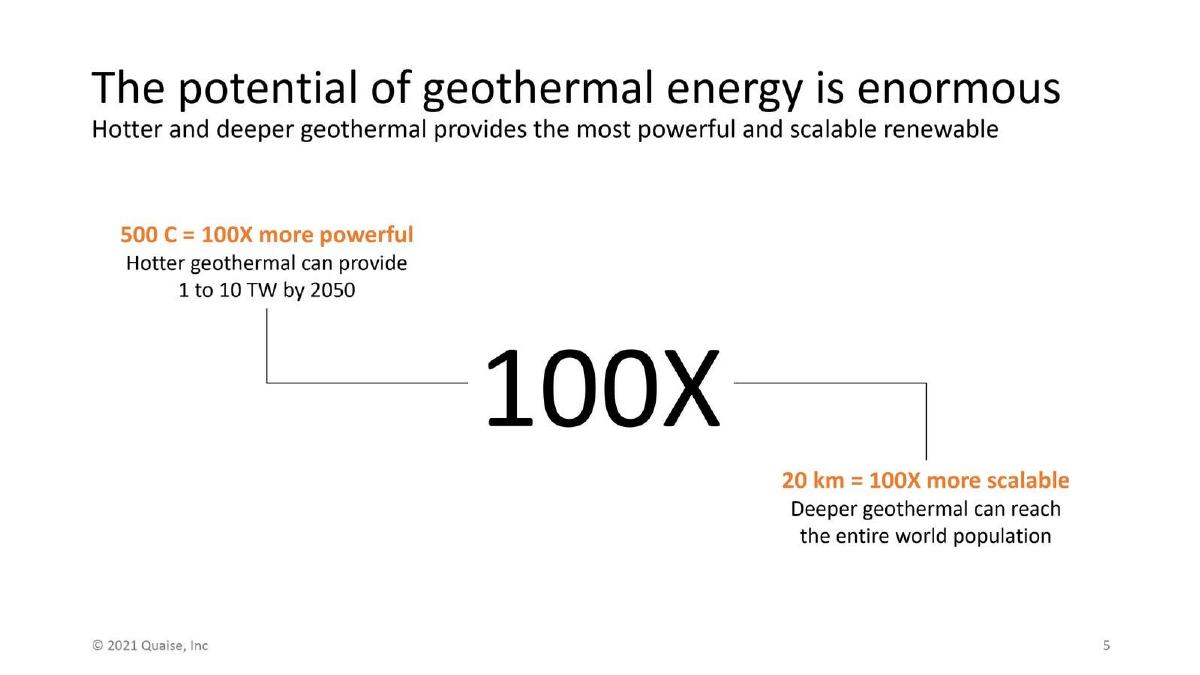
Slide 5 defines the scale of the solution: The potential of geothermal energy is enormous . It introduces two key metrics: 500°C and 20 km. The slide claims that hotter geothermal (500°C) is 100X more powerful and can provide 1 to 10 TW by 2050. Furthermore, drilling to 20 km makes geothermal 100X more scalable , allowing it to reach the entire world population regardless of geographic location. This is a critical pivot from traditional geothermal, which is limited to specific volcanic regions.
Slide 7: Technical Proof of Concept
Hard-tech decks require proof of feasibility. Slide 7, A drilling breakthrough is required , provides visual evidence. It shows a video still of millimeter-wave drilling into hard basement rock at the MIT Plasma Science Fusion Center and a photograph of the resulting 5 cm hole. The slide notes that the process creates a highly competent vitrified wall with 10x the strength of the rock, solving a major engineering hurdle in deep-well stability.
Slide 9: The Mechanism of Action
Slide 9 answers the question: How does millimeter wave drilling work? It breaks the system down into three components:
Source: A gyrotron generates millimeter waves at power densities higher than the surface of the sun. · Gas: Air, nitrogen, or argon is injected to remove rock cuttings, a practice borrowed from the oil and gas industry. · Pipe: Waves and gas travel together; waves vaporize the rock, and gas carries the cuttings to the surface.
The slide also lists the specific patents (US 8,393,410 and 11,028,648) that protect this combination of technologies.
Slide 11: Value Inflection Points
This slide provides a clear roadmap for investors. It outlines the funding and technical milestones required to build the most valuable geothermal company in the world :
2022: Lab scale-up ($10M, noted as already funded). · 2023: 100m field scale-up ($20M). · 2024: 1km field scale-up ($30M). · 2026: First supercritical enhanced geothermal field ($50M). · 2028: First coal/gas power plant repowered (250 MWe, $250M).
This transparency regarding future capital needs is rare but effective for infrastructure-heavy startups.
Slide 13: Impact and Market Fit
Slide 13, Achieving massive impact , focuses on the end goal of 1 TW by 2050. It highlights the strategy of repowering existing fossil fuel plants, which allows Quaise to use existing turbines and grid infrastructure. The slide notes that 1 TW of geothermal capacity eliminates half a Gigaton of CO2 emissions per year, tying the technical success directly to environmental impact.
Slide 15: Closing
The final slide returns to the company logo and contact information for Carlos Araque, maintaining the clean, professional aesthetic established at the start.
What Quaise Energy Does Well
The deck excels at technical translation . It takes a complex concept—using high-frequency electromagnetic waves to melt rock—and explains it through analogies (power density of the sun) and familiar industry terms (drilling mud, waveguides). By citing specific patents and MIT research, the deck builds immediate credibility.
The roadmap on Slide 11 is particularly strong. It doesn't just list dates; it lists the specific dollar amounts required for each phase. This allows investors to understand the capital intensity of the business and the specific valuation step-ups they are buying into. It transforms a high-risk science project into a structured infrastructure play.
What is Missing from the Deck
Despite the successful raise, the deck has several notable omissions based on the slides provided:
Team Slide: There is no slide detailing the backgrounds of the engineering and leadership team. In deep-tech, the pedigree of the scientists and the operational experience of the founders are usually paramount. · Competition: The deck does not address other advanced geothermal players (e.g., Fervo Energy, Eavor) or explain why millimeter-wave drilling is superior to other next-gen drilling techniques like plasma or laser drilling. · Unit Economics: While the deck mentions the cost of repowering plants, it lacks a detailed breakdown of the Levelized Cost of Energy (LCOE) compared to wind, solar, or traditional geothermal. · Risk Mitigation: The deck is highly optimistic. It does not explicitly address the risks of gyrotron degradation at depth or the geological uncertainties of supercritical fluids.
Founder Takeaways
1. Use Visual Evidence: If you are building hardware, show it working. The photo of the vitrified hole on Slide 7 is more persuasive than any bullet point about drilling efficiency.
2. Leverage Existing Infrastructure: Quaise’s strongest business argument is that they don't need to build new power plants; they just need to replace the heat source of old ones. If your technology can 'piggyback' on existing multi-billion dollar infrastructure, make that a central pillar of your pitch.
3. Quantify the 'Why Now': Slide 3 uses third-party data to show that the world is failing its climate goals. This creates a 'market pull' effect, suggesting that the world needs Quaise to succeed because existing solutions are insufficient.
4. Be Clear About Capital: Don't hide the fact that your company will need hundreds of millions of dollars. By laying out the $250M requirement for 2028, Quaise filters for investors who have the stomach and the dry powder for long-term infrastructure projects.
Frequently asked questions
- What is the core technology behind Quaise Energy?
- Quaise uses millimeter-wave drilling powered by gyrotrons. Unlike mechanical drill bits that wear out in hard rock, this technology uses high-power electromagnetic waves to vaporize rock. This allows for drilling much deeper (up to 20 km) where temperatures reach 500°C, providing a power density comparable to fossil fuels.
- How does Quaise plan to scale its geothermal solution?
- The company intends to repower existing coal and gas power plants. By drilling deep geothermal wells at these sites, they can use the existing steam turbines and grid connections, significantly reducing the infrastructure costs typically associated with transitioning to renewable energy.
- What are the key milestones in the Quaise roadmap?
- The roadmap (Slide 11) targets a 100m field scale-up in 2023, a 1km scale-up in 2024, the first supercritical enhanced geothermal field in 2026, and the first 250 MWe repowered fossil fuel plant by 2028.
- What intellectual property does the company hold?
- Slide 9 explicitly cites two patents: US Patent 8,393,410, which is licensed from MIT, and US Patent 11,028,648, which is held by Quaise. The IP covers the combination of gyrotrons, waveguides, and gas injection to create a functional drilling system.
- How much capital does Quaise need to reach commercialization?
- According to Slide 11, the company projected a need for $20M in 2023, $30M in 2024, $50M in 2026, and $250M in 2028 to reach the milestone of the first repowered power plant. The reported $52M Series A in 2022 provided the initial runway for these early scale-up phases.