QoC Health’s 2014 deck outlines a clear strategy for tackling the high costs of hospital re-admissions and inefficient community care. By 2013, the company had already achieved over $280,000 in annual revenue and signed its first international client. The deck emphasizes a 'platform approach' over standalone apps, supported by a strategic partnership with McKesson Canada for HL7 integration. While the financial projections are aggressive—forecasting a jump from $734,720 in 2014 to $4.59 million by 2016—the deck successfully leverages early traction and a specialized team to justify its seed r…
Key takeaways
- The problem slide identifies that re-admissions cost Canada $1.8 billion annually and unnecessary appointments cost the US $125 billion per year (Slide 2).
- QoC Health positions itself as a unified platform rather than a single app, supporting post-surgery, aging, and wound care (Slide 4).
- A key competitive advantage is their partnership with McKesson Canada for integration with existing healthcare workflows via HL7 (Slide 5).
- The total North American market for their categories is estimated between $17.7 billion and $35.8 billion (Slide 6).
- Historical revenue grew from $0 in 2011 to $280,979 in 2013 with only 3 customers (Slide 8).
- The company is a Certified B Corporation, which is highlighted alongside the team photos (Slide 9).
- Future milestones for a Series A include reaching $10 million in revenue and 30-40 recurring clients (Slide 7).
- The team is led by Chancellor Crawford (CEO/Tech) and includes specialized roles for Healthcare Strategy and Quality Improvement (Slide 9).
Slide-by-Slide Analysis
Slide 1: Confidentiality Notice
The deck opens with a standard legal disclaimer. It establishes the company name as QOC Health Inc. and notes a copyright date of 2014. This slide serves as a formal entry point, though it offers no insight into the product or market.
Slide 2: The Problem
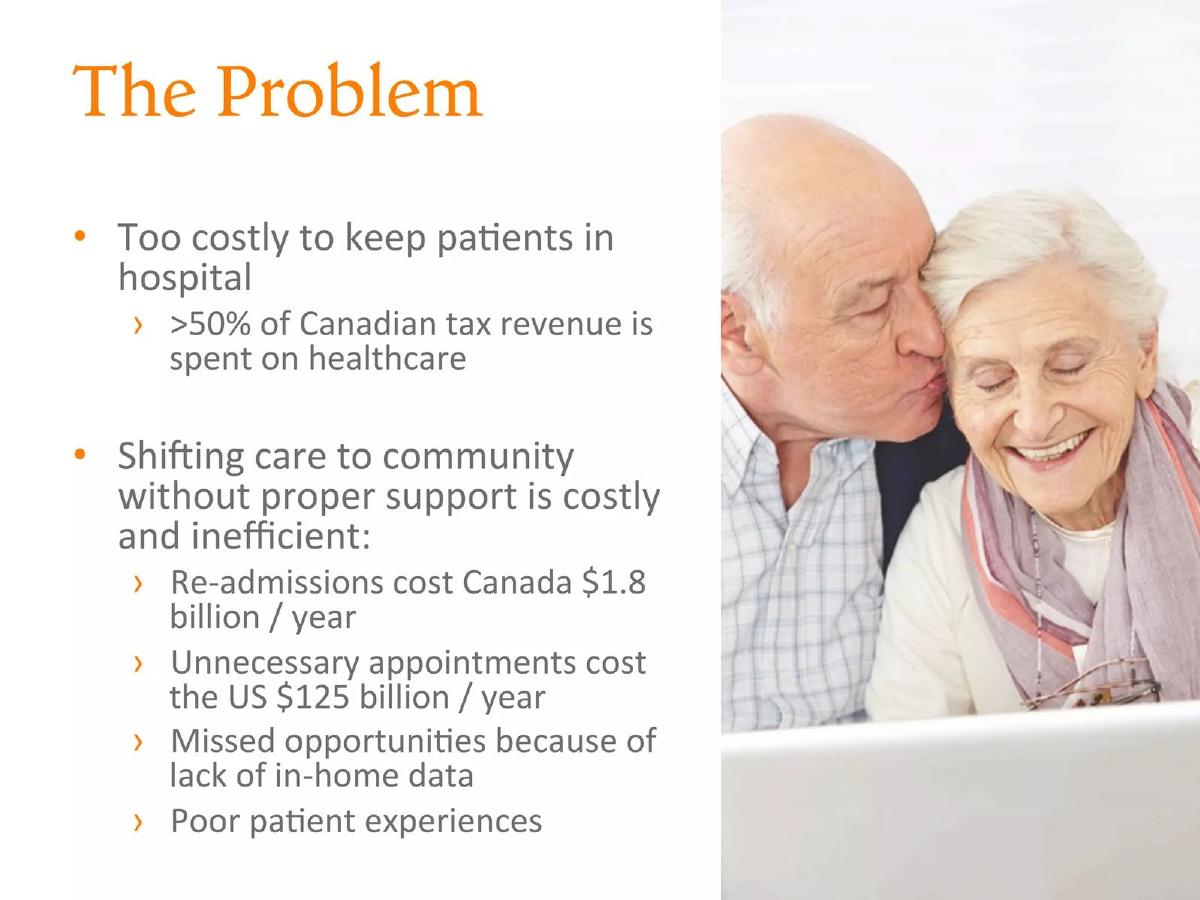
This slide uses a two-pronged approach to define the market pain. First, it addresses the macro-economic burden: ">50% of Canadian tax revenue is spent on healthcare." Second, it identifies specific inefficiencies in shifting care to the community. It cites that re-admissions cost Canada "$1.8 billion / year" and unnecessary appointments cost the US "$125 billion / year." The slide effectively links high-level government spending to granular operational failures like the lack of in-home data and poor patient experiences.
Slide 3: Our Solution (Product UI)
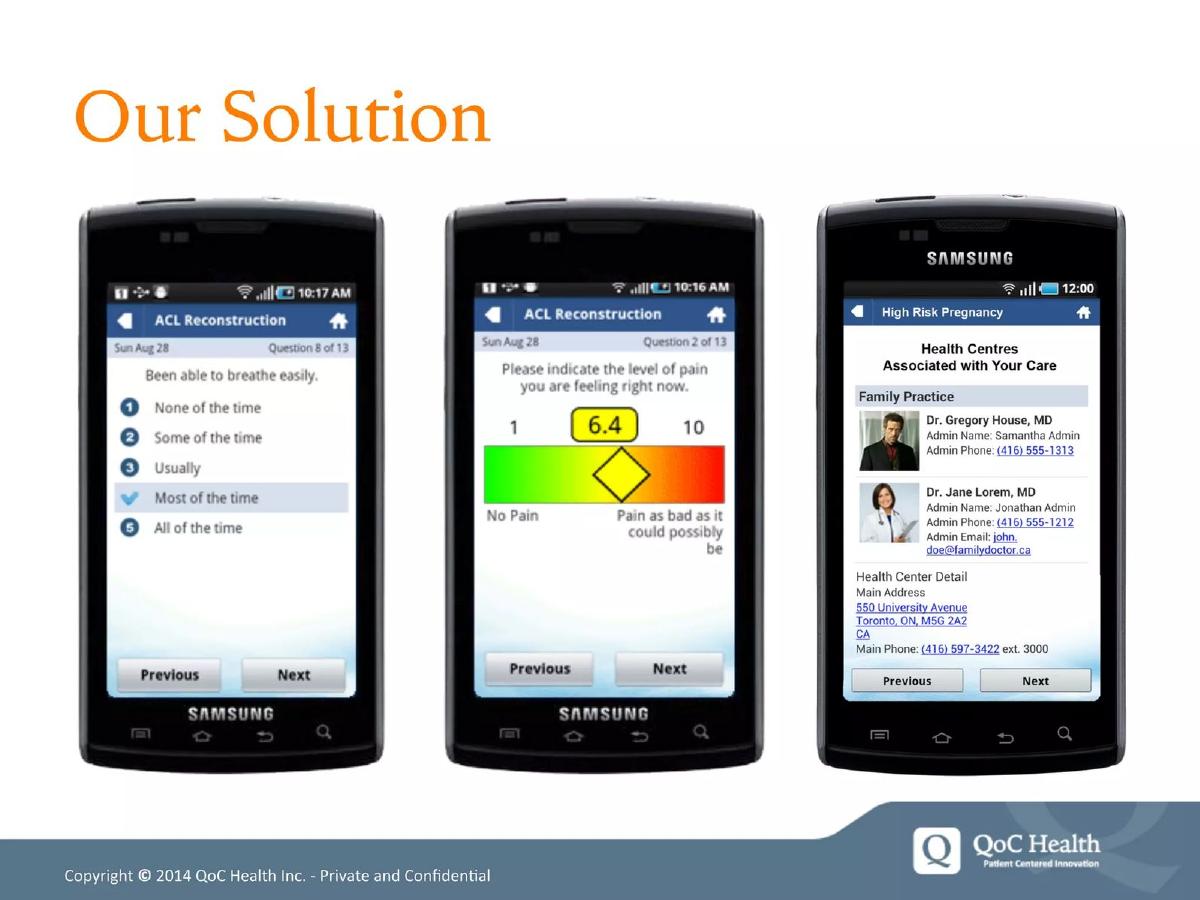
QoC Health shows three screenshots of their mobile application on Samsung devices. The UI displays patient surveys for "ACL Reconstruction" and "High Risk Pregnancy." Features include pain level sliders (rated 1 to 10) and a directory of associated Health Centres and doctors (e.g., Dr. Gregory House, MD). The visual evidence confirms the product is functional and mobile-first.
Slide 4: Our Solution (Platform Architecture)
This slide clarifies that QoC Health is not just a single app but a "unified platform." It visualizes a 'Cloud Connect Platform' that handles profiles, data, analytics, and security. Above this layer sit specific modules: "Post-surgery discharge monitoring," "Aging well," and "Wound care." It also indicates extensibility by showing slots for "Other QoC apps" and "Apps from other developers."
Slide 5: The QoC Difference
The company lists four competitive advantages. The most significant is point number two: "Integration with current systems / workflows through HL7" via a "Partnership with McKesson Canada." This addresses a major hurdle in health-tech: interoperability. They also emphasize independent validation and a platform approach for scalability.
Slide 6: Go-to-Market
This slide breaks down the market opportunity by category. The "Total (North America)" market is estimated at "$17.7 - $35.8" billion. The slide also assigns specific team members to lead generation efforts. For example, Dr. John Semple and Randy Ostojic are tasked with 'Thought leadership' and 'Business development' for the post-surgery and wound care segments.
Slide 7: Timeline / Growth Milestones
The timeline is divided into three stages. "Pre-seed (complete)" highlights incorporation in Nov 2010 and reaching "Annual revenues of > $250K" by Dec 2013. The "Seed Round (current)" goals include securing 4 multi-year clients and 10 pilot projects by Dec 2015. The "Series A (future)" target is a bold "$10 million in revenue."
Slide 8: Finances
This slide provides a table of actuals (2011-2013) and projections (2014-2016). Revenue grew from "$70,800" in 2012 to "$280,979" in 2013. The projections show a steep climb, expecting to hit "$4,590,000" in revenue by 2016 with 55 customers. Interestingly, expenses are projected to stay relatively flat between 2015 ( "$1,674,620" ) and 2016 ( "$1,596,670" ), leading to a projected net income of nearly $3 million.
Slide 9: Team
The final slide in this set introduces the team. It features a group photo and lists five key leads: Chancellor Crawford, Dr. John Semple, Sarah Sharpe, Randy Ostojic, and Raymond Shih. The inclusion of the "Certified B Corporation" logo in the top left corner signals a commitment to social and environmental performance, which may appeal to specific impact investors.
What Works Well
Specific Financial Traction: Unlike many seed decks that hide behind vague percentages, QoC Health provides exact dollar amounts for their historical revenue (Slide 8). Showing $280k in revenue with only 3 customers demonstrates a high-value enterprise sales motion.
Strategic Partnerships: Mentioning McKesson Canada by name and citing HL7 integration (Slide 5) solves the 'how do you actually get into the hospital system?' question that plagues most health-tech startups.
Segmented Market Sizing: Rather than just giving one 'Trillion Dollar' TAM figure, the Go-to-Market slide (Slide 6) breaks the market down into logical service categories (Wound care, Transitions in care, etc.), making the $35B total feel more grounded.
What Is Missing
The Ask: In this 9-slide selection, there is no mention of how much capital the company is actually seeking. While Slide 7 mentions the 'Seed Round (current)', the dollar amount and use of proceeds are absent.
Unit Economics: While the total revenue and expenses are shown, there is no data on Customer Acquisition Cost (CAC) or Lifetime Value (LTV). Given the small customer count (3 in 2013), these metrics might have been early, but they are vital for a 'Platform' play.
Competitive Landscape: The deck mentions why they are different, but it does not name a single competitor. Investors would want to see how they stack up against other remote patient monitoring (RPM) players or legacy hospital software providers.
Founder Takeaways
Validate with Revenue: If you have six-figure revenue at the seed stage, put it front and center. It proves that someone is willing to pay for your solution before you ask for more capital. · Bridge the Integration Gap: In highly regulated or technical industries like healthcare, a partnership with a legacy incumbent (like McKesson) is worth more than ten slides of features. · Show the 'Platform' Path: If you are starting with one niche (like ACL surgery), show the architectural map of how that evolves into a broader platform. Slide 4 does this effectively by showing 'Other apps' and 'Third-party developers' as part of the long-term vision. · Be Realistic with Headcount: The team slide shows seven people, but only five are listed with titles. Ensure every person in a team photo is accounted for, or use a smaller group shot to avoid the 'who are the other people?' question.
Frequently asked questions
- What is the primary value proposition of QoC Health?
- QoC Health aims to reduce healthcare costs by shifting patient care from expensive hospital settings to the community. They achieve this through a unified mobile platform that allows for post-surgery discharge monitoring, wound care, and aging-in-place support. By providing in-home data and reducing unnecessary appointments, they target the $125 billion spent annually on inefficient US healthcare visits.
- How does QoC Health differentiate itself from other health apps?
- According to slide 5, their 'difference' lies in a platform approach rather than standalone apps, which allows for better scalability. Crucially, they emphasize integration with existing healthcare workflows through HL7 and a partnership with McKesson Canada. They also highlight that their tools are designed 'with patients for patients' and undergo independent validation to ensure funding sustainability.
- What does the historical financial performance look like?
- The company showed steady early growth. Slide 8 reports $70,800 in revenue for 2012 with 2 customers, which grew to $280,979 in 2013 with 3 customers. While they were still net-income negative in 2013 (losing $42,114), the revenue-per-customer was high, suggesting a B2B enterprise sales model rather than a low-cost consumer play.
- What are the company's growth targets for the Seed and Series A rounds?
- For the current Seed round, the company aimed to secure one multi-year client by Dec 2014 and four more by Dec 2015, alongside 10 pilot projects. Their Series A targets are significantly higher: reaching $10 million in revenue, securing 30-40 recurring clients, and launching software development kits (SDKs) as a new revenue stream.
- Who are the key members of the leadership team?
- The team is led by Chancellor Crawford (Chief Executive & Technology). Other key members include Dr. John Semple (Healthcare Strategy), Sarah Sharpe (Healthcare Analytics & Quality Improvement), Randy Ostojic (Business Strategy), and Raymond Shih (Finance & Operations). The deck also notes that the company is a Certified B Corporation.