Qover’s Series B deck, used in early 2021, is a study in strategic positioning. With only 14 slides, it avoids the typical data-heavy slog of late-stage decks in favor of high-impact visual storytelling and social proof. The narrative is built on the 'Infrastructure-as-a-Service' trend, placing Qover as the insurance equivalent of Stripe or Adyen. By showcasing deep integrations with iconic partners like Revolut, Deliveroo, and Wolt, the deck proves product-market fit through association rather than exhaustive spreadsheets. While it lacks explicit financial disclosures or a detailed roadmap,…
Key takeaways
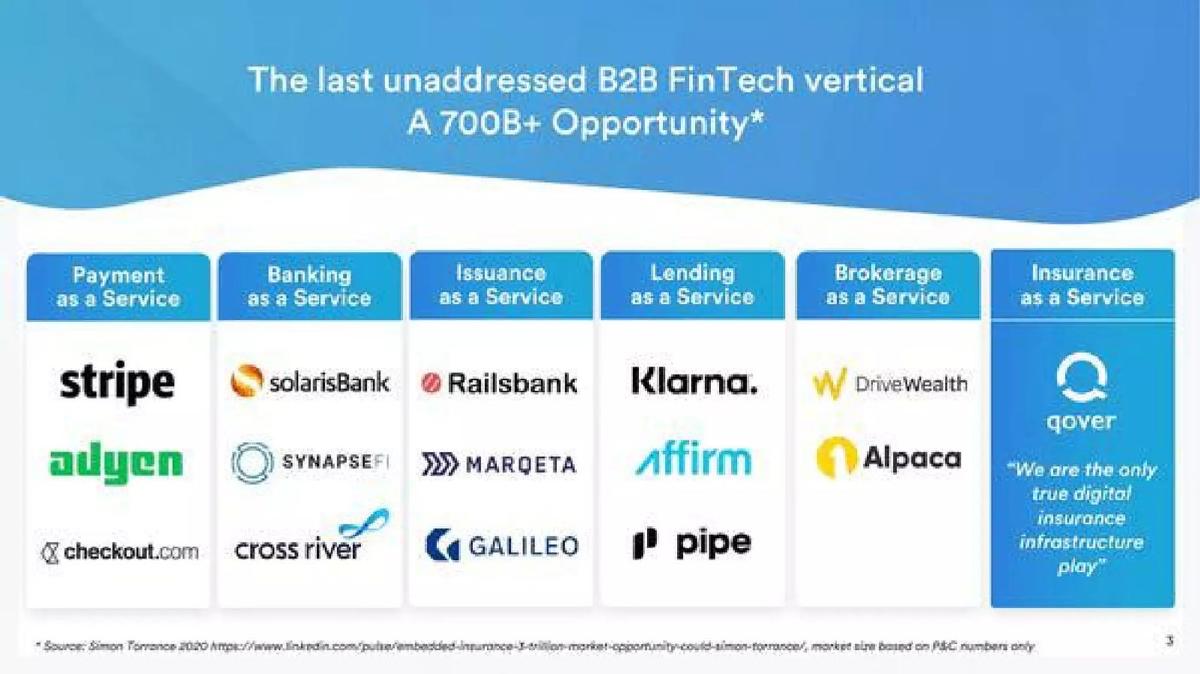
- The deck frames embedded insurance as a $700B+ opportunity and the 'last unaddressed B2B FinTech vertical' on slide 3.
- Qover uses a category-mapping strategy on slide 3 to position itself as the peer of market leaders like Stripe, Klarna, and Marqeta.
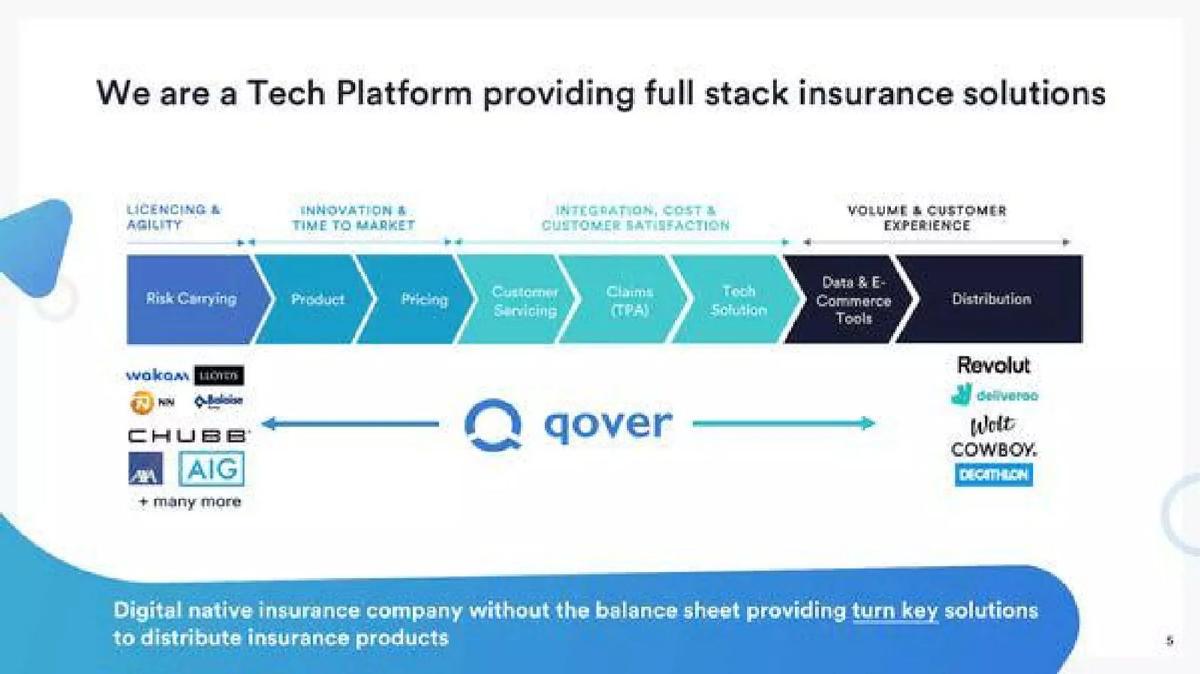
- The company defines itself as a 'digital native insurance company without the balance sheet' on slide 5, emphasizing a capital-light model.
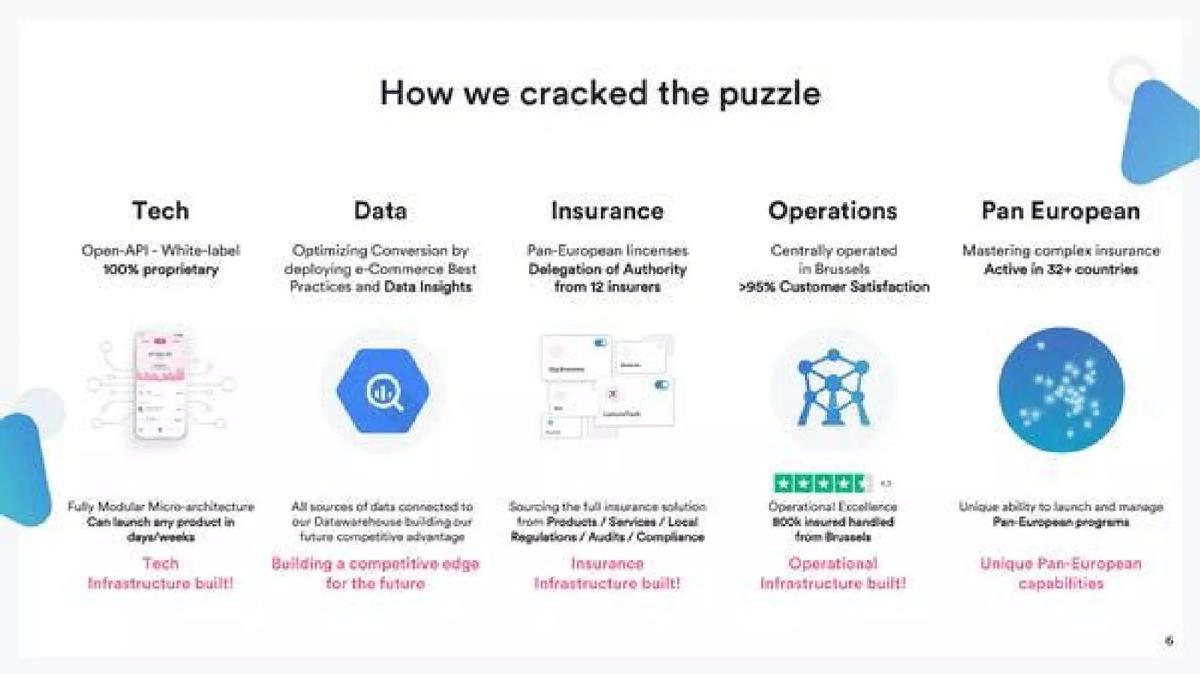
- Operational scale is demonstrated on slide 6, citing active operations in 32+ countries and over 95% customer satisfaction.
- The deck highlights a 'Delegation of Authority from 12 insurers' on slide 6, signaling deep industry trust and regulatory compliance.
- Social proof is the primary driver of the deck, with five dedicated case study slides (9-13) featuring Revolut, Deliveroo, and others.
- The Revolut case study on slide 9 specifically mentions a global solution across 33 countries and automated claim journeys.
- The deck concludes on slide 14 without a specific 'Ask' or financial breakdown, functioning more as a high-level vision and traction summary.
The Infrastructure Play: Qover's Series B Narrative
Qover’s Series B deck is a masterclass in narrative positioning. In the world of venture capital, especially at the Series B stage, companies are often expected to provide exhaustive data rooms. However, this 14-slide deck focuses on a singular, powerful idea: that insurance is the next great 'as-a-Service' frontier. By the time an investor reaches the final slide, Qover has successfully associated itself with the most successful fintech infrastructure companies in the world.
Slides 1-2: The Vision and the Hook
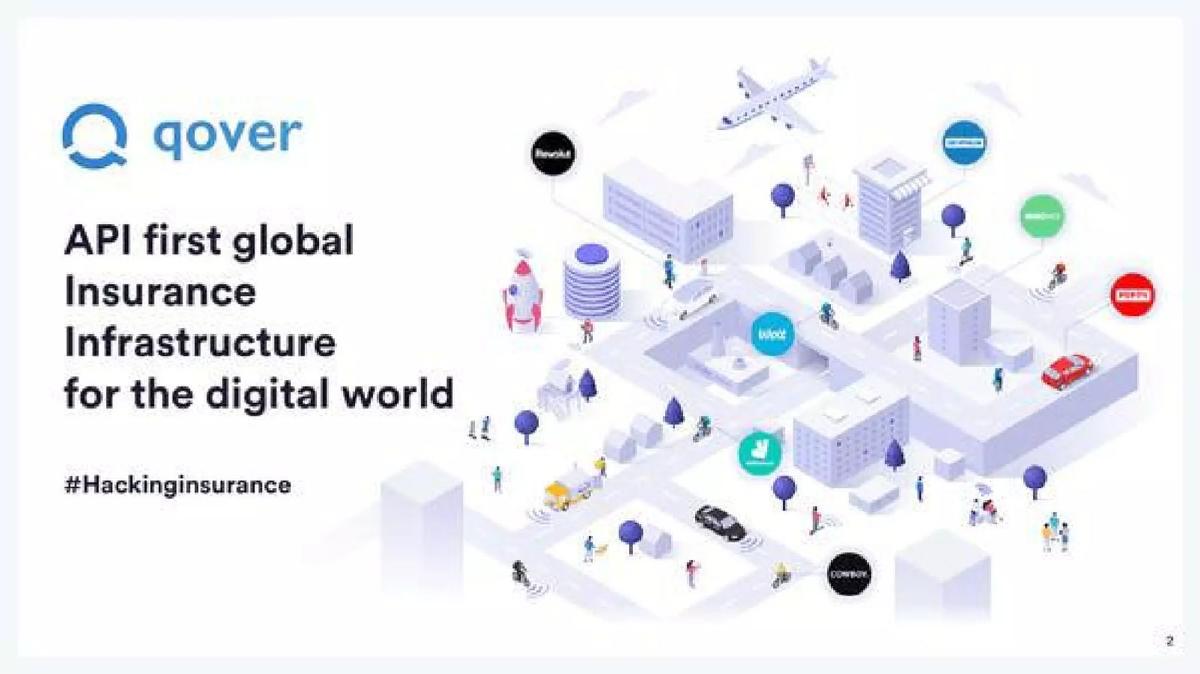
The deck opens with a clean, branded title slide (Slide 1) dated January 2021. Slide 2 immediately establishes the company's identity: "API first global Insurance Infrastructure for the digital world." The use of the hashtag #Hackinginsurance and an isometric city graphic suggests a modern, tech-forward approach. The graphic subtly includes logos of partners like Revolut and Deliveroo, hinting at the traction that will be detailed later. This is a "show, don't just tell" opening that defines the category Qover intends to own.
Slide 3: The Category Map
Slide 3 is arguably the most important slide in the deck. Titled "The last unaddressed B2B FinTech vertical," it presents a table of "as-a-Service" categories. It lists Payment (Stripe, Adyen), Banking (SolarisBank), Issuance (Marqeta), Lending (Klarna), and Brokerage (DriveWealth). In the final column, it places "Insurance as a Service" with Qover as the sole occupant. This slide does three things: it defines a massive $700B+ market opportunity, it uses the success of other unicorns to validate the business model, and it positions Qover as the inevitable winner in the insurance space. The quote, "We are the only true digital insurance infrastructure play," is a bold claim designed to trigger FOMO (Fear Of Missing Out).
Slides 4-5: Rewiring the Industry
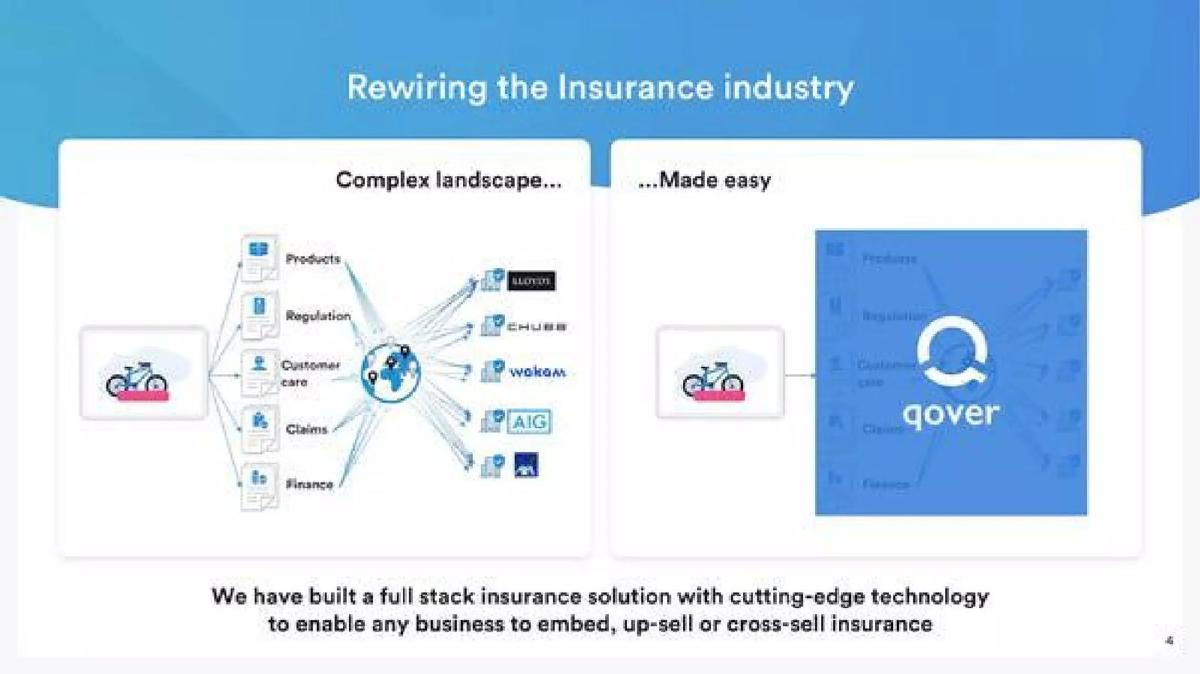
Slide 4 visualizes the problem and solution. On the left, a "Complex landscape" shows a business trying to navigate products, regulation, customer care, claims, and finance across multiple carriers like Chubb and AIG. On the right, Qover acts as a single, blue orchestration layer that simplifies everything. Slide 5 expands on this, describing Qover as a "Tech Platform providing full stack insurance solutions." It highlights their position in the value chain, sitting between risk carriers (AIG, Lloyds, etc.) and distributors (Revolut, Wolt, etc.). The footer contains a key structural detail: "Digital native insurance company without the balance sheet." This tells investors that Qover is a high-margin tech play, not a capital-intensive insurance carrier.
Slide 6: Cracking the Puzzle
Slide 6 addresses the 'how.' It breaks down Qover's moat into five pillars: Tech (Open-API, 100% proprietary), Data (e-commerce best practices), Insurance (Pan-European licenses), Operations (centralized in Brussels, >95% satisfaction), and Pan European (active in 32+ countries). This slide is designed to de-risk the investment by showing that the infrastructure is already built and operational. The mention of "Delegation of Authority from 12 insurers" is a significant proof point, as these are notoriously difficult agreements to secure.
Slides 7-8: Social Proof and Case Studies
Slide 7 is a simple logo wall titled "Iconic players love us!" featuring Revolut, Wolt, Deliveroo, Cowboy, Decathlon, and Immoweb. This leads into a section break for Case Studies (Slide 8). For a Series B company, these logos are the ultimate validation. They represent some of the fastest-growing digital companies in Europe, implying that as these partners scale, Qover scales with them.
Slides 9-13: Deep Dives into Traction
The next five slides are dedicated to specific partner integrations, which is an unusually high percentage of a 14-slide deck.
Slide 9 (Revolut): Highlights a global solution in 33 countries and an automated "Full Claim Journey." · Slide 10 (Deliveroo/Wolt): Focuses on real-time insurance for gig economy riders who get insured "instantaneously" when they switch on the app. · Slide 11 (Cowboy): Shows insurance embedded directly into the bike purchase flow, emphasizing "Easy Up-Sell." · Slide 12 (Angell): Mirrors the Cowboy slide, showing the repeatability of the e-mobility model. · Slide 13 (Immoweb): Demonstrates a white-label front-end for renters' insurance in the real estate sector.
These slides prove that Qover’s API is flexible enough to handle diverse use cases, from fintech and gig work to e-commerce and real estate.
Slide 14: The Team and Contact
The deck ends on Slide 14 with a photo of the two co-founders, Quentin Colmant and Jean-Charles Velge, and their contact information. Surprisingly, there is no detailed team slide listing the broader leadership or their backgrounds, nor is there a specific "Ask" slide. This suggests the deck may have been used as a teaser or a high-level presentation for a known audience of investors.
What Works in This Deck
1. Strategic Positioning: By mapping themselves against Stripe and Klarna, Qover bypasses the "insurance is boring" hurdle and frames the company as a high-growth fintech infrastructure play.
2. Massive Social Proof: The focus on high-tier partners like Revolut and Deliveroo does the heavy lifting. If these tech giants trust Qover's API for their global operations, the tech is implicitly validated.
3. Visual Simplicity: The deck is not cluttered. It uses clear diagrams to explain complex insurance flows, making the value proposition accessible to generalist investors who might not be experts in insurtech.
What Is Missing
1. Financial Data: There is a total absence of revenue, GWP, or growth metrics. While the logos imply traction, investors at Series B usually require a clear look at the numbers to justify valuation.
2. Competitive Landscape: Aside from the category map on Slide 3, there is no mention of other insurtech competitors (like Wakam or Element). Acknowledging the competitive moat more explicitly would have been beneficial.
3. The "Ask" and Roadmap: The deck doesn't state how much money is being raised or what the next 18-24 months look like. Is the goal to expand to the US? To add new insurance products? The deck is silent on future strategy.
What a Founder Should Copy
1. The "Infrastructure" Framing: If you are building a B2B tool, find the "Stripe of [Your Industry]" comparison. It immediately communicates your business model and potential scale to investors.
2. Use Case Diversity: Showing how your product works across different industries (as Qover does with bikes, delivery, and banking) proves that your TAM (Total Addressable Market) is not limited to a single niche.
3. The "Problem/Solution" Visualization: Slide 4 is a perfect example of how to turn a complex, messy industry reality into a clean, proprietary solution. Use icons and arrows to show how you simplify your customer's life.
Frequently asked questions
- What is Qover's core value proposition according to the deck?
- Qover positions itself as an 'API first global Insurance Infrastructure' (Slide 2). Its core value is 'rewiring' the insurance industry by acting as a digital orchestration layer between complex risk carriers (like AIG and Chubb) and modern digital distributors (like Revolut and Deliveroo). It allows any business to embed, up-sell, or cross-sell insurance through a full-stack, white-label tech platform.
- How does Qover handle the complexity of European insurance regulations?
- On slide 6, Qover explains that they have 'cracked the puzzle' by securing pan-European licenses and a 'Delegation of Authority' from 12 major insurers. They operate centrally from Brussels and have mastered the ability to launch and manage programs across 32+ countries, effectively abstracting the regulatory and administrative burden away from their partners.
- Which major partners are used to validate the platform?
- The deck is heavily reliant on high-profile B2B logos. Key partners featured include Revolut (fintech), Deliveroo and Wolt (gig economy/delivery), Cowboy and Angell (e-mobility/bikes), and Immoweb (real estate). These case studies demonstrate the platform's versatility across different sectors and its ability to handle high-volume, real-time insurance needs.
- What is missing from this Series B pitch deck?
- The deck is notably light on hard financials. There are no slides detailing Annual Recurring Revenue (ARR), Gross Written Premium (GWP) growth, unit economics (CAC/LTV), or specific burn rates. Additionally, there is no 'Ask' slide detailing how much capital is being raised or how the funds will be allocated, and no forward-looking roadmap or product pipeline.
- How does Qover differentiate itself from traditional insurance brokers?
- Qover differentiates itself by being a 'Tech Platform' rather than a traditional broker (Slide 5). They emphasize their '100% proprietary' open-API and white-label capabilities. Unlike traditional brokers who may rely on manual processes, Qover highlights automated claim journeys and real-time data exchange, positioning themselves as a 'digital native' infrastructure play that doesn't carry risk on its own balance sheet.