The AudioFav deck, presented by the Quad Squad team in August 2012, outlines a mobile application designed to merge audio and photography. The presentation relies heavily on the psychological impact of multi-sensory inputs, citing research that positive sound can increase mood by up to 65%. While the deck provides a clear product vision and a basic 'App Economics' table, it reveals significant internal challenges, specifically a 50% reduction in team size due to attrition. The roadmap focuses on a 'freemium' model with paid ad-free versions and in-app purchases for filters and ringtones. Howe…
Key takeaways
- The company identifies a gap in the market where video is considered too high-production, while photos lack emotional ambience (Slide 2).
- The team suffered from 50% attrition, shrinking from four members to two, leaving them without front-end developers or UI designers (Slide 7).
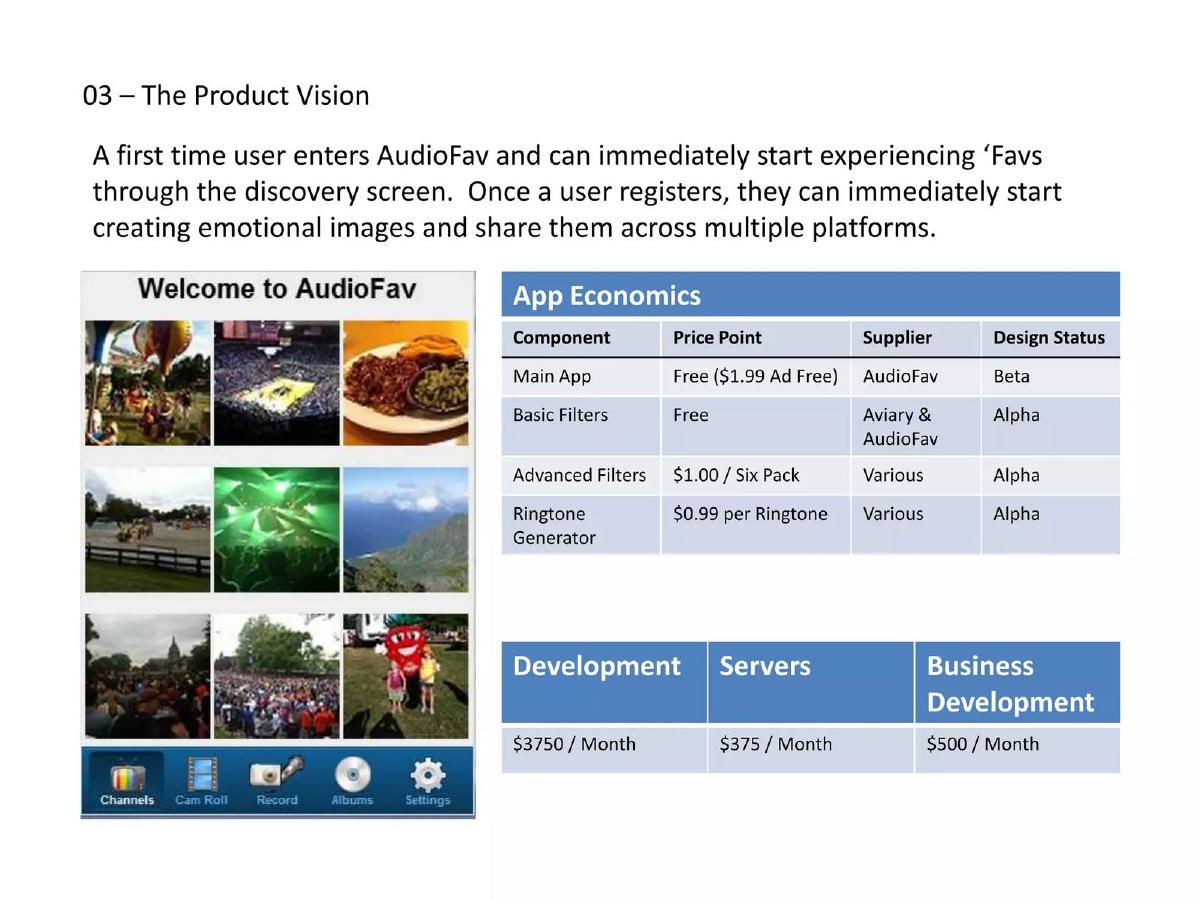
- App economics are based on a $1.99 ad-free version and $1.00 'Six Pack' advanced filters (Slide 4).
- Operating costs are estimated at $3,750/month for development and $375/month for servers (Slide 4).
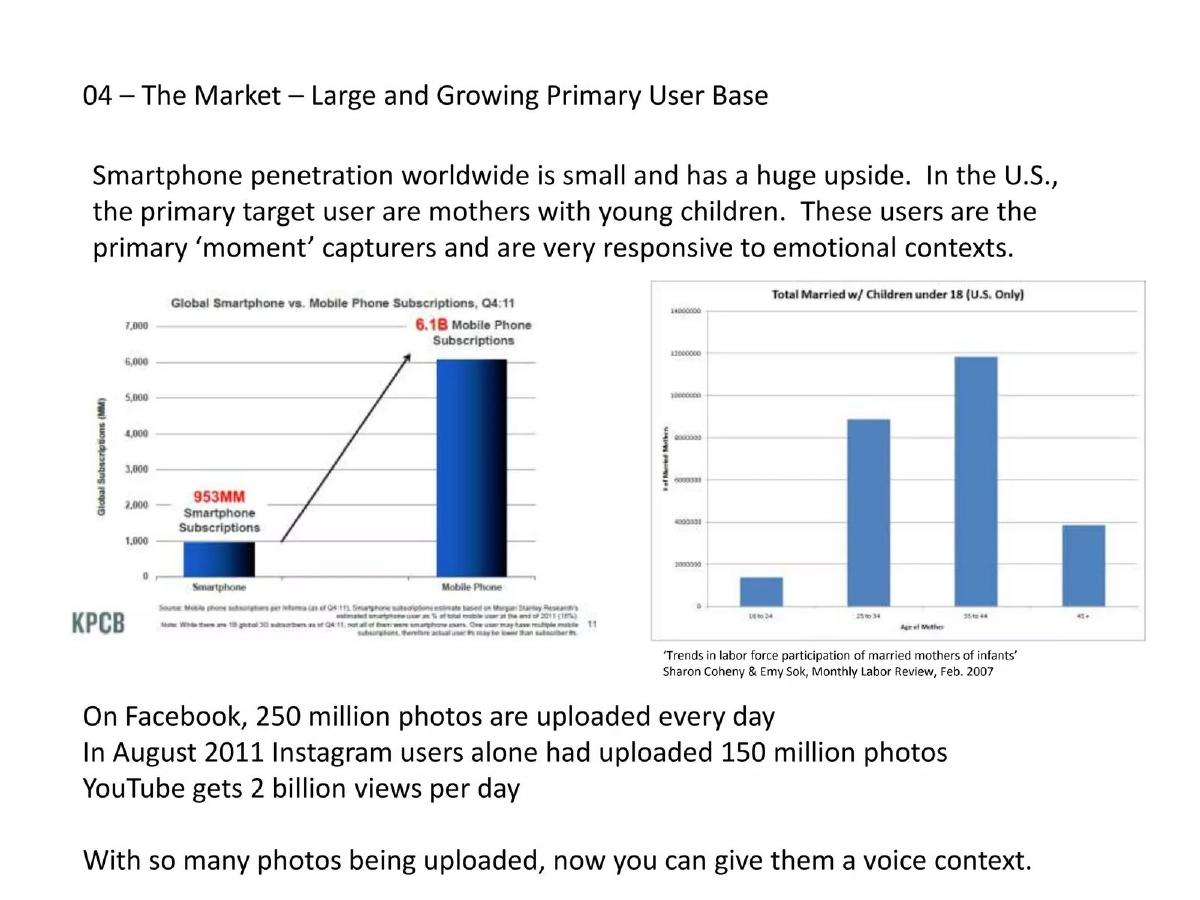
- The primary target demographic is identified as mothers with young children in the U.S. (Slide 5).
- The deck cites 2011 Instagram data (150 million photos uploaded) to justify the scale of the opportunity (Slide 5).
- The product was in Beta/Alpha stages at the time of the presentation, with the main app in Beta and filters in Alpha (Slide 4).
- There is no specific funding request or valuation mentioned in the nine slides.
Introduction and Thesis
The AudioFav deck, prepared by the 'Quad Squad' for Venture Lab in August 2012, is a relic of the early mobile app gold rush. The thesis is built on the psychological value of multi-sensory experiences. By adding audio to photos, the founders believe they can capture 'ambience' better than a static photo and more easily than a high-production video. While the concept is clear, the deck serves more as a project status report than a high-stakes investment pitch, particularly given the candid admission of team attrition and the lack of a formal financial ask.
Slide 1: Title and Hook
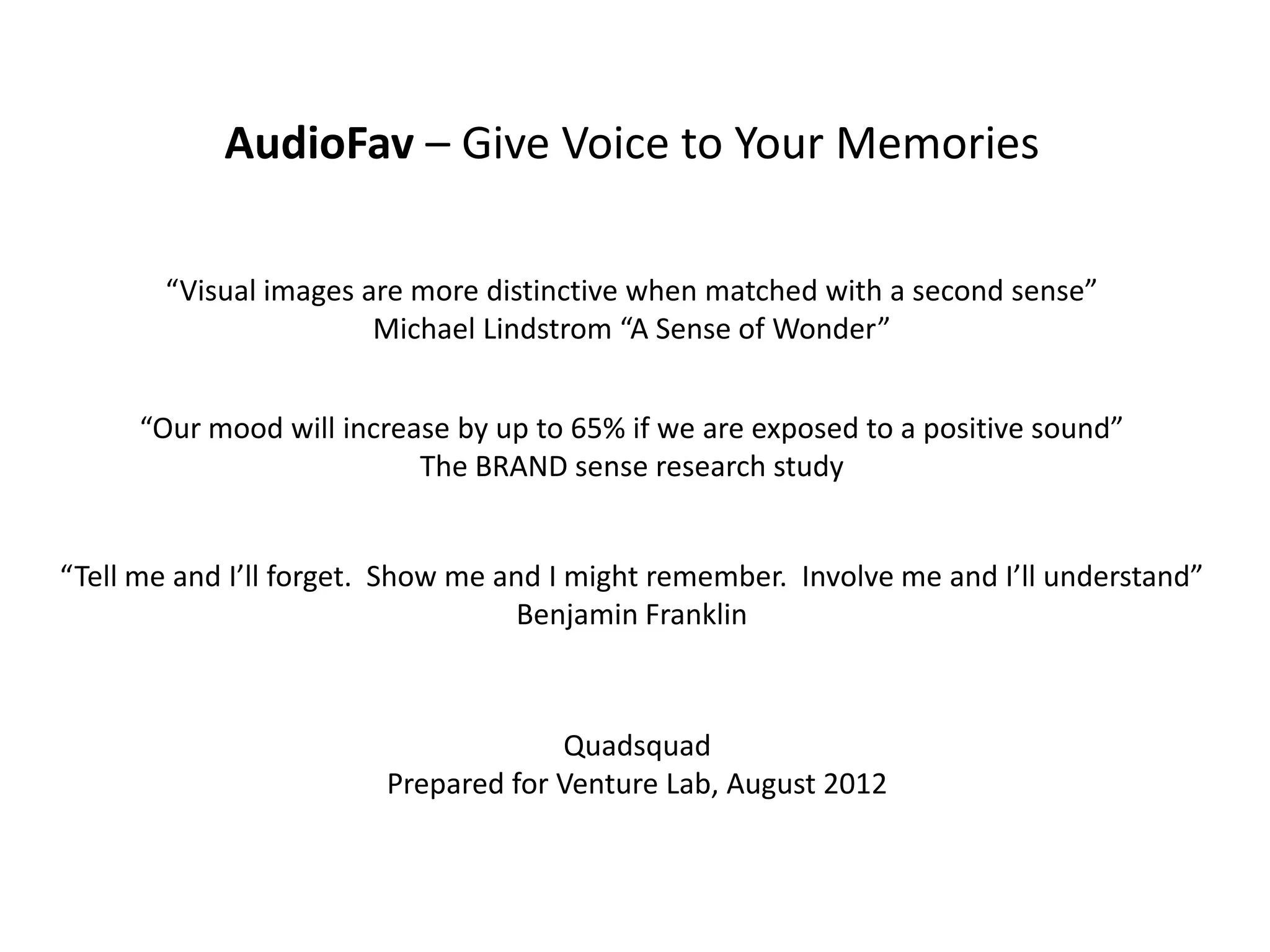
The cover slide introduces the product name, AudioFav, and the tagline 'Give Voice to Your Memories.' It utilizes three quotes to establish a psychological foundation for the product. It cites Michael Lindstrom's 'A Sense of Wonder' regarding the distinctiveness of multi-sensory images and 'The BRAND sense research study' claiming mood increases of 65% when exposed to positive sound. A quote attributed to Benjamin Franklin ('Involve me and I’ll understand') is used to emphasize the interactive nature of the product. The slide notes the presentation was prepared for Venture Lab in August 2012.
Slide 2: Problem and Solution
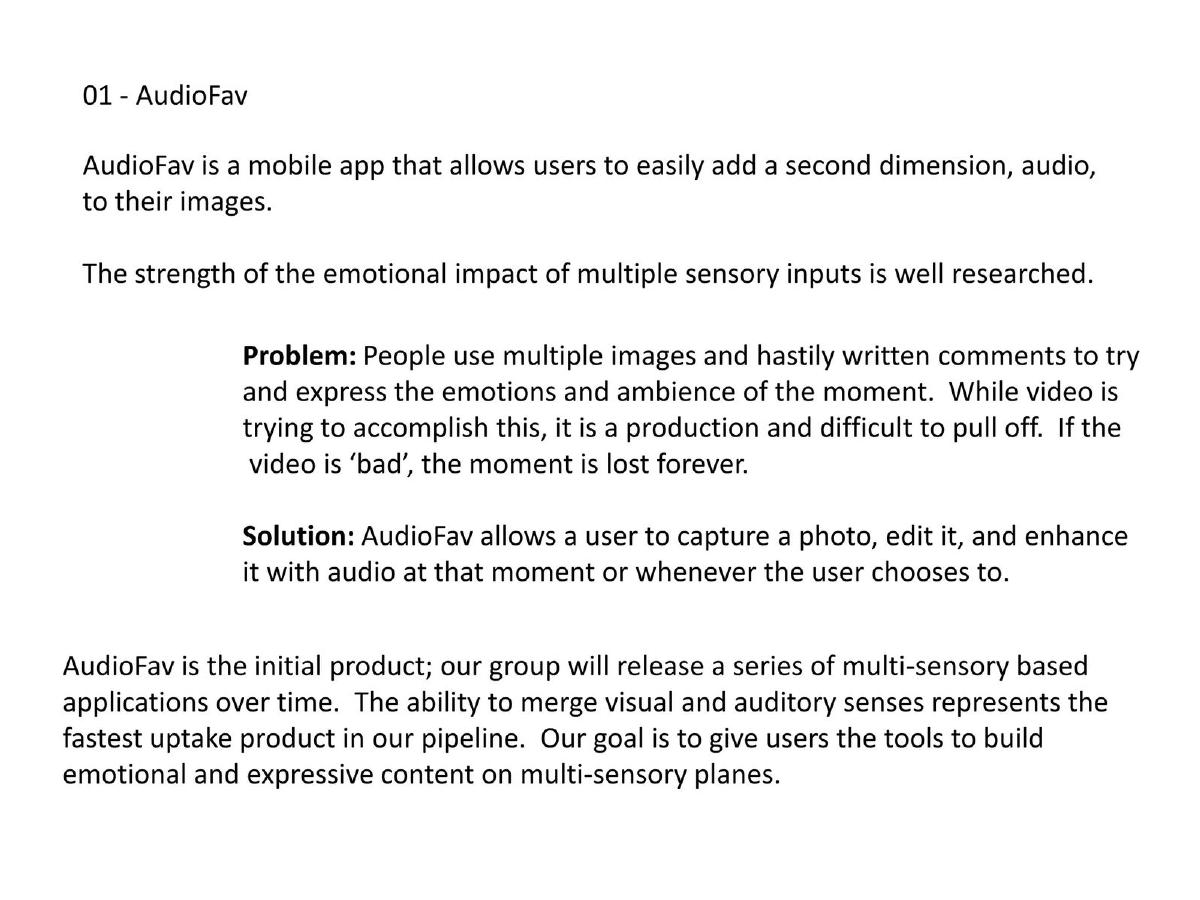
Slide 2 defines the market gap. The 'Problem' is stated as the inadequacy of photos and comments to capture the 'ambience of the moment.' It dismisses video as being too much of a 'production' and 'difficult to pull off.' The 'Solution' is AudioFav, which allows users to capture a photo, edit it, and enhance it with audio. Interestingly, the slide mentions that AudioFav is just the 'initial product' in a planned series of multi-sensory applications, though these other applications are not detailed.
Slide 3: The AudioFav Team
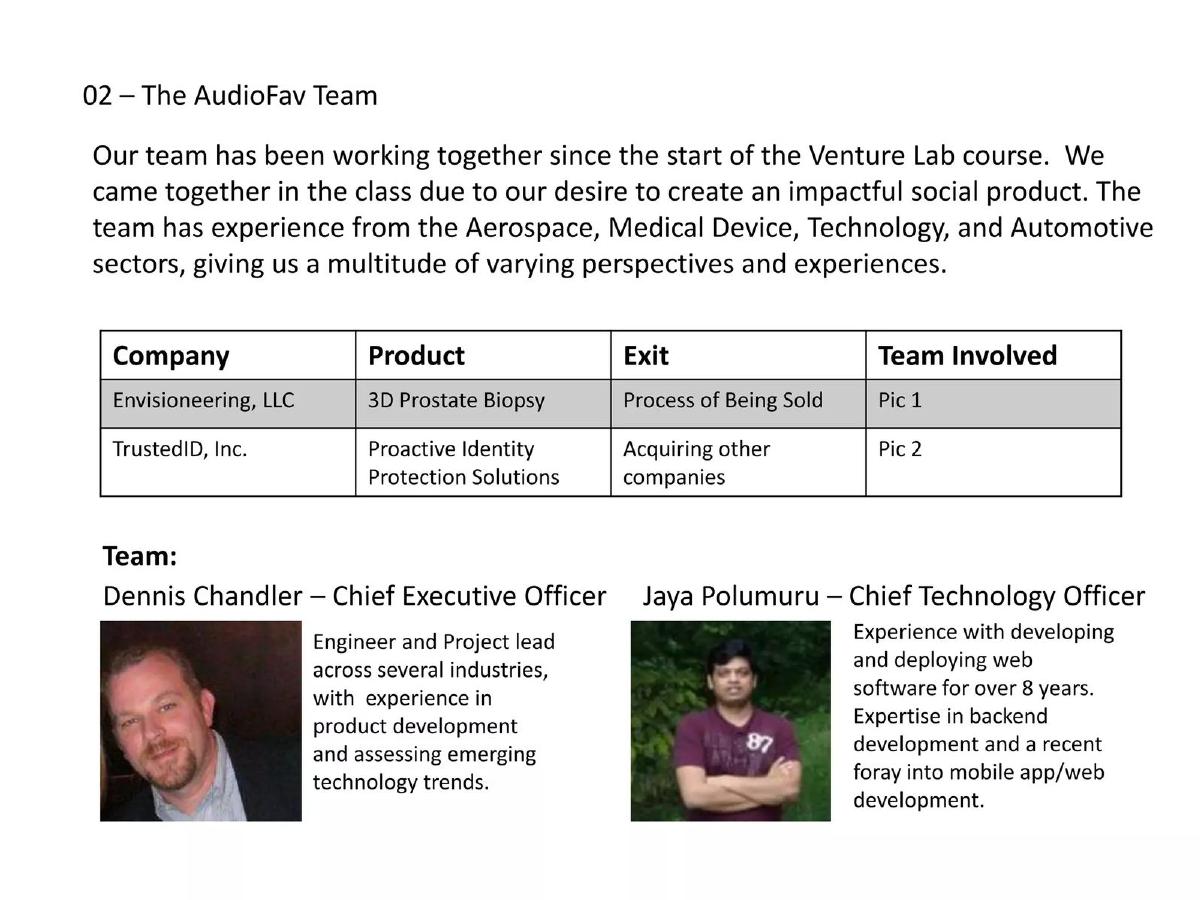
This slide introduces the leadership: Dennis Chandler as CEO and Jaya Polumuru as CTO. Chandler is described as an engineer and project lead with experience in product development across several industries. Polumuru is credited with over 8 years of web software development experience and a 'recent foray' into mobile development. A table at the top of the slide mentions past company involvement with Envisioneering, LLC and TrustedID, Inc., noting that one product (3D Prostate Biopsy) was in the 'Process of Being Sold' and the other involved 'Acquiring other companies.'
Slide 4: The Product Vision and Economics
Slide 4 provides the first look at the UI via a 'Welcome to AudioFav' screen showing a grid of photos. The slide is dominated by two tables. The 'App Economics' table lists the Main App as Free (with a $1.99 Ad-Free option) and currently in Beta. Advanced filters are priced at $1.00 per 'Six Pack' and are in Alpha. The 'Development' table lists monthly costs: $3,750 for Development, $375 for Servers, and $500 for Business Development. This total monthly burn of $4,625 suggests a very lean, early-stage operation.
Slide 5: Market Size and Demographics
The founders identify their 'primary target user' as mothers with young children in the U.S., describing them as 'moment capturers.' The slide includes a KPCB chart showing 953 million smartphone subscriptions against 6.1 billion total mobile subscriptions as of Q4 2011, suggesting significant room for growth. It also includes a bar chart regarding married mothers with children under 18. To emphasize the scale of photo sharing, the slide notes that 250 million photos are uploaded to Facebook daily and Instagram had 150 million photos uploaded as of August 2011.
Slide 6: Opportunity and Competition
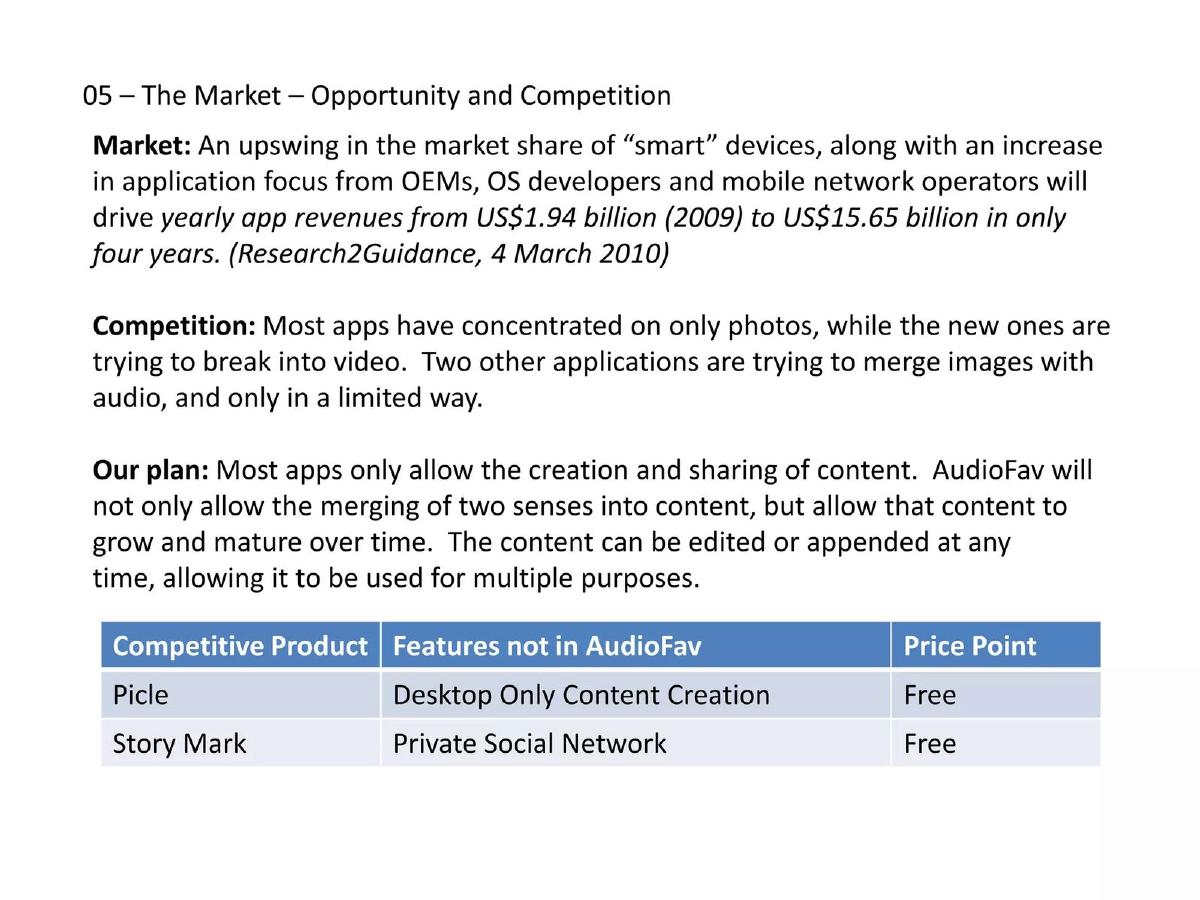
This slide cites Research2Guidance data from 2010, predicting mobile app revenues would grow from $1.94 billion in 2009 to $15.65 billion by 2013. The competitive analysis is brief, naming 'Picle' and 'Story Mark.' The founders argue that while these competitors exist, they are limited by being 'desktop only' or 'private social networks.' AudioFav’s differentiator is stated as allowing content to 'grow and mature over time' by being editable or appendable.
Slide 7: Risks and Attrition
In a rare moment of pitch deck transparency, slide 7 addresses 'Talent' as a primary risk. It states the team started with four members but is down to two due to 'attrition.' The slide explicitly lists the need for Mobile Platform Developers and UX/UI Designers, admitting the current team lacks the time to develop front-end skills in-house. It also notes the risk that existing competitors could pivot into AudioFav’s specific niche.
Slide 8: Market Response
Slide 8 lists qualitative feedback from interviews and surveys based on an initial MVP (linked as a raw IP address mockup). Quotes include a mother wanting to capture moments with her 6-year-old, a teacher wanting to use it for English Learner students, and a user comparing it to a 'visual/audio Evernote.' The feedback is entirely positive, focusing on the utility of annotating photos for both personal and professional use.
Slide 9: Contact
The final slide provides the contact information for Dennis Chandler and the email address info@audiofav.com. There is no closing 'ask,' no summary of the investment opportunity, and no timeline for the next milestones.
What AudioFav Does Well
The deck is grounded in a specific psychological hook. By citing research on how sound affects mood, the founders move the conversation from 'just another photo app' to a 'sensory experience' tool. The inclusion of a basic burn rate ($4,625/month) provides a level of financial realism often missing from early-stage decks. Furthermore, the identification of a specific niche—mothers with young children—shows a level of target marketing that is more focused than a general 'everyone who takes photos' approach.
What is Missing from the Deck
The most glaring omission is a clear 'Ask.' There is no mention of how much capital the team is looking to raise, what the valuation is, or what the specific milestones for that capital would be. The 'Risks' slide, while honest, acts as a significant red flag without a corresponding plan to solve the talent gap beyond simply stating the need. There is also no detailed go-to-market strategy; mentioning that 250 million photos are uploaded to Facebook is a market observation, not a plan for how AudioFav will acquire those users. Finally, the unit economics are speculative, with no data on user acquisition costs (CAC) or projected lifetime value (LTV).
What a Founder Should Copy
Founders should emulate the clarity of the 'App Economics' table on slide 4. Breaking down the product into specific components (Main App, Filters, Ringtone Generator) and assigning each a price point and a current design status (Alpha/Beta) gives investors a clear view of the product roadmap. Additionally, the use of qualitative user quotes on slide 8 is a strong way to demonstrate 'Problem-Solution Fit,' especially when the quotes suggest use cases the founders might not have originally envisioned, such as classroom use or biology studies.
Final Analysis
The AudioFav deck is an example of a 'student' or 'incubator' style presentation that prioritizes product vision over business scalability. While the core idea of 'audio-photos' was a popular experiment in the early 2010s, the deck reveals a company struggling with the realities of startup life—specifically team retention and technical gaps. Without a clear funding goal or a strategy to compete with the burgeoning social giants of the era, the deck remains a conceptual exploration rather than a compelling investment vehicle.
Frequently asked questions
- What is the core problem AudioFav is trying to solve?
- According to slide 2, the problem is that users currently use multiple images and 'hastily written comments' to express the emotion of a moment. While video attempts to solve this, the founders argue it is a 'production' and difficult to execute well. AudioFav aims to provide a middle ground by allowing users to enhance photos with audio at the moment of capture.
- What does the team structure look like?
- As of slide 3 and slide 7, the team consists of Dennis Chandler (CEO) and Jaya Polumuru (CTO). The deck explicitly states on slide 7 that the team started with four members but dropped to two due to attrition. They identify a critical need for Mobile Platform Developers and UX/UI Designers to build the front-end.
- How does AudioFav plan to generate revenue?
- Slide 4 outlines the 'App Economics.' Revenue streams include a $1.99 ad-free version of the main app, $1.00 for a 'Six Pack' of advanced filters, and $0.99 per Ringtone Generator use. The basic app and basic filters are listed as free.
- Who are the primary competitors identified in the deck?
- Slide 6 identifies 'Picle' and 'Story Mark' as competitive products. The deck notes that Picle focuses on desktop-only content creation and Story Mark is a private social network, whereas AudioFav intends to allow content to be edited and appended over time for multiple purposes.
- What is the current status of the product?
- Based on the table on slide 4, the Main App was in Beta at the time of the presentation. The Basic Filters, Advanced Filters, and Ringtone Generator were all listed as being in the Alpha stage of design.