Quarantyne’s pre-seed deck is a minimalist 9-slide presentation that outlines a clear technical solution for a widespread problem: automated web traffic. The founders, Edouard Swiac and Eric Fung, leverage their backgrounds at companies like Twitter and Oracle to pitch a real-time HTTP traffic classifier. The deck is notable for its simplicity, moving quickly from the problem of content scraping and account takeovers to a three-step 'How it Works' process. While it lacks deep market sizing (TAM/SAM/SOM) or financial projections, it provides a concrete business model with specific pricing tier…
Key takeaways
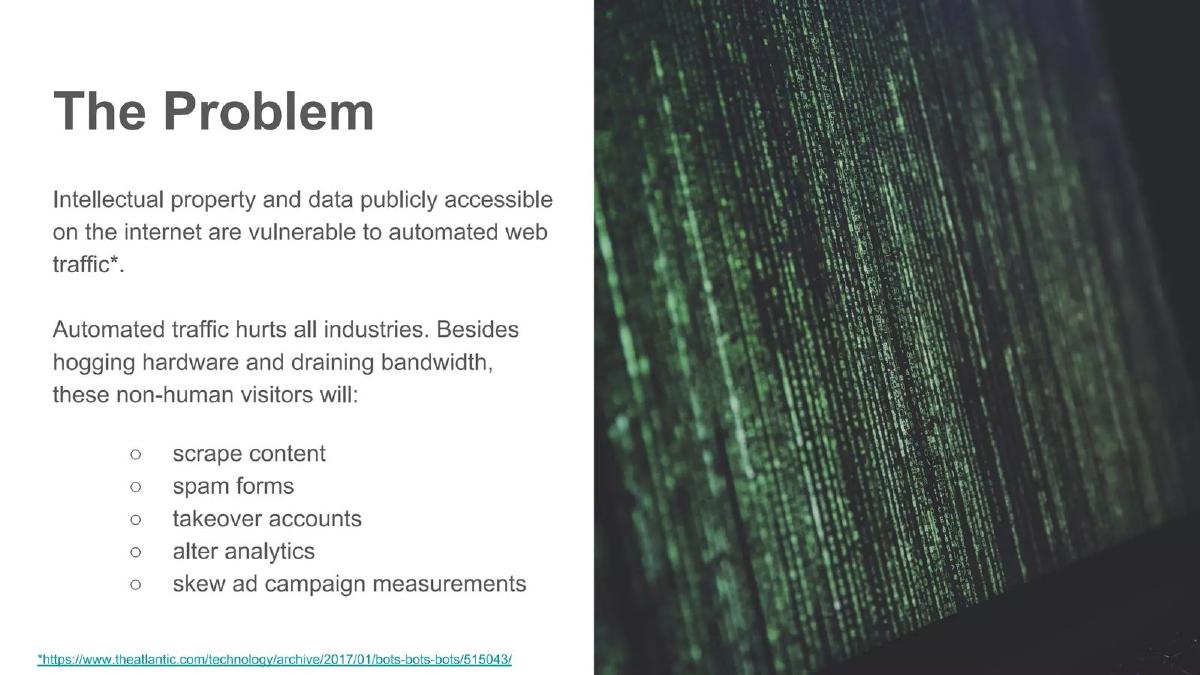
- The deck identifies five specific harms of automated traffic, including scraping content, account takeovers, and skewed ad measurements (Slide 3).
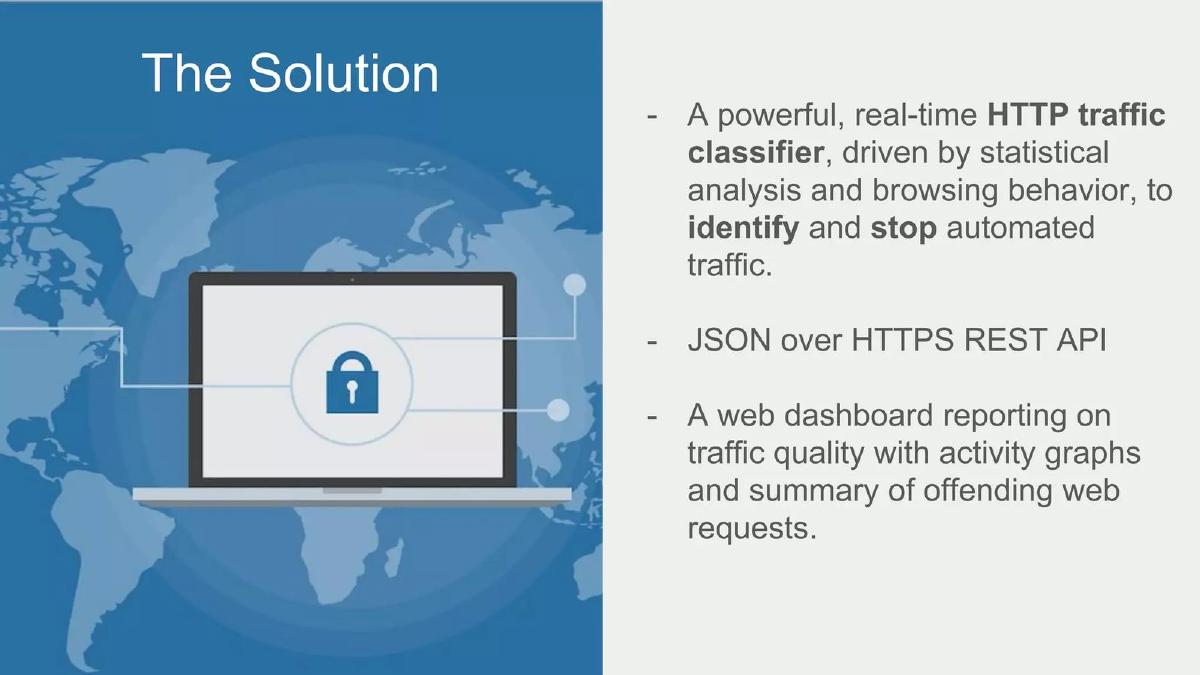
- The solution is defined as a real-time HTTP traffic classifier delivered via a JSON over HTTPS REST API (Slide 4).
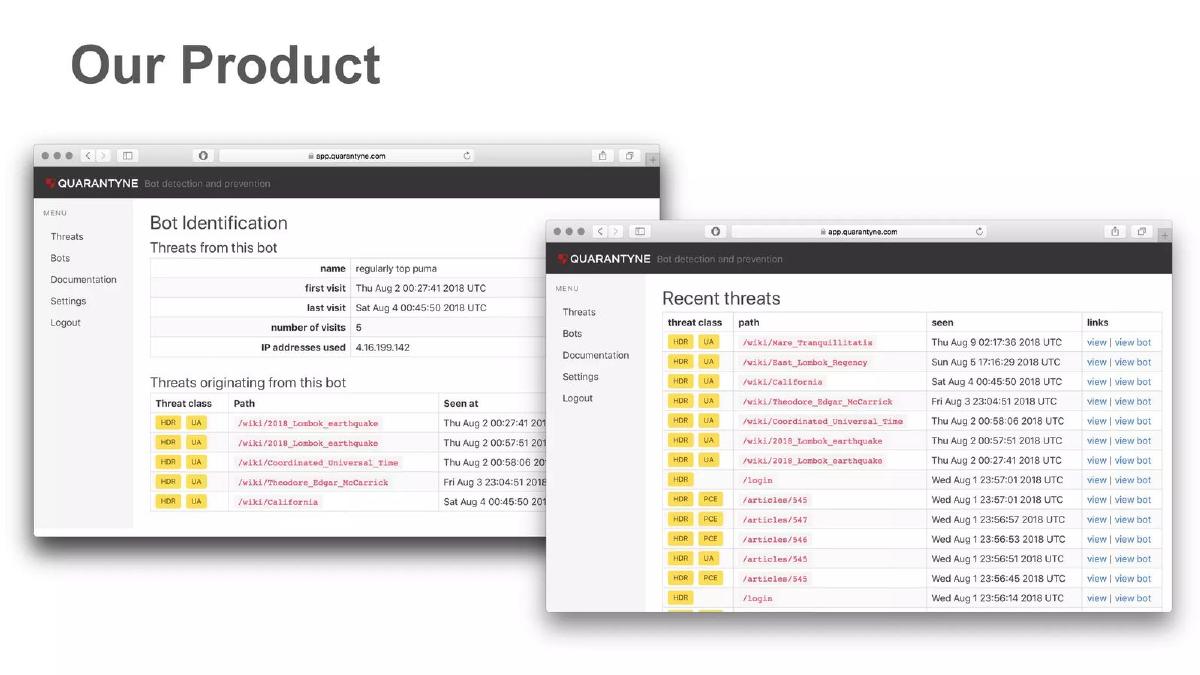
- Product screenshots from August 2018 show a functional dashboard for bot identification and threat classification (Slide 5).
- The business model utilizes a freemium strategy with a free monitoring tier capped at 10k monthly API calls (Slide 8).
- Paid pricing is transparently listed as starting at $50 per 500k API calls for active traffic protection (Slide 8).
- The competitive analysis names five specific rivals, including Distil Networks and PerimeterX, while positioning Quarantyne as the more accessible, transparent option (Slide 7).
- The fundraising ask is exactly $250k to fund product-market fit and customer acquisition over an 8-10 month period (Slide 9).
- The team slide highlights relevant engineering and sales experience from Twitter, Hotwire, and RethinkDB (Slide 2).
Quarantyne Pitch Deck Analysis
Quarantyne’s pre-seed deck is a highly functional, no-frills presentation. It consists of 9 slides that follow a traditional narrative arc: team, problem, solution, product, mechanics, competition, business model, and the ask. The deck is dated by its screenshots, which show timestamps from August 2018, suggesting this was a snapshot of the company's early fundraising efforts during that period.
Slide 1: Title Slide
The deck opens with a clean logo—a red and white shield—and the company name. The subtitle, "API for Intellectual Property and Data Protection," immediately establishes the company as a developer-focused security tool. There are no distracting graphics or vague taglines; the value proposition is technical and direct.
Slide 2: Our Team
The team slide features two founders: Edouard Swiac (Engineering/Product) and Eric Fung (Sales/Ops). The slide effectively uses logos and names of reputable tech companies like Twitter, Oracle, and Hotwire to build immediate credibility. By placing the team slide second, the founders are betting that their professional pedigree is their strongest asset in securing a pre-seed round.
Slide 3: The Problem
The problem is defined as the vulnerability of public data to "automated web traffic." The slide lists five specific pain points: content scraping, form spam, account takeovers, altered analytics, and skewed ad measurements. A footnote links to an Atlantic article, providing external validation for the scale of the bot problem. The imagery is a generic "code rain" background, which is a bit cliché but stays on-theme for a cybersecurity pitch.
Slide 4: The Solution
The solution is described as a "powerful, real-time HTTP traffic classifier." The slide emphasizes three components: statistical analysis of browsing behavior, a JSON over HTTPS REST API, and a web dashboard for reporting. This slide is critical because it moves the conversation from a vague security concept to a specific technical implementation.
Slide 5: Our Product
This slide provides two screenshots of the Quarantyne dashboard. The images show a "Bot Identification" page and a "Recent threats" log. The data in the screenshots (dated August 2018) includes specific threat classes like "HDR" and "UA" and paths like "/wiki/California." These visuals prove that a functional prototype exists and isn't just a conceptual mockup.
Slide 6: How it Works
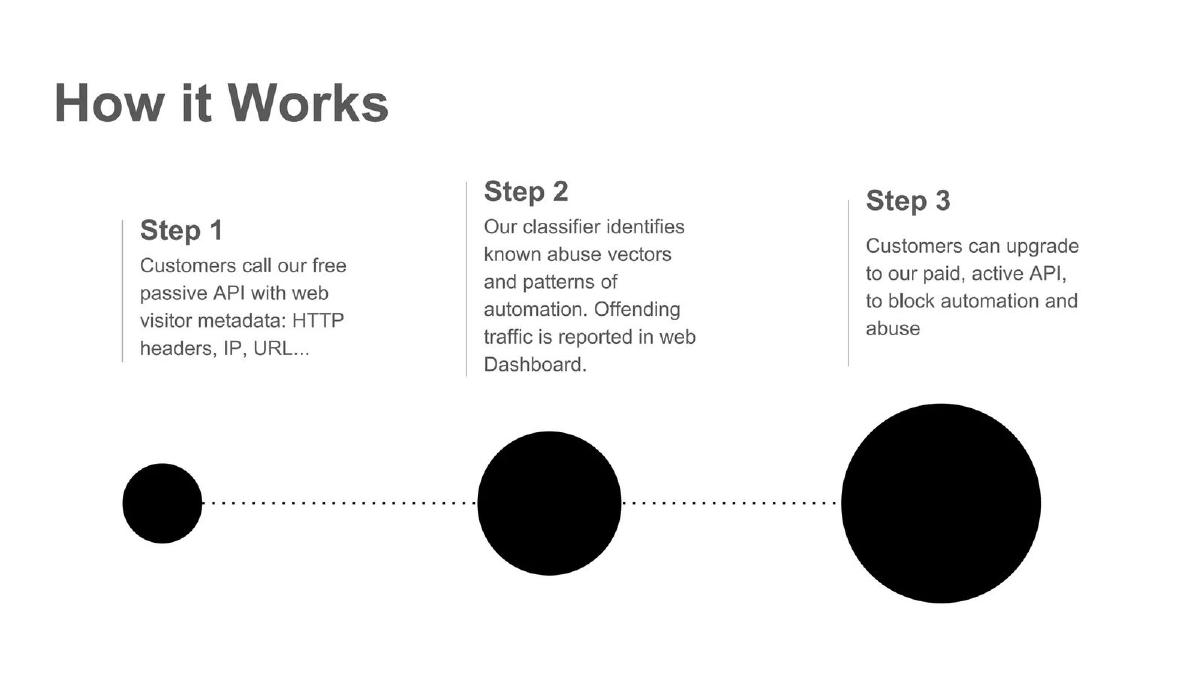
The founders use a simple three-step diagram to explain the user journey. Step 1 is the integration of a free passive API. Step 2 is the identification and reporting of abuse. Step 3 is the upgrade to a paid active API for blocking. This slide is effective because it clearly illustrates the "land and expand" strategy inherent in their freemium model.
Slide 7: Competition & Advantages
Quarantyne lists five major players in the bot detection space: Distil Networks, Kasada, PerimeterX, Imperva, and ShieldSquare. They critique these competitors for being tailored only to large enterprises, requiring complex integrations, and lacking price transparency. Quarantyne’s stated advantages include a monthly SaaS model, a simple API, and a unique plan to open-source their core classifier to build trust and market share.
Slide 8: Business Model
The business model slide is exceptionally clear. It names the two tiers: "Spyglass" (Free) and "Bulwark" (Paid). The paid tier is priced at "$50 monthly, per 500k API Calls." Providing a specific price point in a pre-seed deck is bold and helps investors understand the target customer (likely SMBs or mid-market developers rather than the enterprise giants targeted by their competitors).
Slide 9: Progress and Next Steps
The final slide states that the prototype is developed and in testing. The ask is "Raising 250k" to achieve product-market fit, customer acquisition, and marketing. They also provide a timeline, stating a plan to raise a further round after 8-10 months. This gives investors a clear view of the runway and the milestones the founders intend to hit with the capital.
What Works in This Deck
Clarity of Purpose: Within three slides, the reader knows exactly what Quarantyne does and who it is for. · Transparent Pricing: Including a $50/month price point removes the mystery of the business model and highlights their differentiation from high-touch enterprise competitors. · Technical Credibility: The team’s background at Twitter and Oracle, combined with functional product screenshots, suggests they have the skills to build what they are pitching. · Logical Flow: The deck follows a standard sequence that investors are accustomed to, making it easy to digest in under two minutes.
What Is Missing
Market Sizing: There is no mention of the Total Addressable Market (TAM). While the problem is clearly stated, the deck doesn't quantify how many companies face this issue or how large the bot detection market is. · Traction Metrics: While the prototype is "in testing," there are no details on beta users, waitlists, or early feedback. Even in a pre-seed deck, some evidence of market pull is beneficial. · Financial Projections: The deck lacks a basic revenue forecast. While early-stage projections are often speculative, they help investors understand the founders' ambitions for scale. · Go-to-Market Strategy: Beyond "marketing efforts," there is no specific plan for how they will acquire their first 100 paying customers.
Founder Takeaways
Founders should emulate the simplicity of Quarantyne's "How it Works" slide. Breaking a complex technical product into three digestible steps is a masterclass in communication. Additionally, the competitive positioning on Slide 7 is excellent; instead of just listing features, they identify the structural weaknesses of incumbents (lack of price transparency, complex integration) and position their product as the antidote. However, founders should ensure they include at least one slide on market size to demonstrate that the $250k investment has the potential to grow into a venture-scale return.
Frequently asked questions
- What specific problem does Quarantyne aim to solve?
- According to Slide 3, Quarantyne addresses the vulnerability of public internet data to automated web traffic. Specifically, it targets bots that scrape content, spam forms, take over accounts, alter analytics, and skew ad campaign measurements. The deck cites a 2017 Atlantic article to support the prevalence of these 'non-human visitors' that drain bandwidth and hog hardware.
- How does the product actually work for a customer?
- Slide 6 outlines a three-step process. First, customers call a free passive API providing visitor metadata like HTTP headers, IP, and URL. Second, Quarantyne’s classifier identifies abuse vectors and reports them to a dashboard. Finally, customers can upgrade to a paid, active API that moves beyond reporting to actually blocking the automated traffic and abuse.
- What is the pricing structure for the service?
- Slide 8 details two plans. The 'Spyglass' plan is free, offering monitoring only (no blocking) for up to 10k monthly API calls. The 'Bulwark' plan is the paid tier, starting at $50 per 500k API calls, which includes active traffic protection. This transparent, volume-based pricing is presented as a competitive advantage over 'black box' enterprise rivals.
- Who are the competitors and how does Quarantyne differentiate itself?
- Slide 7 identifies Distil Networks, Kasada, PerimeterX, Imperva, and ShieldSquare as competitors. Quarantyne differentiates by offering a freemium SaaS model, price transparency, and a simple REST API. Notably, they also mention a plan to open-source their core classifier to become the industry reference for low-quality traffic detection.
- What are the founders' backgrounds?
- Slide 2 introduces two founders. Edouard Swiac handles Software Engineering and Product, with previous experience at Twitter, Hotwire, and 2600Hz. Eric Fung manages Sales, Operations, and Biz Dev, bringing experience from RethinkDB, Oracle, EMC, and ERPLY. This provides a balance of technical and commercial expertise for an early-stage startup.