Cybersecurity Competition Slide Examples: How Security
How cybersecurity pitch decks name competing vendors, explain their difference and avoid unproven "first" claims.
Cybersecurity Competition Slide Examples: How Security Startups Show Rivals
Five competition and competitive-advantage slides from real cybersecurity pitch decks, shown in full, compare which vendors each deck names, what it claims to do differently, and how much of that claim a reader can check.
TL;DR
A cybersecurity competition slide is most useful when it names the vendors a security buyer already pays and shows what the startup replaces or does differently. RackTop maps named vendors (Vormetric, Varonis, Cisco and others) to each security layer it builds into storage, then lists the benefit, such as "50-90% Lower TCO". IFG Technology groups rivals as Malaysian, Asian and global vendors, but doesn't say how it differs. Securter names Apple's Secure Enclave and a Mobeewave-based tap-to-pay effort and cites a known Secure Enclave flaw with a link. Claroty and Evervault describe their own strengths ("market leader", "world's first") without naming a single rival.
Cybersecurity competition slides from real pitch decks
Each example shows the exact stored slide above its analysis and links to the full teardown. Stage and year are given only where the deck states them. Claims about rivals are quoted as the slide states them; we have not checked them.
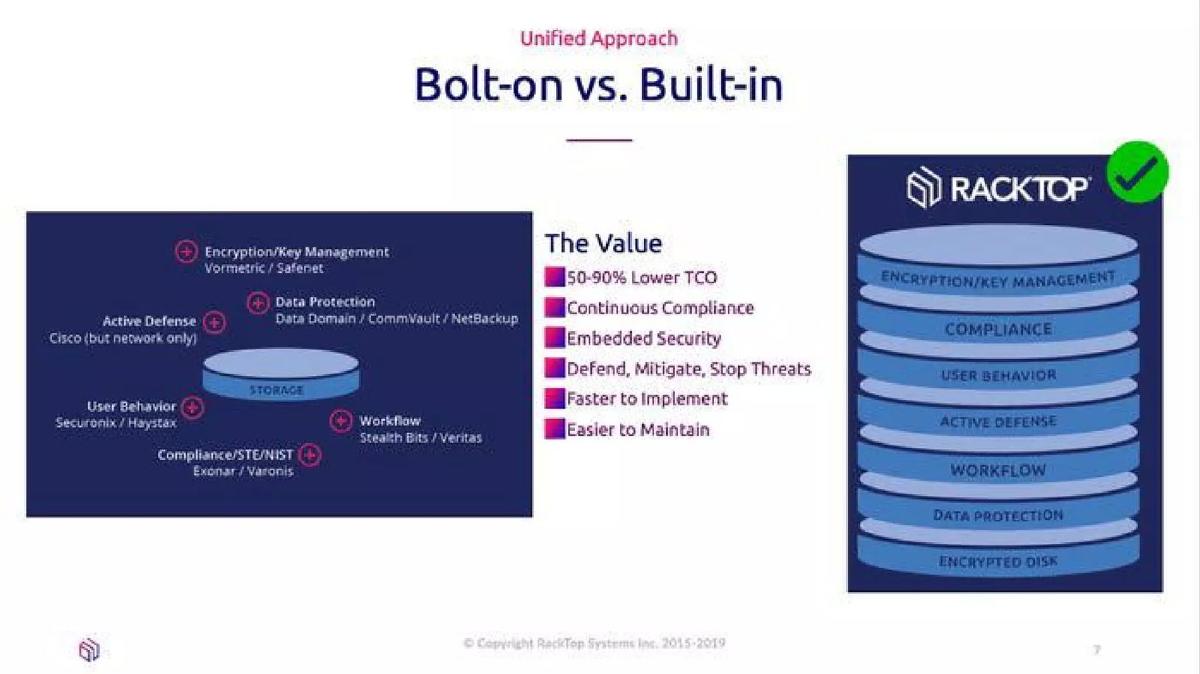
RackTop Systems competition slide — slide 7
Data storage with built-in security. The slide footer reads "Copyright RackTop Systems Inc. 2015-2019". The cybersecurity problem, solution, market and team guides use other slides from this deck.
RackTop Systems deck, slide 7. Exact stored slide matched to this analysis.
Our analysis: It shows exactly which vendors a buyer would need today and which ones RackTop replaces, so the consolidation argument is concrete.
Evidence and limitation: "50-90% Lower TCO" is a wide range with no source or example customer, and the slide doesn't say where a specialist vendor would still beat RackTop.
What a founder can adapt: Draw the stack your buyer pays for today, name the vendor in each slot, and show which slots you replace.
Supporting analysis
What the deck claims: "Unified Approach — Bolt-on vs. Built-in". Left: storage surrounded by separate products, each with named vendors: Encryption/Key Management (Vormetric / Safenet), Data Protection (Data Domain / CommVault / NetBackup), Active Defense ("Cisco (but network only)"), User Behavior (Securonix / Haystax), Workflow (Stealth Bits / Veritas), Compliance/STE/NIST (Exonar / Varonis). Right: the same layers stacked inside RackTop. "The Value": "50-90% Lower TCO", continuous compliance, embedded security, faster to implement, easier to maintain.
Presentation choice: It shows exactly which vendors a buyer would need today and which ones RackTop replaces, so the consolidation argument is concrete.
When it does not fit: "50-90% Lower TCO" is a wide range with no source or example customer, and the slide doesn't say where a specialist vendor would still beat RackTop.
Cybersecurity company based in Malaysia. Stage and year not stated.
IFG Technology deck, slide 6. Exact stored slide matched to this analysis.
Our analysis: Grouping by region shows the reader that IFG knows its home market and the regional and global vendors it meets in deals.
Evidence and limitation: The slide never says how IFG differs, and the listed vendors sell very different products (a log platform, firewalls, antivirus), so the reader can't tell which ones compete with IFG's own offering.
What a founder can adapt: Keep the grouping, and add one line per group on why a buyer in your market would choose you instead.
Supporting analysis
What the deck claims: "Competitors" grouped by region: Malaysia (LGMS, Quann); Asia (360, Igloo, Trend Micro, Qi-Anxin); Global (Splunk, Fortinet, IBM Security, Palo Alto Networks, Kaspersky).
Presentation choice: Grouping by region shows the reader that IFG knows its home market and the regional and global vendors it meets in deals.
When it does not fit: The slide never says how IFG differs, and the listed vendors sell very different products (a log platform, firewalls, antivirus), so the reader can't tell which ones compete with IFG's own offering.
Secure payment app that lets merchants take card payments on a phone. Stage and year not stated. The fintech guides don't use this deck.
Securter Systems deck, slide 5. Exact stored slide matched to this analysis.
Our analysis: It names the large companies working on the same problem and backs its point about a rival's weakness with a linked source.
Evidence and limitation: It describes the rivals' technology at length but spends one sentence on Securter, and never says how its own security differs from a secure enclave.
What a founder can adapt: When you point to a rival's weakness, link the public source, as Securter does with the Secure Enclave flaw.
Supporting analysis
What the deck claims: "Competition": Mobeewave ("recently acquired by Apple for $100 million") and Global Payments, with Mastercard and NMI, "are developing a Tap on Phone secure technology"; Apple Secure Enclave stores encrypted payment data; Android uses a Trusted Execution Environment. The Securter app "can be integrated with existing payment wallets or function as a standalone payment wallet." Footnote: "Unpatchable flaw found in iPhone's Secure Enclave - all Apple chips between the A7 and the A11", with a link to the article.
Presentation choice: It names the large companies working on the same problem and backs its point about a rival's weakness with a linked source.
When it does not fit: It describes the rivals' technology at length but spends one sentence on Securter, and never says how its own security differs from a secure enclave.
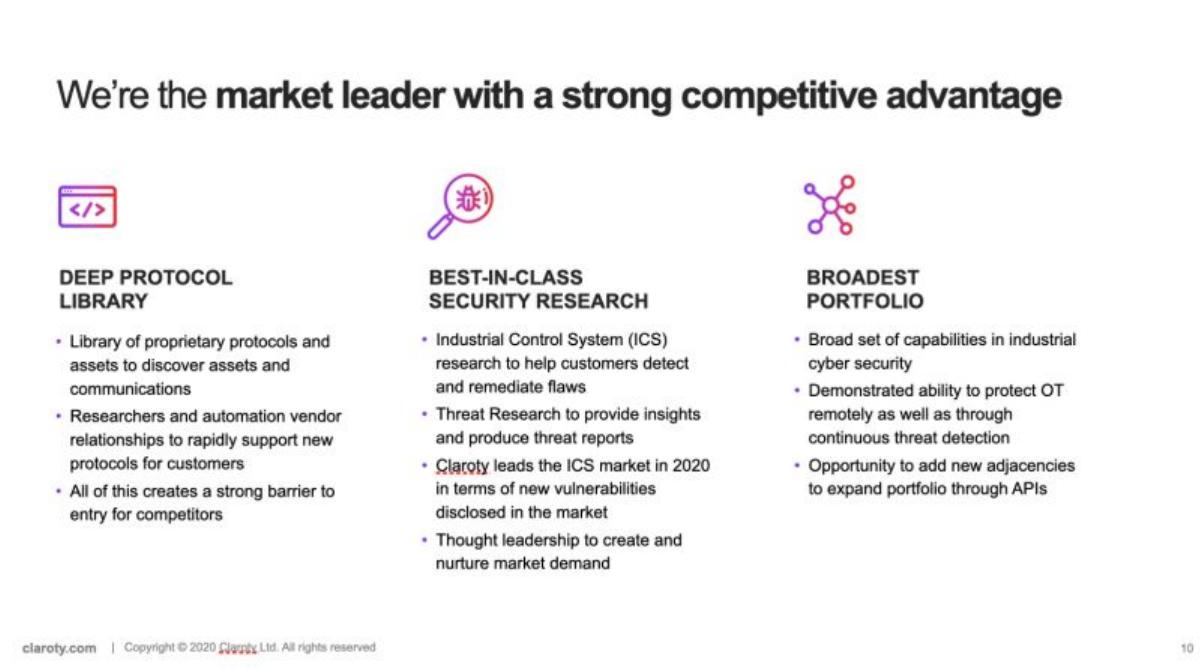
Claroty deck, slide 10. Exact stored slide matched to this analysis.
Our analysis: The research point is specific: it names a measure (vulnerabilities disclosed in industrial control systems in 2020) on which Claroty says it leads.
Evidence and limitation: No competitor is named, so "market leader" and "broadest portfolio" can't be compared with anything, and the vulnerability claim has no source.
What a founder can adapt: Back a leadership claim with one named measure and year, as the research column does.
Supporting analysis
What the deck claims: "We're the market leader with a strong competitive advantage": Deep Protocol Library (proprietary protocol library, automation vendor relationships, "a strong barrier to entry for competitors"); Best-in-Class Security Research ("Claroty leads the ICS market in 2020 in terms of new vulnerabilities disclosed"); Broadest Portfolio (industrial security capabilities, room to expand "through APIs").
Presentation choice: The research point is specific: it names a measure (vulnerabilities disclosed in industrial control systems in 2020) on which Claroty says it leads.
When it does not fit: No competitor is named, so "market leader" and "broadest portfolio" can't be compared with anything, and the vulnerability claim has no source.
Developer tools for encrypting and processing sensitive data. The cybersecurity problem, solution and team guides use other slides from this deck.
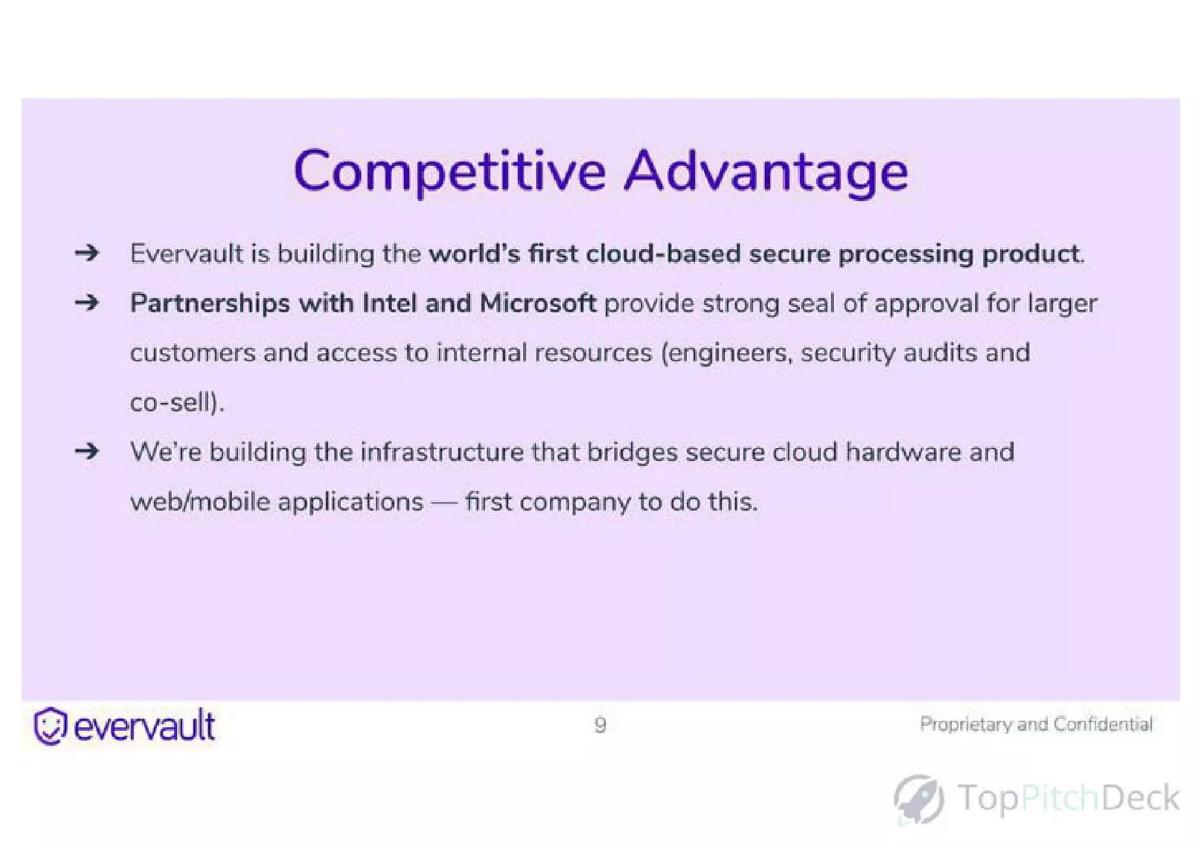
Evervault deck, slide 9. Exact stored slide matched to this analysis.
Our analysis: The Intel and Microsoft partnerships are concrete, and the slide says what they provide: engineers, security audits and co-selling.
Evidence and limitation: Two "first" claims and no named alternatives. A security buyer will know other ways to protect data in use and will expect the slide to address them.
What a founder can adapt: If partnerships are your edge, say what each partner gives you, as Evervault does.
Supporting analysis
What the deck claims: "Competitive Advantage": "Evervault is building the world's first cloud-based secure processing product"; "Partnerships with Intel and Microsoft provide strong seal of approval for larger customers and access to internal resources (engineers, security audits and co-sell)"; "We're building the infrastructure that bridges secure cloud hardware and web/mobile applications — first company to do this."
Presentation choice: The Intel and Microsoft partnerships are concrete, and the slide says what they provide: engineers, security audits and co-selling.
When it does not fit: Two "first" claims and no named alternatives. A security buyer will know other ways to protect data in use and will expect the slide to address them.
What each cybersecurity competition slide gives the reader
Named vendors mapped to what you replace make the comparison useful.
Example
Rivals named
Mapped to a layer or problem
Stated difference
Evidence for the difference
RackTop Systems
11 vendors
Yes (six security layers)
Built into storage
"50-90% Lower TCO", no source
IFG Technology
11 vendors
By region only
Not stated
None
Securter Systems
Apple, Mobeewave, Global Payments
Partly
Works with or as a wallet
Linked article on a rival's flaw
Claroty
0
No
Protocols, research, portfolio
Vulnerability disclosures (no source)
Evervault
0
No
"World's first"
Intel and Microsoft partnerships
Key Takeaways
Security buyers already pay several vendors. Name them, and show which ones you replace or work alongside.
Map rivals to the specific layer or problem they cover, not just a logo wall.
Claims like "world's first" and "market leader" need a named measure or source.
Partnerships with large vendors can reassure buyers, but they are not a comparison.
A linked source for a rival's weakness (for example a published flaw) is stronger than an adjective.
Build your cybersecurity competition slide
Answer these before designing the slide.
Stack. Which security products does your buyer pay for today in the area you cover?
Replace or add. Which of those do you replace, and which do you work alongside?
Difference. What do you do that the nearest vendor can't, stated in one line?
Evidence. What proves it: a test result, a customer figure, a public source?
Claims. Any "first" or "leader" claim: on what measure, and according to whom?
Copyable framework: Today: [vendor A] for [layer], [vendor B] for [layer]. With us: [what changes], shown by [evidence].
Illustrative example 1 — written by us
Before: Evervault is building the world's first cloud-based secure processing product.
After: Alternatives: [approach A], [approach B]. We differ on [measure]: [our result vs theirs], per [source].
What improved: Our illustrative rewrite, not Evervault's text. Bracketed parts are placeholders, not company facts. It replaces a "first" claim with a comparison.
How this guide relates to the other competition and cybersecurity guides
The main competition guide covers comparison tables, positioning maps and feature matrices for any company, and it already uses Portnox's competition slide. The cybersecurity problem, solution, market, product, team and traction guides cover other slides in security decks. This guide covers what is specific to security competition slides: crowded vendor stacks, consolidation claims ("one product instead of five"), and "first" or "leader" claims that buyers will test.
Common mistakes
No rivals named. Security buyers know the market and will fill in the names themselves.
Logo wall with no difference. Say what you do that each group doesn't.
Unmeasured "first" or "leader". Name the measure and the source.
Too much about rivals. Spend at least as much space on your own difference.
Unsourced savings. Back cost claims with a customer example or method.
Diagnostic checklist
The vendors your buyer pays today are named.
Each rival is mapped to the layer or problem it covers.
Your difference is stated in one line.
Every "first" or "leader" claim names its measure and source.
Cost or risk claims have evidence.
Frequently asked questions
How we chose these examples
Corpus: published pitch deck teardowns on StartupFundraising.com. Founder-uploaded private decks are excluded.
Selection (2026-09-28): we searched extracted slide text for slides whose opening words include "competition", "competitors", "competitive", "landscape" or "vs" and whose text mentions security, cyber, threats, breaches or malware. Excluded: Portnox's competition slide (used by the main competition guide), Camdog (video surveillance rather than cybersecurity), Rain (a duplicate of the RackTop deck) and companies outside security.
Images: three slide images (Claroty, Evervault, RackTop) were rendered from the published deck PDFs and stored on 2026-09-28; IFG Technology's and Securter's were already stored.
Overlap check: no competition-slide facet for cybersecurity existed. RackTop, Claroty and Evervault appear in other guides with different slides.
Review: all five stored slide images were inspected on 2026-09-28 and matched to company, deck and slide number (editorial model review). Claims about rivals are quoted from the slides and were not checked. No person has yet completed an editorial review of this page.
We make no claim that any slide caused a fundraising outcome.