How cybersecurity startups present the solution in a pitch deck: close the gap from the problem slide, explain how protection works in plain words.
Cybersecurity Startup Solution Slide: Real Pitch Deck Examples
Eight solution slides from cybersecurity startups, shown in full, compare whether each slide closes the gap its problem slide named, explains how the protection works in words a non-specialist can follow, and says what the buyer has to change to use it.
TL;DR
A cybersecurity solution slide should close the exact gap from the problem slide, explain the mechanism in plain words, and say how little the buyer has to change. Evervault does all three: its problem slide said data "had to be decrypted to process it"; its solution says customers can "process customer data while encrypted", explains the mechanism in three steps, and adds "without changing the way they build their software". RackTop draws its answer — "Protect Data on the Storage System, not just the Perimeter" — as a diagram with the attacker at the gate and data guarded inside. CrowdSec uses an analogy: "The Waze of firewalls". Alcatraz AI's slide is four photos labelled "Past" and "Present", with no explanation, which is the weaker pattern.
Cybersecurity solution slides from real pitch decks
Each example shows the exact stored slide above its analysis and links to the full teardown. Claims are as shown on the slides; we have not verified them.
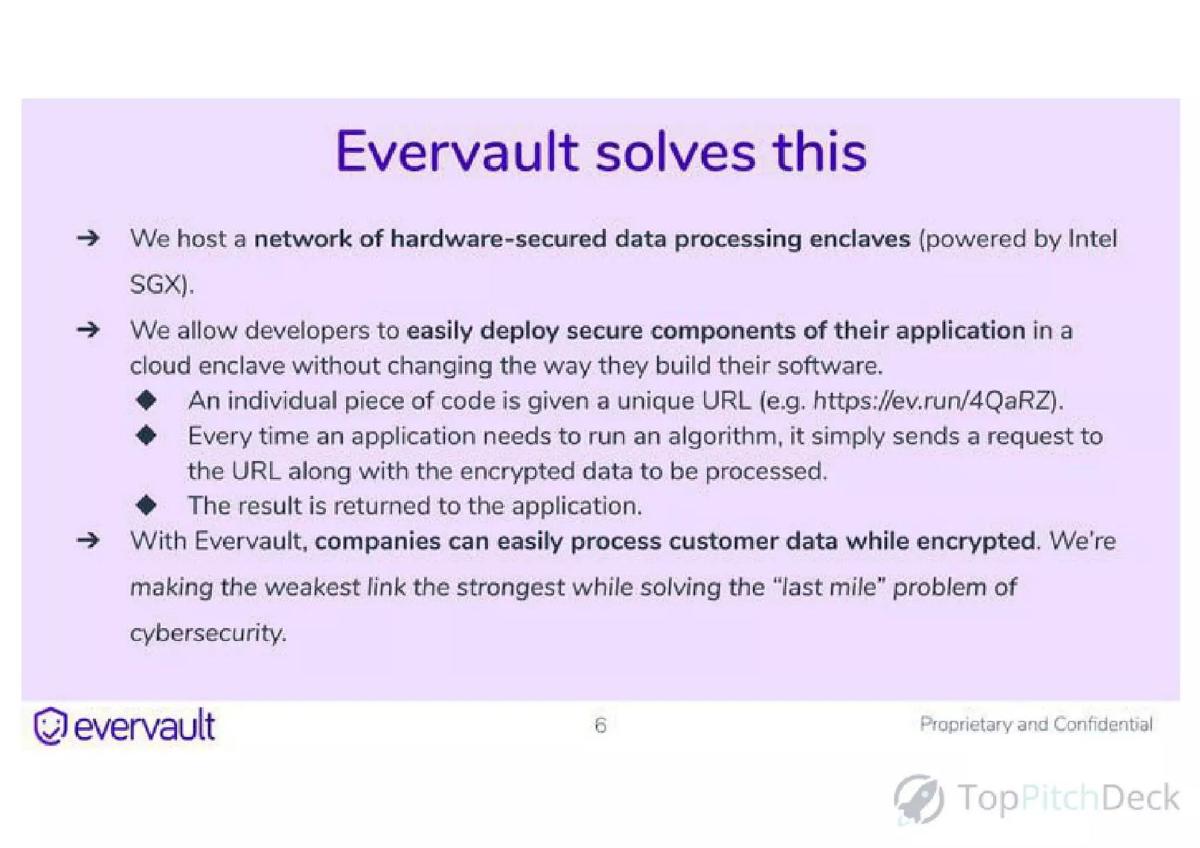
Evervault solution slide — slide 6
Encryption infrastructure for developers. Three arrows and three sub-steps on a plain panel.
Evervault deck, slide 6. Exact stored slide matched to this analysis.
Our analysis: The strongest answer here: it closes the exact gap from its problem slide, explains the mechanism in three steps and removes the adoption objection.
Evidence and limitation: No figures.
What a founder can adapt: End with one sentence that restates your problem slide's gap as solved.
Supporting analysis
What the deck claims: "Evervault solves this." "We host a network of hardware-secured data processing enclaves (powered by Intel SGX)." "We allow developers to easily deploy secure components of their application in a cloud enclave without changing the way they build their software." Sub-steps: code gets "a unique URL"; the application "sends a request to the URL along with the encrypted data"; "The result is returned." "With Evervault, companies can easily process customer data while encrypted."
Presentation choice: The last line mirrors the problem slide's missing line, so the fit is obvious.
When it does not fit: "Intel SGX" means nothing to most investors; say what the hardware guarantees.
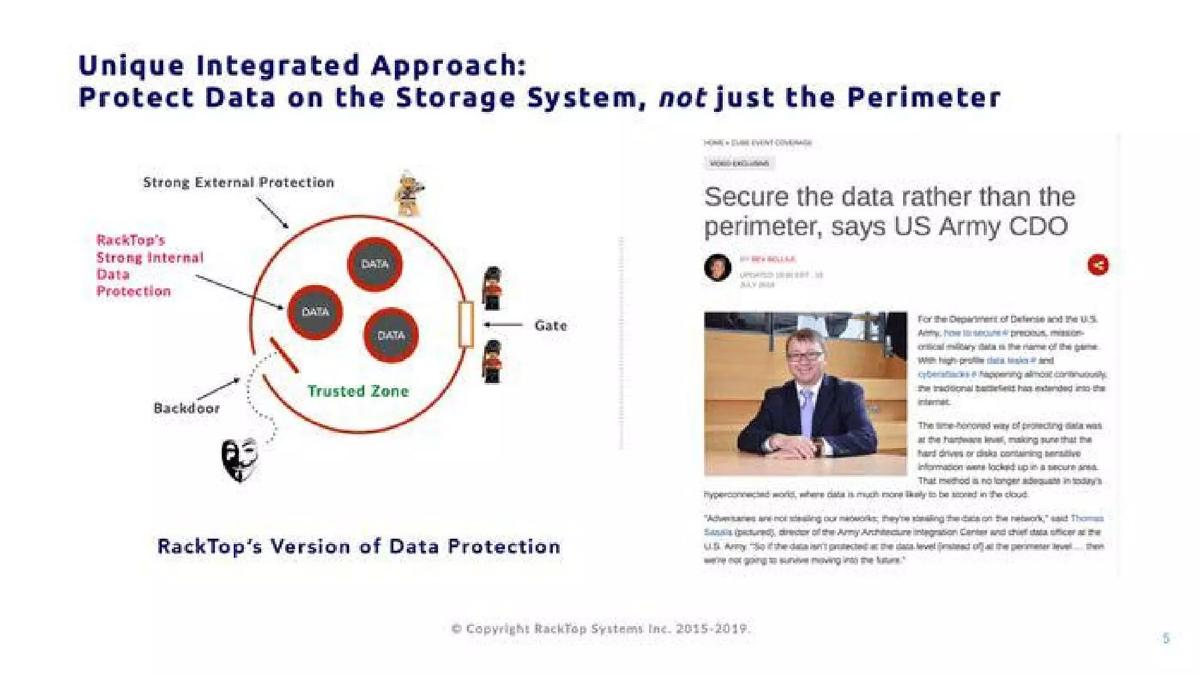
Secure data storage. A diagram beside a press article.
RackTop Systems deck, slide 6. Exact stored slide matched to this analysis.
Our analysis: The diagram shows attackers getting past the gate and through a back door, and the data still protected inside.
Evidence and limitation: A news article quoting a US Army chief data officer; no figures.
What a founder can adapt: Draw where today's protection stops and where yours starts.
Supporting analysis
What the deck claims: "Unique Integrated Approach: Protect Data on the Storage System, not just the Perimeter." Diagram: "Strong External Protection", a "Gate", a "Backdoor", and "RackTop's Strong Internal Data Protection" around data in a "Trusted Zone". Article: "Secure the data rather than the perimeter, says US Army CDO."
Presentation choice: One picture explains the approach; the article shows a credible buyer thinks the same way.
When it does not fit: The article is too small to read; pull out the one quote.
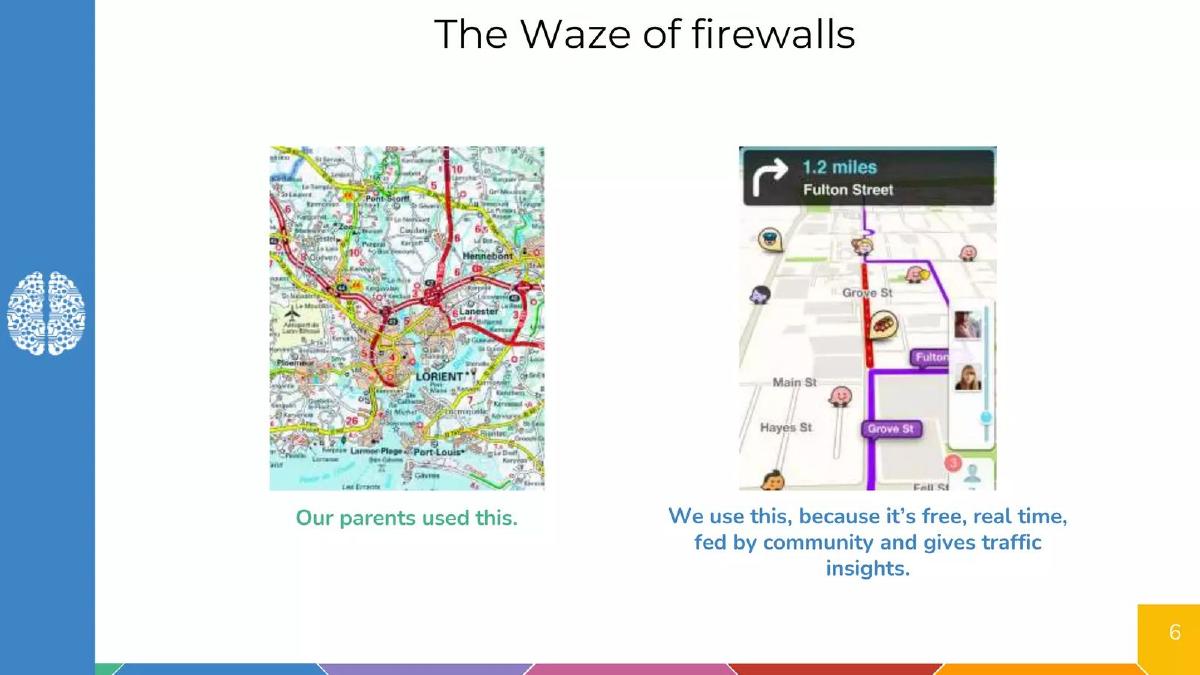
Open-source, crowd-sourced intrusion prevention. A paper road map beside the Waze app.
CrowdSec deck, slide 6. Exact stored slide matched to this analysis.
Our analysis: The analogy explains the model — every user reports attackers, everyone benefits — in five words. The slide before (slide 5) lists the features: real time, reputation, crowd intelligence sharing.
Evidence and limitation: No figures.
What a founder can adapt: If an analogy fits, use it as the headline and let the pictures explain it.
Supporting analysis
What the deck claims: "The Waze of firewalls." Under a paper map: "Our parents used this." Under Waze: "We use this, because it's free, real time, fed by community and gives traffic insights."
Presentation choice: An analogy investors already understand carries both the product and the free, community-fed business model.
When it does not fit: Say once in plain words what CrowdSec does: blocks attackers reported by other users.
Automated security platform for small businesses. Four numbered points beside a graphic.
iSecureCyber deck, slide 5. Exact stored slide matched to this analysis.
Our analysis: It answers its problem slide (SMBs lack knowledge and budget) by replacing the person they can't afford — a cyber officer.
Evidence and limitation: No figures.
What a founder can adapt: Describe your product as the job it replaces.
Supporting analysis
What the deck claims: "Our Solution." "A one stop cloud platform that automates the work of a cyber officer." "1. Developed to be easily operated by the nontechnical novice user." "2. End to End (E2E) automation provides 'implement and forget' functionality." "3. Integrates with different cyber and non cyber products." "4. Designed specifically to address Small & Medium Business's Cyber Risk."
Presentation choice: "Automates the work of a cyber officer" makes the value clear to a small-business owner.
When it does not fit: Show one screen or one task automated; four claims and a decorative graphic prove nothing yet.
Network invisibility for infrastructure. A list of outcomes beside a network image.
NVIS deck, slide 3. Exact stored slide matched to this analysis.
Our analysis: It answers its problem slide (everything on the internet is visible) with what can't happen, and says existing networks are reused.
Evidence and limitation: No figures.
What a founder can adapt: List outcomes, then one line on what the buyer keeps.
Supporting analysis
What the deck claims: "Connect to anyone in the world, securely without restrictions." "NVIS Can't be: Hacked, Sniffed, Traced, Blocked, Censored." "Cost Effective: Take advantage of existing networks or public infrastructure."
Presentation choice: Five one-word outcomes are easy to remember.
When it does not fit: "Can't be hacked" is an absolute claim security buyers distrust; say how it is achieved.
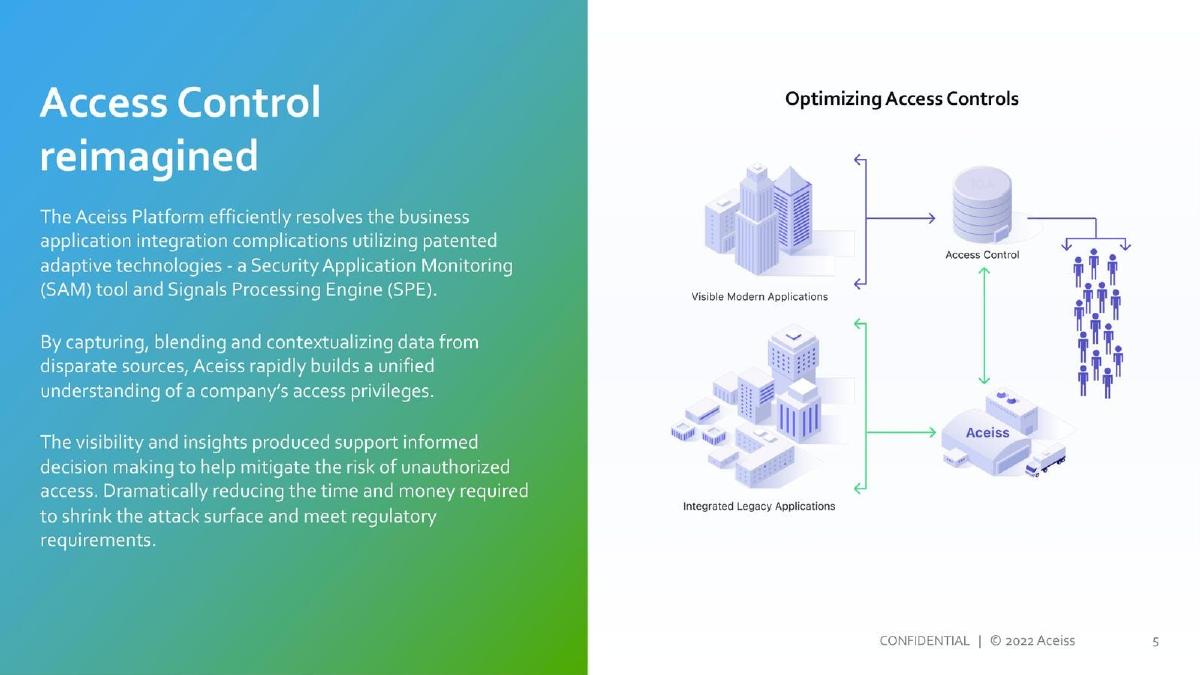
Access-control analytics. A text panel and a diagram connecting applications to access control.
Aceiss deck, slide 5. Exact stored slide matched to this analysis.
Our analysis: The diagram shows legacy applications, previously invisible, now connected through Aceiss — a clear answer to "you cannot protect what you can't see". The text is harder going.
Evidence and limitation: No figures.
What a founder can adapt: Show the before and after diagrams on consecutive slides.
Supporting analysis
What the deck claims: "Access Control reimagined." "The Aceiss Platform efficiently resolves the business application integration complications utilizing patented adaptive technologies — a Security Application Monitoring (SAM) tool and Signals Processing Engine (SPE)." "Aceiss rapidly builds a unified understanding of a company's access privileges." Diagram: "Optimizing Access Controls."
Presentation choice: The diagram does the explaining; compare it with the "bypassed" diagram on its slide 4.
When it does not fit: Cut product acronyms (SAM, SPE) from the solution slide.
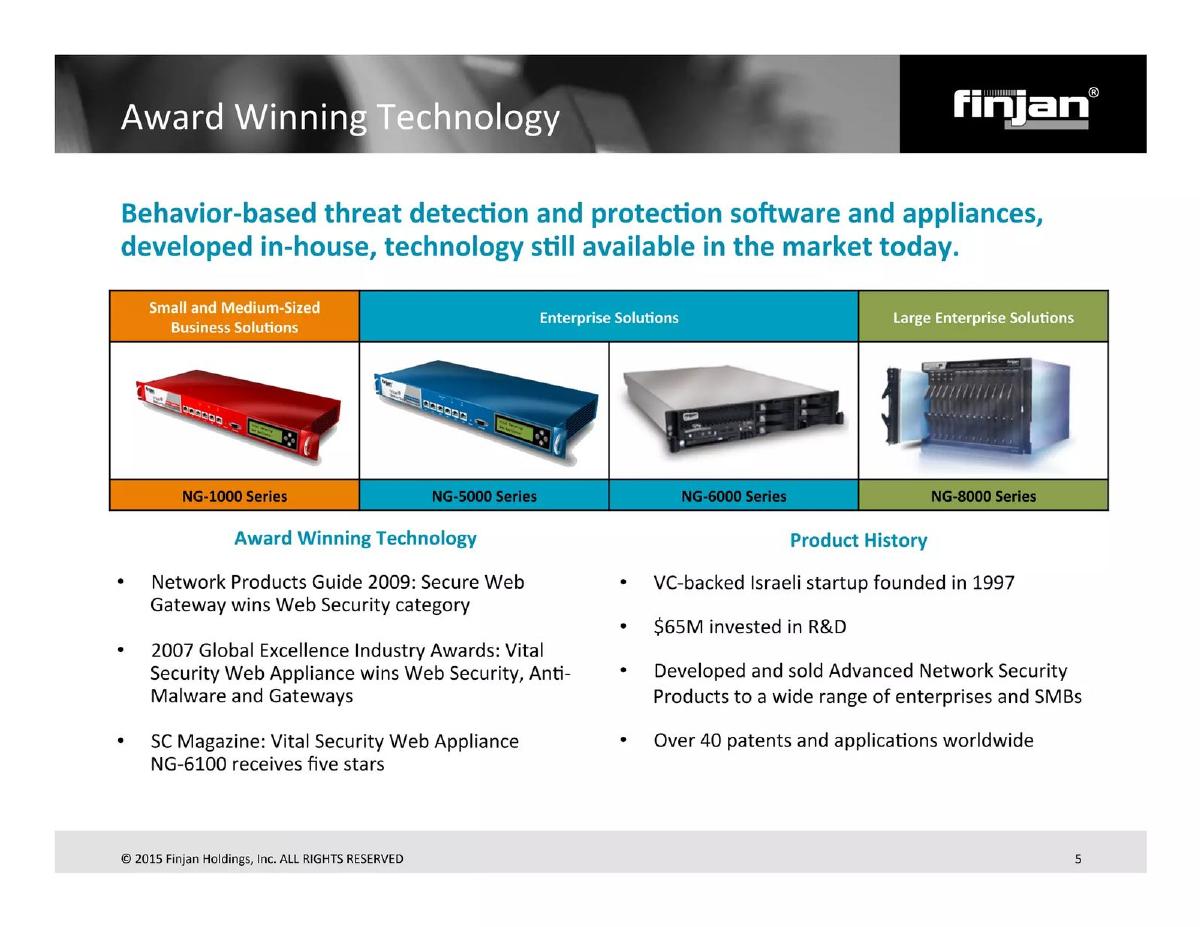
Security technology and patent licensing. Four hardware products, awards and history. Partial.
Finjan deck, slide 5. Exact stored slide matched to this analysis.
Our analysis: It proves a product and investment exist, but doesn't explain how behaviour-based detection would have stopped the breaches on its problem slide.
Evidence and limitation: $65M in R&D; over 40 patents; three named awards.
What a founder can adapt: Connect one breach from the problem slide to how your detection catches it.
Supporting analysis
What the deck claims: "Award Winning Technology." "Behavior-based threat detection and protection software and appliances, developed in-house." Products for "Small and Medium-Sized Business", "Enterprise" and "Large Enterprise". "$65M invested in R&D." "Over 40 patents and applications worldwide."
Presentation choice: Kept as partial: strong proof, missing mechanism.
When it does not fit: Awards from 2007 and 2009 on a solution slide suggest the product is old.
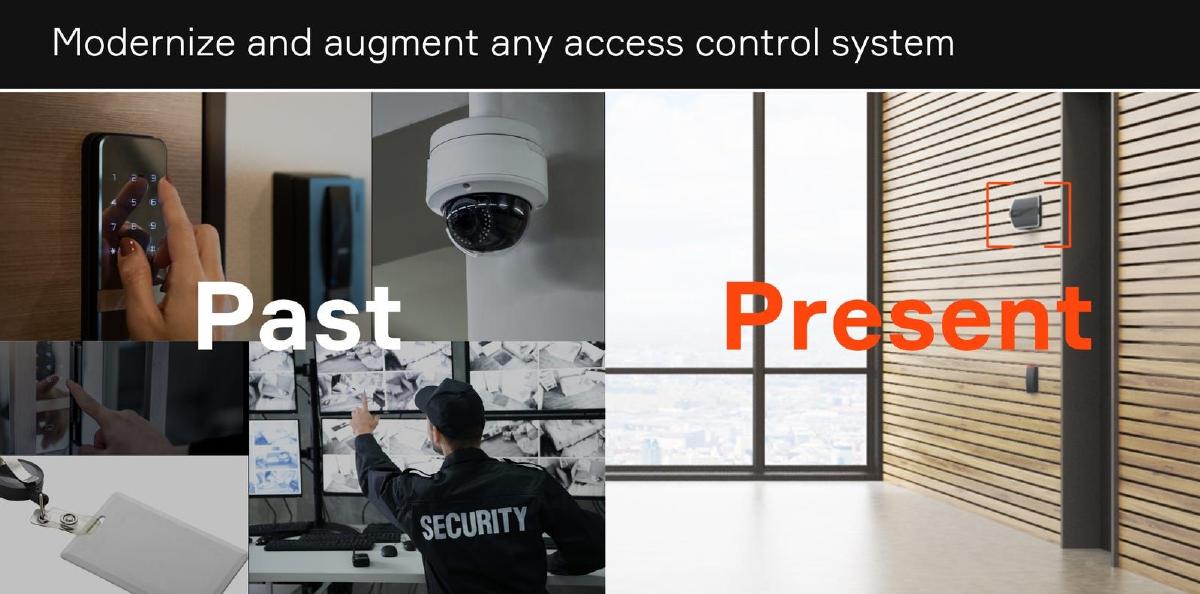
Face-recognition access control for buildings. Four photos under "Past" and one under "Present". Weak on purpose.
Alcatraz AI deck, slide 5. Exact stored slide matched to this analysis.
Our analysis: It suggests one device replaces keypads, badges and guards, but never says what it does or how.
Evidence and limitation: No figures.
What a founder can adapt: Add one line under "Present": what the device checks, and what it stops (the tailgating named on its slide 4).
Supporting analysis
What the deck claims: "Modernize and augment any access control system." Photos labelled "Past": a keypad, a badge, a camera, a security guard. Labelled "Present": a small device beside a door.
Presentation choice: It shows the minimum a solution slide needs: what the product does and why that closes the gap.
When it does not fit: Photos alone leave the investor to guess the mechanism.
Whether each slide closes its problem slide's gap, explains the mechanism, and says what the buyer must change.
Example
Closes the gap
Explains how
Buyer's change
Evervault
Yes (process while encrypted)
Yes (three steps)
Yes (no change to how software is built)
RackTop Systems
Yes (protect data, not just perimeter)
Yes (diagram)
No
CrowdSec
Yes (budgets alone fail)
Yes (analogy)
Partly (free)
iSecureCyber
Yes (no cyber officer needed)
Partly (claims)
Yes (for non-technical users)
NVIS
Yes (can't be seen)
No
Yes (existing networks)
Aceiss
Yes (can now see legacy apps)
Partly (diagram, dense text)
No
Finjan
No
No
No
Alcatraz AI
Implied
No
Partly (augments existing system)
Key Takeaways
Close the gap your problem slide named, in the same words; seven decks here have their problem slide in the cybersecurity problem guide.
Explain the mechanism in plain steps; security buyers and investors both need to see why it works.
Say what the buyer must change; "without changing the way they build their software" removes an objection.
A familiar analogy (Waze) or a simple diagram (attacker at the gate) beats a list of technical terms.
Photos and product lineups show that a product exists, not how it protects anyone.
Build your cybersecurity solution slide
Close the gap, explain the mechanism, say what the buyer changes.
Gap. Which line on your problem slide does this close? Reuse its words.
Mechanism. How does it work, in three steps a non-specialist can follow?
Change. What does the buyer install or change: nothing, an agent, a DNS record, a new process?
Picture. One diagram or analogy that shows where your protection sits.
Copyable framework: [Product] stops [attack] by [mechanism in plain words]. [Buyer] installs [what] in [time], with no change to [existing tools].
Illustrative example 1 — written by us
Before: Next-generation AI-powered zero-trust platform for holistic threat protection.
After: We check every staff email link before it opens and block the ones that lead to fake login pages. Clinics add one DNS setting in 10 minutes; nothing else changes.
What improved: Our illustrative rewrite; the details are invented for the example. It says what is stopped, how, and what the buyer changes.
What this guide adds
The cybersecurity problem guide covers the slide before this one. Seven of the eight companies here have their problem slide in that guide, so each solution can be checked against the gap it promised to close.
Security buyers are sceptical by profession and usually already pay for several tools. A solution slide has to show a mechanism that plausibly works and an adoption cost the buyer will accept.
Three things a cybersecurity solution slide proves
It closes the named gap: data during processing (Evervault), data behind the perimeter (RackTop), visibility of the network (NVIS).
It explains how: Evervault's three steps, RackTop's diagram, CrowdSec's shared crowd intelligence.
It says what adoption costs the buyer: no change to how software is built (Evervault), "for non-technical novice user" (iSecureCyber), existing networks reused (NVIS).
Common mistakes
Absolute claims. "Can't be hacked" invites disbelief; explain how the risk is reduced.
Acronyms instead of a mechanism. Product module names don't explain how anything works.
Proof of existence, not of protection. Awards, patents and hardware photos belong on a traction or technology slide.
No adoption cost. Security buyers already run many tools; say what yours asks of them.
Photos with no words. Say what the pictured product does.
Diagnostic checklist
It closes the gap named on your problem slide, in the same words.
It explains the mechanism in plain steps or one diagram.
It says what the buyer must install or change.
It avoids absolute claims.
The slide is readable at a glance.
Frequently asked questions
How we chose these examples
Corpus: published pitch deck teardowns on StartupFundraising.com. Founder-uploaded private decks are excluded.
Selection (2026-09-25): we searched slides 2–7 for solution slides mentioning cyber threats, breaches, encryption, access control or hackers. Nineteen stored images were inspected. MetaCert (no stored solution slide), Aura (its slides 4–5 describe the market, not a solution), Nord (a brand lineup, not a solution) and IriusRisk and Cloudsmith (their solution slides appear in the SaaS solution guide) were left out; identity-verification, payment and crypto decks were left out as outside this series. Finjan is marked partial; Alcatraz AI is kept as a weaker contrast.
Overlap check: none of these eight slides appears in another guide. Seven of the companies have their problem slide in the cybersecurity problem guide.
Review: all eight stored slide images were inspected on 2026-09-25 and matched to company, deck and slide number (editorial model review). No person has yet completed an editorial review of this page.
Claims are as shown on the slides; we have not verified them. We make no claim that any slide caused a fundraising outcome.