Cybersecurity Startup Problem Slide: Pitch Deck Examples
How cybersecurity startups present the problem in a pitch deck: name the buyer, the gap today's tools leave open, and what a breach costs.
Cybersecurity Startup Problem Slide: Real Pitch Deck Examples
Eight problem slides from cybersecurity startups, shown in full, compare whether each slide names the buyer, points to the specific gap that today's security tools leave open, and puts a sourced cost on it.
TL;DR
A cybersecurity problem slide should name one buyer, show the gap existing tools leave open, and put a sourced cost on it. Every investor already knows cybercrime is expensive, so a global figure alone adds little. iSecureCyber names its buyer and sources three figures: "70% of SMBs would experience increased cyber attacks", "55% of SMBs lack in budget planning on cybersecurity", "Source: NSW Business Chamber". CrowdSec shows that money isn't the answer: companies with "amongst the largest security budgets on earth" were still breached. Evervault names the exact gap: data is encrypted at rest and in transit, but "until now, data had to be decrypted to process it". Aceiss's slide is two columns of dense text that mix the problem with the product, which is the weaker pattern.
Cybersecurity problem slides from real pitch decks
Each example shows the exact stored slide above its analysis and links to the full teardown. Claims are as shown on the slides; we have not verified them.
iSecureCyber problem slide — slide 4
Automated security platform for small businesses. Three statistics in a blue panel with a source line.
iSecureCyber deck, slide 4. Exact stored slide matched to this analysis.
Our analysis: The strongest structure here: one buyer, why they are exposed (no knowledge, no budget) and what it costs them (the business itself).
Evidence and limitation: Three percentages with a named source.
What a founder can adapt: Three sourced numbers about your buyer: how often they are hit, why they can't defend, what it costs.
Supporting analysis
What the deck claims: "The Problem." "70% of SMBs would experience increased cyber attacks owing to lack of knowledge on how to protect their organization from these attacks." "55% of SMBs lack in budget planning on cybersecurity." "80% of Australian SMBs are estimated to go bankrupt within 12 months owing to cyber attacks." "Source: NSW Business Chamber."
Presentation choice: Every number is about the buyer the product serves, not about cybercrime in general.
When it does not fit: Word the bankruptcy figure carefully; "estimated to go bankrupt within 12 months" of an attack needs the exact source.
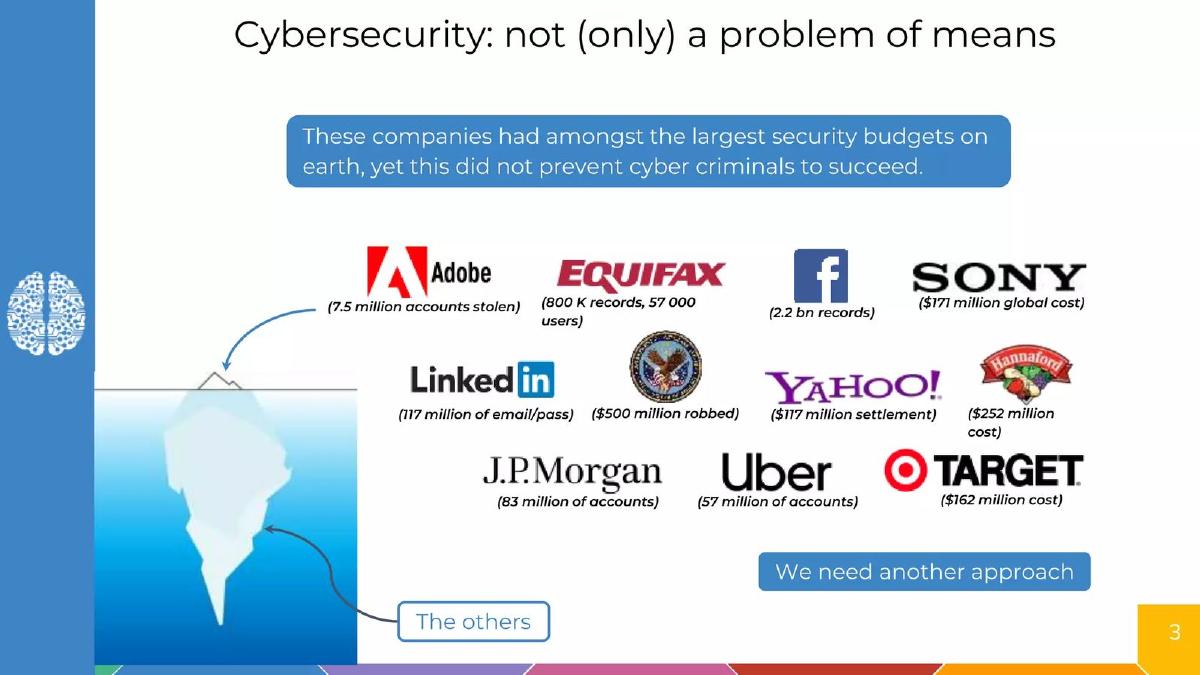
Open-source, crowd-sourced intrusion prevention. An iceberg and twelve breached companies with their losses.
CrowdSec deck, slide 3. Exact stored slide matched to this analysis.
Our analysis: It argues that spending more doesn't work, which sets up a different approach; the iceberg suggests smaller companies ("the others") are worse off.
Evidence and limitation: Losses listed for each company; no source on the slide.
What a founder can adapt: Use the headline to say why current spending fails, not that attacks happen.
Supporting analysis
What the deck claims: "Cybersecurity: not (only) a problem of means." "These companies had amongst the largest security budgets on earth, yet this did not prevent cyber criminals to succeed." Logos with figures, including Adobe "(7.5 million accounts stolen)", Sony "($171 million global cost)", Target "($162 million cost)", Uber "(57 million of accounts)". "The others." "We need another approach."
Presentation choice: Famous names and specific losses turn "attacks are rising" into something an investor remembers.
When it does not fit: Name the buyer: "the others" at the bottom of the iceberg is the customer, and should be the focus. Source the figures.
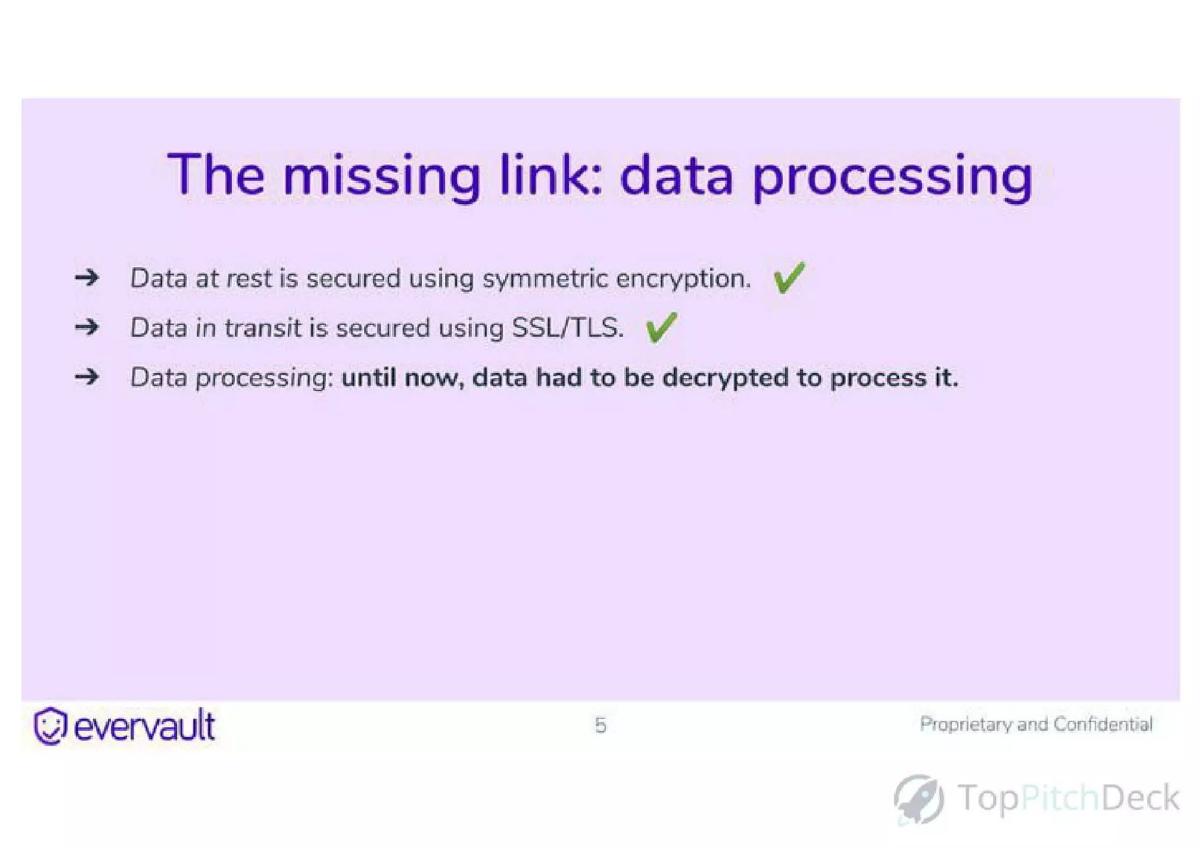
Encryption infrastructure for developers. Three lines on a plain panel.
Evervault deck, slide 5. Exact stored slide matched to this analysis.
Our analysis: Two ticks show what is already solved; the third line is the gap. An investor sees exactly where the product fits.
Evidence and limitation: No figures.
What a founder can adapt: List what your buyer already has covered, then the one thing not covered.
Supporting analysis
What the deck claims: "The missing link: data processing." "Data at rest is secured using symmetric encryption." [tick] "Data in transit is secured using SSL/TLS." [tick] "Data processing: until now, data had to be decrypted to process it."
Presentation choice: Showing what already works makes the missing piece obvious.
When it does not fit: Add who suffers from the gap and one example of it causing a breach.
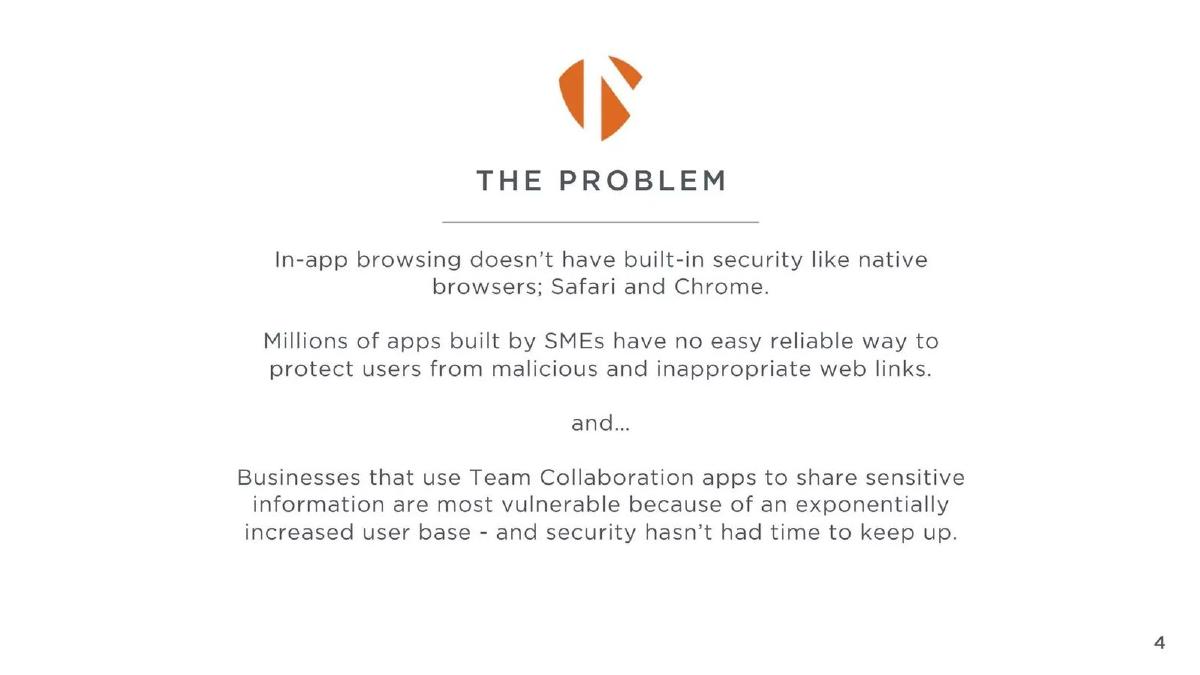
Link-security service for apps. Three short paragraphs.
MetaCert deck, slide 5. Exact stored slide matched to this analysis.
Our analysis: It names the gap by comparison (in-app browsers lack what Safari and Chrome have) and the buyer (small app makers).
Evidence and limitation: "Millions of apps"; no source.
What a founder can adapt: Explain your gap by comparing with a protection people already know.
Supporting analysis
What the deck claims: "The Problem." "In-app browsing doesn't have built-in security like native browsers; Safari and Chrome." "Millions of apps built by SMEs have no easy reliable way to protect users from malicious and inappropriate web links." "Businesses that use Team Collaboration apps to share sensitive information are most vulnerable."
Presentation choice: Comparing with a browser every investor uses makes the gap easy to understand.
When it does not fit: Two different buyers (app makers and collaboration users); pick one. No cost is given.
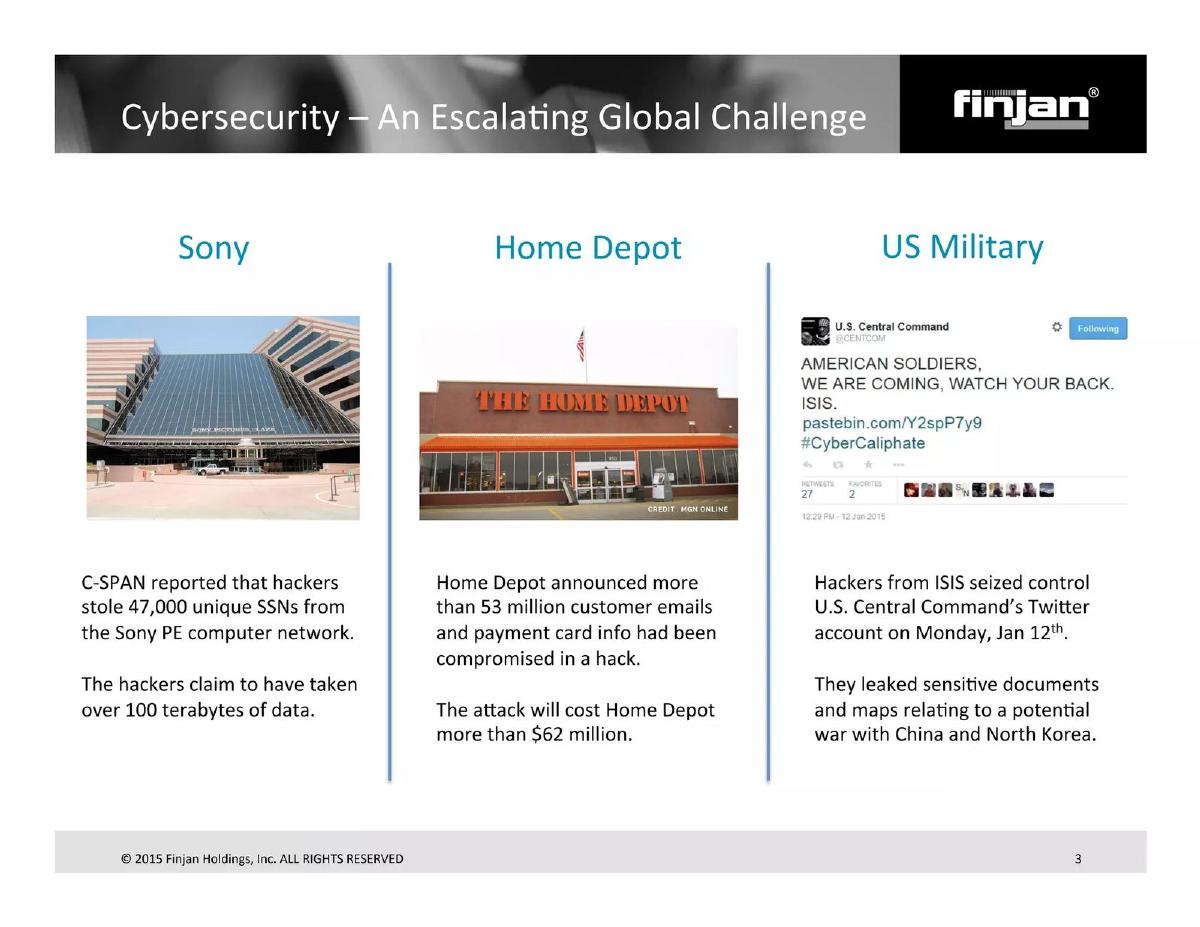
Security technology and patent licensing. Three columns, one breach each, with photos.
Finjan deck, slide 3. Exact stored slide matched to this analysis.
Our analysis: Three concrete breaches show the risk, but none says what Finjan's customers lack or why these attacks succeeded.
Evidence and limitation: Figures quoted from news reports (C-SPAN named for Sony).
What a founder can adapt: If you use breaches, pick ones your product would have stopped and say how.
Supporting analysis
What the deck claims: "Cybersecurity – An Escalating Global Challenge." Sony: "hackers stole 47,000 unique SSNs" and "claim to have taken over 100 terabytes of data". Home Depot: "more than 53 million customer emails and payment card info had been compromised"; "The attack will cost Home Depot more than $62 million." US Military: "Hackers from ISIS seized control" of a US Central Command Twitter account.
Presentation choice: Specific, reported incidents are more believable than a trend line.
When it does not fit: "Escalating global challenge" describes the news, not a buyer's problem.
Network invisibility for infrastructure. A list of technical weaknesses and a global cost.
NVIS deck, slide 6. Exact stored slide matched to this analysis.
Our analysis: A clear technical cause (everything on the internet can be found), but the cost is global and no buyer is named.
Evidence and limitation: $10.5 trillion a year, sourced as a projection.
What a founder can adapt: Keep the one-line thesis; replace the global cost with one for your buyer.
Supporting analysis
What the deck claims: "The Core Problem." "Visibility is the problem." "Internet is OPEN which means VULNERABLE BY DESIGN: Geolocation; Routes are traceable; Lookup by name (DNS); IP address is public; TCP ports well known / discoverable; Open Protocols yield Connectivity but NO SECURITY." "Result: Global Cost of Cybercrime 10.5 Trillion dollars Annually." "Projected by CyberSecurity Ventures, 2021."
Presentation choice: The one-line thesis ("Visibility is the problem") sets up an invisibility product neatly.
When it does not fit: Six technical bullets lose non-technical investors; two would do.
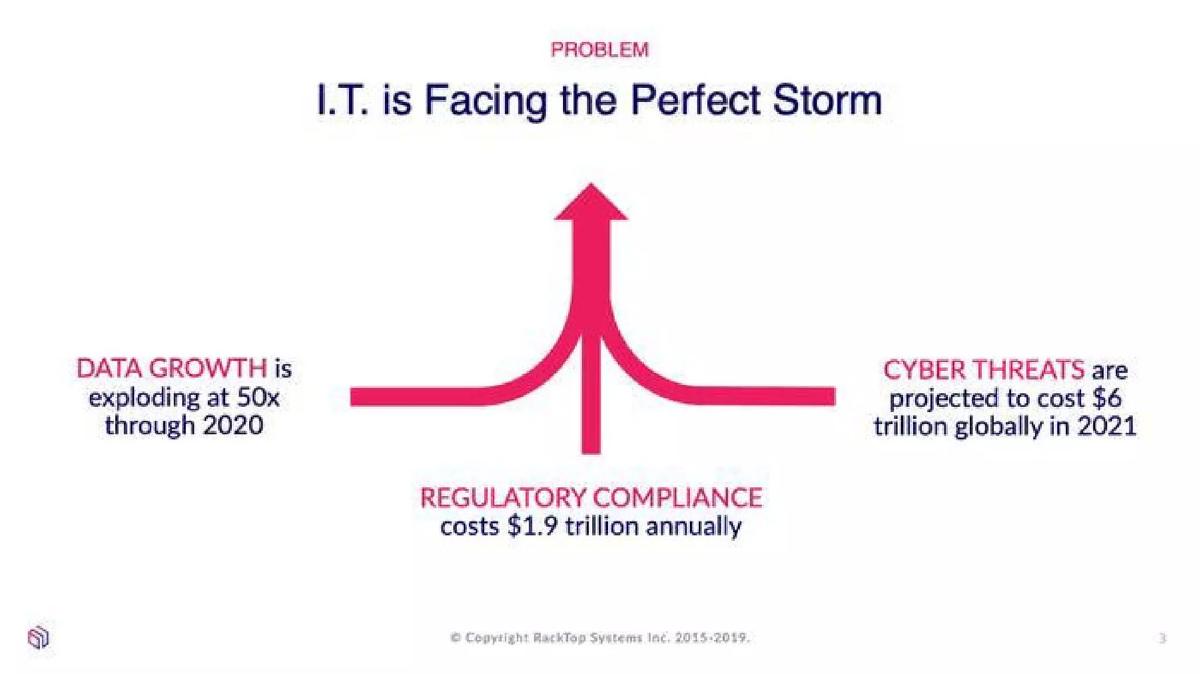
Secure data storage. Three pressures around a pink arrow. Partial.
RackTop Systems deck, slide 4. Exact stored slide matched to this analysis.
Our analysis: It names a buyer (IT teams) and three pressures, but every number is global, so none describes the buyer's own cost.
Evidence and limitation: Three large figures; none sourced on the slide.
What a founder can adapt: Turn each pressure into the buyer's cost: storage growth per year, cost of one compliance audit.
Supporting analysis
What the deck claims: "Problem." "I.T. is Facing the Perfect Storm." "Data growth is exploding at 50x through 2020." "Cyber threats are projected to cost $6 trillion globally in 2021." "Regulatory compliance costs $1.9 trillion annually."
Presentation choice: Kept as partial: the structure is clear, the numbers are background.
When it does not fit: Unsourced global figures; investors have seen "$6 trillion" many times.
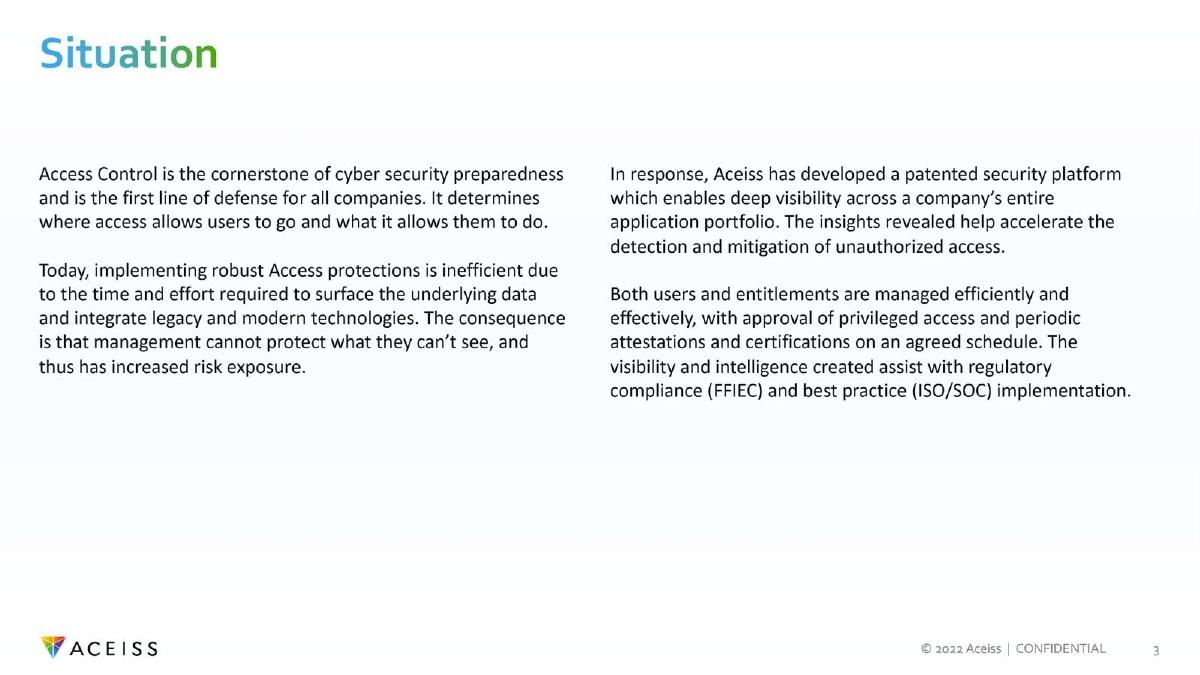
Access-control analytics. Two columns of small text. Weak on purpose.
Aceiss deck, slide 3. Exact stored slide matched to this analysis.
Our analysis: The problem is there ("management cannot protect what they can't see") but it is buried in a paragraph, and half the slide describes the product.
Evidence and limitation: No figures.
What a founder can adapt: Pull out the one line ("can't protect what they can't see") as the headline and add what that costs.
Supporting analysis
What the deck claims: "Situation." "Access Control is the cornerstone of cyber security preparedness." "Today, implementing robust Access protections is inefficient due to the time and effort required to surface the underlying data... management cannot protect what they can't see." Second column: "In response, Aceiss has developed a patented security platform..."
Presentation choice: It shows what the stronger slides avoid: dense text, no number and the solution mixed in.
When it does not fit: Move the product description to the solution slide.
Whether each slide names a buyer, points to a specific gap, and gives a sourced cost.
Example
Buyer
Specific gap
Sourced cost
iSecureCyber
Yes (SMBs)
Yes (no knowledge or budget)
Yes (NSW Business Chamber)
CrowdSec
Implied ("the others")
Partly (budgets don't stop attacks)
Figures, no source
Evervault
No
Yes (data during processing)
No
MetaCert
Yes (small app makers)
Yes (in-app browsers)
No
Finjan
No
No
Partly (news reports)
NVIS
No
Yes (internet is visible)
Global only (sourced)
RackTop Systems
Yes (IT)
Partly (three pressures)
Global only (unsourced)
Aceiss
Partly (management)
Buried
No
Key Takeaways
Name one buyer: small businesses, developers, app makers, IT teams.
Point to the gap today's tools miss; Evervault's one missing line (data in use) is the clearest example here.
A global cybercrime figure ("$6 trillion", "10.5 trillion") is background everyone knows; add a cost for your buyer.
Named breaches (Equifax, Sony, Home Depot) make the risk concrete, but say why your buyer is next.
Keep the product off the problem slide; Aceiss mixes both and neither lands.
Build your cybersecurity problem slide
One buyer, the gap today's tools leave, a sourced cost.
Buyer. Who is exposed and who pays: SMB owners, developers, CISOs at mid-size banks?
Covered. What do they already have (firewall, antivirus, encryption at rest)?
Gap. What gets through, and why? One line.
Cost. What does one incident cost this buyer? Name the source.
Copyable framework: [Buyer] already use [existing tools], but [gap] leaves them open to [attack]. One incident costs them [amount] (Source: [source]).
Illustrative example 1 — written by us
Before: Cybercrime will cost the world $10 trillion and attacks are increasing every year.
After: Dental practices already run antivirus, but 1 in 4 was hit by ransomware through staff email last year, costing an average of $42,000 in downtime. (Source: our survey of 310 practices.)
What improved: Our illustrative rewrite; the figures are invented for the example. It names the buyer, what they have, the gap and a cost.
What this guide adds
The SaaS problem guide covers software sold to businesses in general, including one security deck (IriusRisk) that is left out here. Cybersecurity decks face a particular difficulty: investors have seen hundreds of slides saying attacks are growing. What earns attention is a specific buyer and a specific gap.
Three slides here name a buyer (iSecureCyber, MetaCert, RackTop implicitly), two describe a technical gap (Evervault, NVIS), two rely on famous breaches (CrowdSec, Finjan), and Aceiss explains access control in general.
Three things a cybersecurity problem slide proves
Who is exposed: "Small Medium Business" (iSecureCyber), "Millions of apps built by SMEs" (MetaCert), "I.T." (RackTop).
What today's tools miss: data while it is processed (Evervault), in-app browsers without the protection of Safari or Chrome (MetaCert), a public, traceable internet (NVIS).
What it costs: sourced (iSecureCyber, NVIS citing CyberSecurity Ventures) or shown through named breaches (CrowdSec's "$171 million" for Sony, Finjan's "$62 million" for Home Depot).
Common mistakes
Global cybercrime figure as the problem. Everyone has seen "$6 trillion"; it doesn't say who your buyer is.
Breaches with no link to the product. Name breaches your product would have stopped, and say why.
Too many technical bullets. Two clear weaknesses beat six protocol names.
No buyer. Security is bought by specific people with specific budgets.
Solution on the problem slide. Keep the product for the next slide.
Diagnostic checklist
It names one buyer.
It says what they already have and what gets through.
It gives a cost for that buyer, with a source.
Any named breaches connect to the gap.
The product description is on the next slide.
Frequently asked questions
How we chose these examples
Corpus: published pitch deck teardowns on StartupFundraising.com. Founder-uploaded private decks are excluded.
Selection (2026-09-25): we searched slides 2–6 for problem slides mentioning cyber attacks, hackers, breaches, vulnerabilities or malware. Twelve stored images were inspected. IriusRisk and Cloudsmith were excluded because their problem slides appear in the SaaS problem guide; Securter and other card-fraud and crypto-exchange decks were left out as payments (financial services are outside this series); ad-fraud and identity-verification decks were left out as separate categories. RackTop Systems is marked partial; Aceiss is kept as a weaker contrast.
Overlap check: none of these eight slides appears in another guide.
Review: all eight stored slide images were inspected on 2026-09-25 and matched to company, deck and slide number (editorial model review). No person has yet completed an editorial review of this page.
Claims are as shown on the slides; we have not verified them. We make no claim that any slide caused a fundraising outcome.