RackTop Systems utilized a 10-slide deck to secure $15.8 million in Series A funding, focusing heavily on the convergence of data storage and cybersecurity. The deck relies on the 'Cyber-Converged' narrative, arguing that traditional perimeter security is insufficient in an era where data growth is exploding at 50x. By highlighting their founders' 20+ years of NSA experience and a massive logo wall of government and enterprise clients, RackTop established immediate credibility. The presentation effectively contrasts 'bolt-on' security solutions against their 'built-in' architecture, claiming…
Key takeaways
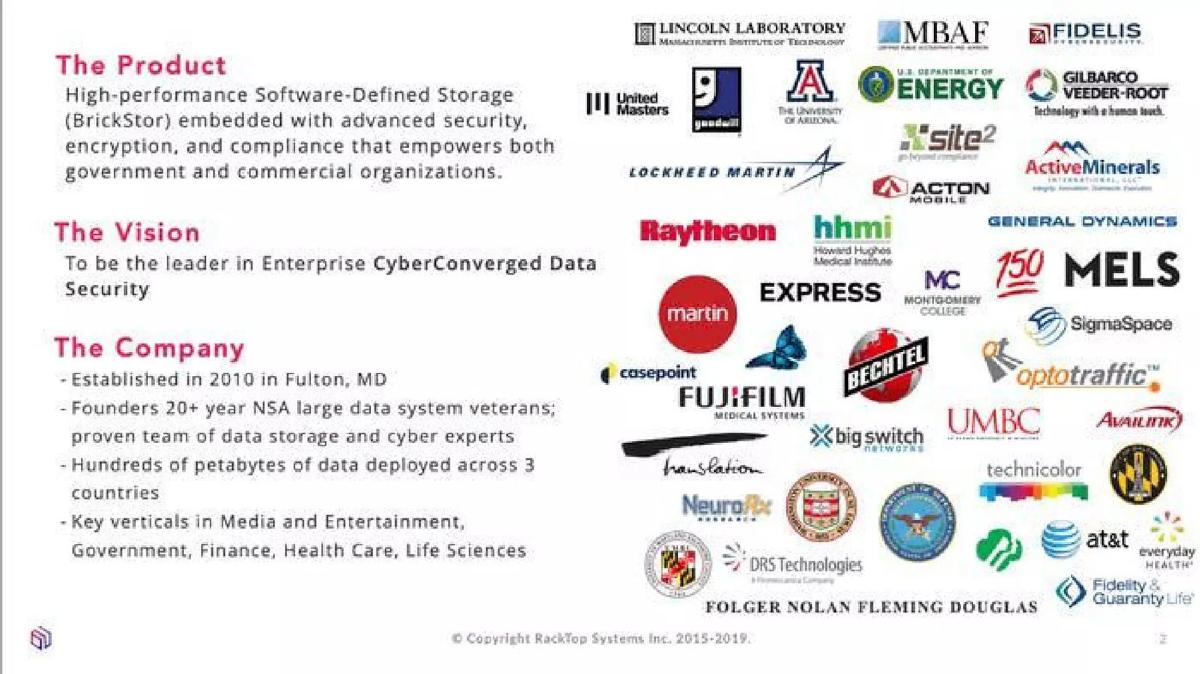
- The company was established in 2010 in Fulton, MD, by founders with over 20 years of experience as NSA large data system veterans (Slide 2).
- RackTop claims to have hundreds of petabytes of data deployed across three countries as of the time of the deck (Slide 2).
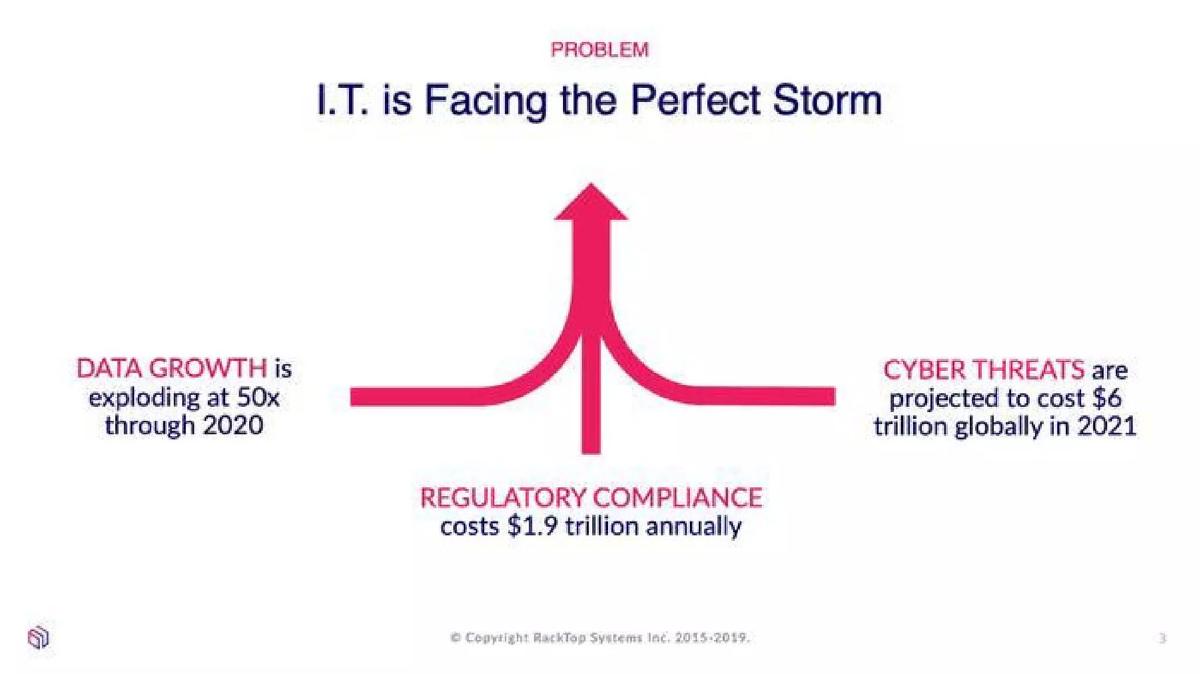
- The problem slide identifies a 'Perfect Storm' where data growth is exploding at 50x while cyber threats are projected to cost $6 trillion globally by 2021 (Slide 3).
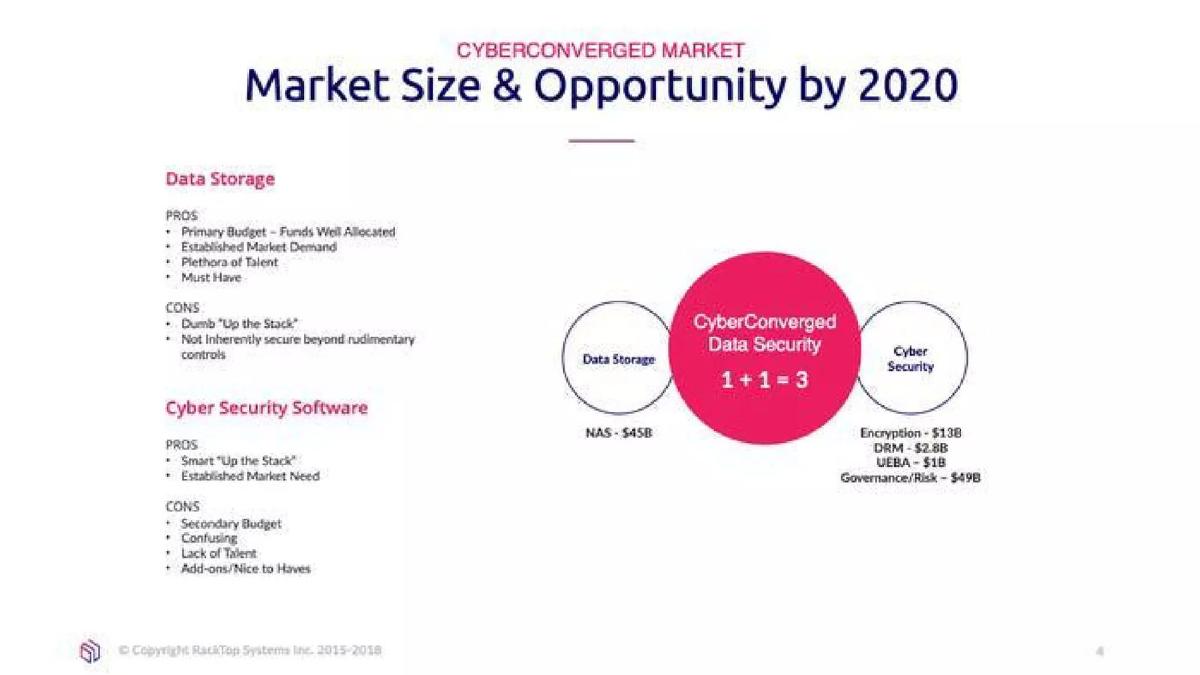
- RackTop defines a new 'CyberConverged' market, valuing the Network Attached Storage (NAS) segment at $45 billion and various security segments like Encryption at $13 billion (Slide 4).
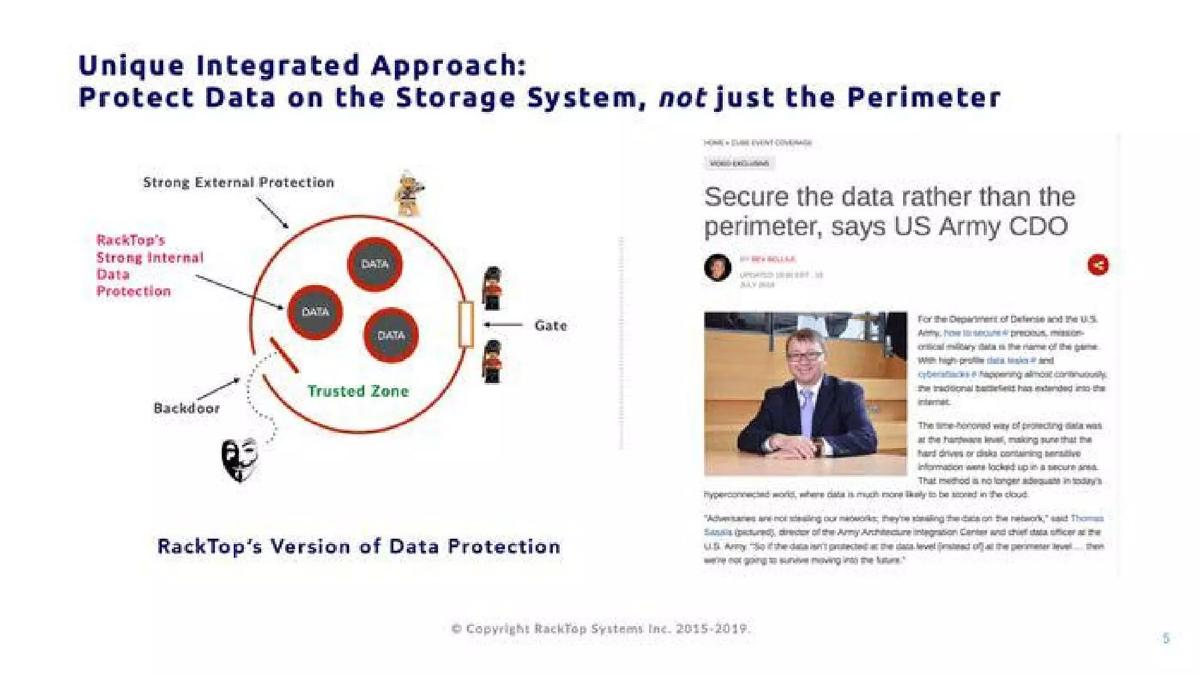
- The deck emphasizes a shift from perimeter security to internal data protection, citing a US Army CDO who advocates for securing data rather than the perimeter (Slide 5).
- RackTop claims their integrated approach offers a 50-90% lower Total Cost of Ownership (TCO) compared to 'bolt-on' solutions from competitors like Varonis or Cisco (Slide 7).
- The BrickStor product is described as the world's first storage that maps directly to all five functional areas of the NIST Cyber Security Framework: Identify, Protect, Detect, Respond, and Recover (Slide 9).
- The deck includes a massive logo wall featuring high-profile entities such as Lockheed Martin, Raytheon, General Dynamics, and the U.S. Department of Energy (Slide 2).
Executive Summary: The Cyber-Converged Narrative
RackTop Systems’ pitch deck is a highly technical, credibility-focused presentation designed for a Series A audience. Rather than focusing on flashy growth charts, the deck centers on the 'Cyber-Converged' market—a term they use to describe the inevitable merger of data storage and cybersecurity. By framing the problem as a 'Perfect Storm' of exploding data and trillion-dollar cyber threats, RackTop positions their BrickStor product as a necessary evolution for both government and enterprise IT infrastructure. The deck’s strength lies in its pedigree (NSA veterans) and its alignment with federal standards like the NIST framework.
Slide 1: Title and Recognition
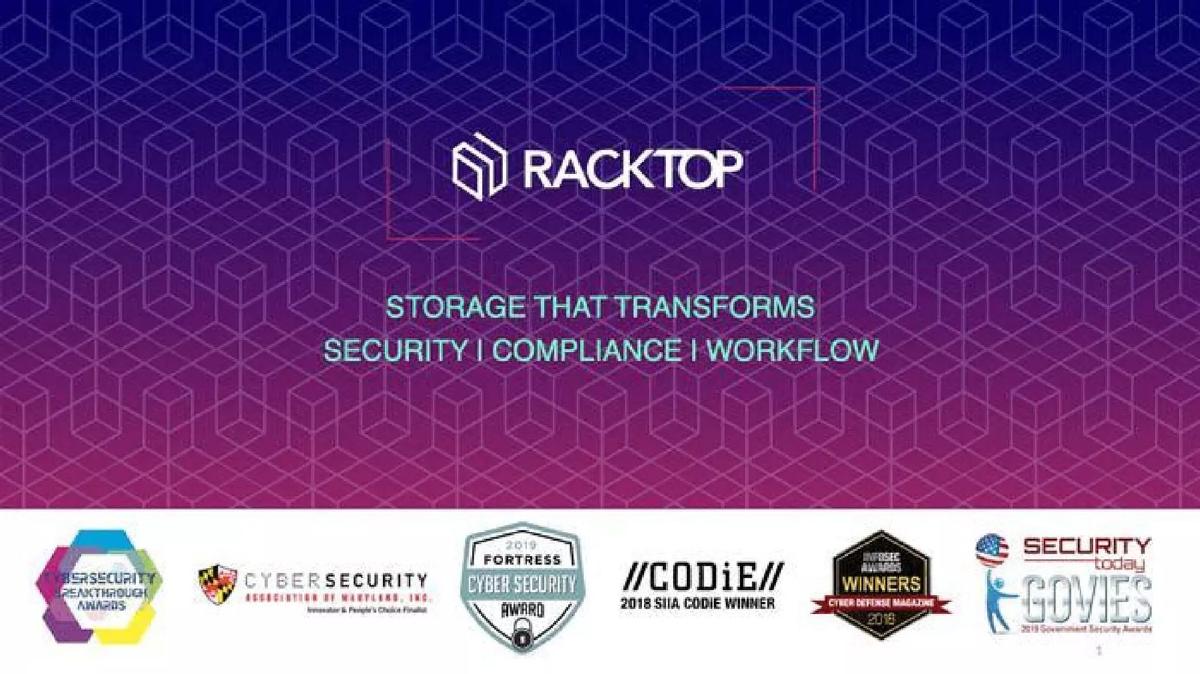
The deck opens with a title slide that immediately emphasizes industry validation. Below the RackTop logo and the tagline 'Storage That Transforms Security | Compliance | Workflow,' the slide features six industry awards. These include the 2019 Fortress Cyber Security Award, the 2018 SIIA CODiE Winner, and the 2019 Government Security Awards (Govies). This establishes immediate third-party verification before the company even describes its product.
Slide 2: The Company and Traction
Slide 2 serves as a multi-purpose introduction. It defines the product as 'High-performance Software-Defined Storage (BrickStor)' and sets a vision to lead the 'Enterprise CyberConverged Data Security' market. The 'Company' section highlights that they were established in 2010 and are led by founders with over 20 years of NSA experience. The most impactful part of this slide is the logo wall, which includes heavyweights like Lockheed Martin, Raytheon, General Dynamics, AT&T, and the U.S. Department of Energy. This suggests that the company has already passed the most rigorous security audits in the world.
Slide 3: The Problem - The Perfect Storm
Slide 3 uses a simple infographic to illustrate three converging pressures on IT departments: data growth (exploding at 50x through 2020), regulatory compliance costs ($1.9 trillion annually), and cyber threats (projected to cost $6 trillion globally by 2021). By quantifying these problems with large, global figures, RackTop justifies why traditional storage methods are no longer sufficient.
Slide 4: Market Opportunity
This slide defines the 'CyberConverged Market.' It breaks down the pros and cons of the two existing silos: Data Storage and Cyber Security Software. It labels storage as 'Dumb' and security software as 'Secondary Budget' or 'Nice to Have.' The central graphic argues that '1 + 1 = 3,' suggesting that a converged solution captures the 'Must Have' primary budget of storage while solving the talent and complexity issues of standalone security software. It cites a $45B NAS market and billions in related security segments.
Slide 5: The Shift in Strategy
Slide 5 focuses on a 'Unique Integrated Approach.' It uses a diagram to show that while traditional security focuses on the perimeter (the 'Gate'), RackTop focuses on the 'Trusted Zone' where the data actually lives. To reinforce this, they include a screenshot of an article featuring a US Army CDO stating, 'Secure the data rather than the perimeter.' This aligns RackTop’s product strategy with the stated goals of top-tier military leadership.
Slide 6: Product Architecture - BrickStor
Slide 6 provides a technical overview of the BrickStor platform. It is divided into three pillars: Data Management, Data Security & Compliance, and High Performance Storage. Key technical features mentioned include 'Single Pane-of-Glass Management,' 'Multi-Layer Encryption with Key Management,' and support for 'SSD + HDD & NVMe.' It also notes the use of 'ZFS Core with RackTop Specific Enhancements,' which appeals to technical buyers familiar with robust file systems.
Slide 7: Bolt-on vs. Built-in
This is the primary competitive slide. It contrasts 'Bolt-on' solutions (naming competitors like Varonis, Cisco, and NetBackup) against RackTop’s 'Built-in' architecture. The slide claims that by integrating these features into the storage layer, customers achieve a '50-90% Lower TCO.' It lists specific benefits such as continuous compliance, embedded security, and being 'Easier to Maintain.'
Slide 8: Unified Approach
Slide 8 reinforces the 'Unified' message. It shows a stack of capabilities—from encrypted disks up to user behavior and encryption/key management—all contained within the RackTop 'Brick.' This visual contrast against the fragmented 'Bolt-on' model from Slide 7 is intended to demonstrate simplicity and efficiency.
Slide 9: NIST Framework Alignment
Slide 9 is perhaps the most important for government and highly regulated enterprise sales. It claims BrickStor is the 'World’s First Storage That Maps to the NIST Cyber Security Framework.' It lists specific product features under the five NIST categories: Identify (Data Reporting), Protect (Access Controls), Detect (User Behavior Tracking), Respond (File Immutability), and Recover (Data DVR). This mapping makes it easy for a CISO to justify the purchase as part of a broader compliance strategy.
Slide 10: Contact Information
The final slide provides the company’s headquarters address in Fulton, MD, a phone number, and social media links. It maintains the consistent branding seen throughout the deck.
What Works in This Deck
Credibility by Association: The logo wall on Slide 2 is exceptionally strong for a Series A company. Including names like Lockheed Martin and the Department of Energy immediately answers the question of whether the technology works in high-stakes environments. Clear Market Categorization: By coining and defining 'Cyber-Converged,' RackTop avoids being compared strictly to commodity storage vendors or pure-play security software. They create their own category where they are the leader. Regulatory Alignment: Mapping the product directly to the NIST framework (Slide 9) is a brilliant move for a B2B/B2G (Business to Government) company. It transforms the product from a 'tool' into a 'compliance solution.'
What Is Missing
Financial Data: There is no mention of current Revenue, Annual Recurring Revenue (ARR), or growth rates. While the 'hundreds of petabytes' metric is impressive, investors need to see how that translates into dollars. The Ask: The deck does not state how much capital they are looking to raise or how they intend to use the funds (e.g., hiring, R&D, sales expansion). Team Details: While the NSA background is mentioned, there are no headshots or specific bios for the leadership team. Competition: While Slide 7 mentions some competitors in a 'bolt-on' context, there is no traditional competition matrix comparing RackTop to other emerging software-defined storage players.
What a Founder Should Copy
The 'Problem' Framing: Founders should look at Slide 3 as a template for how to frame a problem as an inevitable 'Perfect Storm.' It uses macro trends to make the company's existence feel necessary rather than optional. The TCO Argument: Slide 7’s comparison of 'Bolt-on vs. Built-in' is a classic and effective way to demonstrate value. If your product simplifies a complex stack, showing the 'messy' alternative next to your 'clean' solution is a powerful visual. Third-Party Validation: Using a quote from a high-ranking official (Slide 5) or industry awards (Slide 1) to validate your core thesis is often more convincing than the founders saying it themselves.
Frequently asked questions
- What is the primary value proposition of RackTop Systems?
- RackTop Systems proposes a 'Cyber-Converged' model where security is built directly into the storage software (BrickStor) rather than added as a third-party layer. According to slide 7, this 'built-in' approach provides continuous compliance and embedded security, resulting in a 50-90% lower Total Cost of Ownership compared to traditional 'bolt-on' security products.
- How does RackTop differentiate itself from traditional storage providers?
- On slide 4, RackTop labels traditional data storage as 'Dumb Up the Stack,' noting it is not inherently secure. They differentiate by combining high-performance NAS capabilities with advanced security features like user behavior auditing, file immutability, and real-time threat mitigation, effectively merging two distinct budgets into one 'Cyber-Converged' category.
- What evidence of market validation does the deck provide?
- The deck provides significant validation through its customer base and deployment scale. Slide 2 lists 'hundreds of petabytes' deployed across three countries and showcases a logo wall including major defense contractors (Raytheon, Lockheed Martin), government agencies (DOE), and large enterprises (AT&T, Fujifilm), signaling high trust in their technology.
- What technical frameworks does the product support?
- The product, BrickStor, is built on a ZFS Core with RackTop-specific enhancements. As shown on slide 8, it supports standard protocols including NFS, SMB, AFP, Web, and iSCSI. Most notably, slide 9 illustrates how the software maps to the NIST Cybersecurity Framework, covering Identify, Protect, Detect, Respond, and Recover.
- What is missing from this Series A pitch deck?
- The deck is notably missing several standard fundraising elements. There is no slide detailing the specific 'Ask' (how much money is being raised and for what), no financial projections or historical revenue growth, no detailed team bios beyond a mention of NSA experience, and no explicit roadmap for future product development.