Ramp’s seed deck is a study in focused positioning, targeting the specific pain points of finance teams struggling with manual revenue forecasting. By emphasizing the transition from descriptive to proactive analytics, the company frames its ML-infused platform as a necessary evolution beyond traditional spreadsheets. The deck relies heavily on product visualization and a clear pricing structure to demonstrate market readiness. While it lacks a traditional team slide or detailed market sizing in the provided visuals, the narrative successfully connects technical cohort modeling to high-level…
Key takeaways
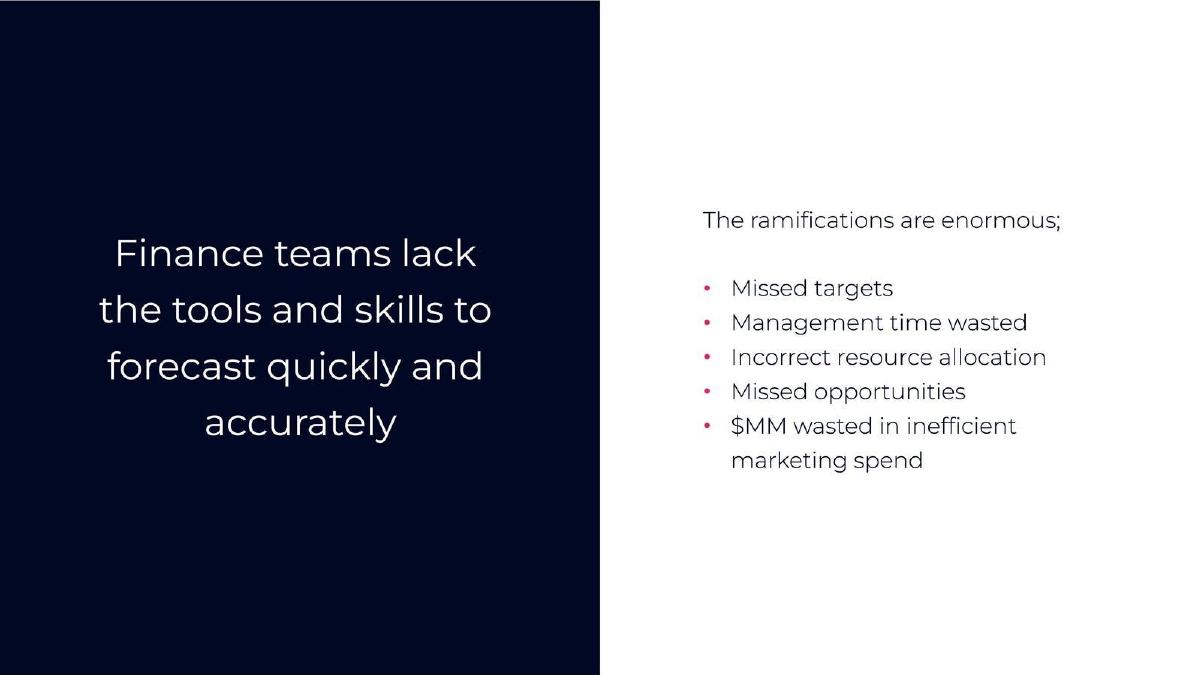
- The deck identifies a specific gap where finance teams lack the tools to forecast quickly, leading to wasted marketing spend (Slide 2).
- Ramp positions itself as a web-based SaaS that automates budget cycles to occur daily rather than periodically (Slide 3).
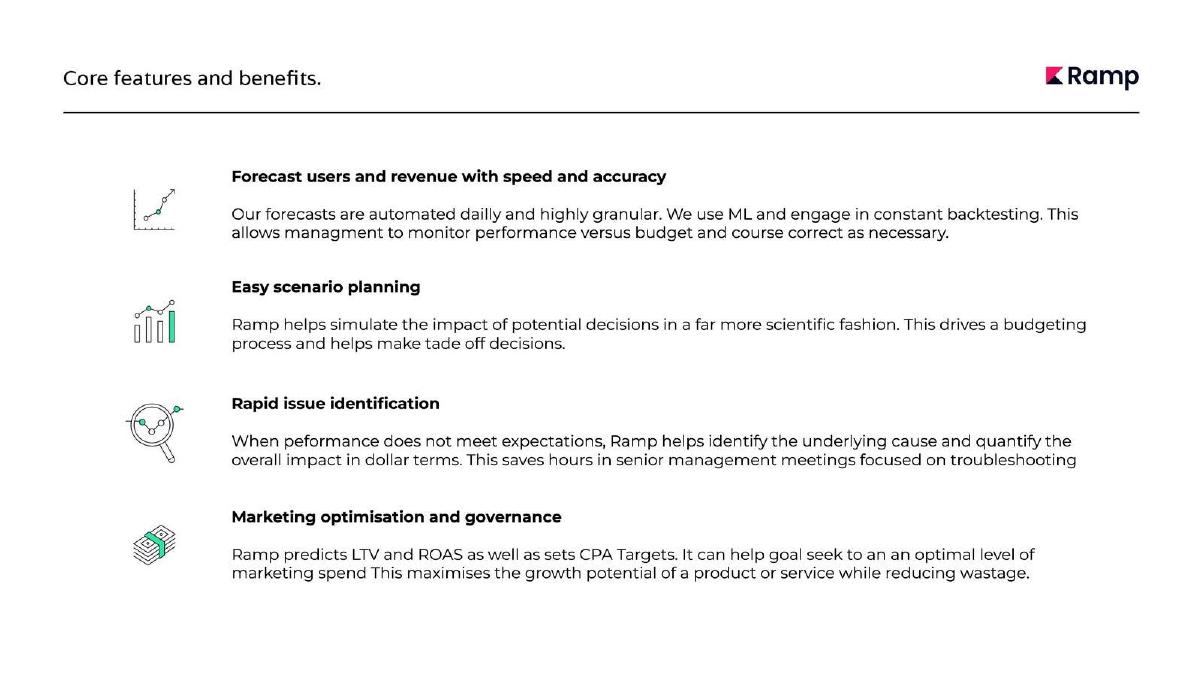
- The product uses 'ML infused' cohort-based forecasting to provide granularity that is impossible to replicate in spreadsheets (Slide 4).
- A redacted testimonial from a Gaming Company CFO validates the platform's utility in optimizing CAC vs. LTV (Slide 5).
- The business model is clearly defined with two tiers: Growth at £4k p/m and Enterprise at £10k p/m (Slide 6).
- The company maps the evolution of analytics, placing itself in the 'Proactive' category compared to competitors focused on the past (Slide 7).
- Transparency is prioritized through a 'Model Explainer' video link to ensure clients trust the platform's outputs (Slide 8).
- The deck omits a team slide, competitive landscape, and specific use-of-funds breakdown in the provided images.
Ramp Seed Deck Analysis
Ramp, a London-based fintech startup, successfully raised $5M in a 2024 seed round as reported by Business Insider. The company focuses on a very specific, high-value problem: the inefficiency of manual revenue forecasting. By utilizing machine learning and cohort-based models, Ramp aims to transform the finance department from a reactive reporting unit into a proactive strategic partner. The deck is concise, focusing on the transition from spreadsheets to automated intelligence.
Slide 1: Title Slide
The opening slide is minimalist, featuring the Ramp logo and the tagline 'FutureKnown.' This branding immediately signals the company's core value proposition—predictability. The slide is labeled as a 'Press Release: Investment Deck,' suggesting this version was curated for public or semi-public distribution following the round's closure.
Slide 2: The Problem Statement
Slide 2 identifies the pain point with blunt precision: 'Finance teams lack the tools and skills to forecast quickly and accurately.' The slide lists five specific ramifications, ranging from 'Missed targets' to '$MM wasted in inefficient marketing spend.' By quantifying the loss in millions of dollars, Ramp elevates the problem from a mere administrative headache to a critical bottom-line issue for the C-suite.
Slide 3: The Solution and Product Interface
This slide introduces Ramp as a 'web based SAAS that automates user and revenue forecasting.' The visual shows a complex dashboard featuring 'Active User Cohort Contribution' and 'Revenue Cohort Contribution' graphs. The key takeaway here is the frequency of operation; Ramp claims it is 'like conducting a new budget cycle each and every day,' contrasting sharply with the quarterly or annual cycles typical of traditional finance teams.
Slide 4: The Technology Edge
Slide 4 focuses on the methodology: cohort-based forecasting. It displays a cohort table showing user retention and behavior over an 8-day period. The text asserts that Ramp's 'ML infused' forecasts are impossible to replicate in spreadsheets. This is a classic 'moat' argument, suggesting that even if a company has a talented finance team, they cannot manually match the speed or granularity of Ramp's algorithms.
Slide 5: Social Proof and Validation
Validation is provided via a redacted testimonial from a CFO at a 'Gaming Company.' The quote emphasizes the ability to 'nimbly iterate or scale' based on identified opportunities. Crucially, the testimonial mentions the optimization of 'cac vs ltv,' which is the primary metric for growth-stage companies. This slide serves to prove that the theoretical benefits mentioned earlier are already being realized by enterprise-level clients.
Slide 6: Monetization Strategy
The 'How we make money' slide is refreshingly transparent. It breaks down two tiers: 'Growth' at £4k/month and 'Enterprise' at £10k/month. The inclusion of 'Enterprise (Now)' and 'Growth (Future)' suggests that the company is currently focused on high-touch, high-value contracts while building toward a more scalable, lower-priced offering. The £2.5k/month fee for additional products indicates a clear path to expansion revenue within existing accounts.
Slide 7: Market Positioning
This slide uses a linear progression to map the 'evolution of analytics.' It moves from 'Descriptive' (What happened?) to 'Proactive' (Do it for me). Ramp places itself at the far right of this spectrum. The visual effectively communicates that while most competitors are looking in the rearview mirror, Ramp is looking through the windshield, providing 'Prescriptive' advice on what the business should do next.
Slide 8: The 'Black Box' Solution
A common objection to AI/ML tools is the 'black box' problem—users don't trust what they don't understand. Slide 8 addresses this head-on with a 'Model Explainer.' It includes a link to a Vimeo video, stating, 'we tell them exactly how we do it.' This transparency is a strategic move to build trust with skeptical CFOs who are ultimately responsible for the accuracy of these numbers.
Slide 9: Closing Slide
The deck concludes with a simple 'Questions?' slide, maintaining the dark blue and pink color palette used throughout. It repeats the 'FutureKnown' tagline, reinforcing the brand identity one last time.
What Works in the Ramp Deck
Specific Pain Point Identification: By listing the exact 'ramifications' of poor forecasting on Slide 2, the founders speak directly to the anxieties of their target buyers (CFOs and VPs of Finance). They aren't just selling software; they are selling the avoidance of 'millions wasted.'
Clear Pricing: Many seed decks hide their pricing, but Ramp’s inclusion of a detailed pricing table on Slide 6 demonstrates a level of commercial maturity. It shows that they have tested the market and know what the product is worth to an enterprise client.
Visualizing the 'Why': Slide 7 is a masterclass in positioning. By categorizing the entire analytics industry into 'past-focused' vs. 'future-focused,' they make their product feel like an inevitable technological evolution rather than just another tool.
What is Missing from the Ramp Deck
The Team Slide: In the provided 9 slides, there is no mention of the founders or their backgrounds. For a $5M seed round, the 'why us' is usually as important as the 'what.' Investors need to know if the team has the machine learning expertise or the finance background to execute this vision.
Market Sizing (TAM/SAM/SOM): While the deck mentions '$MM wasted,' it does not provide a macro view of the total addressable market. Investors typically want to see how large the opportunity could become if Ramp dominates the predictive finance space.
Competitive Landscape: Slide 7 alludes to 'most analytics companies,' but it doesn't name specific competitors like Anaplan, Pigment, or even specialized tools like Mosaic. A dedicated slide showing a feature-by-feature comparison would strengthen the argument for Ramp's technical superiority.
The Ask and Use of Funds: The deck does not explicitly state how much they are raising or how they plan to spend the capital. While the publisher reports a $5M raise, the deck itself leaves the investor without a clear call to action regarding the investment terms.
Founder Takeaways
Quantify the Cost of Inaction: Don't just say the current way is 'bad.' Say it costs 'millions in inefficient marketing spend.' Highlighting the financial penalty of the status quo is the fastest way to get a lead investor's attention. · Bridge the Trust Gap: If your product uses complex AI or ML, include a 'Model Explainer' or a transparency slide. CFOs are risk-averse; they won't use a tool if they can't explain its logic to the Board. · Use a Maturity Curve for Positioning: If you are entering a crowded market (like analytics), don't try to compete on every feature. Use a slide like Slide 7 to redefine the category so that you are the only player in the 'future' or 'proactive' segment. · Show, Don't Just Tell: The inclusion of actual cohort tables and dashboard screenshots (Slides 3 and 4) makes the product feel real and ready for deployment, which is crucial for a seed round where 'vaporware' is a common concern.
Frequently asked questions
- What is the primary problem Ramp solves?
- According to Slide 2, finance teams lack the tools and skills to forecast quickly and accurately. This leads to missed targets, wasted management time, incorrect resource allocation, and millions of dollars wasted in inefficient marketing spend. Ramp aims to replace manual, error-prone spreadsheet models with automated, machine-learning-driven predictions.
- How does Ramp's technology differ from traditional spreadsheets?
- Slide 4 states that Ramp provides highly granular, ML-infused forecasts that are 'impossible to replicate in spreadsheets.' While traditional companies rely on custom-built models and experimentation, Ramp uses cohort-based forecasting 'on steroids' to provide the speed and accuracy needed for optimal decision-making in real-time.
- What is Ramp's pricing and business model?
- Slide 6 outlines two primary packages. The 'Growth (Future)' package is priced at £4k per month for one product and a yearly budget refresh. The 'Enterprise (Now)' package is £10k per month, including two products, quarterly budget refreshes, and a bi-weekly review call. Additional products can be added to either tier for £2.5k per month.
- What industry vertical does Ramp specifically target?
- While the platform is broadly applicable to SaaS, Slide 5 features a testimonial from a CFO at a Gaming Company. This suggests a strong initial product-market fit in industries with high volumes of user data and a critical need to optimize the ratio between Customer Acquisition Cost (CAC) and Lifetime Value (LTV).
- How does Ramp categorize its position in the analytics market?
- Slide 7 uses a maturity curve to position Ramp. It classifies 'Descriptive' and 'Diagnostic' analytics as looking at 'what happened' and 'why.' Ramp focuses on the 'Future' through 'Prescriptive' and 'Proactive' analytics, moving from 'what should we do?' to 'do it for me,' thereby deriving higher business value from application.