Rasgo’s 15-slide Series A deck is a masterclass in technical narrative, specifically targeting the inefficiencies in the data science lifecycle. By positioning their 'Feature Store' as the missing link in the modern data stack, they successfully raised $20M from Insight Partners and Unusual Ventures. The deck relies heavily on the 'ELT' (Extract, Load, Transform) trend, arguing that traditional data processing is too slow for modern machine learning. With 70,000 downloads of their 'pyrasgo' library and validation from enterprise giants like AES and Stanley Black & Decker, the company moved be…
Key takeaways
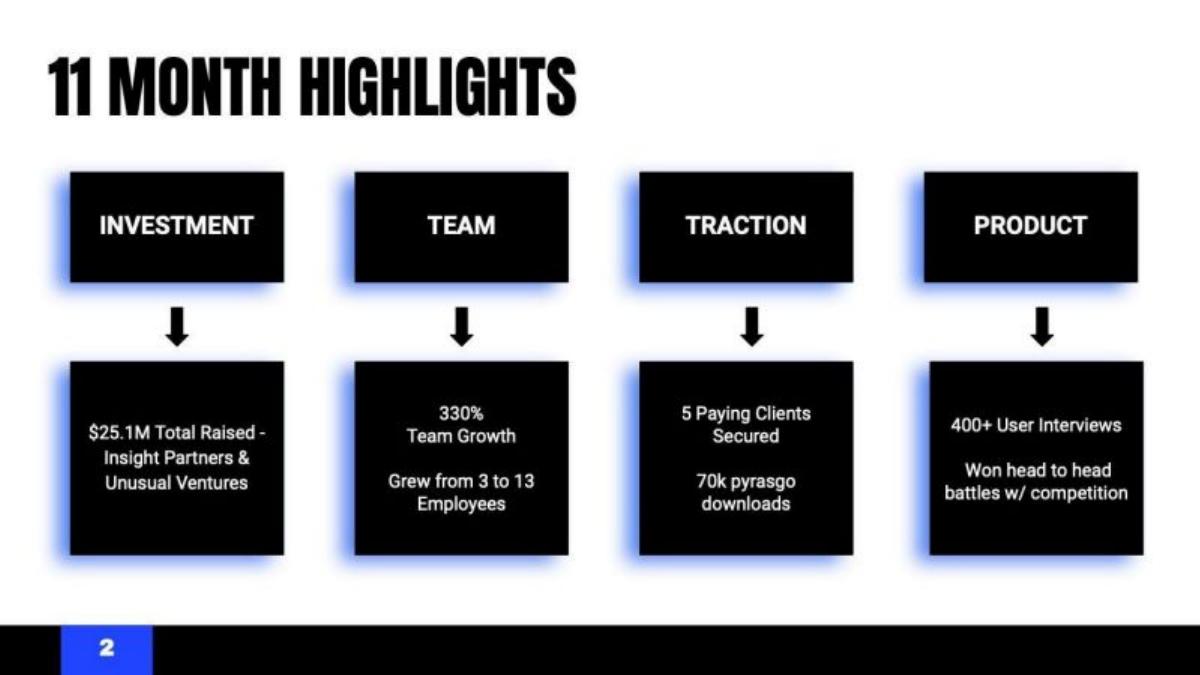
- The company highlights a total of $25.1M raised from Insight Partners and Unusual Ventures as a key 11-month highlight on slide 2.
- Rasgo reports significant community traction with 70,000 'pyrasgo' downloads and 5 paying clients secured within 11 months (slide 2).
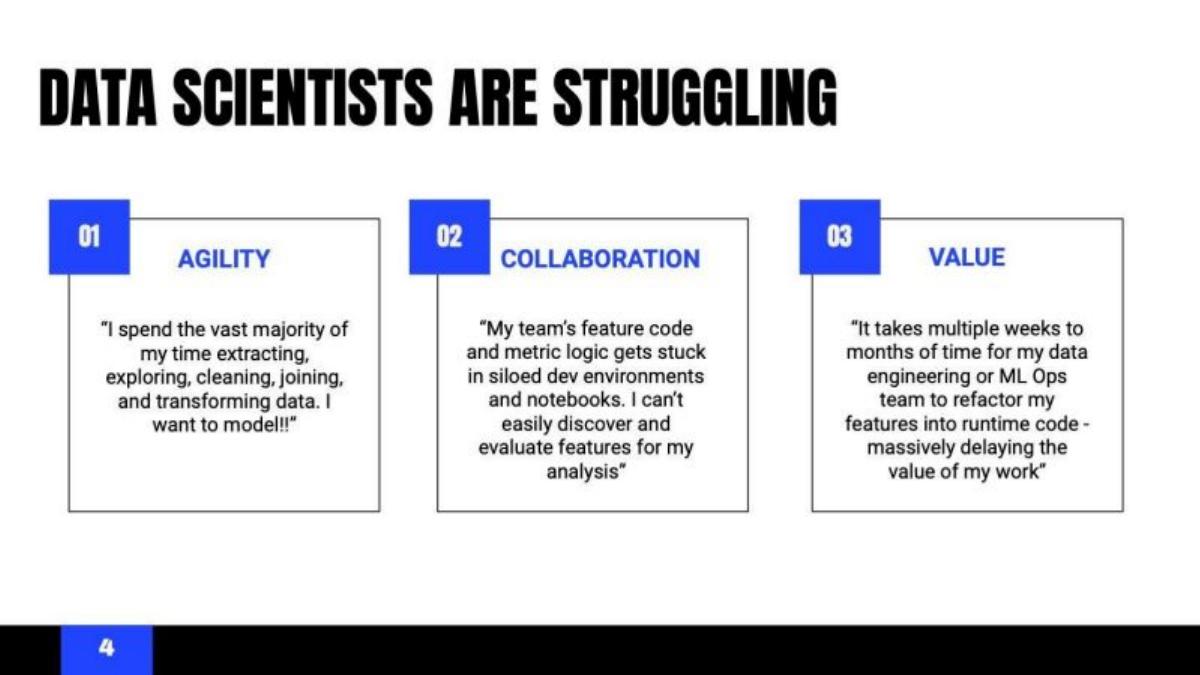
- The core problem is identified as data scientists spending the 'vast majority' of time on data cleaning rather than modeling (slide 4).
- The product claims a 140x reduction in cost to compute and 17x faster feature query performance compared to separate data warehouses (slide 9).
- Rasgo positions itself as the 'ELT' equivalent for data scientists, mirroring what dbt did for data engineers (slide 8).
- The deck includes a direct endorsement from Snowflake’s Director of Technology Alliances to validate their cloud-native approach (slide 12).
- The founding team combines deep GTM experience from Confluent and Domino Data Labs with technical expertise in data science (slide 14).
- The deck omits a specific 'Ask' slide, financial forecasts, and a detailed competitive landscape matrix.
The Narrative Arc: From Pain to Infrastructure
Rasgo’s Series A deck is structured to move an investor from a known industry pain point to a specific technical solution. It doesn't start with the product; it starts with the 11-month momentum the company has built since its seed round. This approach is common for Series A companies that need to prove they have moved past the 'idea' phase and into the 'execution' phase.
Slide 1: Title Slide
The deck opens with a minimalist black background featuring the Rasgo logo and the tagline: "Built for Data Scientists By Data Scientists." This establishes immediate founder-market fit and identifies the target user persona.
Slide 2: 11 Month Highlights
This is the 'momentum' slide. It breaks down progress into four categories: Investment ($25.1M total raised from Insight Partners & Unusual Ventures), Team (330% growth, from 3 to 13 employees), Traction (5 paying clients and 70k pyrasgo downloads), and Product (400+ user interviews and winning 'head to head battles' with competition). This slide serves to de-risk the investment by showing that reputable VCs are already on board and the market is responding to the product.
Slide 3: The Data Science Lifecycle
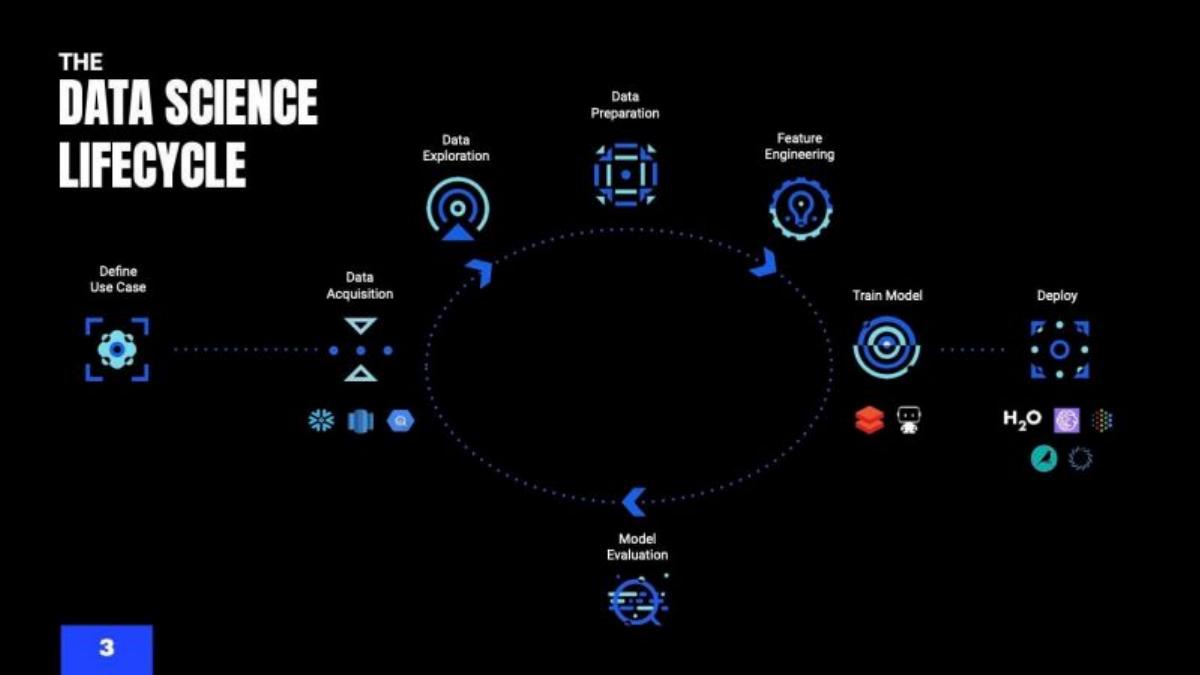
This slide visualizes the workflow from 'Define Use Case' to 'Deploy.' It uses icons to represent the ecosystem, including logos for Snowflake, AWS Redshift, and Google BigQuery under Data Acquisition, and H2O.ai and Databricks under Train/Deploy. It sets the stage for where Rasgo fits in the middle of this loop.
Slide 4: Data Scientists Are Struggling
The 'Problem' slide uses three pillars: Agility , Collaboration , and Value . It uses a quote to emphasize the pain: "I spend the vast majority of my time extracting, exploring, cleaning, joining, and transforming data. I want to model!!" This highlights the inefficiency of the current state where data scientists are acting as ad-hoc data engineers.
Slide 5: The Answer is a Feature Store
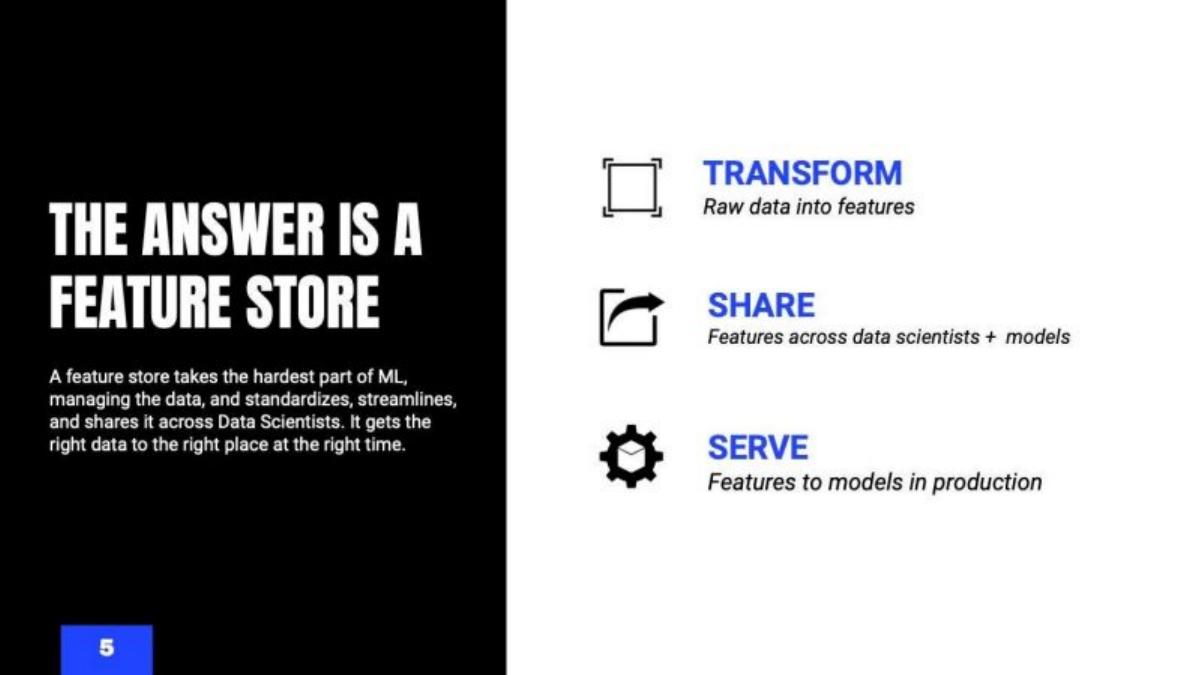
Rasgo introduces the category solution. They define a Feature Store as a tool that handles three core functions: Transform (raw data into features), Share (features across scientists), and Serve (features to models in production). It positions the Feature Store as the mechanism to get the "right data to the right place at the right time."
Slide 6: The Rasgo Feature Store
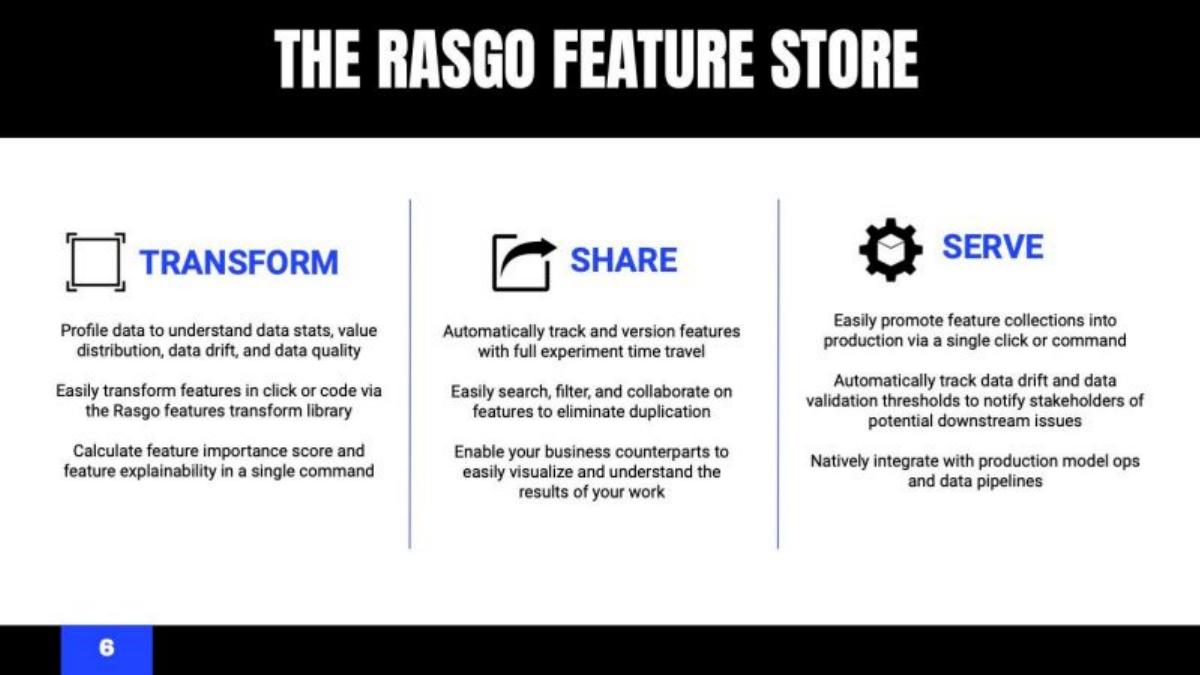
This slide goes deeper into product functionality. Under Transform , it mentions profiling data for stats and drift. Under Share , it highlights versioning and 'experiment time travel.' Under Serve , it emphasizes one-click production promotion and integration with model ops. This is the 'How it Works' slide for a technical audience.
Slide 7 & 8: The Rasgo Difference and Disruption of Legacy
Slide 8 is the most critical strategic slide in the deck. It maps the transition from ETL (Legacy) to ELT (Modern). It shows how Data Engineers moved from tools like Alteryx to dbt/Airflow, and argues that Data Scientists must move from Spark/Pandas to Rasgo. By aligning themselves with dbt—a massive success story in the data engineering space—Rasgo provides investors with a clear mental model for their potential growth trajectory.
Slide 9: The Competitive Edge
Rasgo argues that a feature store should not be a separate data warehouse. They claim that using Rasgo as a metadata layer on top of existing warehouses (Snowflake, BigQuery, Redshift) leads to:
140X Reduction in Cost to Compute · 17X+ Faster Feature Query Performance · 30 minutes to deploy on Snowflake
This slide addresses the 'build vs. buy' and 'architectural complexity' concerns that often plague enterprise data sales.
Slide 10 & 11: Validation
These slides provide social proof. Slide 10 features logos and quotes from AES , Chisholm Financial Labs , and a Fortune 500 manufacturing company . Slide 11 focuses on 'End Users,' with quotes from senior data scientists at social media companies and SaaS firms. The quote "Everytime I meet with you it's like Christmas" is a high-impact piece of qualitative data.
Slide 12: Cloud Data Warehouse Validation
To further cement their position in the 'Modern Data Stack,' Rasgo includes a slide dedicated to their relationship with Snowflake . A quote from Tarik Dwiek, Director of Technology Alliances at Snowflake, explicitly states that Rasgo helps customers unlock new use cases and accelerate ML projects. This is a powerful 'stamp of approval' from a market leader.
Slide 13 & 14: The Team
The 'Founding Team' is introduced. Jared Parker (CEO) is credited with GTM leadership at Platfora, Kinetica, Domino Data Labs, and Confluent. Patrick Dougherty (CTO) is described as a data scientist by trade who built a practice at Slalom. The emphasis here is on the balance between high-growth sales experience and deep technical domain expertise.
What Works in the Rasgo Deck
1. The 'dbt for Data Science' Analogy: By explicitly comparing the shift in data science to the shift in data engineering (Slide 8), Rasgo makes a complex technical product easy for a generalist VC to understand. They aren't just selling a tool; they are selling a shift in architecture.
2. Quantitative Performance Claims: The 140x and 17x figures on Slide 9 are bold. Even if an investor discounts them, they signal that the product offers an order-of-magnitude improvement rather than an incremental one.
3. Layered Social Proof: The deck doesn't just show logos; it shows community downloads (70k), enterprise buyer quotes, end-user 'love' quotes, and a strategic partner endorsement. This covers all bases of the sales cycle.
What is Missing from the Rasgo Deck
1. The 'Ask' and Use of Funds: There is no slide stating how much they are looking to raise in this specific round or how they plan to spend the capital. While the catalogue facts state they raised $20M, the deck itself is silent on the terms of the round.
2. Financial Projections: There are no charts showing ARR growth, CAC/LTV, or future revenue targets. This suggests the Series A was likely driven by product-market fit and technical vision rather than a mature revenue engine.
3. Detailed Competitive Matrix: While they mention winning 'head to head battles,' they do not name specific competitors or provide a feature-by-feature comparison. This is a confident move that keeps the focus on their unique 'ELT' architecture rather than a 'feature war.'
What Other Founders Should Copy
The 'Momentum First' Slide: Starting with a 'Highlights' slide (Slide 2) is an excellent way to set a positive tone for the meeting. It tells the investor immediately that the company is a 'moving train' they should want to get on.
The Ecosystem Map: Slide 3 is a great example of how to show where your product fits in a crowded market. By using the logos of other tools your customers already use, you demonstrate that your product is an 'and,' not an 'instead of,' making the sales hurdle lower.
The 'Legacy vs. Future' Comparison: If you are building in a technical category, use a slide like Slide 8 to show the evolution of the market. Investors love to back 'inevitable' shifts in technology, and mapping your product to a successful historical shift (like ETL to ELT) is a highly effective persuasion tactic.
Final Analysis
Rasgo’s deck is a highly professional, technically-focused presentation that successfully navigates the 'trough of disillusionment' in AI/ML by focusing on the unglamorous but essential work of data management. It leverages the success of the Modern Data Stack (Snowflake, dbt) to argue for its own necessity. While it lacks the financial transparency of some Series A decks, its heavy emphasis on user validation and architectural superiority clearly resonated with top-tier investors like Insight Partners.
Frequently asked questions
- What is the primary value proposition of Rasgo?
- Rasgo provides a 'Feature Store' that allows data scientists to transform raw data into machine learning features, share them across teams, and serve them to production models. According to slide 5, it aims to standardize and streamline the hardest part of ML—managing data—ensuring the right data reaches the right place at the right time.
- How does Rasgo differentiate itself from traditional ETL tools?
- On slide 8, Rasgo contrasts the legacy ETL (Extract, Transform, Load) approach with the modern ELT (Extract, Load, Transform) workflow. While legacy tools like Alteryx or Informatica are siloed, Rasgo integrates directly with cloud warehouses like Snowflake and BigQuery, allowing data scientists to perform transformations where the data already lives.
- What evidence of market validation does the deck provide?
- The deck provides three layers of validation: community traction (70k downloads on slide 2), enterprise testimonials from companies like AES and Chisholm Financial Labs (slide 10), and strategic partnership validation from Snowflake (slide 12). This multi-pronged approach demonstrates both bottom-up developer interest and top-down enterprise viability.
- Who are the founders of Rasgo?
- The founders are Jared Parker (CEO) and Patrick Dougherty (CTO). Parker brings GTM leadership experience from high-growth data companies like Confluent and Domino Data Labs. Dougherty is a data scientist by trade with an MS in Analytics and experience building data science practices at Slalom (slide 14).
- What metrics are used to prove the product's technical efficiency?
- Slide 9 cites specific performance gains: a 140x reduction in compute costs, 17x faster feature query performance, and the ability to deploy on Snowflake in just 30 minutes. These figures are used to argue that a feature store should not be a separate data warehouse, but a metadata layer on top of existing infrastructure.