The Raxar (Raur) pitch deck is a study in visual minimalism, utilizing high-impact imagery and sparse text to convey a vision for 'social' talk radio. The deck identifies a massive market shift from traditional to online talk radio, projecting a jump from $7B in 2014 to $25B by 2025. Its strongest asset is a clear traction slide showing 1.6 million streams in March with steady 20% month-over-month growth. However, the deck is notably light on business fundamentals; it lacks a formal business model, a specific financial 'ask,' and a competitive landscape analysis beyond a visual nod to social…
Key takeaways
- The company projects the online talk radio market will grow from $7B in 2014 to $25B by 2025 (Slide 3).
- Raur reports achieving 1.6 million streams in March with a 20% month-over-month growth rate since December (Slide 7).
- The deck positions the product as a social alternative to iTunes, which it claims controls 80% of all podcast listening (Slide 5).
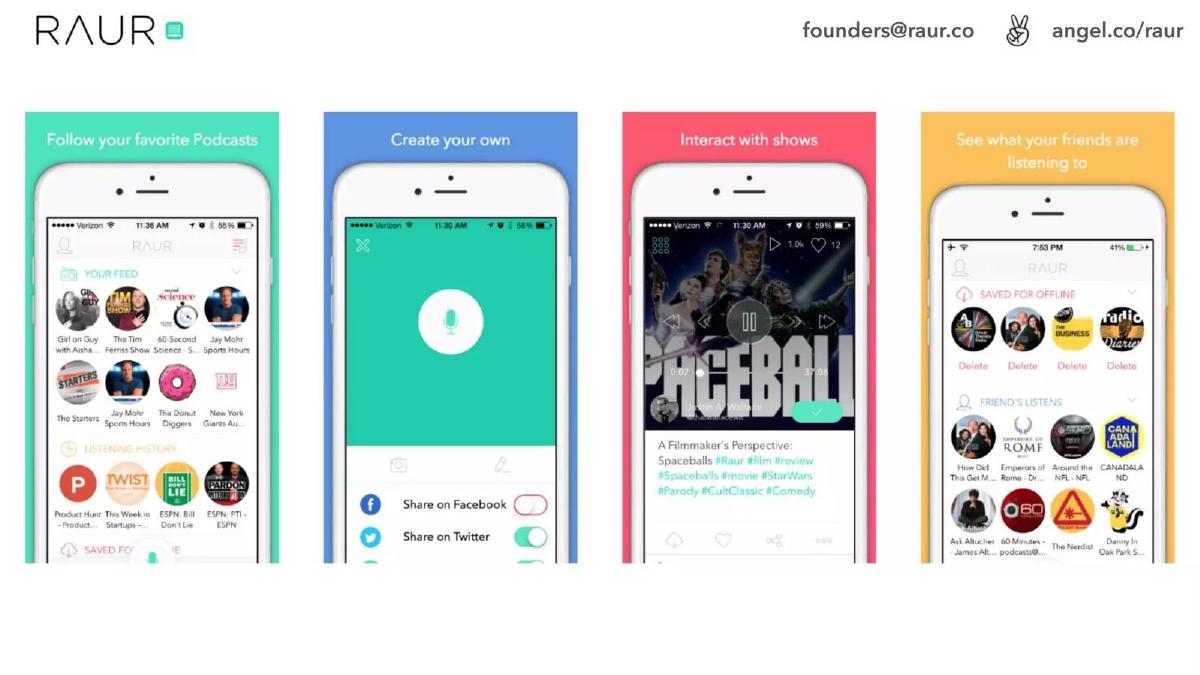
- Product features include following podcasts, creating original content, interacting with shows, and social listening (Slide 6).
- The team includes members with previous experience at BlackBerry, The Weather Network, Disney, and Hockey Canada (Slide 10).
- The deck contains no mention of revenue streams or a specific monetization strategy.
- There is no slide detailing the specific amount of capital being raised or the intended use of funds.
- The presentation uses a minimalist aesthetic with almost no bullet points, favoring large-scale photography and single-metric slides.
Introduction: The Minimalist Vision for Social Audio
The Raxar pitch deck (presented under the brand name Raur) is a 12-slide presentation that leans heavily into the 'show, don't tell' philosophy of startup pitching. It avoids the dense, text-heavy slides common in enterprise software pitches, opting instead for a consumer-facing aesthetic that mirrors the app's own interface. The deck focuses on three main pillars: the massive market opportunity in digital audio, the social deficiency of current market leaders, and the company's rapid early traction.
Slides 1-2: The Hook and the Vision
Slide 1 is a standard title slide featuring the Raur logo—a stylized teal radio icon—and the tagline 'THE FUTURE OF TALK RADIO.' It includes contact information for the founders and a link to their AngelList profile. The design is clean, using a wave motif at the bottom that persists throughout the deck.
Slide 2 immediately pivots the tagline to 'THE FUTURE OF PODCASTS,' accompanied by a lifestyle image of a woman wearing headphones. This dual positioning suggests the company views 'talk radio' and 'podcasts' as a single, converging market that they intend to lead.
Slides 3-5: Market Opportunity and the 'iTunes Problem'
Slide 3 addresses the market size. It uses a dashboard image of a Tesla to emphasize the shift to connected devices. The slide cites Pew Research Centre, stating the market for 'Moving Talk Radio Online' was $7B in 2014 and is projected to reach $25B by 2025. This is a significant 10-year projection intended to show the scale of the opportunity.
Slide 4 is purely visual, displaying the logos of YouTube, Twitter, Pinterest, and Instagram. There is no text on this slide, but the implication is clear: Raur aims to be the social layer for audio, just as these platforms are the social layers for video, text, and images. It positions Raur within the 'Social Media' pantheon rather than just a utility app.
Slide 5 identifies the incumbent. It features an image of a person in a suit with their head buried in the sand next to an iTunes logo. The text reads '80% OF ALL THE PODCAST LISTENING.' This slide serves as the 'Problem' slide, suggesting that while iTunes dominates the market share, it is stagnant and failing to innovate, particularly in social engagement.
Slides 6-9: Product and Traction
Slide 6 provides the first look at the product interface. Four iPhone mockups show the core features: 'Follow your favorite Podcasts,' 'Create your own' (with social sharing toggles for Facebook and Twitter), 'Interact with shows' (showing likes, comments, and hashtags), and 'See what your friends are listening to.' This slide validates the 'social' claim made earlier in the deck.
Slide 7 is the 'Traction' slide and is arguably the strongest in the deck. In large, bold type, it states '1.6M streams in March' and 'GROWING 20% MOM SINCE DEC.' By focusing on a single, impressive metric, the founders demonstrate that there is already significant user demand for their solution.
Slide 8 features a black-and-white photo of a man in a recording studio (likely a well-known podcaster, though not explicitly named on the slide) with the text '30hrs content.' This is somewhat ambiguous—it could refer to the average user consumption or the amount of original content produced daily—but it reinforces the theme of high engagement.
Slide 9 shows a screenshot of a specific piece of content within the Raur app: a post by Harley Morenstein regarding a 'Game of Thrones' leak. The screenshot shows 56,520 plays, 26 likes, and 16 comments. This serves as a micro-case study of how viral content looks and performs on the platform.
Slides 10-12: Team and Conclusion
Slide 10 introduces the team. CEO Kevin Kliman and CTO Ryan Renna are the leads, supported by Dima Yashkir and David Ozersky. The slide uses logos to highlight their professional pedigree, including BlackBerry, The Weather Network, Disney, and Hockey Canada. This provides the necessary 'credibility' check for investors.
Slide 11 is a conceptual graphic showing the Raur logo surrounded by icons representing broadcasting, messaging, music, and streaming. It acts as a summary of the app's multi-faceted nature.
Slide 12 is the closing slide, repeating the contact information and ending with a simple 'thanks, Kevin.' Notably, there is no 'Ask' slide detailing the amount of money being raised or the terms of the round.
What Works in the Raxar Deck
The deck excels at visual storytelling . By using large images and very little text, the founders force the audience to listen to their verbal pitch rather than reading off the screen. This is a high-confidence approach that works well for consumer apps where 'feel' and 'vibe' are part of the product's value proposition.
The traction slide (Slide 7) is a masterclass in clarity. Many founders bury their growth metrics in complex charts; Raur puts a single, large number on the screen that is impossible to ignore. A 20% month-over-month growth rate is a strong signal for a seed-stage consumer startup.
The competitive positioning (Slide 5) is also effective. By framing iTunes as a 'head in the sand' incumbent, Raur creates a clear narrative of a legacy giant that is ripe for disruption by a more agile, social-first competitor.
What is Missing from the Raxar Deck
The most glaring omission is the Business Model . There is no explanation of how Raur intends to capture a portion of the $25B market mentioned on Slide 3. Without a discussion of advertising, subscriptions, or creator tools, investors are left to guess how the company will eventually become profitable.
There is also no Financial Ask . A pitch deck is a tool for fundraising, yet this deck fails to mention how much capital is needed or what that capital will be used for. While this might be intentional for a 'teaser' deck, it leaves a significant gap in a formal pitch setting.
Finally, the Competitive Landscape is oversimplified. While iTunes is the primary incumbent, the deck ignores other emerging social audio platforms or the social features being added to Spotify and SoundCloud. A more nuanced view of the competition would demonstrate a deeper understanding of the market dynamics.
What a Founder Should Copy
Founders should emulate the minimalist design of this deck. Each slide has one clear purpose and one clear message. This prevents 'cognitive load' for the investor and keeps the focus on the most important data points.
The use of social proof on Slide 9 is another great tactic. Showing a real-world example of a high-performing post within the app makes the product feel 'alive' and proves that creators are already using the platform to reach audiences.
Lastly, the pedigree logos on the team slide (Slide 10) are a highly efficient way to communicate experience. Instead of writing long bios, the founders use recognizable brands to instantly validate their technical and business capabilities.
Final Analysis
The Raxar (Raur) deck is a high-energy, visual-first presentation that successfully communicates a 'big vision' and 'strong traction.' It is designed to get an investor excited about the 'social audio' category. However, to close a round, the founders would likely need a secondary document or a 'Part 2' to this deck that dives into the unit economics, monetization strategy, and the specific roadmap for the funds they are seeking. As it stands, it is an excellent 'hook' deck that leaves the audience wanting to know more about the business behind the app.
Frequently asked questions
- What is the primary problem Raxar is trying to solve?
- Based on Slide 5, Raxar (Raur) is targeting the fragmentation and lack of social features in the podcasting market, which is currently dominated by iTunes (80% market share). The deck implies that current platforms are 'burying their heads in the sand' regarding social interaction, whereas Raur aims to make podcasting a two-way, interactive experience.
- How does Raxar plan to make money?
- The pitch deck does not include a business model or monetization slide. While it mentions the growth of the talk radio market to $25B on Slide 3, it does not specify if Raur intends to generate revenue through advertising, subscriptions, premium creator tools, or data analytics.
- What is the current traction of the platform?
- Raur demonstrates significant early usage on Slide 7, reporting 1.6 million streams in the month of March. Furthermore, the company claims a consistent growth rate of 20% month-over-month starting from December, suggesting a healthy upward trajectory for user engagement.
- Who are the founders and what is their background?
- The team slide (Slide 10) lists Kevin Kliman as CEO and Ryan Renna as CTO, supported by Dima Yashkir (Backend) and David Ozersky (Android). Their collective experience includes roles at established entities like BlackBerry, Disney, The Weather Network, and Hockey Canada, providing a mix of enterprise and consumer tech backgrounds.
- Is there a clear 'Ask' in this deck?
- No. The deck concludes on Slide 12 with a 'thanks' and contact information but does not state a funding goal, valuation, or specific milestones the team intends to reach with new capital. This suggests the deck may have been used as a teaser or as part of a larger conversation rather than a standalone investment proposal.