The Rowan Companies (RDC) June 2018 investor deck is a technical, asset-heavy presentation designed for institutional investors in the energy sector. Rather than focusing on a 'problem/solution' narrative typical of startups, RDC emphasizes operational superiority through a fleet of 7th-generation ultra-deepwater rigs and a unique 50/50 joint venture with Saudi Aramco, known as ARO Drilling. The deck provides granular detail on capital allocation, including a $1.2 billion cash balance and $780 million in retired debt, while acknowledging a challenging market where dayrate improvements were no…
Key takeaways
- The company differentiates itself by operating a fleet where 100% of ultra-deepwater rigs are 7th generation, compared to competitors like RIG (15%) or ESV (22%) as shown on slide 13.
- A central pillar of the growth strategy is ARO Drilling, a 50/50 joint venture with Saudi Aramco that commenced operations on October 17, 2017 (slide 33).
- Financial stability is highlighted by a cash balance of approximately $1.2 billion and the retirement of ~$780 million in debt since late 2015 (slide 17).
- The company holds the #1 rank among offshore drillers for HPHT (High Pressure High Temperature) applications according to EnergyPoint Research (slide 9).
- Operational capabilities include drilling depths beyond 30,000 ft and handling pressures greater than 20,000 PSI (slide 9).
- Market analysis on slide 25 shows a global UDW utilization rate of 71%, with specific regional highs in the North Sea (100%) and Australia/NZ (100%).
- The ARO Drilling venture resulted in an $88 million cash distribution to Rowan in 4Q 2017 (slide 33).
- Strategic capital allocation favors preserving liquidity and opportunistic investments at the 'bottom of the cycle' (slide 17).
Introduction: The Industrial Giant's Strategic Pivot
The June 2018 investor presentation for Rowan Companies (RDC) is a comprehensive look at a legacy offshore driller navigating a cyclical low in the energy market. Unlike the high-growth narratives of Silicon Valley, this deck is built on the pillars of asset quality, joint venture mechanics, and balance sheet preservation . With 40 slides in the full deck, the selection provided focuses heavily on the company's technological edge and its transformative partnership with Saudi Aramco.
Slides 1-2: Branding and The ARO Growth Engine
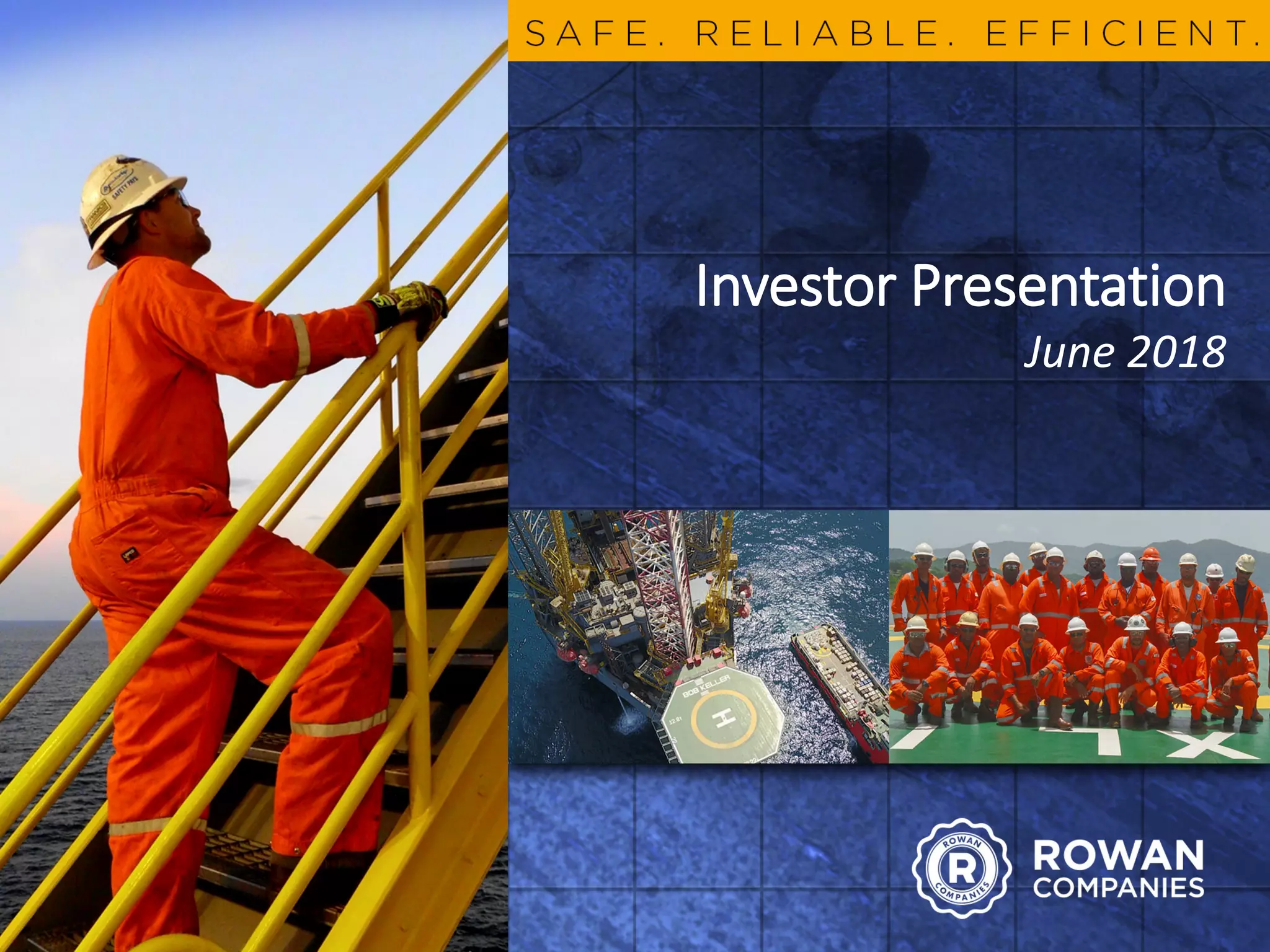
The deck opens with high-resolution industrial photography, establishing a theme of safety and reliability. Slide 2 immediately introduces the primary value driver: "Visible Growth Through ARO Drilling." By placing this so early, Rowan signals to investors that their future is inextricably linked to this joint venture. The use of the word "Visible" is a deliberate choice to reassure shareholders who, in 2018, were wary of the volatility in offshore drilling markets.
Slide 9: Operational Dominance and Customer Validation
Slide 9 serves as the 'Social Proof' and 'Product' slide. Rowan highlights its mission to be the most efficient provider of "demanding" drilling services. They back this up with a #1 ranking from EnergyPoint Research for HPHT (High Pressure High Temperature) applications. The bottom of the slide lists technical achievements that act as a barrier to entry: drilling depths beyond 30,000 feet , temperatures up to 450°F , and pressures exceeding 20,000 PSI . The map displays a blue-chip customer list including Shell, BP, Total, and ConocoPhillips, proving global reach and trust from 'Supermajors.'
Slide 13: The Fleet Quality Gap
This is arguably the most important competitive slide in the deck. Rowan compares its ultra-deepwater (UDW) fleet to six competitors. The metric is specific: "Breakdown of 34 floaters with 1,250-ton, dual BOP." Rowan (RDC) claims that 100% of its fleet in this category is 7th generation. This is contrasted against RIG (15%), ESV (22%), and SDRL (19%). By narrowing the definition to high-spec rigs, Rowan frames itself as the premium, modern choice in a market where older rigs were being scrapped or cold-stacked.
Slide 17: Capital Allocation and Liquidity
In a capital-intensive industry, the balance sheet is the product. Slide 17 details Rowan's "unrelenting focus" on return on invested capital. The key figures are a $1.2 billion cash balance and the retirement of $780 million in debt . The slide uses a flow chart to show how they prioritize liquidity and debt reduction over dividends and share repurchases during a "challenging business environment." This transparency is designed to win the confidence of credit investors and long-term equity holders.
Slide 21: Market Outlook and Realism
Rowan avoids the trap of over-optimism. Slide 21 admits that "financial results will lag behind the change in business fundamentals." They project that while jack-up demand is rising in 2018, dayrate improvements won't happen until 2019+ . They explicitly state that utilization must reach ~85% for pricing to improve. This level of honesty is rare in startup decks but mandatory for public company investor relations to maintain credibility.
Slide 25: Global Utilization Metrics
This slide provides a heat map of the UDW market as of May 2018. It shows a 71% worldwide marketed utilization . Specific data points include 100% utilization in the North Sea and Australia, while West Africa (53%) and the Far East (25%) lag significantly. This data justifies Rowan's geographic footprint and helps investors model future earnings based on regional rig counts.
Slides 29, 33, and 37: The ARO Drilling Deep Dive
The final section of the teardown focuses on the ARO Drilling joint venture. Slide 29 provides a timeline of the deal, showing a multi-year commitment starting in 2016. Slide 33 breaks down the 2017 contributions: Rowan and Saudi Aramco each contributed $25MM in cash and a selection of jack-up rigs. The result was an $88MM cash distribution to each partner in 4Q 2017. Slide 37 explains the ongoing financial impact of leased rigs, using a diagram to show how EBITDA flows from ARO back to Rowan as bareboat charter revenue. This level of structural detail is essential for analysts to understand how the JV impacts Rowan’s income statement versus its unconsolidated subsidiaries.
What Rowan Companies Does Well
Rowan excels at technical differentiation . By focusing on the "7th generation" rig metric, they move the conversation away from total fleet size (where they might lose to larger players) and toward fleet quality and efficiency. Their explanation of the ARO Drilling joint venture is also a masterclass in explaining complex corporate structures; they use clear flowcharts to show exactly how cash and assets move between the parent company and the JV.
What is Missing from the Deck
Unit Economics per Rig: While they discuss dayrates generally, the deck lacks a specific breakdown of daily operating costs (OPEX) versus dayrates for their specific 7th-gen rigs, which would allow for better margin modeling. · ESG Commitments: In 2018, Environmental, Social, and Governance (ESG) criteria were becoming more prominent. This deck is almost entirely focused on mechanical efficiency and financial returns, with very little mention of carbon footprint or environmental mitigation strategies beyond a generic "Safe" tag on the cover. · Management Team: As a public company deck, it likely assumes the audience knows the executive team, but the lack of a dedicated leadership slide in this 10-slide sample misses an opportunity to highlight the experience of the people managing the Saudi Aramco relationship.
Founder Takeaways: How to Pitch a Joint Venture
If your startup or growth-stage company is relying on a massive partnership or JV, follow the Rowan model. Don't just name-drop the partner. Use a slide like Slide 33 to show the "give and get"—what assets you contributed, what they contributed, and exactly how the cash flows back to your entity. Furthermore, Rowan’s use of third-party validation (EnergyPoint Research on Slide 9) is a powerful way to claim a "#1" position without sounding like self-aggrandizement. Finally, be honest about the market cycle. If the industry is down, acknowledge it and show how your balance sheet is built to survive the winter.
Frequently asked questions
- What is ARO Drilling and why is it significant in this deck?
- ARO Drilling is a 50/50 joint venture between Rowan and Saudi Aramco. It is significant because it provides Rowan with a 'visible growth' path in a challenging market. As detailed on slide 33, the venture involved contributing jack-up rigs and cash ($25MM each) to create a dedicated drilling entity that serves the Saudi Arabian market, providing Rowan with steady cash distributions and a long-term partnership with the world's largest oil producer.
- How does Rowan compare its fleet to competitors?
- Rowan uses slide 13 to highlight its technological lead. It claims that 100% of its ultra-deepwater (UDW) fleet consists of 7th-generation rigs. In contrast, the deck points out that competitors like Transocean (RIG), Ensco (ESV), and Seadrill (SDRL) have much lower percentages of 7th-gen rigs in their 1,250-ton dual BOP floater fleets, suggesting Rowan's assets are more modern and efficient.
- What was Rowan's financial position at the time of this deck?
- According to slide 17, Rowan was in a defensive but liquid position. They reported approximately $1.2 billion in cash and had retired $780 million in debt since the end of 2015. This 'unrelenting focus' on return on invested capital was intended to signal to investors that the company could survive the 'challenging business environment' of 2018 while waiting for market dayrates to improve.
- What were the market expectations for 2018 and 2019?
- Slide 21 outlines a bifurcated recovery. For 2018, Rowan saw improving Brent oil prices and rising demand for jack-up rigs, though floater demand was expected to lag. However, the company was transparent that material improvements in dayrates were not anticipated until 2019 or later, citing the need for marketed utilization to hit ~85% before pricing power returned.
- How does the revenue model work for rigs leased to ARO Drilling?
- Slide 37 explains that when a Rowan rig is leased to the ARO joint venture, Rowan receives a 'bareboat charter' revenue. This rate is calculated as an undisclosed percentage of the rig's EBITDA after overhead allocations. While ARO records the rig revenue and OPEX, Rowan remains responsible for 'special surveys' (major inspections) every five years.