Rattle’s Series A deck is a masterclass in narrative-driven enterprise software fundraising. By identifying a specific friction point—the 'system of record' problem where sales reps hate manual data entry—Rattle built a middleware layer that brings CRM functionality into Slack and Teams. The deck highlights a massive 982% year-over-year revenue growth from 2021 to 2022, supported by high-velocity case studies showing 75% reductions in lead response times. While the deck uses placeholders for specific market dollar amounts and conversion percentages, the structural logic is sound: start with a…
Key takeaways
- Rattle reported a 982% YoY revenue growth from 2021 to 2022 on slide 10.
- The product claims to reduce lead response time by 75% for customers like LogDNA as shown on slide 9.
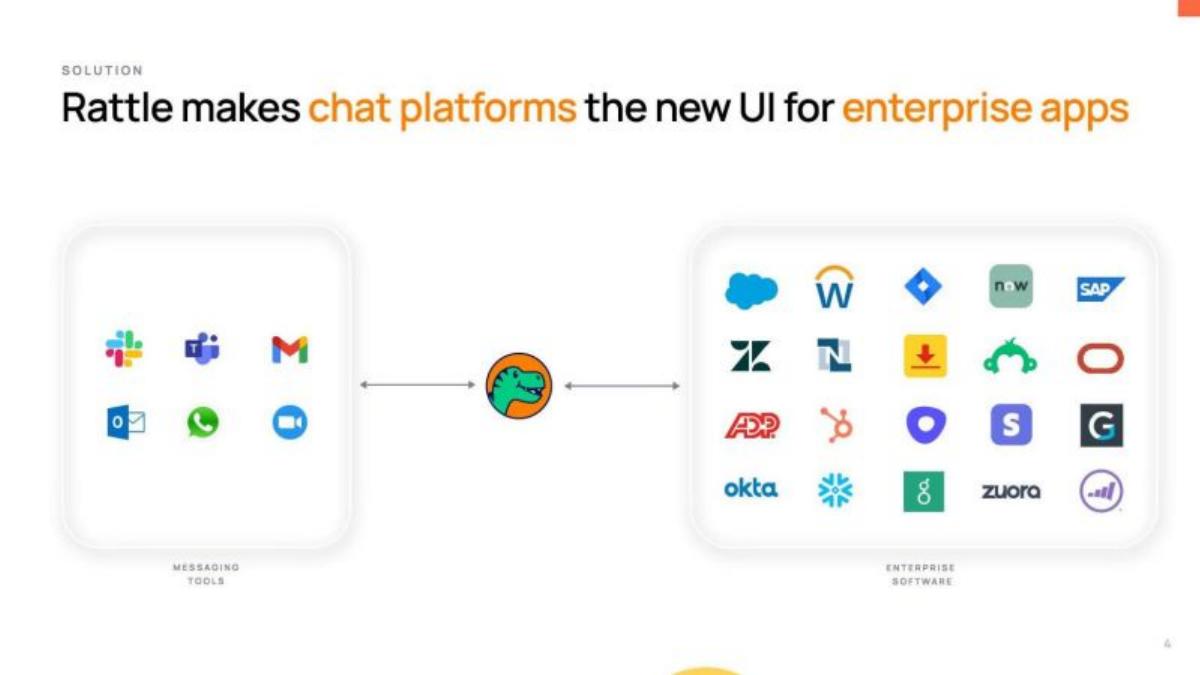
- The core value proposition is turning chat platforms into the 'new UI for enterprise apps' (slide 4).
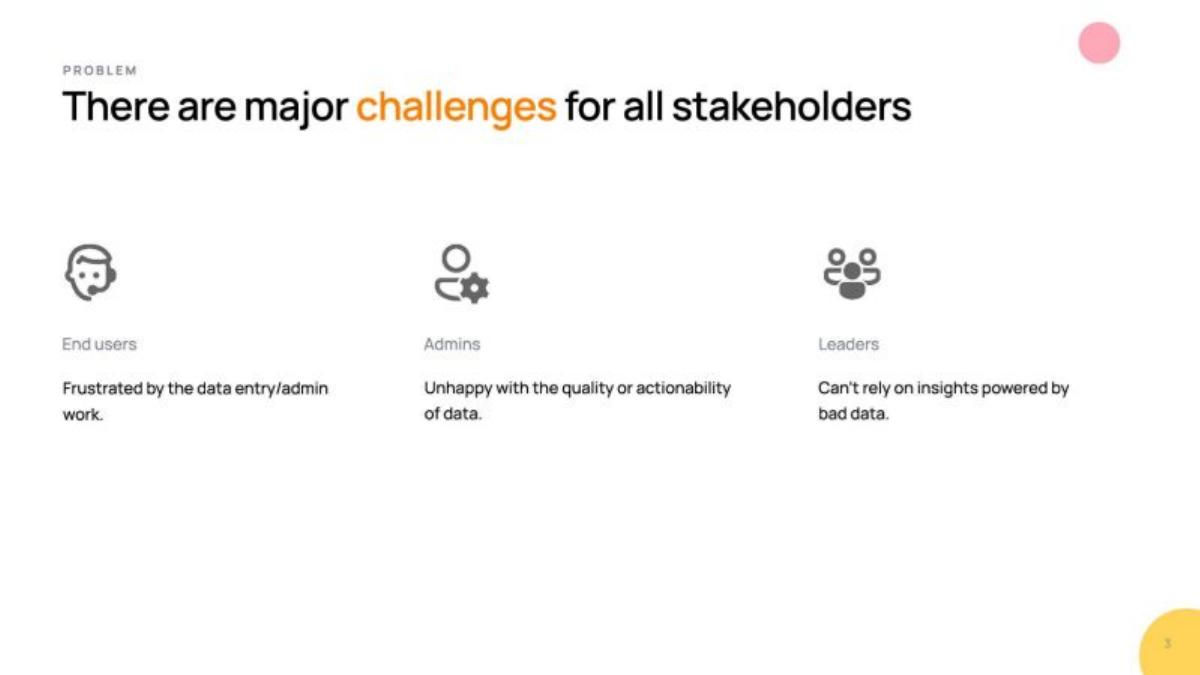
- The deck identifies three distinct stakeholder pain points: frustrated end users, unhappy admins, and leaders who can't rely on data (slide 3).
- Rattle claims a setup time of less than 1 minute with ROI visible within the same day (slide 12).
- The market expansion strategy moves from Salesforce to the 'next 10 integrations' and eventually the 'next 50 integrations' (slide 13).
- The team consists of serial founders with experience at YC-backed companies like Mutiny and Gigster (slide 15).
- The deck omits specific fundraising terms, valuation, or a detailed breakdown of the $26M use of funds.
The Narrative: From System of Record to System of Action
Rattle’s 2022 Series A deck is built on a very simple, relatable premise: everyone hates their CRM. By framing enterprise software as a 'system of record' that is inherently non-collaborative, Rattle sets the stage for a 'system of action' that lives inside messaging apps. This teardown explores how they used a narrow wedge—Salesforce to Slack—to raise $26M for a much broader vision.
Slides 1-3: The Problem with the Status Quo
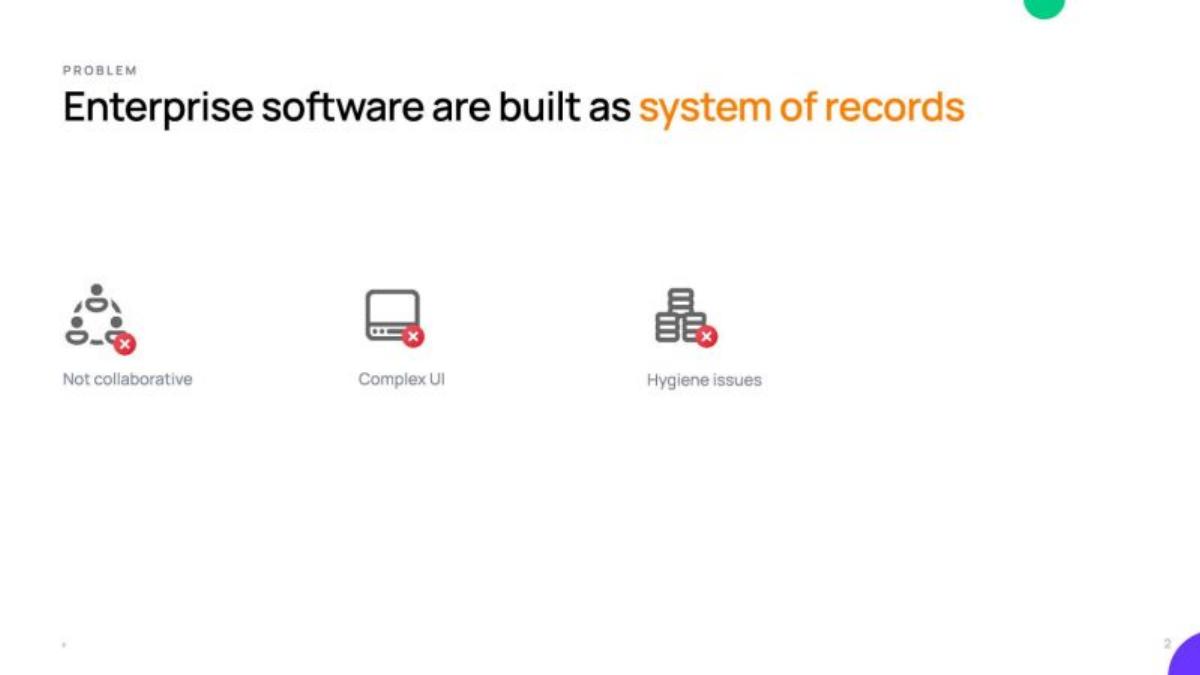
The deck opens with a bold claim on slide 1: 'A new way of working with enterprise software!' This is followed immediately by the 'Problem' on slide 2. Rattle identifies three core issues with current enterprise software: it is not collaborative, it has a complex UI, and it suffers from 'hygiene issues.' This is a classic 'show the monster' slide, where the monster is the clunky, old-school database interface.
Slide 3 deepens the pain by segmenting it by stakeholder. End users are frustrated by admin work, admins are unhappy with data quality, and leaders can't trust their insights. By addressing all three levels of the organization, Rattle positions itself as a solution that provides value to the person using it, the person managing it, and the person paying for it. This is a critical distinction in enterprise sales.
Slides 4-6: The Solution as a Middleware UI
Slide 4 is the 'Aha!' moment. It shows a logo-heavy diagram where Rattle sits in the middle of messaging tools (Slack, Teams, etc.) and enterprise software (Salesforce, Workday, SAP, etc.). The headline is clear: 'Rattle makes chat platforms the new UI for enterprise apps.' This reframes Rattle from a simple integration to a fundamental architectural layer.
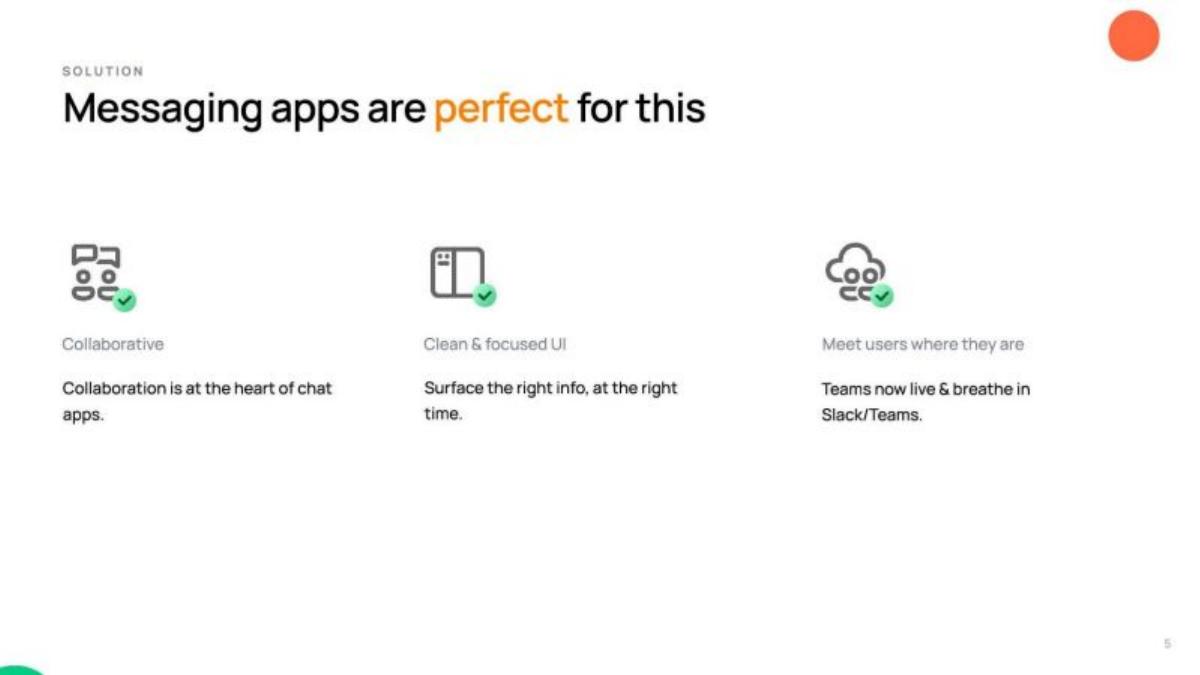
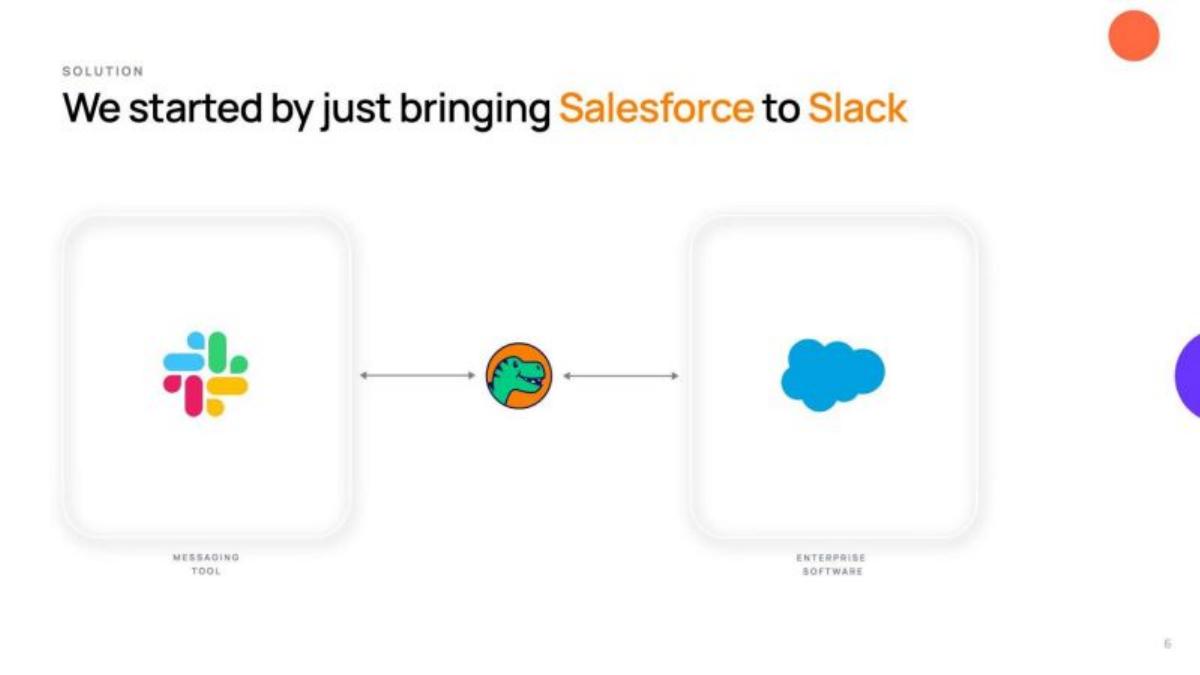
Slide 5 explains why messaging apps are the right place for this: they are collaborative by nature and they are where teams 'live & breathe.' Slide 6 then narrows the focus to their starting point: 'We started by just bringing Salesforce to Slack.' This demonstrates a disciplined 'wedge' strategy—solving a massive problem for a specific pair of tools before expanding.
Slides 7-9: Product and Immediate Impact
Slide 7 provides a product screenshot showing Rattle in action within Slack. It highlights a specific use case: logging calls in seconds. The text notes this is 'one of 100s of use cases.' This is a strong way to show product utility without getting bogged down in a feature list.
Slide 8, titled 'PMF' (Product-Market Fit), uses placeholders like 'xx% of users' but makes the qualitative claim that Rattle becomes a 'verb.' Slide 9 is the 'Impact' slide, and it is one of the strongest in the deck. It lists six specific customers and the metrics they achieved. Notable figures include a 75% reduction in lead response time for LogDNA and 45 mins saved each rep every day for Slintel. These are 'hard' ROI metrics that make a Series A investment feel de-risked.
Slides 10-11: Traction and Social Proof
Slide 10 is the 'money slide.' It shows a steep upward curve with the headline: '982% YoY revenue growth from 2021 to 2022.' For a Series A, this level of growth is the primary driver of valuation. While the Y-axis lacks specific dollar amounts, the percentage growth and the shape of the curve tell the story of a company that has found its stride.
Slide 11 reinforces this with a wall of logos and testimonials. Logos include Miro, ClickUp, and Rippling. The testimonials focus on ease of use and high ROI. One quote from Litmus stands out: 'Rattle has become a verb at Litmus.' When a product enters the daily lexicon of a customer, churn becomes highly unlikely.
Slides 12-14: The Vision and Market Opportunity
Slide 12 answers 'Why now?' and 'Why Rattle?' by focusing on the friction-less nature of the product. They claim a setup time of 'less than 1 min' and ROI 'within the same day.' In enterprise software, where implementations often take months, this is a massive competitive advantage.
Slide 13 addresses Market Size. It uses a nested circle diagram to show the expansion path. It starts with Salesforce (the current wedge), moves to the 'Next 10 integrations,' and finally the 'Next 50 integrations.' The slide uses placeholders like '$xxB' for the opportunity size, but the logic is clear: Rattle is a horizontal platform, not a vertical tool.
Slide 14 is the Landscape slide. Rattle positions itself in the 'Easy' and 'Effective' quadrant. They contrast themselves against 'Email' (ineffective), 'Native' integrations (difficult/ineffective), and 'iPaaS' (difficult). The headline 'Most tools simply move data from point A to point B' suggests that Rattle is doing something more sophisticated—managing the human-to-data interaction.
Slides 15-17: The Team and The Ask
Slide 15 introduces the founders. They are described as 'Serial founders with domain expertise.' The bios highlight past exits and experience at high-growth companies like Mutiny and Gigster. This gives investors confidence that the team can handle the 982% growth shown earlier.
Slide 16 is a simple 'Thank You' with contact information. Notably, the deck omits a specific 'Ask' slide . There is no mention of the $26M figure or how the capital will be spent (e.g., hiring, marketing, R&D). This is common in 'clean' versions of decks used for initial outreach or public sharing, though it is usually present in the version used for final partner meetings.
What Works in This Deck
The Wedge Strategy: Rattle clearly explains that while they want to be the UI for all enterprise software, they started with Salesforce and Slack. This focus makes the 982% growth believable because it shows they dominated a specific niche before trying to expand.
Hard ROI Metrics: Slide 9 is excellent. It doesn't just say 'users like us'; it says 'LogDNA reduced lead response time by 75%.' These are the types of metrics that internal champions use to justify buying software, and they are exactly what VCs want to see.
Stakeholder Alignment: By identifying the pain points for end users, admins, and leaders on slide 3, Rattle shows they understand the complex dynamics of enterprise sales. They aren't just building a 'cool tool' for reps; they are building a data integrity tool for the C-suite.
What Is Missing
The Financial Ask: As mentioned, there is no slide detailing how much they are raising or what the milestones for the next 18-24 months are. For a Series A, investors expect to see a plan for how the capital will scale the sales team or accelerate the product roadmap.
Unit Economics: There is no mention of CAC (Customer Acquisition Cost), LTV (Lifetime Value), or Churn rates. While the revenue growth is impressive, at the Series A stage, investors want to know if that growth is efficient and sustainable.
Specific Market Data: The use of 'xx' placeholders on slides 8 and 13 suggests this is a redacted version of the deck. While this protects sensitive data, it makes it harder to judge the actual scale of the opportunity from this document alone.
What Other Founders Should Copy
The 'System of Record' vs. 'System of Action' Narrative: This is a powerful way to frame any middleware or productivity tool. If you are building something that sits on top of a legacy system, use Rattle’s logic to explain why the legacy system’s UI is the bottleneck.
The Impact Slide Layout: Slide 9 is a perfect template for showing case studies. Use a logo, a single bold metric, and a short descriptive sentence. It is much more effective than a wall of text.
The Expansion Map: Slide 13’s nested circles are a great way to show how a small 'wedge' product becomes a multi-billion dollar platform. It allows you to be realistic about where you are today while being ambitious about where you are going.
Frequently asked questions
- What is the primary problem Rattle is solving?
- According to slide 2, Rattle addresses the fact that enterprise software is built as a 'system of record' rather than a collaborative tool. This leads to complex UIs and 'hygiene issues' where data is not updated because the interface is too cumbersome for end users. By moving the interface to where teams already work (Slack/Teams), they solve the data entry friction.
- How does Rattle demonstrate product-market fit?
- Rattle uses a combination of quantitative growth and qualitative 'love.' Slide 10 shows a nearly 10x revenue jump in one year. Slide 11 provides testimonials from high-growth companies like ClickUp and Rippling, with one customer stating that Rattle has 'become a verb' within their organization, indicating deep workflow integration.
- What is Rattle's competitive advantage according to the deck?
- Slide 14 places Rattle in the top-right quadrant of a landscape map, defined as 'Easy' and 'Effective.' They differentiate themselves from 'Native' integrations and 'iPaaS' (Integration Platform as a Service) tools by focusing on being a purpose-built UI rather than just a tool that 'moves data from point A to point B.'
- What are the key metrics mentioned in the Rattle deck?
- Key metrics include a 982% YoY revenue growth (slide 10), 75% reduction in lead response time, 45 minutes saved per rep daily, and a 50% reduction in data hygiene issues (slide 9). Interestingly, slide 8 uses 'xx%' as a placeholder for trial-to-paid conversion, suggesting this version of the deck was sanitized for public viewing.
- Who are the founders of Rattle?
- The leadership team includes CEO Sahil Aggarwal (formerly of Mutiny and Leadworx), CTO Milan Pal Singh (formerly of Zostel and Leadworx), and COO Apoorva Verma (formerly of BCG and ZS). The deck emphasizes their 'domain expertise' and 'Bay Area exposure' as key strengths for scaling an enterprise SaaS company.