Rapa’s pitch deck is a concise, 9-slide presentation focusing on a highly specific niche: cross-border lending for the Indian diaspora in the United States. The company identifies a massive $50 billion market opportunity where high-earning individuals (the 'Dr. Rajesh' persona) are underserved by both US banks, which lack the infrastructure for international property lending, and Indian banks, which offer high interest rates and slow service. Rapa leverages a team with deep institutional experience from Bank of America, PwC, and Capital One to build a digital-first mortgage platform. While th…
Key takeaways
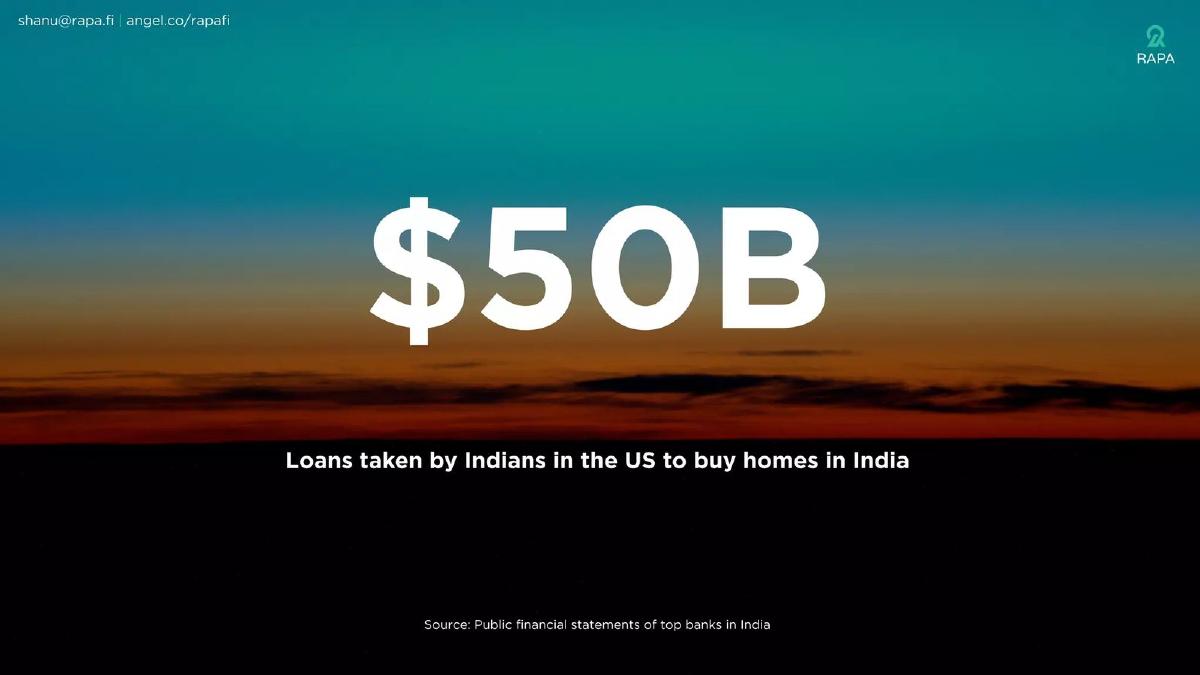
- The total addressable market is defined as $50B in loans taken by Indians in the US to buy homes in India (Slide 2).
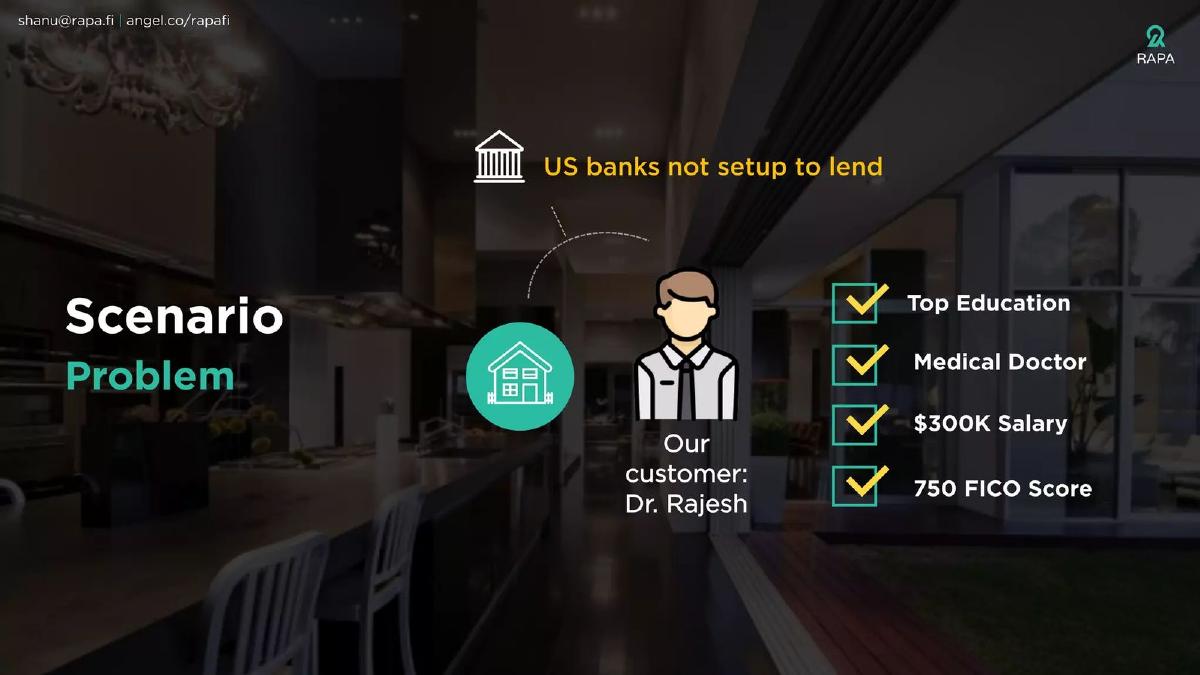
- The target customer profile is highly specific: individuals with top education, $300K salaries, and 750+ FICO scores (Slide 3).
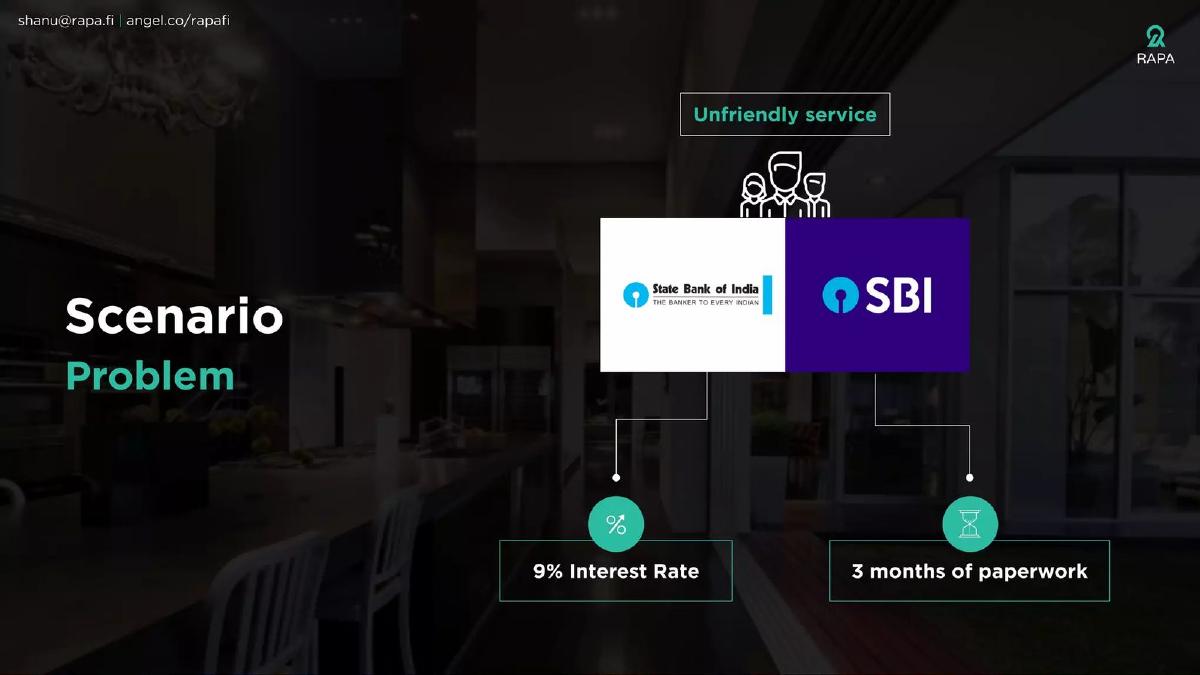
- Rapa identifies a 9% interest rate and 3 months of paperwork as the primary pain points with incumbent banks like SBI (Slide 4).
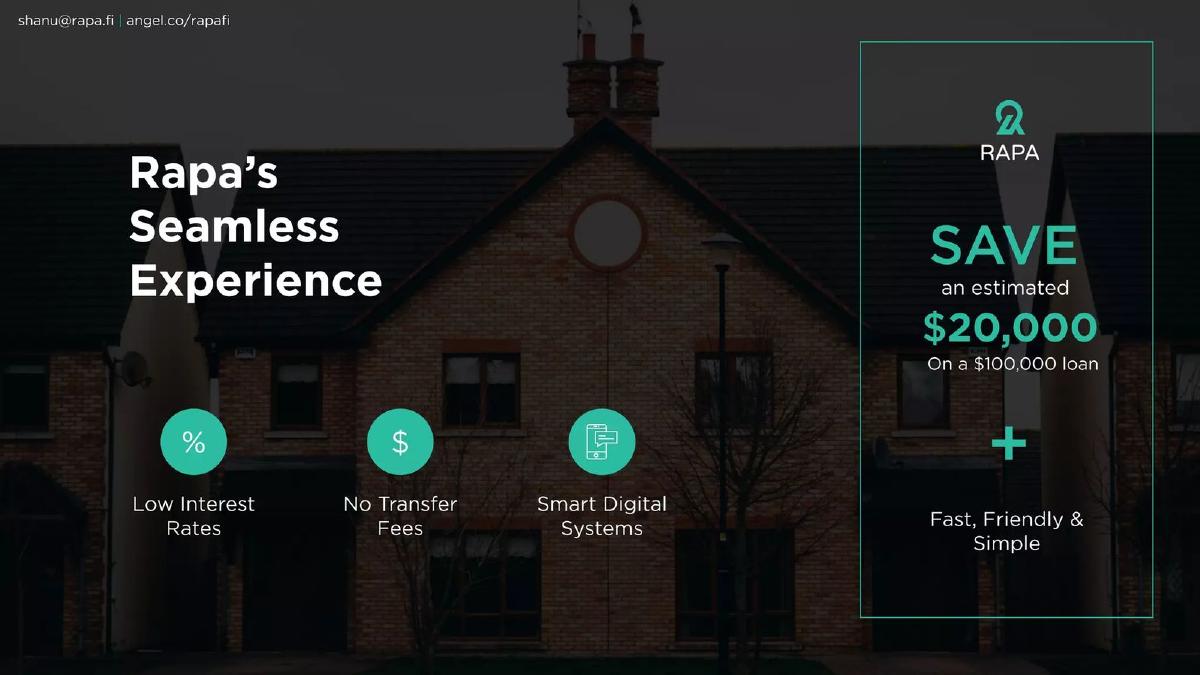
- The value proposition claims an estimated $20,000 savings on a $100,000 loan through lower rates and no transfer fees (Slide 5).
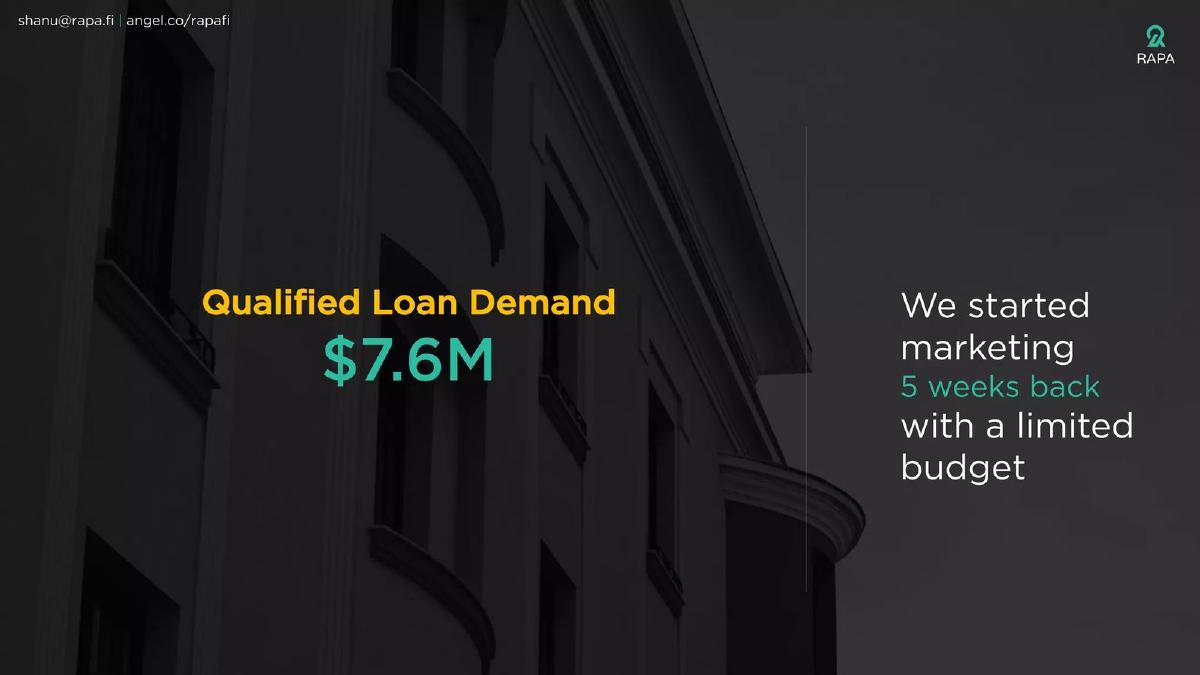
- Early traction is demonstrated by $7.6M in qualified loan demand generated within 5 weeks of limited marketing (Slide 6).
- The credit quality of the pipeline is exceptionally high, with 92% of customers falling into Prime or Super Prime categories (Slide 7).
- The founding team features significant pedigree, including experience at Bank of America, Stanford, PwC, and Cornell (Slide 8).
- The deck completely omits a financial 'Ask' slide, leaving the desired funding amount and use of proceeds unknown.
Executive Summary: A Niche Fintech Play with Institutional Pedigree
Rapa’s pitch deck is a masterclass in narrow positioning. Rather than attempting to disrupt the entire mortgage industry, they focus on a single, high-value corridor: the US-to-India property market. By highlighting the inefficiencies of the current system—where high-earning doctors and engineers are treated as high-risk or low-priority by traditional banks—Rapa builds a compelling case for a specialized digital lender. The deck relies heavily on the 'Prime' nature of their customer base to offset the inherent risks of cross-border lending.
Slide 1: Title and Tagline
The cover slide features a clean logo and the tagline: "Loans to buy homes abroad." It includes the website (www.rapa.fi) and a direct contact email for the CEO. The background image of a modern, wood-paneled interior reinforces the aspirational nature of the real estate product they are financing.
Slide 2: The $50B Opportunity
Rapa opens with a massive 'hook' number: $50B. This represents the volume of loans taken by Indians in the US to buy homes in India. By citing public financial statements of top Indian banks as the source, they establish immediate credibility for the market size. This slide effectively answers the 'Why now?' and 'How big?' questions simultaneously.
Slide 3: The Persona - Dr. Rajesh
Slide 3 introduces the 'Scenario' or problem through a specific persona: Dr. Rajesh. He represents the ideal customer: a medical doctor with a $300K salary, a 750 FICO score, and a top-tier education. The core conflict is stated clearly: "US banks not setup to lend." This highlights a structural gap in the market where high-net-worth individuals are unable to leverage their US-based creditworthiness for international assets.
Slide 4: The Incumbent Friction
This slide targets the competition, specifically the State Bank of India (SBI). Rapa identifies three critical pain points: "Unfriendly service," a "9% Interest Rate," and "3 months of paperwork." By quantifying the interest rate and the time delay, Rapa sets a clear benchmark that their solution must beat to be viable.
Slide 5: The Rapa Solution
Rapa’s value proposition is centered on savings and speed. They claim a customer can "SAVE an estimated $20,000 on a $100,000 loan." The pillars of their "Seamless Experience" are listed as Low Interest Rates, No Transfer Fees, and Smart Digital Systems. The slide promises a "Fast, Friendly & Simple" alternative to the friction described in the previous slide.
Slide 6: Early Traction and Demand
To prove product-market fit, Rapa shares a traction metric: "$7.6M Qualified Loan Demand." Crucially, they note that they started marketing only "5 weeks back with a limited budget." This suggests a high organic or low-cost acquisition interest, which is a strong signal for investors looking for scalability.
Slide 7: Credit Quality Breakdown
Slide 7 is a data-heavy visualization of their loan demand. It shows that 92% of their potential customers are "Prime & Super Prime." A donut chart breaks down the $7.08M (a slightly different figure than the $7.6M on the previous slide) by FICO score: $5.65M are above 720 FICO. This slide is designed to de-risk the investment by showing that the borrowers are the 'safest' possible cohort.
Slide 8: The Experienced Team
The team slide is a significant strength for Rapa. CEO Shanu and COO Jay bring pedigrees from Bank of America, Stanford, PwC, and Cornell. The supporting team (CFO, CRO, and Legal) adds layers of institutional security, with backgrounds in Societe Generale and Capital One. In fintech, where regulatory compliance and risk management are paramount, this level of experience is a requirement rather than a luxury.
Slide 9: The Vision
The deck concludes with a vision statement: "Building the mortgage and data company for the global prime customer." This suggests that while they are starting with the US-India corridor, their long-term goal is to become a broader data and lending platform for high-earning expats globally.
What Works in the Rapa Deck
Specific Persona Mapping: By using 'Dr. Rajesh' as a proxy for their target market, Rapa makes the problem relatable and the solution obvious. Investors can easily visualize the customer and the frustration they face.
Speed of Traction: Claiming over $7M in demand within five weeks is an impressive velocity. It demonstrates that the pain point is acute and that the target audience is actively searching for a solution.
Focus on 'Super Prime': In a lending business, the biggest fear for an investor is default risk. By showing that nearly all their demand comes from 720+ FICO borrowers, Rapa addresses this concern head-on.
What is Missing from the Rapa Deck
The Business Model: While the slide mentions "Low Interest Rates" and "No Transfer Fees," it doesn't explain how Rapa actually makes money. Are they taking an origination fee? A spread on the interest? Selling the data? This is a major omission.
The Ask: There is no slide indicating how much money Rapa is raising or what they intend to do with the capital. Without an 'Ask' slide, the deck feels more like a partnership proposal than a fundraising tool.
Regulatory and Legal Framework: Lending across borders is a regulatory minefield. The deck mentions a "Legal & Compliance" lead but does not explain what licenses Rapa holds or how they navigate the banking laws of two different countries.
Founder's Guide: What to Copy
The 'Friction Comparison': Slide 4 is excellent. If you are disrupting a legacy industry, show the incumbent's logo and list their specific failures (9% rate, 3 months of waiting). It creates a clear 'villain' for your 'hero' product to defeat.
Pedigree Alignment: Rapa does a great job of matching their team’s past experience to their current roles. The CRO comes from underwriting; the CEO comes from a major bank. Founders should always highlight the specific 'right to win' their team possesses.
Market Sizing via Existing Flows: Instead of using a vague 'top-down' market size, Rapa uses the actual loan volume currently being processed by banks. This proves the money is already moving; they just need to redirect the flow.
Frequently asked questions
- What is Rapa's core product?
- Rapa provides cross-border mortgage products specifically designed for Indian citizens or expats living in the US who wish to purchase property in India. Their platform acts as a digital bridge, offering lower interest rates, no transfer fees, and a faster approval process compared to traditional Indian banks like State Bank of India (SBI).
- How does Rapa justify its market size?
- On slide 2, Rapa cites public financial statements from top banks in India to claim a $50 billion market for loans taken by Indians in the US to buy homes in India. This suggests a massive, existing flow of capital that is currently being processed through inefficient, high-friction traditional banking channels.
- What is the credit profile of Rapa's target user?
- Rapa is exclusively targeting 'Prime and Super Prime' customers. According to slide 7, 92% of their demand comes from borrowers with FICO scores above 660, with the vast majority ($5.65M of the $7.08M shown in the chart) having scores above 720. This reduces the risk profile for potential investors or debt partners.
- Who are the founders of Rapa?
- The team is led by CEO Shanu (Bank of America, Stanford) and COO Jay (PwC, Cornell). The broader executive team includes a CFO who was formerly the CFO of Societe Generale Georgia and a Chief Risk Officer with an underwriting background from Capital One. This institutional background is a key trust signal in the fintech space.
- What is missing from the Rapa pitch deck?
- The deck is missing several standard components: a specific funding ask, a clear revenue model (how they make money beyond 'low rates'), a roadmap for geographic expansion, and a detailed explanation of their regulatory or licensing status in both the US and India.