Rapchat's seed deck is a high-signal, low-noise presentation that relies heavily on early proof of concept. In an era where mobile music creation was still nascent, Rapchat used its 10 slides to demonstrate that a massive, underserved audience (500M+ hip hop fans) was already using their tool to bypass the traditional barriers of studios and distribution. The deck is notable for its 'traction-first' approach, placing massive usage numbers on slide two before even explaining the product. This strategy, combined with a team that had already achieved individual success in the music industry (10M…
Key takeaways
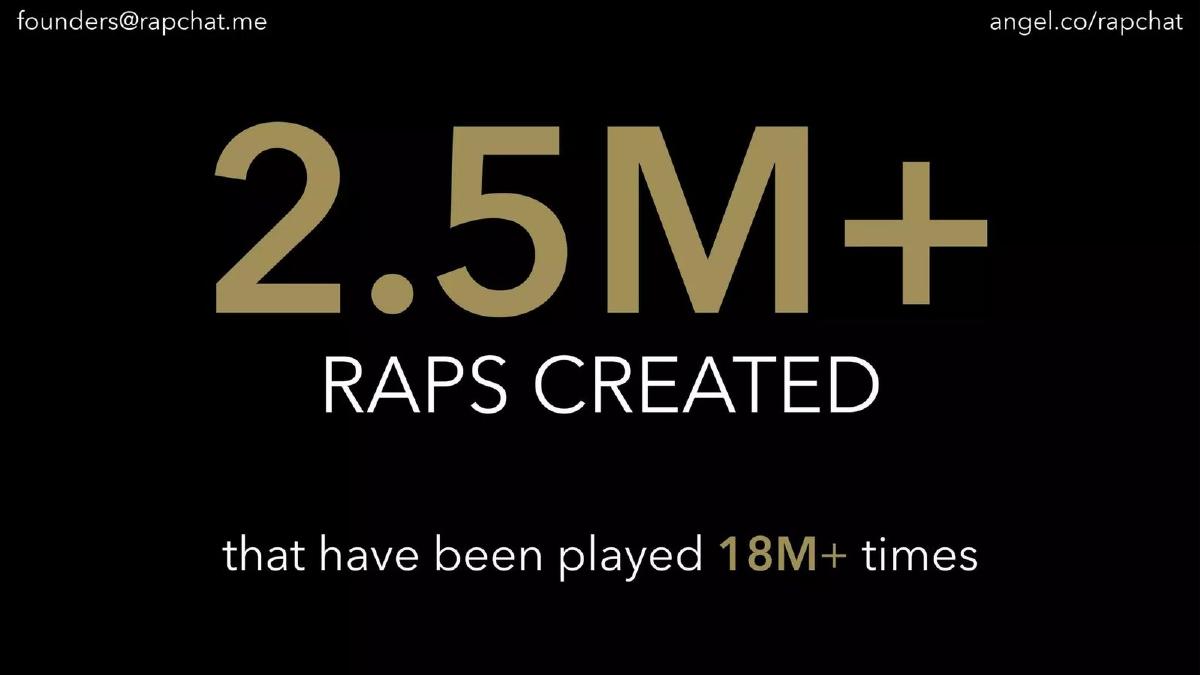
- The deck leads with aggressive traction, citing 2.5M+ raps created and 18M+ plays on slide 2.
- Founder-market fit is established by Pat Gibson's history of 10M+ hits and selling beats to MTV (slide 9).
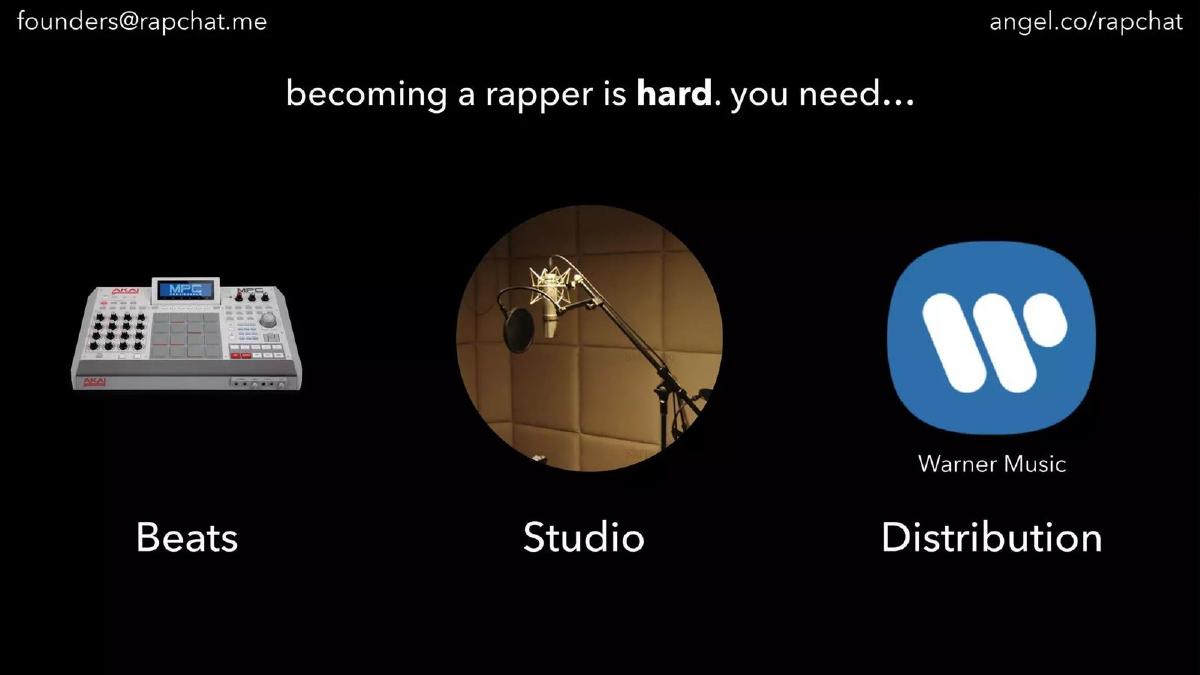
- The problem is framed as a high barrier to entry involving expensive beats, studios, and distribution (slide 4).
- User engagement is high, with the deck reporting 320 minutes spent per month per user on slide 7.
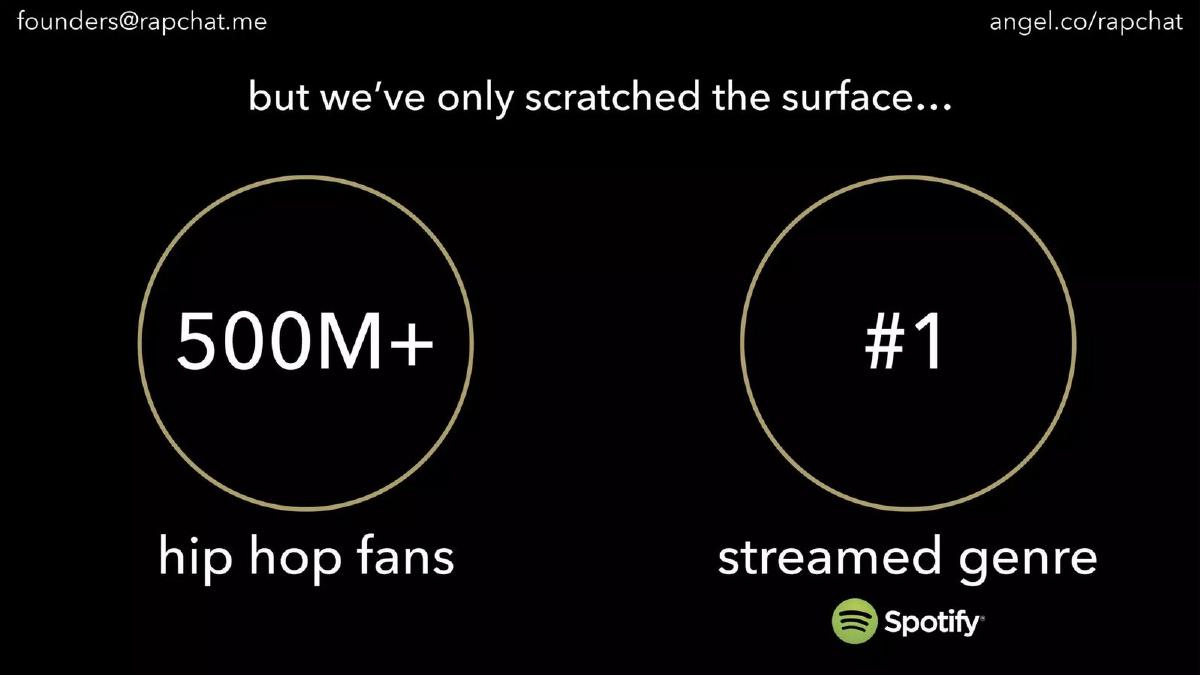
- The market opportunity is anchored in the fact that hip hop is the #1 streamed genre on Spotify (slide 6).
- Revenue models are presented as future possibilities, specifically premium beats and sponsored content (slide 8).
- The deck reports a 35% monthly retention rate alongside 50k MAU on the final slide.
- There is no explicit 'Ask' slide detailing the amount of capital being raised or the valuation sought.
The Traction-First Seed Deck
Rapchat’s pitch deck is a lean, 10-slide document that follows a classic narrative arc: traction, problem, solution, market, engagement, and team. In 2015, the idea of a mobile-first recording studio was ambitious, but Rapchat used its existing user data to prove that the demand was not theoretical. The deck successfully raised $4,000,000 by focusing on the sheer volume of content being created on the platform before the company had even fully formalized its revenue model.
Slides 1-3: The Hook and Immediate Proof
Slide 1: Title The deck opens with a minimalist black and gold logo for Rapchat. There is no tagline or mission statement here, just the brand identity. It sets a professional, high-end tone that contrasts with the 'scrappy' nature of many seed-stage startups.
Slide 2: Traction Rapchat makes a bold move by placing traction on the second slide. It states: 2.5M+ RAPS CREATED and that have been played 18M+ times . By leading with these figures, the founders immediately silence doubts about whether people actually want to rap into their phones. The contact information (founders@rapchat.me) and AngelList link are present in the corners, a recurring theme throughout the deck.
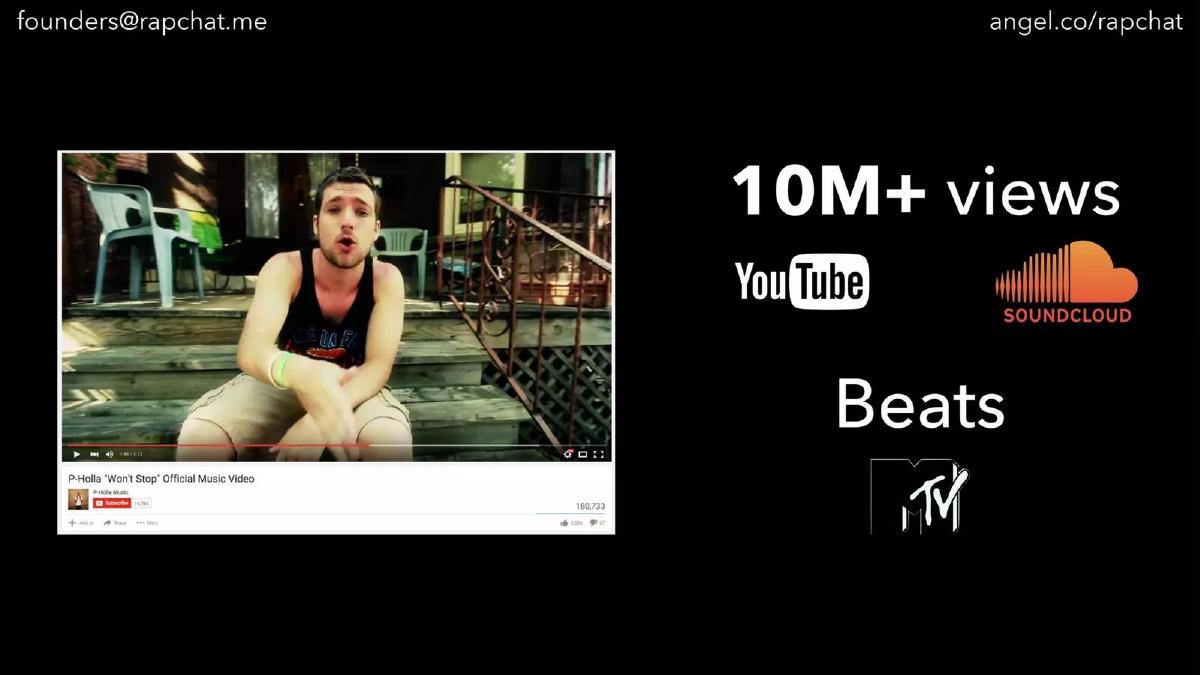
Slide 3: Social Proof This slide features a screenshot of a YouTube music video for P-Holla's 'Won't Stop.' It lists 10M+ views across YouTube and SoundCloud, alongside logos for Beats and MTV. This slide serves to bridge the gap between 'app users' and 'real-world success,' implying that the platform is a springboard for legitimate music careers.
Slides 4-5: The Problem and The Answer
Slide 4: The Problem The slide states becoming a rapper is hard. you need... and displays three icons: Beats (represented by an Akai MPC), Studio (a professional vocal booth), and Distribution (the Warner Music logo). This effectively visualizes the high financial and institutional barriers to entry in the music industry.
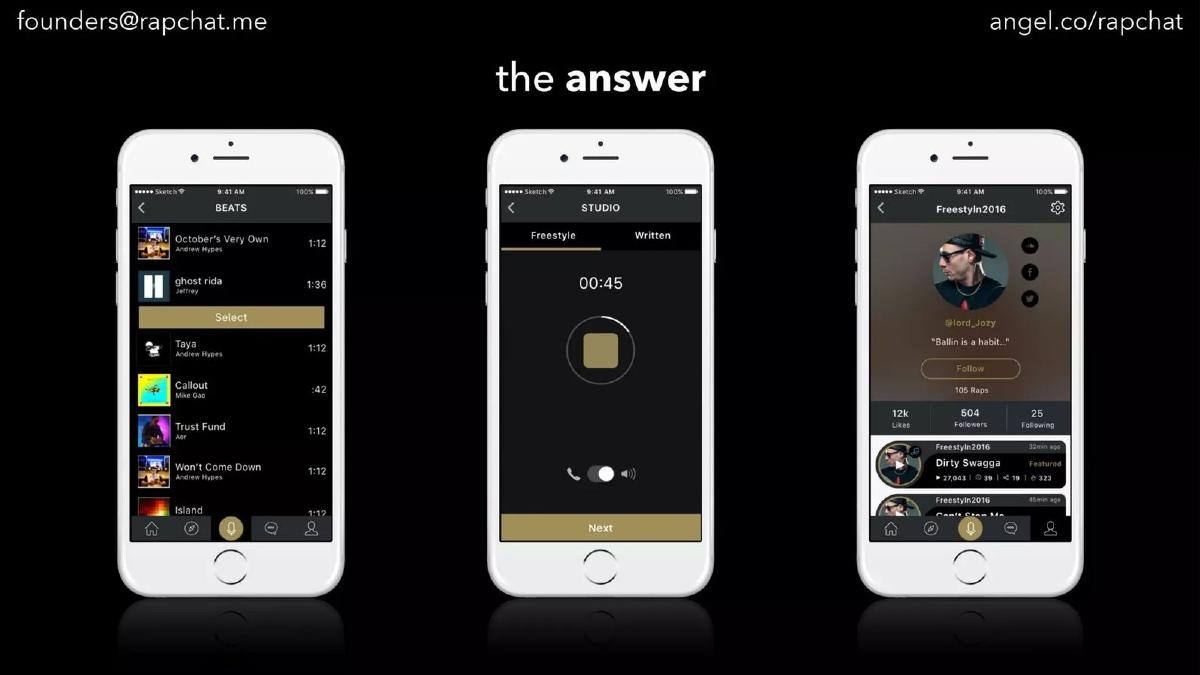
Slide 5: The Answer Titled the answer , this slide shows three iPhone mockups. The first shows a list of beats (October's Very Own, ghost rida), the second shows a simple 'Studio' interface with a record button, and the third shows a user profile (@lordjozy) with 12k likes and 504 followers. This slide demonstrates how Rapchat collapses the three barriers mentioned in the previous slide into a single mobile interface.
Slides 6-7: Market Size and User Behavior
Slide 6: The Opportunity Rapchat frames the market through two data points: 500M+ hip hop fans and the fact that hip hop is the #1 streamed genre on Spotify. This is a macro-level justification for the business. It doesn't calculate a specific dollar amount for the market but instead points to a massive cultural shift that the company is positioned to ride.
Slide 7: Engagement Metrics The deck returns to hard data to prove 'stickiness.' It lists 50K MAU (Monthly Active Users), 320 min (Time spent per month), and 300k Monthly Listens . The 320-minute figure is particularly impressive, as it suggests users are spending over 10 minutes a day in the app, which is high for a creative utility.
Slides 8-10: Revenue, Team, and Retention
Slide 8: Future Revenue Streams Rapchat is honest about its stage, labeling this slide future revenue streams . It proposes two models: premium beats (showing a $1.99 price tag) and sponsored content (showing a contest sponsored by Beats by Dre). This shows investors that while the app is currently free, there are clear, industry-standard paths to monetization.
Slide 9: The Team The team slide focuses on the two co-founders. Pat Gibson is highlighted for having 10M+ hits on songs and selling beats to MTV, establishing him as the domain expert. Seth Miller (CEO) is described as having Managed Upcoming Rappers and being an iOS Developer and Former Systems Engineer . This covers the three pillars of a tech startup: product, engineering, and industry expertise.
Slide 10: The Closer The final slide features a video still of DJ Khaled on a jet ski with the caption 'Ride wit me through the journey of more success.' More importantly, it reiterates the 50K MAU and introduces a new metric: 35% Monthly Retention . Ending on a high retention number is a strong tactical choice, as it leaves investors with the impression of a stable, growing user base.
What Works in the Rapchat Deck
1. Data-Driven Narrative: The deck is remarkably light on 'fluff.' Almost every slide contains a hard number (2.5M raps, 18M plays, 320 minutes, 35% retention). For a consumer app, these metrics are the only thing that truly matters to a Seed investor.
2. Visual Simplicity: The use of a black background with gold and white text creates a 'premium' feel that aligns with the hip-hop aesthetic without being distracting. The mockups are clean and clearly illustrate the user journey from beat selection to recording to social sharing.
3. Founder-Market Fit: The team slide is a standout. By proving that one founder is a successful music producer and the other is a developer who has managed artists, they eliminate the 'why you?' question immediately.
What is Missing from the Rapchat Deck
1. The Ask: There is no slide detailing how much money they are raising, what the terms are, or what the milestones for the next 18 months look like. While this information is often handled in the email or the meeting, its absence in the deck makes the presentation feel like a teaser rather than a full pitch.
2. Competitive Landscape: The deck ignores other music creation apps (like Smule or Voisey). While Rapchat’s focus on hip-hop is a differentiator, investors generally want to see that the founders are aware of their direct and indirect competitors.
3. Unit Economics: While they show engagement, they don't show the cost to acquire a user (CAC) or the projected lifetime value (LTV). For a $4M raise, investors usually expect at least a preliminary look at the efficiency of the growth engine.
What a Founder Should Copy
1. Lead with Traction: If you have numbers as strong as Rapchat’s, do not bury them on slide 8. Put them on slide 2. It changes the entire tone of the meeting from 'convincing' to 'validating.'
2. Use 'The Answer' Framework: Slide 4 and 5 are a perfect example of how to present a solution. Identify three specific pain points (Beats, Studio, Distribution) and show exactly how your app replaces them in one screen.
3. Focus on Dwell Time: If your product is a social or creative tool, 'Time Spent' is often more important than 'Total Users.' Rapchat’s inclusion of the 320-minute metric is a powerful way to prove that their app is a habit, not just a one-time download.
4. Consistent Branding: The contact info and AngelList URL in the corners of every slide is a subtle but effective way to ensure the investor knows exactly where to go next, regardless of which slide they are looking at when they decide to move forward.
Frequently asked questions
- How did Rapchat justify its market size without a TAM/SAM/SOM slide?
- Rapchat bypassed traditional market sizing formulas by using cultural relevance and platform-specific data. On slide 6, they cite 500M+ hip hop fans and note that hip hop is the #1 streamed genre on Spotify. This approach suggests that the market is already proven and massive, shifting the investor's focus from 'is the market big enough?' to 'can this team capture the existing audience?'
- What is the significance of the '320 minutes per month' metric?
- This is a critical engagement metric found on slide 7. For a social or creative app, 320 minutes (over 5 hours) per month indicates that the product is not just a novelty but a utility or a primary social outlet. High dwell time is often a leading indicator for monetization potential through advertising or subscriptions, which Rapchat hints at in their revenue slide.
- Why did the founders include their personal music achievements in the team slide?
- In the music tech space, 'tourist' founders often fail because they don't understand the creator's workflow. By highlighting that Pat Gibson had 10M+ hits and sold beats to MTV (slide 9), Rapchat proves they have 'insider' status. This reduces perceived execution risk because the founders are building for a community they are already a part of.
- Is the lack of a 'Competitors' slide a red flag in this deck?
- While usually a mistake, Rapchat frames their product as 'The Answer' to a hardware and institutional problem (beats, studios, distribution) rather than a software competition. By positioning themselves against expensive physical studios rather than other apps, they make their value proposition seem more disruptive and unique, though it does leave the competitive landscape unaddressed.
- What does the 35% monthly retention rate tell us about the business?
- A 35% monthly retention rate (slide 10) for a consumer creative app is relatively strong for the seed stage. It suggests that once a user records their first rap, there is a high likelihood they will return to the 'studio.' This metric validates the product-market fit and justifies the $4M raise to scale user acquisition.