The Deal Box Investment Brief from August 2016 is less a traditional pitch deck and more a formal private placement memorandum supplement. It targets the 'democratized' investing public created by the JOBS Act, specifically focusing on Rule 506(c) offerings. The company positions itself as a consolidated service provider that reduces the 'cost of offering' from an estimated $58,000 to $36,190 by streamlining legal, accounting, and marketing workflows. While the deck is text-heavy and lacks visual product demonstrations, it provides an unusual level of detail regarding its capitalization table…
Key takeaways
- The company sought to raise $1.5 million via Series A Preferred Shares under Rule 506(c) of Regulation D (Slide 2).
- The offering featured a $20,000 minimum investment and a 1:2 conversion ratio for preferred to common stock (Slide 2).
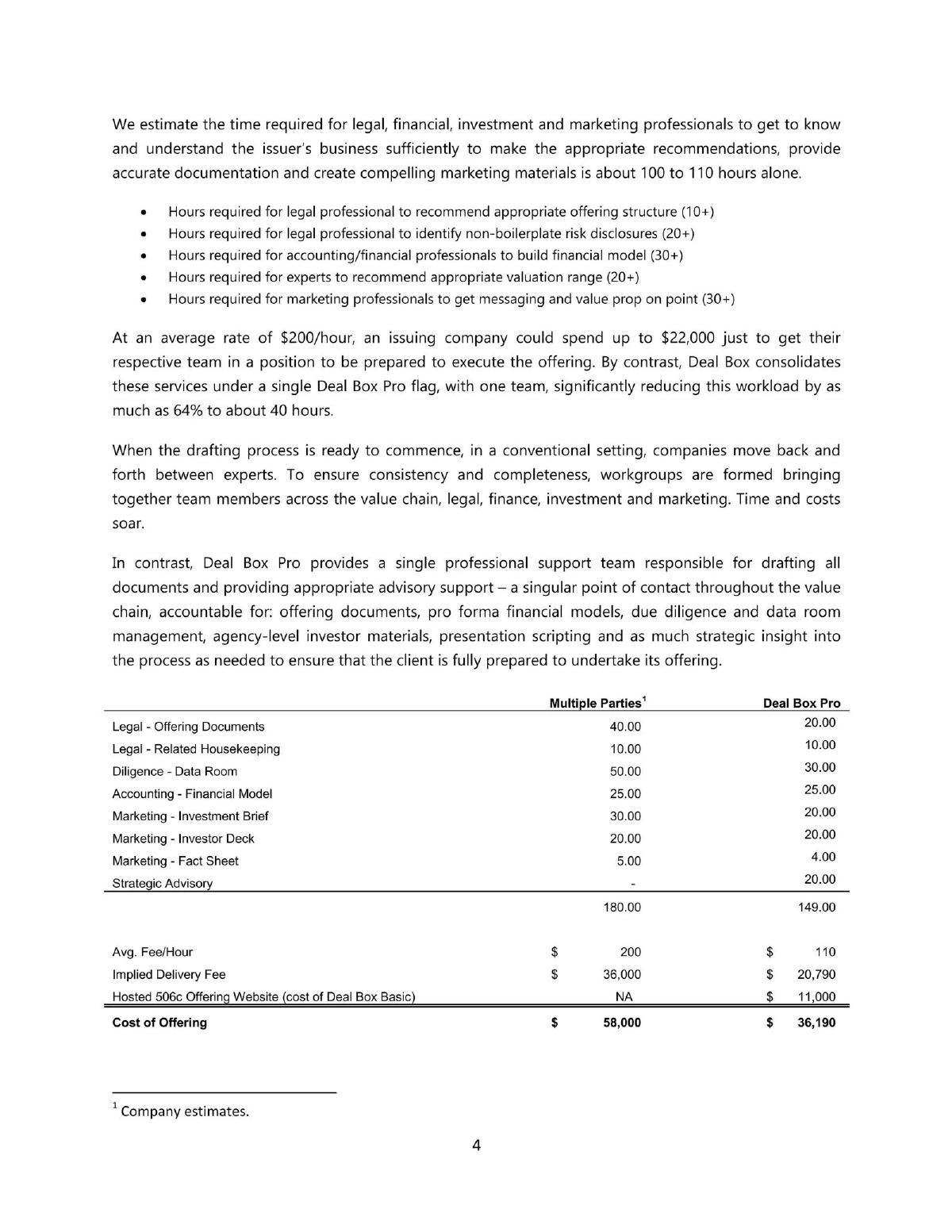
- Deal Box claimed to reduce the time required for offering preparation from 180 hours to 149 hours through its 'Deal Box Pro' service (Slide 4).
- The market opportunity was defined by 33,429 reported Regulation D offerings in 2014, totaling $1.3 trillion in capital (Slide 6).
- Founder Robert J. Caruso is highlighted for his background managing over $10 billion at Select Equity Group and $40 billion at Highbridge Capital Management (Slide 8).
- Financial projections estimated a 2016 EBITDA of $110,000, growing to $2.95 million by 2020 (Slide 10).
- The post-offering valuation was explicitly stated at $10,500,000 (Slide 2).
- The deck includes a comprehensive risk disclosure section covering macro-economic conditions and pipeline reliance (Slide 12).
Introduction and Cover
Slide 1: Title Slide
The deck opens with a minimalist cover page dated August 2016. It identifies the document as an "Investment Brief" for Deal Box, Inc. The background features a grayscale, abstract architectural rendering of glass cubes, suggesting a focus on structure, transparency, and perhaps the "box" element of the brand name. There is no tagline or mission statement on this slide.
The Investment Terms
Slide 2: Investment and Capitalization
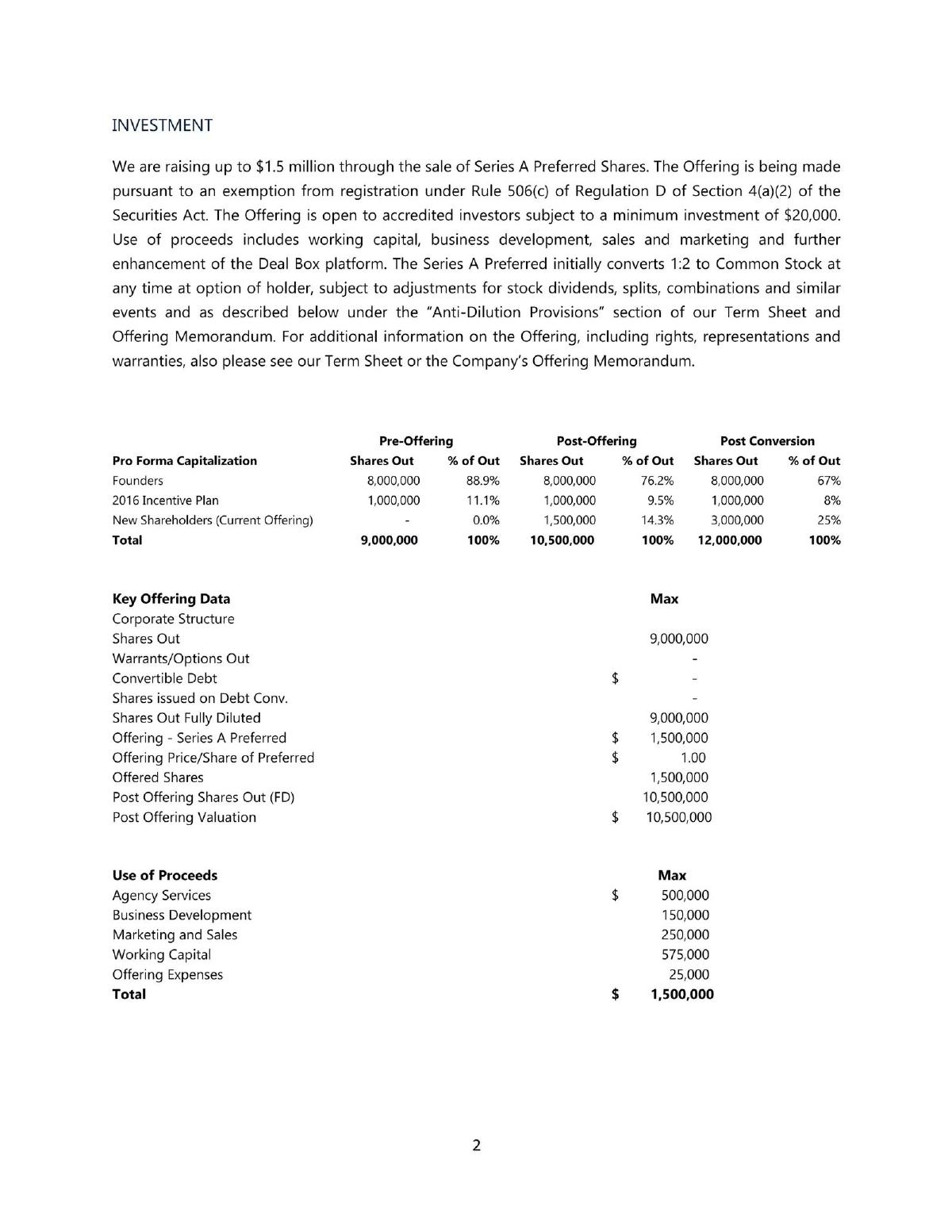
This slide is exceptionally dense with data, functioning more like a term sheet than a pitch slide. It explicitly states the ask: up to $1.5 million through the sale of Series A Preferred Shares under Rule 506(c). Key figures include a minimum investment of $20,000 and a post-offering valuation of $10,500,000.
The slide includes a Pro Forma Capitalization table showing three stages: Pre-Offering, Post-Offering, and Post Conversion. It notes that founders hold 8,000,000 shares (88.9% pre-offering) and that new shareholders will hold 25% of the company post-conversion. The "Use of Proceeds" table is also highly specific, allocating $500,000 to Agency Services and $575,000 to Working Capital.
The Value Proposition
Slide 4: Efficiency and Cost Comparison
Slide 4 addresses the problem of the high cost and time commitment required to launch a securities offering. It estimates that a conventional process takes 180 hours and costs $58,000. Deal Box Pro is positioned as a solution that reduces this to 149 hours and $36,190.
The slide breaks down these costs into granular line items, such as "Legal - Offering Documents" (reduced from 40 to 20 hours) and "Accounting - Financial Model" (remaining at 25 hours). It emphasizes the benefit of a "single professional support team" to ensure consistency across the value chain of legal, finance, and marketing.
Market Opportunity
Slide 6: The Crowdfunding Landscape
This slide provides the macro-economic context for the business. It cites that in 2014, there were 33,429 reported Regulation D offerings involving approximately 301,000 investors. It notes that while $1.3 trillion was raised in total Reg D offerings that year, only 2% ($33 billion) was raised via Rule 506(c).
The slide uses three silhouettes to illustrate different issuer needs: General Crowdfunding (Issuer #1), Deal Box Basic (Issuer #2), and Deal Box Pro (Issuer #3). The "Pro" option is marketed to issuers who want a dedicated, company-owned website to ensure "100% of the traffic will be focused on its offering alone."
Leadership Team
Slide 8: Executive Biographies
The team slide focuses on two individuals with deep institutional and academic backgrounds. Robert J. Caruso is highlighted for his experience at Select Equity Group (managing $10 billion) and Highbridge Capital Management (managing $40 billion). The biography emphasizes his role in management, strategy, and risk oversight.
Dr. Richard Swart is presented as the academic and industry authority. His bio mentions his role as a founding member of the Crowdfunding Professional Association and his work with the World Bank’s InfoDev group. The inclusion of these high-level biographies is clearly intended to build institutional credibility for a startup operating in a highly regulated space.
Financial Projections
Slide 10: Pro Forma Financials
Slide 10 presents a full five-year financial model from 2016 to 2020. The level of detail here is rare for a pitch deck, including line items for "Total Direct Costs," "Income Taxes," and "Liquidation Preference Value."
2016: $880,000 Revenue, $110,000 EBITDA · 2018: $5,770,000 Revenue, $1,850,000 EBITDA · 2020: $8,540,000 Revenue, $2,950,000 EBITDA
The slide also calculates "Total Founders and Mgmt. Value," projecting it to reach $33,139,996 by 2020 based on an enterprise value multiple.
Risk and Contact
Slide 12: Risk Factors and Contact Information
The final slide in the provided set acts as a legal disclaimer and risk disclosure. It lists eight specific risks, including macro-economic conditions, reliance on referrals, and the potential failure to effectively launch the "Equity Round Marketplace." It concludes with contact information for Thomas Carter at Capital Services Group, Inc.
What Works Well
The Deal Box deck excels in its financial transparency . Unlike most modern decks that use vague charts, Deal Box provides a full cap table and a detailed five-year pro forma. This is highly appropriate for their target audience: accredited investors who are likely familiar with institutional investment documents.
The comparative cost analysis on Slide 4 is a strong piece of sales collateral. By breaking down the hours and fees of "Multiple Parties" versus "Deal Box Pro," the company makes a logical, data-driven argument for its service. It transforms an abstract value proposition into a concrete dollar-saving calculation.
What Is Missing
The most notable omission is a product demonstration or visual interface . The deck describes a "platform" and "hosted 506c offering websites," but there are no screenshots or mockups of what these actually look like. For a technology-enabled service, the lack of UI/UX visuals makes the product feel theoretical.
There is also a lack of traction data . While the financials project future growth, the deck does not list current clients, successful offerings completed to date, or a pipeline of signed contracts. In a 2016 market where crowdfunding was still proving its viability, actual case studies would have been more persuasive than pro forma projections.
Founder Takeaways
Founders in the fintech or regtech space should take note of the detailed cap table presentation on Slide 2. Clearly showing the pre-offering, post-offering, and post-conversion ownership percentages removes ambiguity for sophisticated investors and demonstrates that the founders have a firm grasp on their equity structure.
Additionally, the granularity of the 'Use of Proceeds' is a best practice. Instead of a generic pie chart with categories like "Hiring" or "Product," Deal Box provides specific dollar amounts for Agency Services and Business Development. This level of detail suggests a disciplined approach to capital allocation that can help build investor trust during the due diligence phase.
Frequently asked questions
- What is the primary value proposition of Deal Box?
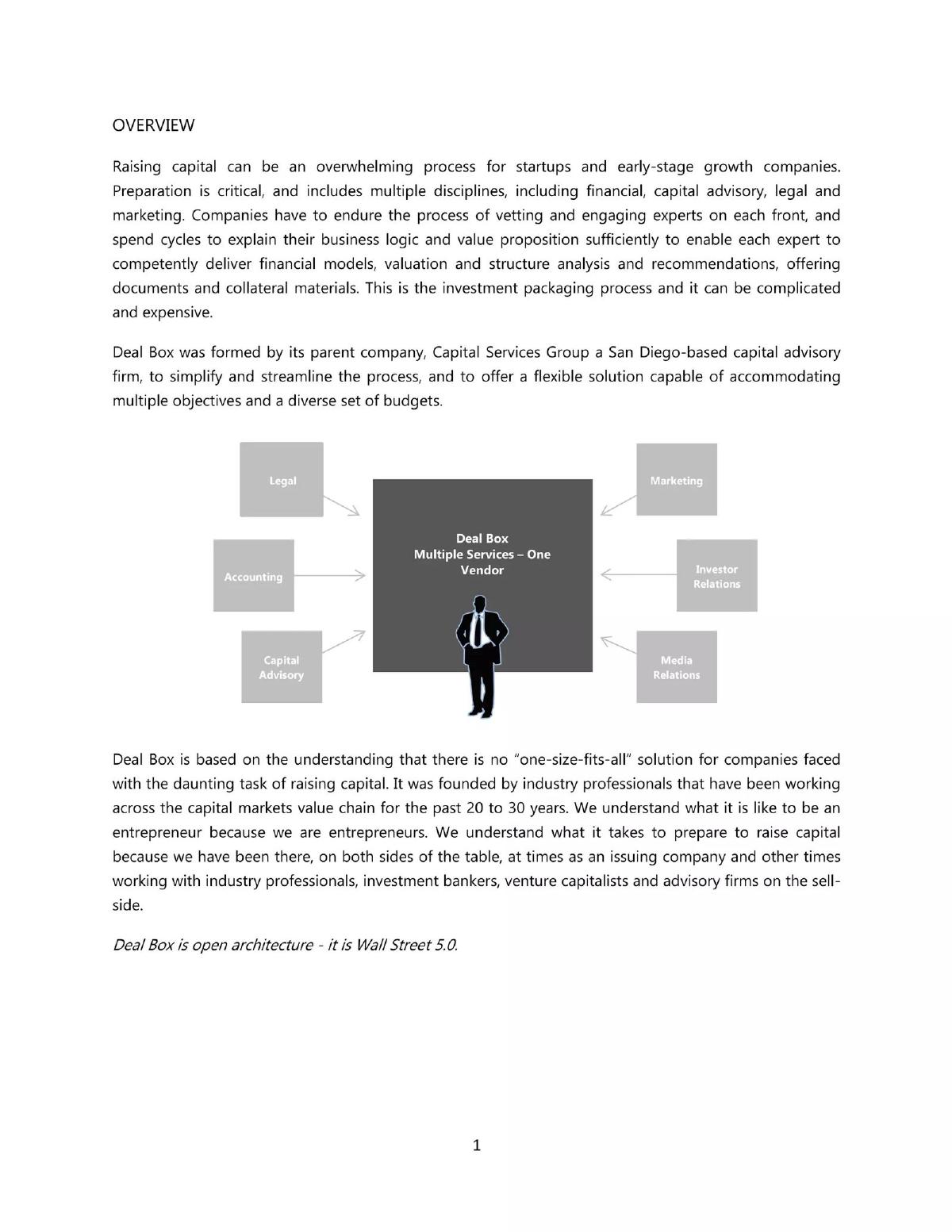
- Deal Box positions itself as a efficiency engine for companies conducting 506(c) offerings. According to slide 4, they consolidate legal, accounting, and marketing services into a single professional support team. This approach is claimed to reduce the total cost of an offering by approximately 37%, bringing the price down from a market average of $58,000 to $36,190.
- How does the company plan to use the $1.5 million investment?
- Slide 2 provides a specific breakdown of the use of proceeds. The largest allocation is $575,000 for working capital, followed by $500,000 for agency services. The remainder is split between marketing and sales ($250,000), business development ($150,000), and offering expenses ($25,000).
- What are the specific terms of the Series A Preferred Shares?
- The shares were offered at $1.00 per share. A key technical detail on slide 2 notes that the Series A Preferred initially converts 1:2 to Common Stock. This is an unusual term that effectively gives new shareholders a larger stake upon conversion than their initial share count suggests, resulting in a 25% post-conversion ownership for the new investors.
- Who are the key people behind Deal Box?
- The deck highlights two primary figures on slide 8. Robert J. Caruso, the Founder and Chairman, brings significant institutional experience from Select Equity Group and Highbridge Capital Management. Dr. Richard Swart is presented as a thought leader in the crowdfunding industry and a founding member of the Crowdfunding Professional Association (CfPA).
- What were the projected financials for the company?
- Slide 10 outlines a five-year growth plan. Starting with $880,000 in revenue and $110,000 in EBITDA for 2016, the company projected significant scaling. By 2020, they aimed for $8.54 million in revenue with a 35% EBITDA margin, resulting in $2.95 million in operating income.