Dayforward’s 2019 pitch deck is a masterclass in identifying structural industry failure and positioning a 'full-stack' solution as the only logical remedy. By highlighting that 1 in 17 children will lose a parent and that 20 million households are currently uninsured, the deck establishes a massive, underserved market. The core of their argument rests on the distinction between being a mere broker and a full-stack carrier; Dayforward claims that by holding the risk and owning the underwriting, they can solve the 'product confusion' and 'distribution mistrust' that plagues the 95% of policies…
Key takeaways
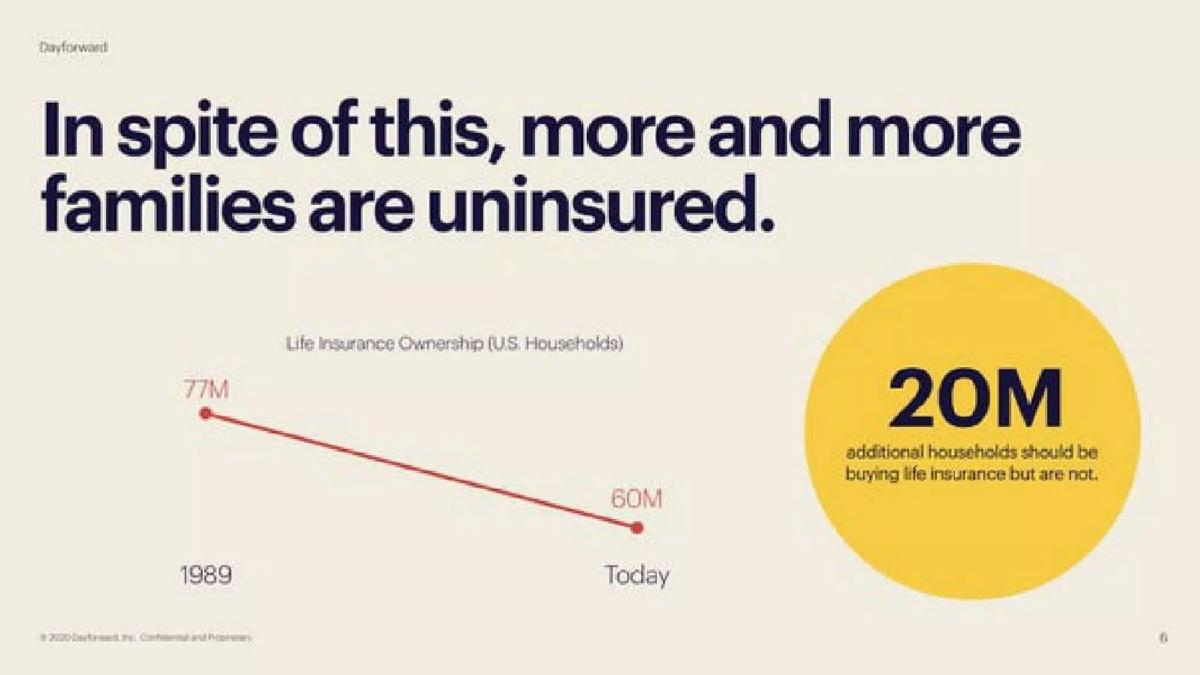
- The deck identifies a massive protection gap, noting that 20 million additional households should be buying life insurance but are not (Slide 6).
- Dayforward attacks the current market efficiency, stating that 85% of people try to buy online but less than 5% actually do (Slide 9).
- The company positions itself as a 'full-stack carrier' rather than a broker, allowing them to hold risk and generate 'superior economics' (Slide 15).
- A significant portion of the deck is dedicated to industry distrust, citing that 89% of people distrust commissioned brokers (Slide 12).
- The 'Dayforward Solve' focuses on proprietary underwriting driven by new data sources to enable 'near-frictionless buying' (Slide 17).
- The deck uses successful 'full-stack' precedents like Root (Auto) and Lemonade (Home) to frame the 'Life' category as the next logical IPO-scale opportunity (Slide 18).
- The team slide emphasizes a cross-disciplinary approach, featuring leaders from Apple, MassMutual, and Huge to cover tech, insurance, and marketing (Slide 21).
- Regulatory credibility is established through a Board of Directors that includes a former NYS Insurance Commissioner (Slide 22).
The Macro Narrative: Why Life Insurance is Broken
Dayforward begins its pitch not with a product, but with a somber social reality. The opening slides establish a high-stakes environment where financial security is a necessity, not a luxury. By framing the problem through the lens of family protection, they immediately elevate the business beyond a simple fintech utility.
Slides 1-5: The Emotional and Statistical Hook
The deck opens with a bold red title slide (Slide 2) and quickly moves to an image of a father and son (Slide 3) with the caption: "In these uncertain times, families need financial security." This sets an emotional tone that is immediately backed by a jarring statistic on Slide 5: "1 in 17 children will experience the loss of a parent." This is a classic 'fear, uncertainty, and doubt' (FUD) opening, designed to make the investor feel the urgency of the problem before any solution is presented.
Slides 6-8: The Market Gap
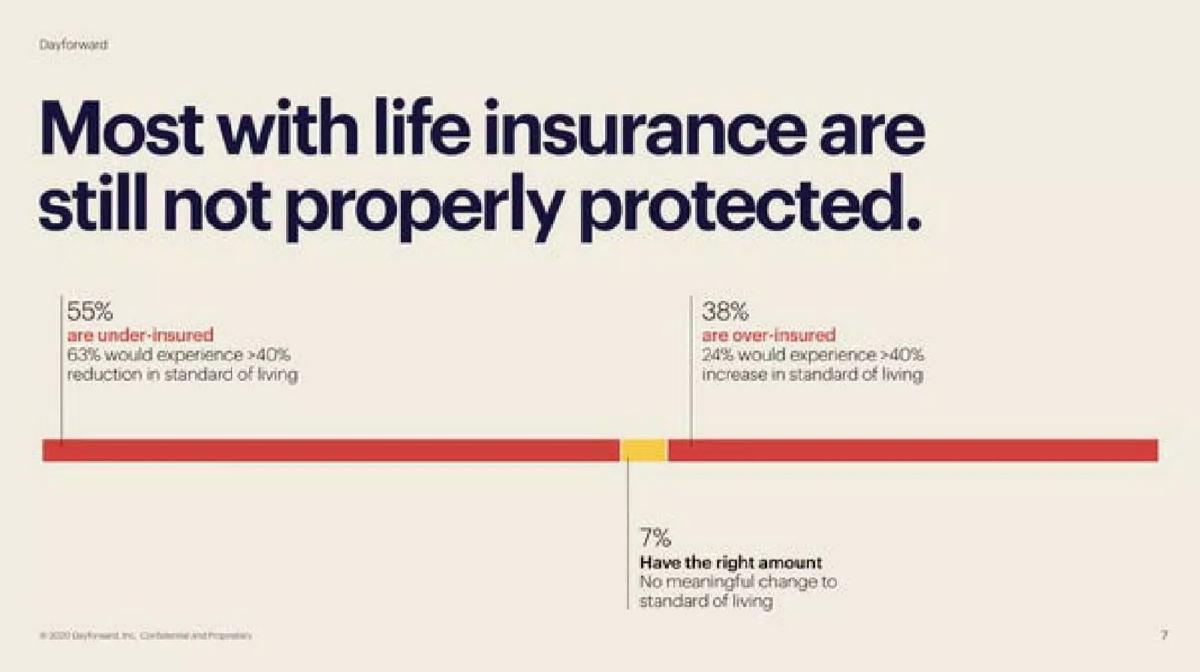
Slide 6 provides the quantitative 'Why Now.' It shows a decline in life insurance ownership from 77M households in 1989 to 60M today, noting that "20M additional households should be buying life insurance but are not." Slide 7 further segments the market, claiming that 55% of those who do have insurance are under-insured, while only 7% have the "right amount." This suggests that the existing market is not just shrinking, but also failing to serve its current customers correctly.
The Industry Failure: Why Digital Hasn't Won Yet
The second section of the deck focuses on the friction within the current system. Dayforward argues that the industry's failure to digitize is not due to a lack of consumer interest, but due to structural flaws in how insurance is sold and underwritten.
Slides 9-10: The 85/5 Problem
Slide 9 presents a compelling paradox: "Why is it that 85% try to buy online, but less than 5% do?" This slide is crucial because it proves there is massive demand for a digital solution that is currently being thwarted. Slide 10 attributes this to three reasons: Product confusion ("I don't understand the lingo"), Distribution mistrust ("Most insurance companies seem sketchy"), and Underwriting complexity ("The whole application process was very long and frustrating").
Slides 11-13: Traditional Carriers vs. InsurTech 1.0
On Slide 11, Dayforward takes a swipe at both incumbents and first-generation InsurTechs. They claim traditional carriers are held back by "Legacy technology" and a "Risk-adverse culture," while existing InsurTech startups are merely "Agents or brokers selling third-party products." This positioning is vital; it tells investors that Dayforward is not just another app on top of an old system, but a fundamental replacement of the system itself. Slide 12 hammers this home by stating that "95% of policies are sold through commissioned brokers, and 89% of people distrust them."
The Solution: The Full-Stack Carrier Model
Having established that the middleman (the broker) and the engine (the legacy carrier) are the problems, Dayforward introduces itself as the 'full-stack' alternative.
Slides 14-15: Enter Dayforward
Slide 14 introduces the company as "The first digital, direct-to-consumer life insurance company." The 'Which means...' slide (Slide 15) is the most important strategic slide in the deck. It explains that Dayforward is a "carrier that issues policies, holds risk, and generates superior economics." This is the 'moat'—by owning the entire stack, they claim they can innovate on the product, distribution, and underwriting simultaneously, rather than being beholden to a third-party carrier's rigid rules.
Slides 16-17: The 'Solve' and the Checklist
Slide 16 is a 'de-risking' slide. It shows a grid of complex requirements—Actuarial, Financial Structuring, Regulatory Approvals, Compliance—all marked with yellow checkmarks. The message is: "Building a carrier is complex, but we've done it." This is intended to show that the $20M investment isn't going toward figuring out how to be an insurance company, but toward launching one that is already built. Slide 17 summarizes the 'Solve,' promising "Proprietary underwriting, driven by new data sources" and "Compelling economics" with a better LTV (Lifetime Value) than conventional term life.
The Opportunity and the Team
The final section of the deck focuses on the scale of the opportunity and the pedigree of the people executing the plan.
Slide 18: The 'Next Big Thing' Comparison
Slide 18 uses a common pitch deck trope: the 'Category Comparison.' It shows Root (Auto) and Lemonade (Home) as successful full-stack carriers that are "Likely to IPO." It then leaves a blank box for Life Insurance , labeled "Our opportunity." This frames Dayforward as the inevitable winner of the final major insurance category to be disrupted by the full-stack model.
Slides 21-22: Pedigree and Governance
The team slide (Slide 21) is exceptionally strong, featuring leaders with experience at Apple, MassMutual, Huge, and AXA. This blend of high-end consumer tech/marketing and deep insurance expertise is exactly what a full-stack InsurTech needs. Slide 22, the Board of Directors, adds even more weight with a Former Global COO of ManuLife and a Former Superintendent of the NYS Department of Financial Services. Having a former head insurance commissioner on the board is a massive signal to investors that the company can handle the intense regulatory scrutiny of the insurance industry.
What Works in This Deck
The 'Full-Stack' Narrative: The deck does an excellent job of explaining why being a carrier is better than being a broker. It turns a regulatory burden into a competitive advantage. · The Trust Deficit: By citing that 89% of people distrust brokers, Dayforward makes a data-driven case for why a D2C model is the only way to win the modern consumer. · Regulatory Credibility: The board of directors slide is a powerhouse. In a highly regulated industry, showing that you have the 'regulators' on your side is a top-tier de-risking move. · The 85/5 Paradox: The statistic that 85% try to buy online but only 5% succeed is a perfect 'gap' slide that makes the market opportunity feel immediate and obvious.
What is Missing
The Ask: There is no slide stating how much money is being raised, the valuation, or the specific use of funds. · Product Specifics: While they mention "new, revolutionary products," they don't actually show what a policy looks like or how it differs from a standard $500k term life policy. · Financial Projections: For a 'Later' stage deck (as per the catalogue), the lack of a 3-5 year financial roadmap or unit economics (CAC/LTV) targets is a notable omission. · Roadmap: There is no mention of which states they are licensed in or the timeline for a national rollout.
What a Founder Should Copy
The 'Checklist' Slide: If you are building in a complex, regulated space, use a slide like Slide 16 to show that you have already cleared the 'boring' but difficult hurdles (compliance, legal, etc.). · The Category Comparison: Use Slide 18's format to show that your business model has already been proven in adjacent industries. It makes your 'unproven' startup feel like an 'inevitable' successor. · Problem-Solution Alignment: Notice how every 'Industry Issue' on Slide 12 is directly answered by a 'Dayforward Solution' on Slide 17. This symmetry makes the pitch feel logically sound and complete.
Frequently asked questions
- What is the primary problem Dayforward is solving?
- Dayforward identifies a massive 'under-insured' problem in the U.S., where 20 million households lack coverage despite a high statistical need. They argue that the current industry fails because it relies on confusing products, slow underwriting that takes months, and a distribution model based on commissioned brokers whom 89% of consumers distrust. They aim to replace this with a digital, direct-to-consumer experience.
- How does Dayforward differentiate itself from other InsurTech startups?
- According to Slide 11, most InsurTech startups are merely agents or brokers selling third-party products, which limits their innovation to the 'customer experience' layer. Dayforward differentiates by being a 'full-stack carrier.' This means they issue the policies, hold the risk, and own the underwriting process, which they claim leads to superior unit economics and the ability to create truly new products.
- What evidence of 'traction' or 'readiness' does the deck provide?
- The deck does not show revenue or user growth metrics. Instead, it demonstrates 'readiness' through a checklist on Slide 16, claiming they have already built the complex infrastructure required for a carrier, including actuarial, financial structuring, regulatory approvals, and compliance. This suggests the $20M raise was intended for launch or scaling rather than initial R&D.
- Who is the target audience for Dayforward's product?
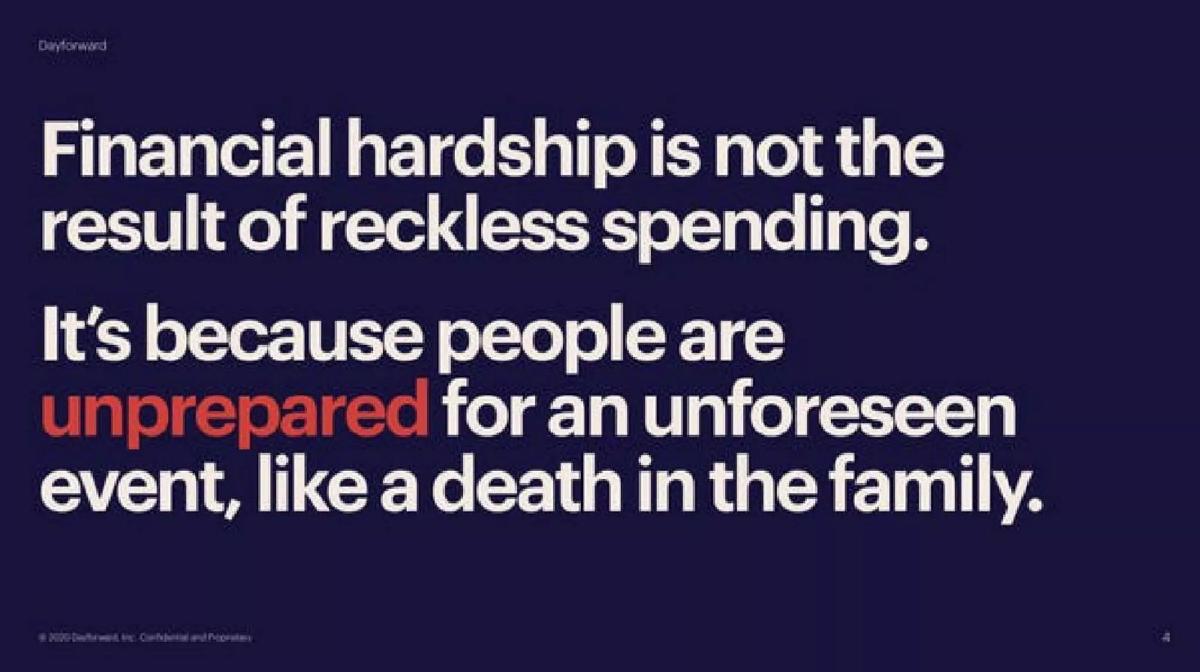
- The deck focuses heavily on families and the financial security of children. Slide 5 highlights that 1 in 17 children will experience the loss of a parent, and Slide 3 explicitly states that 'families need financial security.' The marketing imagery and problem statements suggest a focus on parents who are currently underserved by traditional, high-friction insurance sales processes.
- What is missing from this pitch deck?
- The deck is notably missing a specific 'Ask' slide detailing how much they are raising and how the funds will be used (though catalogue facts state $20M). It also lacks a detailed product demo, specific pricing examples, financial projections, and a clear roadmap of which states they plan to launch in first. It relies more on the 'macro opportunity' and 'team' than on granular business mechanics.