Datelytics presents a 12-slide pitch deck focused on solving the 'shallow' nature of modern dating apps by integrating third-party activities and events. The company identifies core problems such as spam bots, awkward dates, and superficiality, proposing a solution that uses a 'Facebook Analyzer' to match users based on interests and then suggests specific activities to attend together. The business model is purely commission-based, earning revenue from transactions made through the app. While the deck is visually simple and uses meme-style imagery to convey pain points, it lacks critical inv…
Key takeaways
- The company identifies three primary pain points in dating: spam bots/weirdos, awkward dates, and superficiality (Slides 3-5).
- The solution is an app that aggregates activities from third-party programs for singles to meet (Slide 6).
- Product functionality allows users to toggle between finding a specific date or finding an event to attend (Slide 8).
- The 'magic' behind the platform involves a Facebook Analyzer to determine user interests (Slide 9).
- Revenue is generated through commissions earned on transactions made within the app (Slide 11).
- The deck contains no mention of current traction, user numbers, or growth metrics.
- There is no competitive landscape slide to address how Datelytics differs from incumbents like Tinder or Meetup.
- The team slide introduces the CEO and COO but provides no bios, past experience, or credentials (Slide 12).
The Datelytics Pitch Deck: A Narrative-Heavy Approach to Dating
Datelytics enters the crowded dating app market with a specific thesis: the current experience is broken because it is superficial and leads to awkward real-world interactions. Their deck is structured as a narrative of pain and relief, using large-scale imagery and minimal text to drive home the emotional frustration of modern dating. However, as a fundraising tool, it leaves many quantitative questions unanswered.
Slide 1: Title Slide
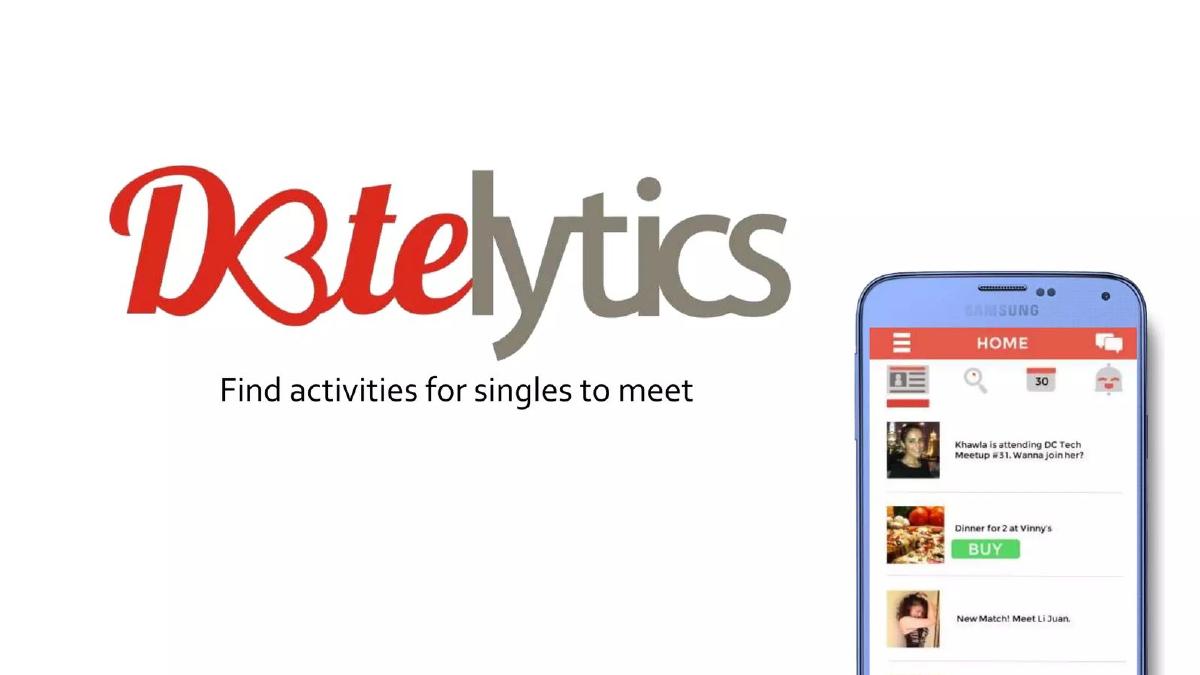
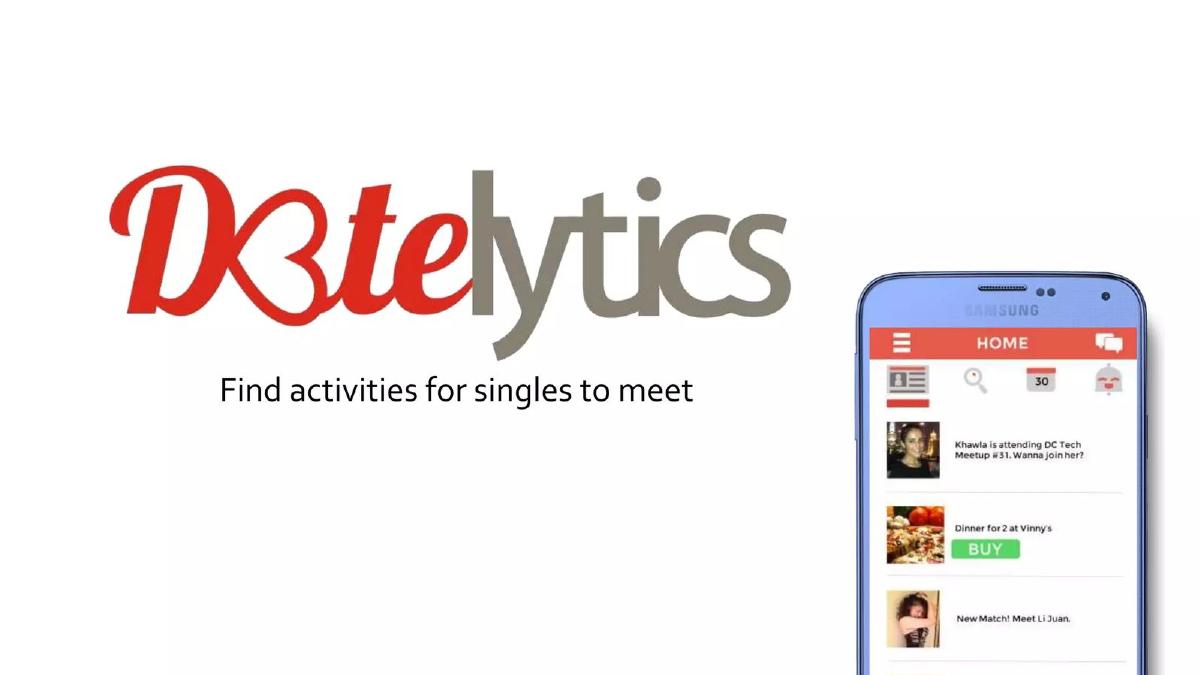
The deck opens with the Datelytics logo and the tagline: "Find activities for singles to meet." The visual includes a smartphone mockup showing a feed that includes a tech meetup, a dinner for two at a restaurant called 'Vinny's' with a 'BUY' button, and a new match notification. This immediately establishes the product's hybrid nature as both a dating tool and an event marketplace.
Slides 2-5: The Problem Statement
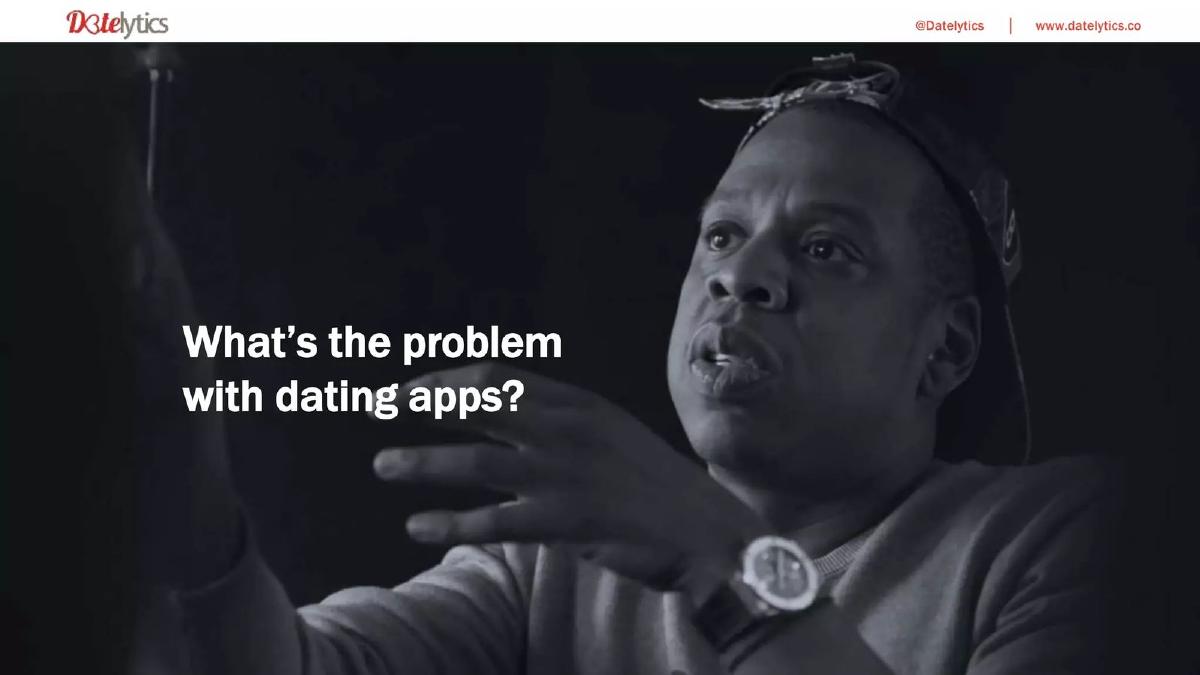
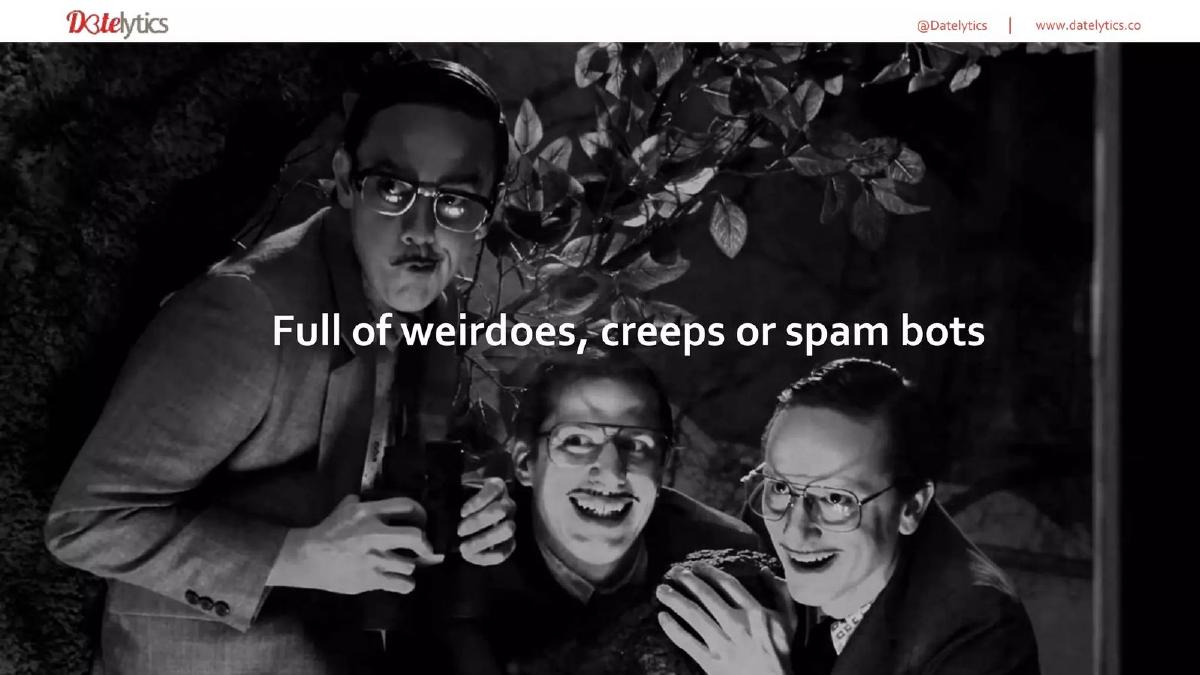
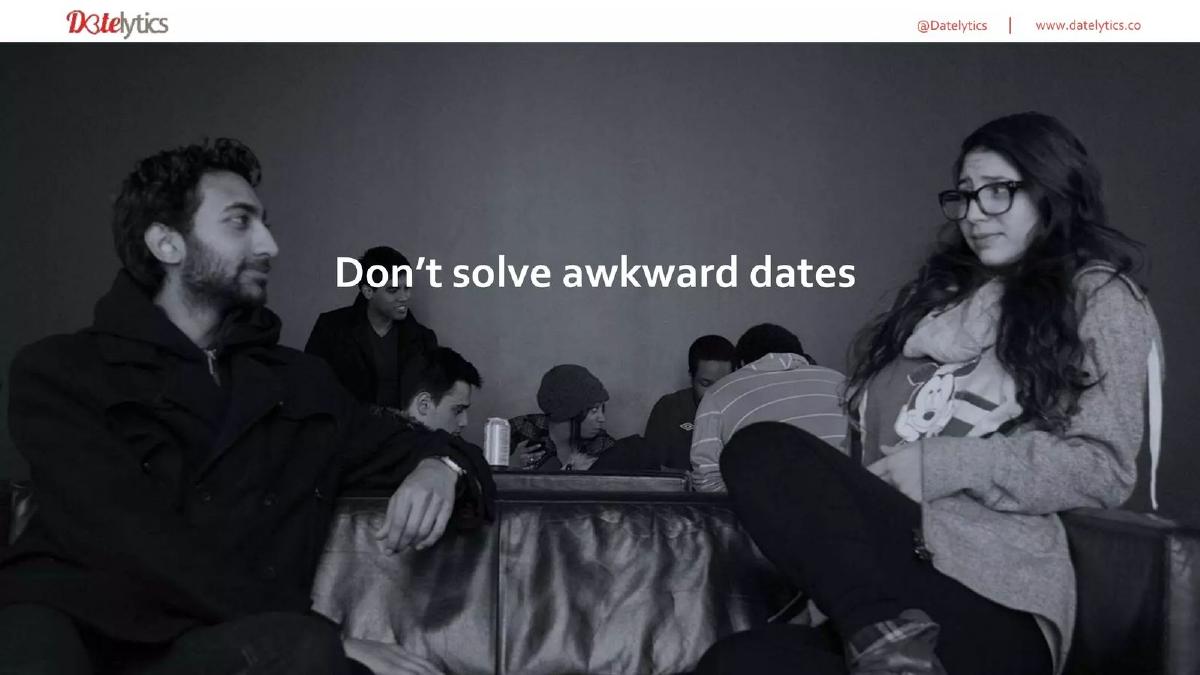
Datelytics uses a four-slide sequence to define the problem. Slide 2 asks, "What's the problem with dating apps?" overlaid on a black-and-white image of Jay-Z. Slide 3 claims apps are "Full of weirdoes, creeps or spam bots," using a comedic image of three men with binoculars. Slide 4 addresses the user experience, stating they "Don't solve awkward dates," while Slide 5 characterizes the entire industry as "Completely Shallow." This section is effective at identifying common grievances, but it lacks data or research to quantify the scale of these issues.
Slide 6: The Solution
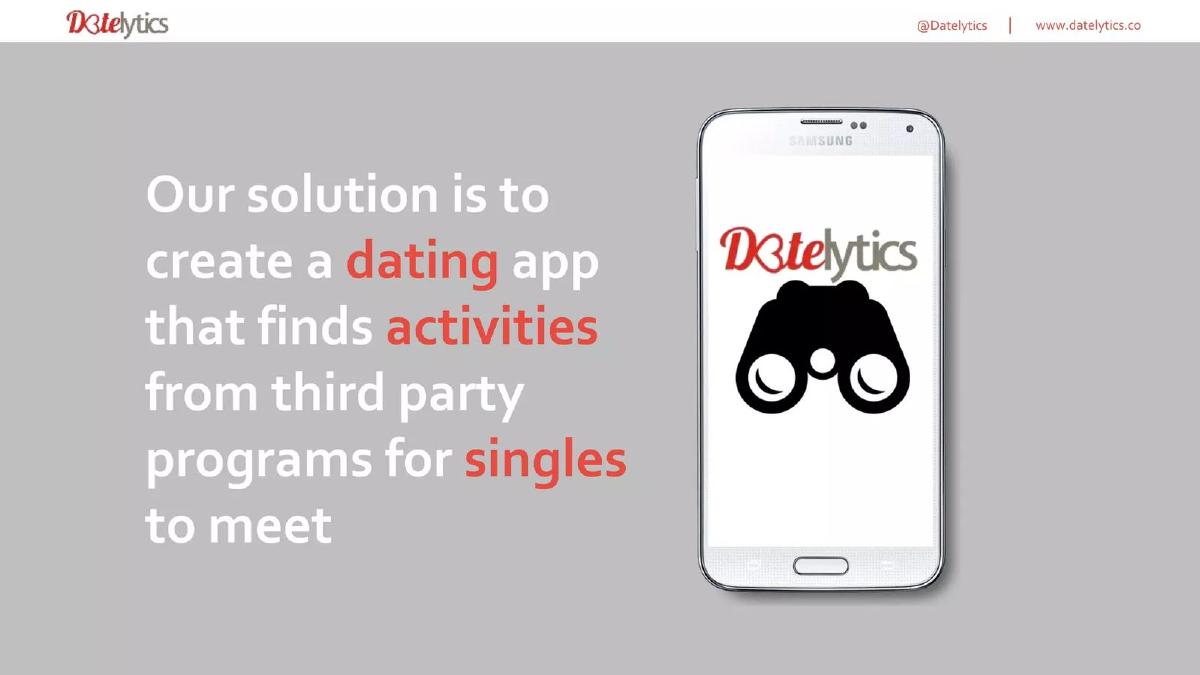
The solution is stated plainly: "Our solution is to create a dating app that finds activities from third party programs for singles to meet." The slide features a binocular icon, reinforcing the idea of 'finding' or 'scouting' opportunities rather than just passive swiping. It positions the company as an aggregator of third-party content.
Slides 7-8: Product Functionality
Slide 7 shows the dual-path nature of the app. Users can find "a date" (viewing individual profiles like 'Carla') or "an event" (viewing listings like 'Salsa lessons' or '2014 Year End Awards'). Slide 8 provides a three-step process for the 'magic' of the platform: 1) Facebook Analyzer, 2) Select a person or an event/daily deal, and 3) Find something to do with the new match. This confirms that the app relies on the Facebook API for interest-based matching.
Slide 9: Target Audience
Slide 9 features a group photo of diverse individuals with the caption: "We're here for single folks who enjoy their lives, but looking to share it with someone." This slide attempts to define the brand identity—social, active, and grounded—but it does not provide demographic data or a specific target persona (e.g., urban professionals aged 25-35).
Slide 10: Business Model
The monetization strategy is presented on Slide 10: "We will be paying our bills by every commission earned through our app." The background is a pile of hundred-dollar bills. While the revenue stream is clear (transactional commissions), the deck does not explain the expected take rate, the cost of customer acquisition (CAC), or the lifetime value (LTV) of a user.
Slide 11: The Team
The team slide introduces Brandon T. Luong (CEO) and Phaka Dludla (COO) . The photos are informal. Crucially, there is no text describing their backgrounds, previous startups, or technical skills. In a seed-stage pitch, the team's ability to execute is often the most important factor for investors, making this omission significant.
Slide 12: Conclusion
The deck ends with a "Thank You" slide, repeating the logo, Twitter handle (@Datelytics), and website (www.datelytics.co). There is no call to action or specific request for capital.
What Works in the Datelytics Deck
Clear Problem Identification: The deck does a good job of tapping into the emotional frustrations of dating app users. By focusing on 'awkwardness' and 'shallowness,' they create a clear 'enemy' for their solution to fight. · Simple UI Presentation: The mockups on Slides 1 and 7 clearly show how the product works. The 'BUY' button next to events immediately explains the transactional nature of the platform without needing a long explanation. · Focused Value Prop: The deck doesn't try to be everything to everyone. It is strictly about activity-based dating, which differentiates it from general-purpose apps like Tinder.
What is Missing from the Datelytics Deck
Market Size: There is no mention of the Total Addressable Market (TAM). Investors need to know if this is a billion-dollar opportunity or a niche hobbyist app. · Traction: The deck contains zero metrics. Even if the app is in pre-launch, data on waitlist signups, pilot partnerships with event venues, or user interview insights would provide much-needed validation. · Competitive Analysis: The dating space is incredibly crowded. Datelytics fails to mention how it will compete with incumbents who are also moving into 'experiences' (like Bumble's 'Bumble Bizz' or 'Bumble BFF' features). · Financial Ask: A pitch deck is a tool for a transaction. By omitting the amount of money they are looking to raise and what they plan to do with it, the founders miss the opportunity to set the stage for a deal. · Founder Credentials: The team slide is purely visual. Without knowing if the founders have experience in software development, marketing, or the hospitality industry, it is difficult for an investor to assess execution risk.
What Founders Should Copy
The 'Problem-Solution' Bridge: The transition from Slide 5 (Shallow) to Slide 6 (Activity-based solution) is a textbook example of how to frame a solution as the direct antidote to a specific pain point. · Visual Simplicity: The deck avoids 'wall of text' syndrome. It uses large fonts and clear headers, ensuring that even a quick skim allows the reader to understand the core concept. · Direct Revenue Model: Many early-stage apps are vague about how they will eventually make money. Datelytics is refreshingly honest about its commission-based model, even if it lacks the supporting unit economics.
Frequently asked questions
- What is the core value proposition of Datelytics?
- Datelytics aims to move dating away from 'shallow' swiping by focusing on shared activities. By integrating third-party events and using social media data to analyze interests, the app facilitates real-world meetings centered around specific plans, such as salsa lessons or tech meetups, rather than just digital conversation.
- How does Datelytics plan to make money?
- The business model is commission-based. According to slide 11, the company intends to 'pay their bills' by taking a cut of every transaction or booking made through the app. This suggests an affiliate or marketplace model where users buy tickets to events or dinners directly within the Datelytics interface.
- What technical components power the app?
- The deck highlights a 'Facebook Analyzer' as the primary technical driver. This tool is intended to scrape or analyze a user's social data to understand their interests, which then informs the selection of people or events the app recommends to the user.
- Who are the founders of Datelytics?
- The team consists of Brandon T. Luong, serving as CEO, and Phaka Dludla, serving as COO. The slides include photos of the founders—one featuring a Google Glass wearable—but do not list any prior professional achievements, education, or industry expertise.
- What is missing from the Datelytics pitch deck?
- The deck is missing several standard venture components: a market size analysis (TAM), a competitive matrix, a financial forecast, and a clear funding ask. It also lacks a 'Why Now' slide and any evidence of traction, such as beta user feedback or partnership agreements with event providers.