DataCulture’s 11-slide deck is a masterclass in brevity, focusing almost entirely on high-level financial performance and proof of concept. The company positions itself as an applied AI solution for the supply chain, claiming a $2M ARR (estimated for 2016) with impressive 89% margins. The narrative relies heavily on a comparative case study between a traditional human-led approach at HP and DataCulture’s automated platform at Askme.com, showing a 15x improvement in preventing returns. While the deck lacks a formal 'Ask' slide, market size breakdown, or detailed product roadmap, it leverages t…
Key takeaways
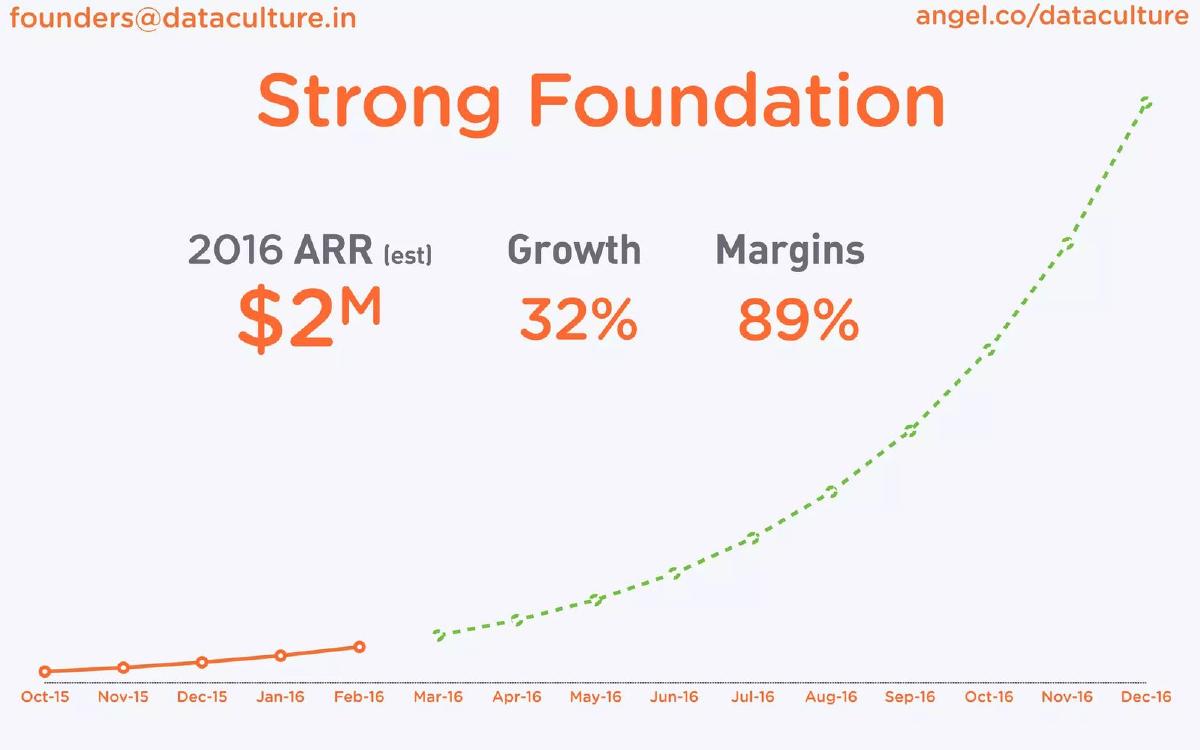
- The company reported an estimated 2016 ARR of $2M with a growth rate of 32% on slide 2.
- DataCulture claims exceptionally high software margins of 89% as shown on slide 2.
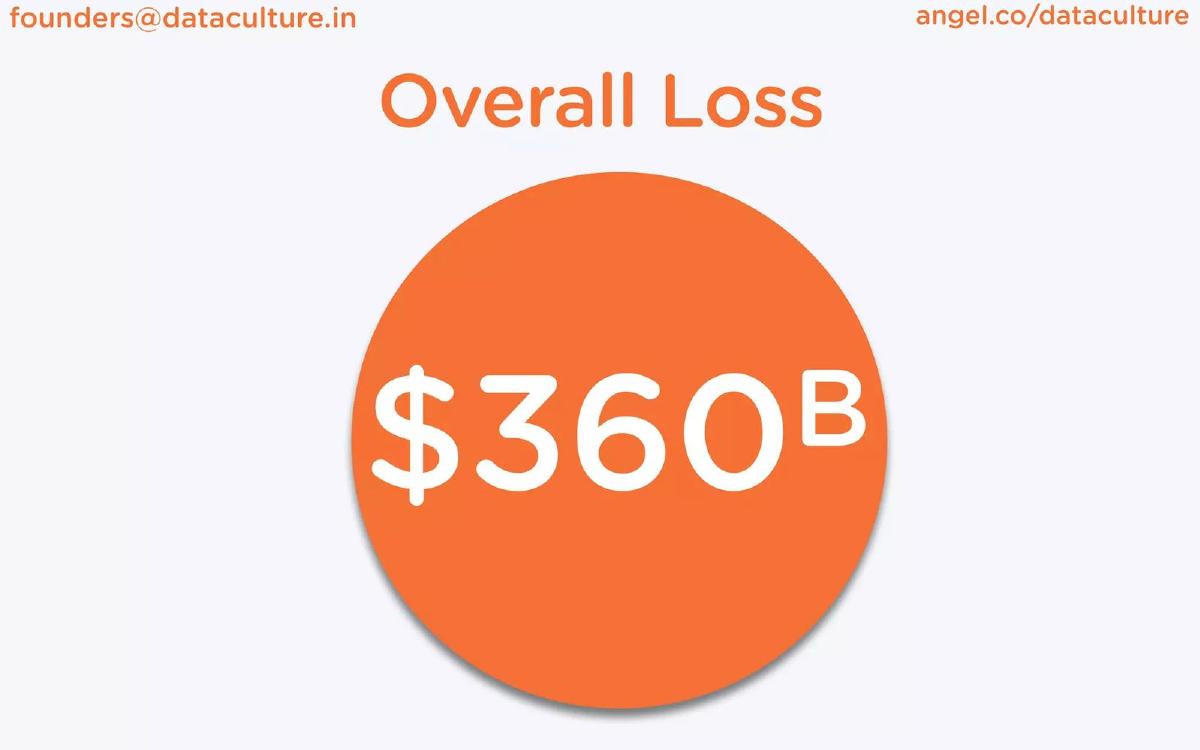
- The deck identifies a massive $360B 'Overall Loss' in the industry on slide 3, though it does not specify the source or exact segment.
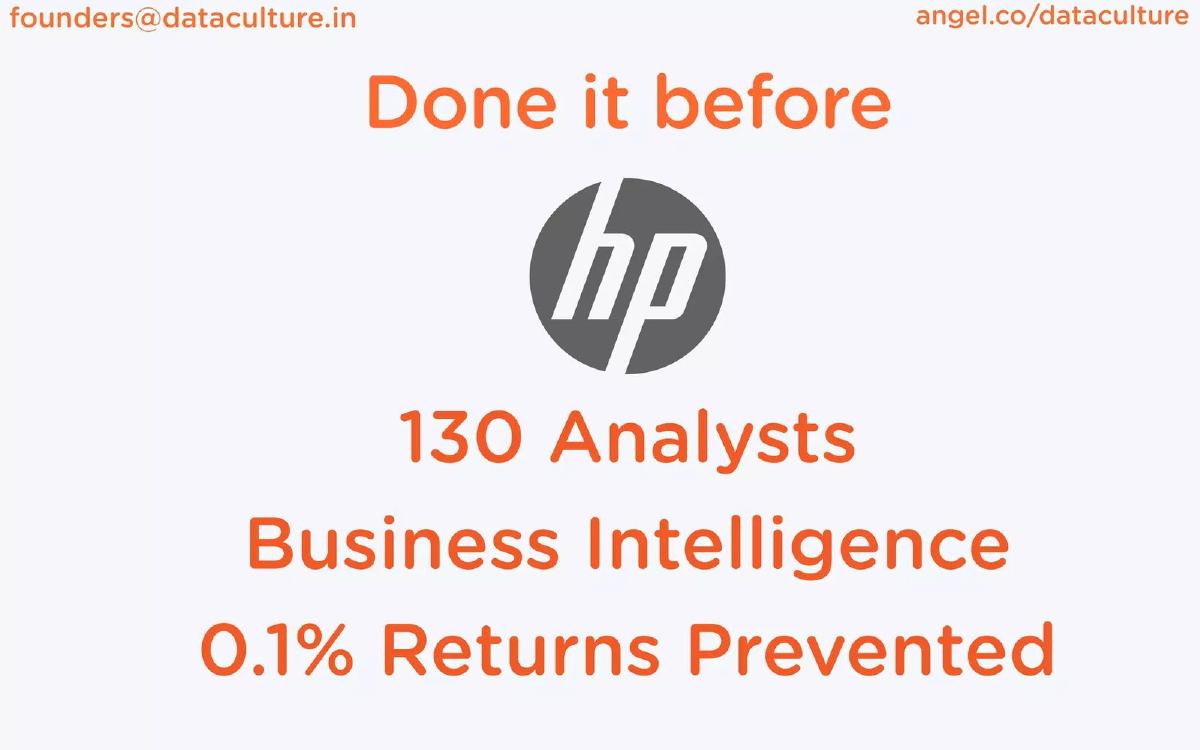
- A direct comparison on slides 4 and 5 shows DataCulture's AI prevented 16% of returns compared to 0.1% prevented by 130 analysts at HP.
- The platform claims to offer 'Instant ROI' and 'No Human Cost' on slides 7 and 8.
- The solution slide (slide 9) indicates a cost or value of $60 per transaction.
- The founding team features experience from Delphi, HP, Merck, and Baxter as shown on slide 10.
- The deck omits a specific funding request, use of funds, or detailed competitor analysis.
Executive Summary: The Lean Traction Deck
DataCulture’s pitch deck is a focused, 11-slide presentation that prioritizes financial metrics and proof of concept over technical jargon. Operating in the applied AI space for supply chain management, the company uses this deck to showcase a business that is already generating significant revenue ($2M ARR) with high efficiency (89% margins). The narrative structure is simple: define a massive loss, show how humans fail to solve it, and demonstrate how DataCulture’s AI succeeds with zero human cost.
Slide 1: Title and Positioning
The cover slide establishes the brand identity immediately. The company name, DataCulture , is paired with the tagline "Applied Artificial Intelligence for Supply Chain." The background image of a warehouse reinforces the physical industry they serve, while the contact information (email and AngelList profile) is clearly visible in the header. This slide sets a professional, industry-specific tone.
Slide 2: The Strong Foundation
DataCulture leads with its strongest suit: traction. Slide 2, titled "Strong Foundation," presents three key metrics: 2016 ARR (est) of $2M , Growth of 32% , and Margins of 89% . A dotted green line graph indicates an upward trajectory from October 2015 through December 2016. By putting these numbers upfront, the founders are signaling that this is not a pre-revenue science project, but a scaling business.
Slide 3: The $360B Problem
Slide 3 uses a minimalist approach to define the market opportunity. A large orange circle contains the figure "$360B" under the heading "Overall Loss." While the slide lacks a citation for this figure, in the context of supply chain management, this typically refers to the global cost of returns, shrinkage, or logistics inefficiencies. The simplicity of the slide is intended to create a 'shock' factor regarding the scale of the problem.
Slides 4-6: The Comparative Case Study
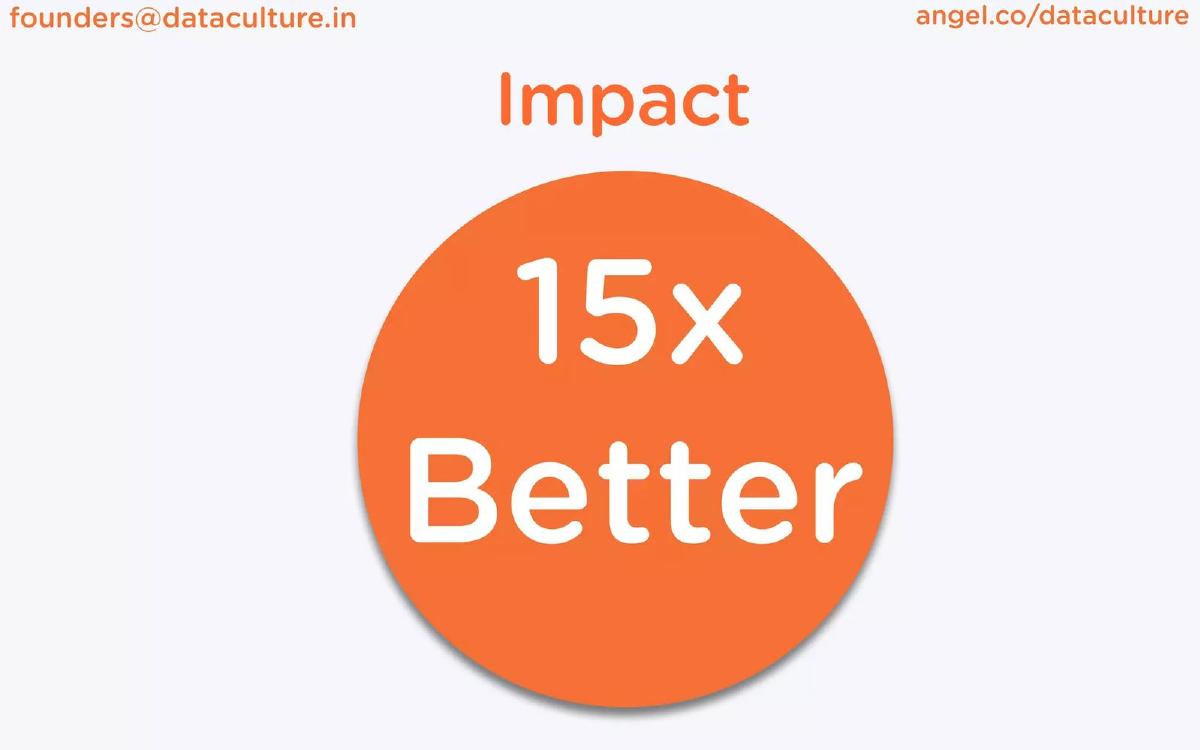
This section is the heart of the deck's logical argument. Slide 4, "Done it before," shows the HP logo and notes that 130 Analysts using traditional Business Intelligence only prevented 0.1% of returns . Slide 5, "Clear Proof," introduces the client Askme.com, stating that DataCulture’s A.I. Platform prevented 16% of returns with ZERO Resources (meaning no human analysts required). Slide 6 summarizes this as "15x Better." This is a powerful 'Before vs. After' or 'Human vs. Machine' comparison that justifies the AI's value proposition.
Slides 7-8: The Impact of Automation
These two slides reinforce the benefits of the platform using the same visual language as the problem slide. Slide 7 claims "NO Human Cost," emphasizing the automation aspect, while Slide 8 promises "Instant ROI." These are bold claims that appeal directly to the bottom-line concerns of supply chain executives, though the deck does not provide the specific data to back up the 'instant' nature of the ROI here.
Slide 9: The Solution Mechanism
Slide 9 provides a high-level look at how the software works. It uses icons representing shopping carts, currency exchange, and emails to show a flow from "Pattern" recognition to "Prevent." A crucial figure appears at the bottom: "$60 / Transaction." This suggests either the cost of the problem being solved per instance or the value captured by the DataCulture platform for every transaction it processes.
Slide 10: The Team
The team slide features CEO Karthik Sridhar and COO Gurudatt Bhobe . Rather than long biographies, the slide uses a 'logo wall' of previous employers to establish credibility. The logos include Delphi, Corporate Executive Board, HP, Merck, and Baxter . This indicates the founders have experience in both the technology side (HP) and the heavy industrial/pharmaceutical supply chain side (Delphi, Merck, Baxter).
Slide 11: The Conclusion
The final slide serves as a summary and a call to action. It restates the core metrics from slide 2— $2M ARR, 32% Growth, 89% Margins —and repeats the tagline "A.I. to Optimize Supply Chain Costs." Contact information is again displayed prominently, ensuring that the primary takeaway for an investor is the company's financial health and its specific niche.
What DataCulture Does Well
The deck is exceptionally disciplined. It avoids the common pitfall of explaining how the AI works (neural networks, data lakes, etc.) and focuses entirely on what it does for the customer's P&L. By comparing their results to a massive incumbent like HP, they provide a relative benchmark that makes their 16% return prevention figure feel significant. The use of 89% margins is a strong signal to SaaS investors that this is a scalable software play, not a tech-enabled service business.
What is Missing from the Deck
The Ask: There is no slide detailing how much money is being raised or what the valuation expectations are. · Use of Funds: Investors cannot see if the capital will go toward engineering, sales, or geographic expansion. · Market Analysis: While the $360B figure is large, there is no breakdown of the Total Addressable Market (TAM) or Serviceable Obtainable Market (SOM). · Competition: The deck assumes a vacuum. It does not mention other AI supply chain startups or how they differ from legacy ERP modules. · Product Screenshots: For a platform claiming 'Zero Resources,' seeing the dashboard or the integration points would add a layer of tangible proof.
Founder Takeaways: Copy the Clarity
Founders should emulate DataCulture’s use of bold, singular metrics . If you have revenue and high margins, they should be the first thing an investor sees, not the last. The comparative case study (Slide 4 vs. Slide 5) is also a highly effective way to demonstrate product-market fit without needing a 20-slide technical manual. Finally, the consistent visual branding—using a single accent color and clean typography—makes the deck feel like a cohesive product rather than a collection of disparate ideas.
Frequently asked questions
- What is DataCulture's primary value proposition?
- DataCulture positions itself as an applied AI platform that optimizes supply chain costs by preventing returns and inefficiencies. According to slide 5, their AI platform prevented 16% of returns for a client (Askme.com) with 'ZERO Resources,' contrasting this with traditional business intelligence teams that require significant headcount for lower returns.
- How much revenue was DataCulture generating at the time of this deck?
- Slide 2 states an estimated 2016 Annual Recurring Revenue (ARR) of $2M. The slide also notes a 32% growth rate and 89% margins, suggesting a highly efficient SaaS-style business model applied to the supply chain sector.
- Who are the founders and what is their background?
- The team consists of Karthik Sridhar (CEO) and Gurudatt Bhobe (COO). Slide 10 highlights their professional pedigree with logos from major industrial and tech firms including Delphi, HP, Merck, and Baxter, suggesting deep domain expertise in logistics and corporate operations.
- What specific problem does the deck address?
- The deck focuses on the financial loss associated with supply chain inefficiencies, cited as a $360B problem on slide 3. Specifically, it targets the 'returns' process, illustrating how their AI can identify patterns to prevent costly transactions, valued at $60 per transaction on slide 9.
- Is there a clear investment ask in the deck?
- No. The 11-slide deck concludes with a 'Thank You' slide that restates their ARR and margins but does not include a specific dollar amount being raised, the valuation, or how the capital will be deployed. This is common in 'teaser' decks used to initiate conversations.