Beveragewala is an Indian e-commerce startup launched in August 2014, focusing on the 'e-tailing' of premium teas and coffees. The deck outlines a transition from a niche provider with 95 brands and 1,300 SKUs to a broader beverage platform including juices, health drinks, and equipment. The company relies on a high-variety strategy to compete with offline retailers and generalist e-commerce giants like Amazon. While the deck provides aggressive seven-year projections—forecasting a rise in average cart size from 622 to 3,250—it lacks specific details on current revenue, customer acquisition c…
Key takeaways
- The startup launched in August 2014 and reported an average of 10,000 monthly visitors at the time of the deck (Slide 3).
- Beveragewala manages a catalog of over 95 brands and 1,300 SKUs, primarily focused on tea and coffee (Slide 3).
- The company identifies offline stores like Big Bazaar as competitors, claiming a variety advantage of 90+ brands versus the typical 10 found in physical retail (Slide 9).
- Future revenue streams include private labels, digital advertisements, tea tasting events, and catering (Slide 7).
- Seven-year projections estimate a growth in visitors from 1.9 million in Year 1 to 10.6 million in Year 7 (Slide 11).
- The conversion rate is projected to double from a current 7% to 15% by Year 4 (Slide 11).
- Market data cites a projected growth of the Indian retail market to USD 1,440 billion by 2021, with e-tailing reaching USD 76 billion (Slide 13).
- The team is lean, consisting of two directors and two employees, with one director focused on marketing and the other on IT (Slide 3).
Executive Summary: The Niche E-commerce Play
Beveragewala’s investment deck presents a specialized approach to the Indian e-commerce market, focusing exclusively on the beverage vertical. Launched in 2014, the company attempts to carve out a space between massive generalist platforms like Amazon and traditional brick-and-mortar grocery stores. The deck relies heavily on the 'long tail' theory—offering a depth of inventory (1,300 SKUs) that physical stores cannot justify stocking. While the market opportunity for Indian e-tailing is well-documented in the deck, the presentation functions more as a business plan summary than a high-pressure investment vehicle.
Slide 1: Title Slide
The deck opens with a simple title: 'Beverages E-tailing: Opportunity for Investment.' It features generic imagery of various teas and coffees. The footer contains a confidentiality notice and the branding for 'libgem,' which appears to be the advisory or parent entity. The slide establishes the sector immediately but lacks a compelling hook or a unique brand identity for Beveragewala itself.
Slide 3: Company Overview
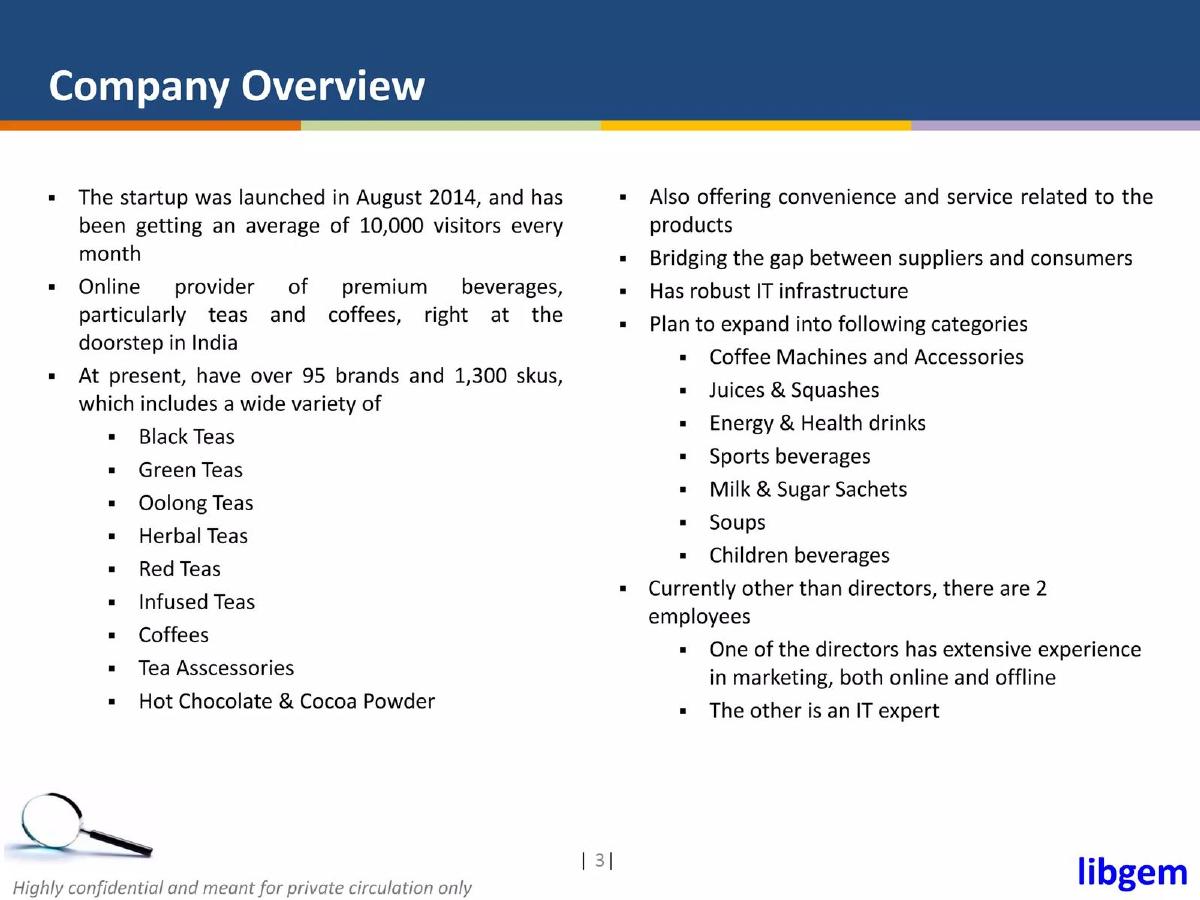
This slide provides the most concrete data regarding the startup's status at the time of the pitch. It states the launch date as August 2014 and claims an average of 10,000 monthly visitors. The inventory depth is highlighted as a key asset: 95 brands and 1,300 SKUs. The slide also lists current categories (Black, Green, Oolong, Herbal, Red, and Infused Teas, plus Coffees and Accessories) and future expansion plans into juices, energy drinks, and soups. The team description is minimal, noting only two directors and two employees, which indicates a very early-stage, lean operation.
Slide 5: Broad Product Category
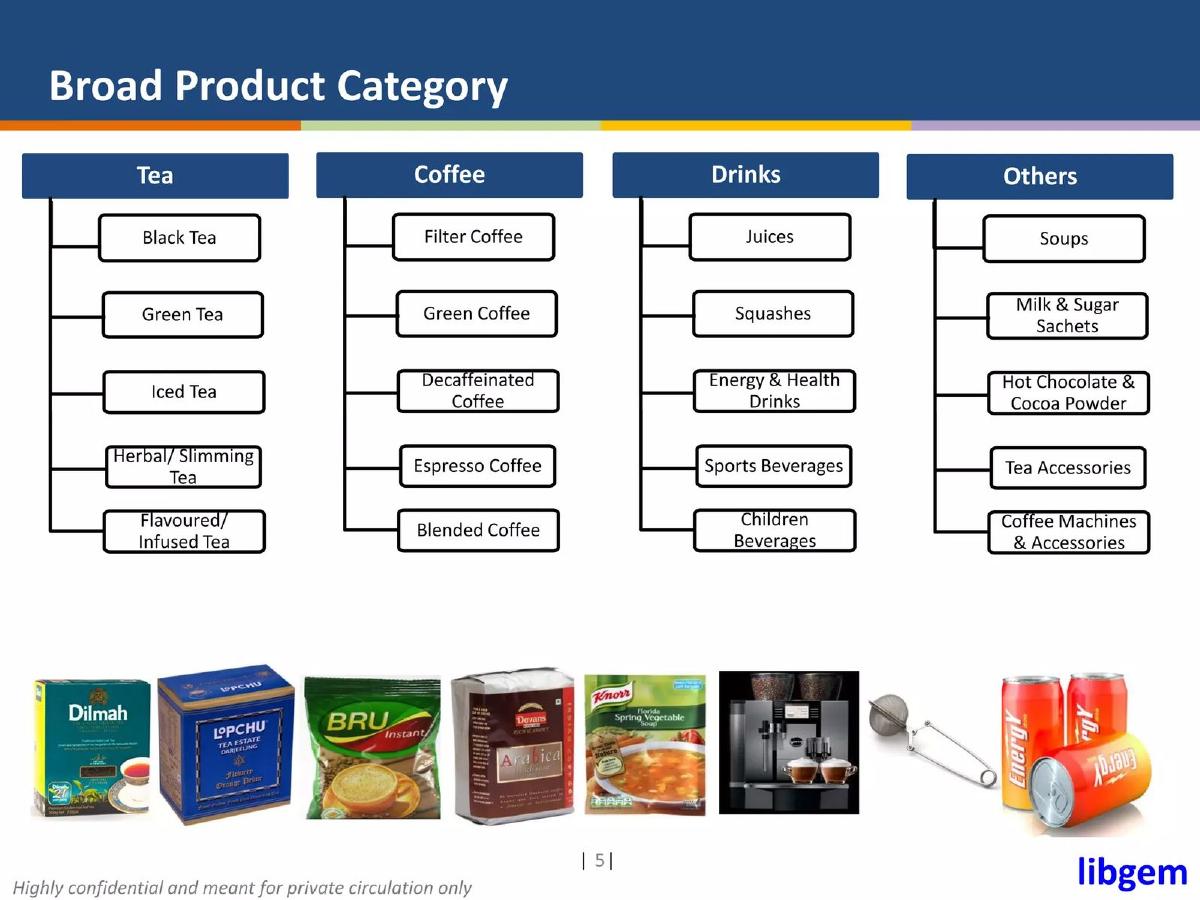
Slide 5 uses a hierarchy chart to visualize the product breadth. It categorizes the offerings into Tea, Coffee, Drinks, and Others. The 'Others' category is particularly broad, including everything from soup and milk sachets to coffee machines. The inclusion of product photography at the bottom (Dilmah, Bru, Knorr, etc.) reinforces that they are a multi-brand retailer rather than a direct-to-consumer (DTC) brand. This slide effectively communicates the 'one-stop-shop' ambition for beverages.
Slide 7: Additional Revenue
To move beyond simple retail margins, Beveragewala identifies four secondary revenue streams. Digital advertisements and sampling for brands on the website represent a high-margin media play. Tea tasting events and catering suggest an O2O (Online-to-Offline) strategy to build brand loyalty. Most importantly, the slide mentions 'Private label' as a source of better margins, though it does not provide a timeline or specific product focus for these labels.
Slide 9: Competitor Analysis
The competitive landscape is broken down into three tiers. Against offline stores, Beveragewala claims a variety advantage (90 brands vs. 10). Against online private labels, they claim a selection advantage. The most revealing section is the 'Online Market' analysis, where they admit Amazon has 504 teas and 70 coffees. Beveragewala’s counter-strategy is 'focus' and 'education,' suggesting they intend to win through curation and content rather than sheer volume, though their own SKU count (1,300) actually exceeds the Amazon figures they cited.
Slide 11: Projection
This slide presents a seven-year financial forecast using a bar chart for Visitors, Orders, and Units, and a table for Conversion Rate and Average Cart Size. The growth is modeled as linear and aggressive. The conversion rate is expected to jump from 7% to 15%, which is exceptionally high for e-commerce. Furthermore, the 'Average Cart Size' is projected to grow from 622 to 3,250. Without an explanation of whether these figures are in Rupees or another currency, or how they plan to quintuple the cart value, these projections remain speculative.
Slide 13: E-tailing in India
The final analyzed slide provides macro-market context. It uses Technopak Analysis to show the Indian retail market growing from USD 490 billion in 2012 to USD 1,440 billion by 2021. The slide also lists 'Top e-commerce investments in India in 2014,' citing rounds for Urbanladder ($21M), Pepperfry ($15M), and Bigbasket ($33M). This is a classic 'social proof by association' tactic, intended to show that the Indian e-commerce sector is attracting significant venture capital, even if the companies listed are in different verticals.
What Beveragewala Does Well
The deck is successful in defining a clear, narrow niche. By calling themselves an 'e-tailer' for beverages, they avoid the trap of trying to sound like a generalist grocery store. The inventory metrics (1,300 SKUs) provide a tangible sense of the business's scale and the logistical effort already invested. The identification of private labels as a margin-expansion strategy shows that the founders understand the limitations of pure third-party retail. The layout is clean and follows a logical progression from the current state to the market opportunity and future projections.
What is Missing from the Deck
The most glaring omission is a clear 'Ask' slide. There is no mention of how much money is being raised, the valuation, or the specific milestones the funding will enable. The 'Team' slide is also insufficient; investors back people, and simply stating 'one is an IT expert' does not build the necessary credibility. There is no data on customer acquisition cost (CAC), churn, or lifetime value (LTV), which are the lifeblood metrics of any e-commerce teardown. Finally, the deck lacks a 'Problem' slide—it assumes that the lack of beverage variety in physical stores is a painful enough problem to drive millions of customers online, but it doesn't prove it with consumer behavior data.
Founder's Takeaway: What to Copy and What to Avoid
Copy the vertical focus: Beveragewala does a great job of owning a specific category. If you are building a marketplace, showing that you have more depth than Amazon in a specific niche is a strong starting point. Avoid the vague team slide: Never list your team as '2 employees.' Even in the early stages, highlight the specific pedigree, past successes, and unique skills of the founders. Avoid unexplained projections: If your cart size is projected to grow by 500%, you must explain the mechanism—are you moving into high-end hardware, B2B bulk sales, or subscription models? Without the 'how,' the 'what' in your projections will be dismissed by savvy investors.
Frequently asked questions
- What is Beveragewala's primary value proposition?
- Beveragewala positions itself as a specialist 'e-tailer' bridging the gap between premium beverage suppliers and consumers in India. According to Slide 3, their core value lies in offering a massive variety—1,300 SKUs across 95 brands—that physical retailers cannot match. They emphasize convenience through doorstep delivery and a 'robust IT infrastructure' to manage a complex catalog of teas, coffees, and accessories.
- How does the company plan to diversify its revenue?
- Beyond direct sales, Slide 7 outlines four additional revenue pillars: digital advertising for brands on their website, tea tasting events in various cities, the launch of private labels for better margins, and B2B services like tea catering and corporate gifting. This suggests a move toward becoming a full-service beverage platform rather than just a retail storefront.
- Who are the main competitors identified in the deck?
- Slide 9 categorizes competition into three groups: offline stores (e.g., Big Bazaar), online private labels (e.g., Udyan Tea, Tea Trunk), and general online marketplaces. Interestingly, they note that while Amazon has a larger tea selection (504 teas), Beveragewala aims to win through 'better understanding of the domain' and providing more comprehensive consumer education.
- What are the projected growth metrics for the business?
- The projections on Slide 11 are aggressive. The company expects to grow from 1.9 million visitors in Year 1 to 10.6 million by Year 7. More notably, they project the average cart size to increase from 622 to 3,250 over the same period, while maintaining a 15% conversion rate from Year 4 onwards. These figures suggest a significant shift toward higher-value items or bulk purchasing.
- What critical information is missing from this pitch deck?
- The deck lacks several standard fundraising components. There is no specific 'Ask' slide detailing how much capital is being raised or how it will be used. Additionally, there are no historical financial statements, no breakdown of unit economics (like CAC or LTV), and the 'Team' section is vague, mentioning only two employees without names or specific bios for the directors.