Bev rage presents a hardware-centric solution for the outdoor beverage market, specifically targeting tailgaters and campers. The deck outlines a Multi Beverage Dispensing Chiller (MBDC) designed to eliminate the thermal inefficiency of opening cooler lids and the mess of individual bottles. With a total addressable market cited at 275 million enthusiasts, the company projects over $82 million in revenue over five years. The founders, led by a CEO with 28 years of government contracting experience, are seeking a two-stage funding round: $50,000 in seed capital for prototyping and $3.15 millio…
Key takeaways
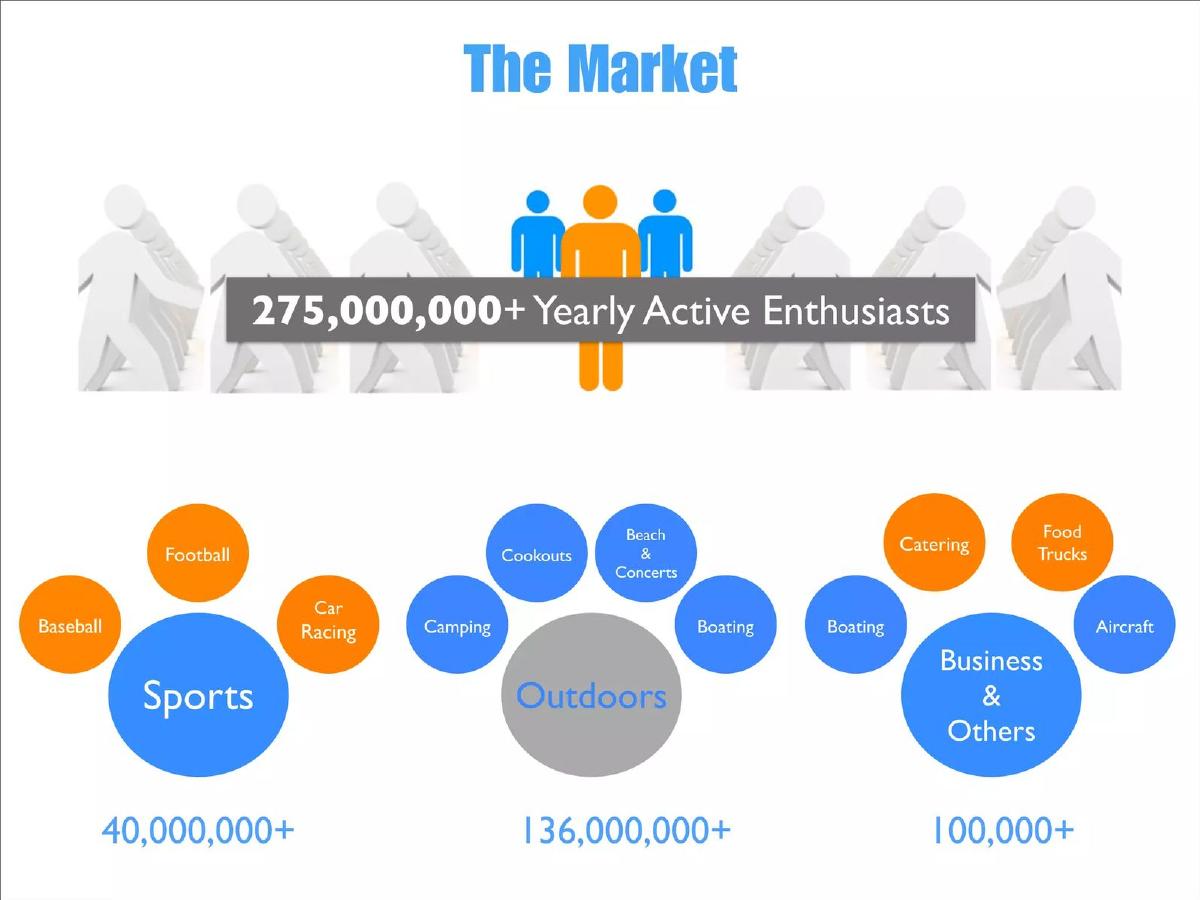
- The company identifies a total market of 275,000,000+ yearly active enthusiasts across sports, outdoors, and business sectors (Slide 2).
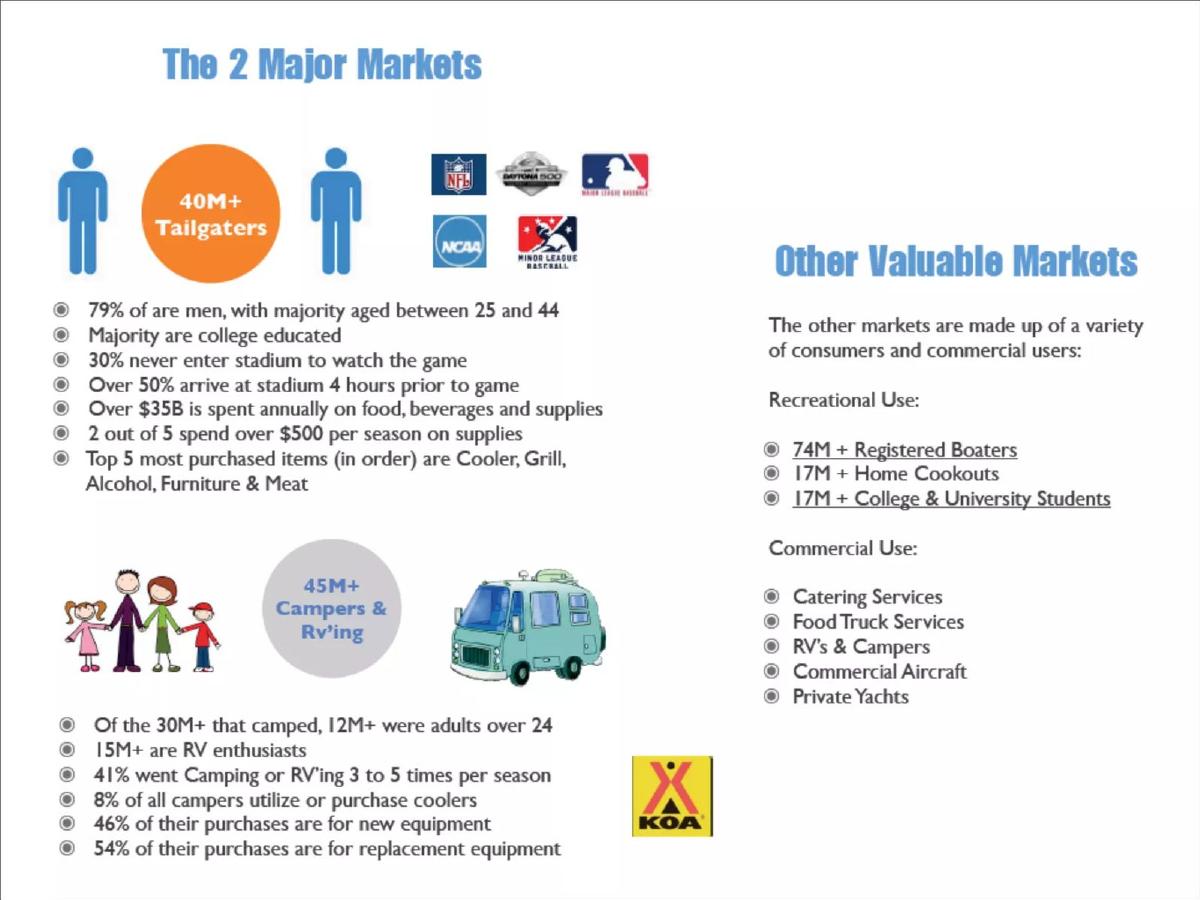
- Bev rage targets 40M+ tailgaters, noting that 30% never enter the stadium and over $35B is spent annually on food and supplies (Slide 3).
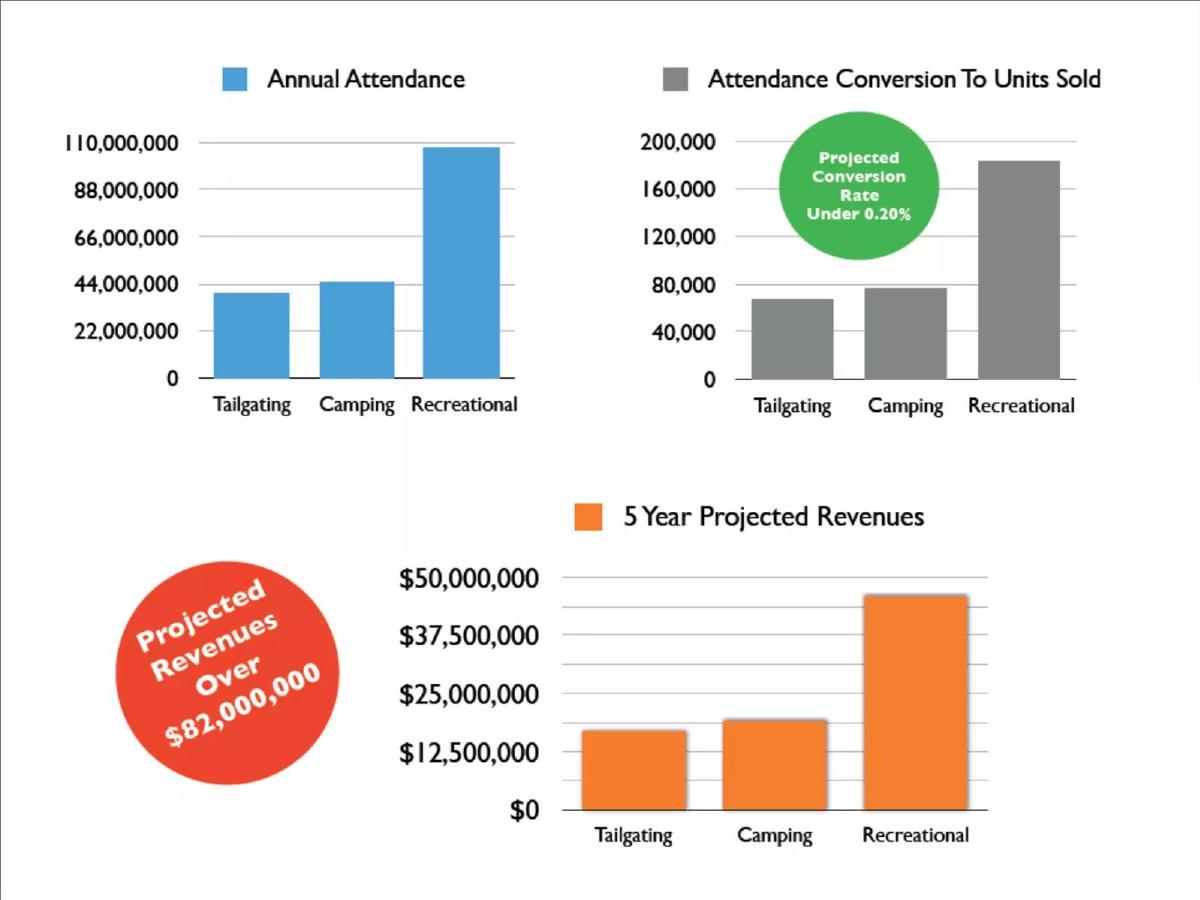
- Financial projections estimate revenues exceeding $82,000,000 over a five-year period (Slide 4).
- The product, the Multi Beverage Dispensing Chiller (MBDC), features a multi-button nozzle to dispense drinks without opening the lid (Slide 6).
- The team includes a CEO with 28 years of Federal Government service and a Head of Product Development with 10+ utility patents (Slides 10-11).
- Marketing strategy focuses on a mix of digital channels and high-profile blog outreach like TechCrunch and Mashable (Slide 14).
- The funding ask is split into a $50,000 seed round for prototypes and a $3.15M Round I for team building and inventory (Slide 17).
- Founders have invested over $80,000 of their own capital as 'skin in the game' (Slide 16).
Executive Summary and Brand Identity
Slide 1: Title Slide
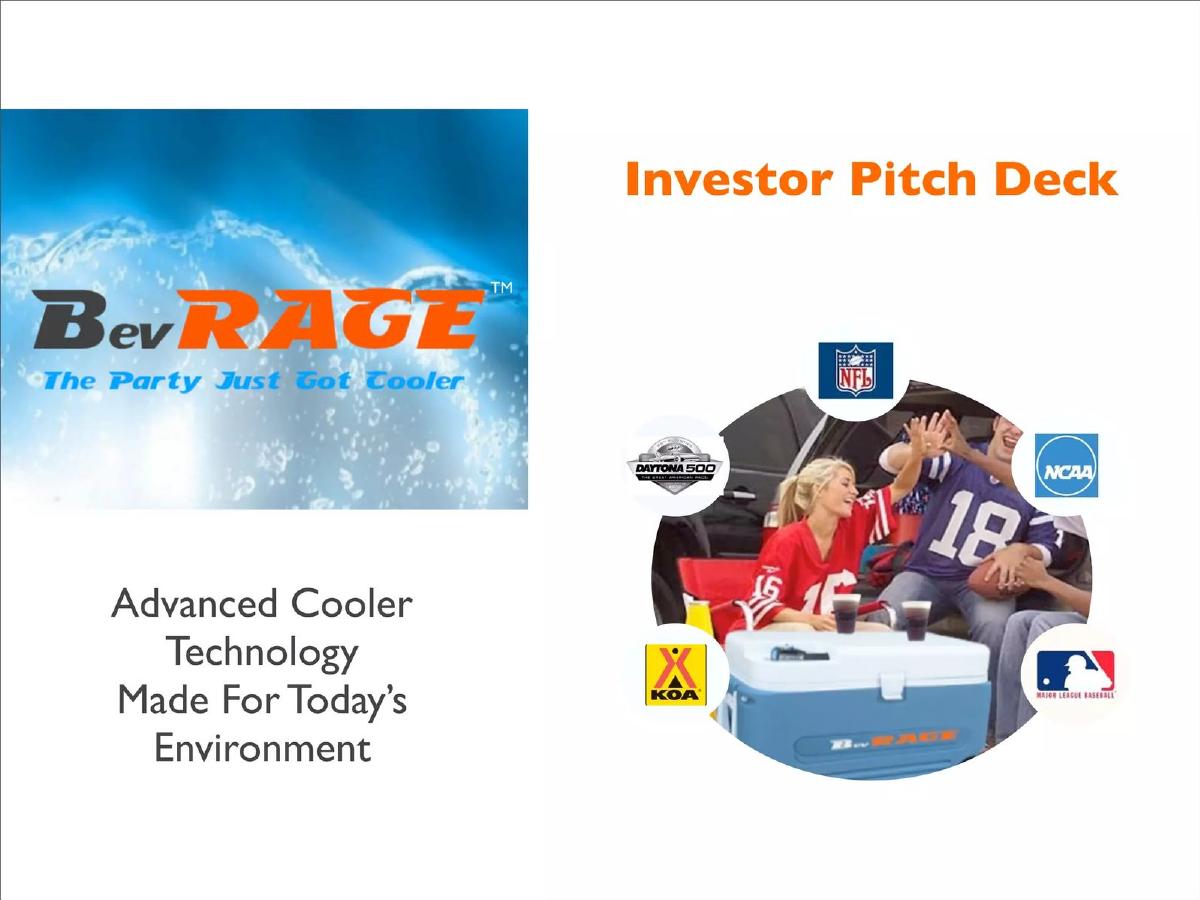
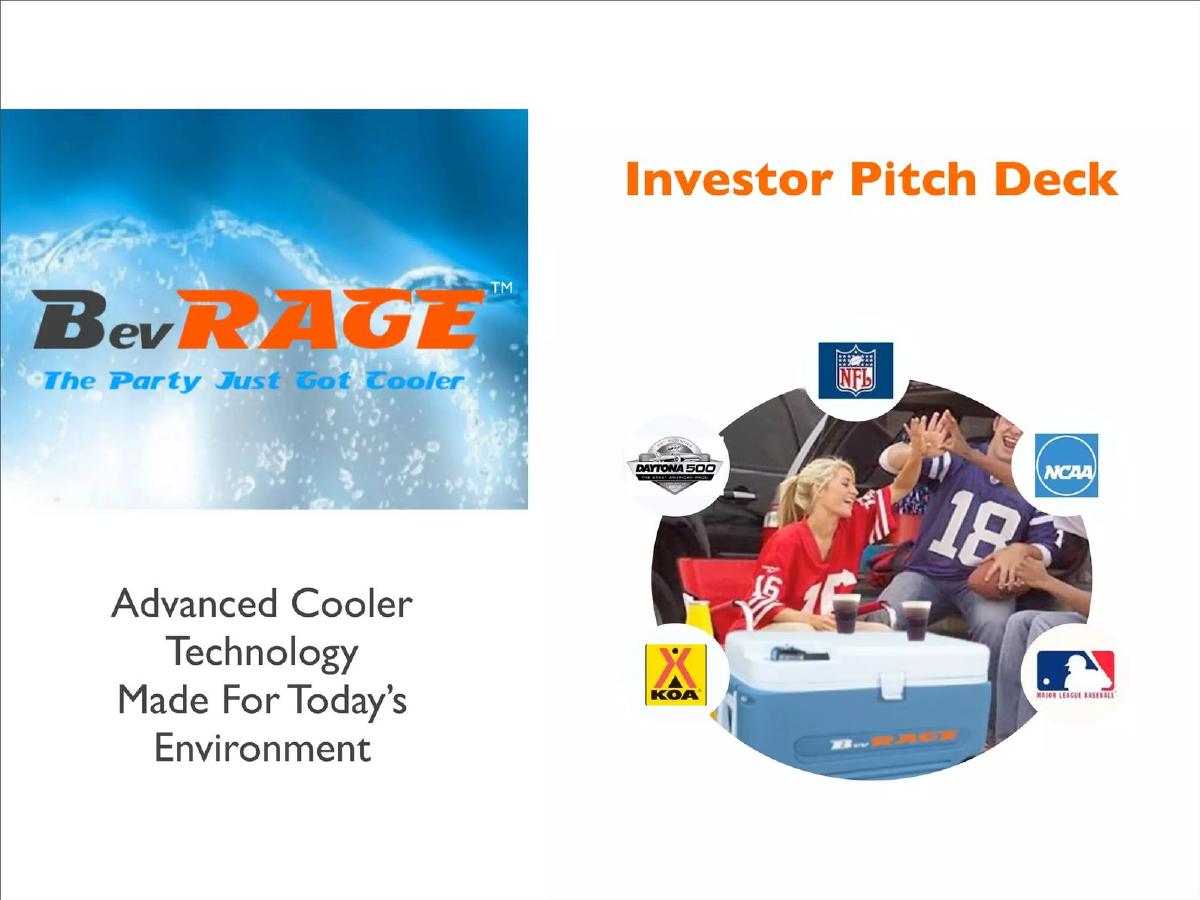
The deck opens with the Bev rage logo and the tagline "The Party Just Got Cooler." It positions the product as "Advanced Cooler Technology Made For Today’s Environment." The slide features logos for the NFL, NCAA, MLB, Daytona 500, and KOA, signaling a heavy reliance on sports and outdoor licensing as a core business pillar. The visual theme is centered on water and ice, reinforcing the cooling function of the hardware.
Market Opportunity and Segmentation
Slide 2: The Market
This slide quantifies the total addressable market at 275,000,000+ yearly active enthusiasts. It breaks this down into three primary segments: Sports (40,000,000+), Outdoors (136,000,000+), and Business & Others (100,000+). The visual uses simple iconography to represent the scale of these consumer groups, though it does not cite specific sources for these figures on the slide itself.
Slide 3: The 2 Major Markets
Bev rage drills down into its primary targets: Tailgaters and Campers. For the 40M+ tailgaters, the slide notes that 79% are men aged 25-44, and $35B is spent annually on supplies. For the 45M+ campers, it highlights that 46% of purchases are for new equipment. The slide also mentions "Other Valuable Markets" including 74M+ registered boaters and commercial users like catering services and food trucks.
Slide 4: Market Conversion and Projections
The company presents a conservative conversion model. It shows annual attendance across tailgating, camping, and recreation, then applies a "Projected Conversion Rate Under 0.20%" to estimate units sold. This leads to a 5-year projected revenue figure of over $82,000,000. By showing a low conversion percentage, the company attempts to demonstrate that even minimal market penetration results in significant top-line growth.
Problem and Solution
Slide 5: The Opportunity - The Problems
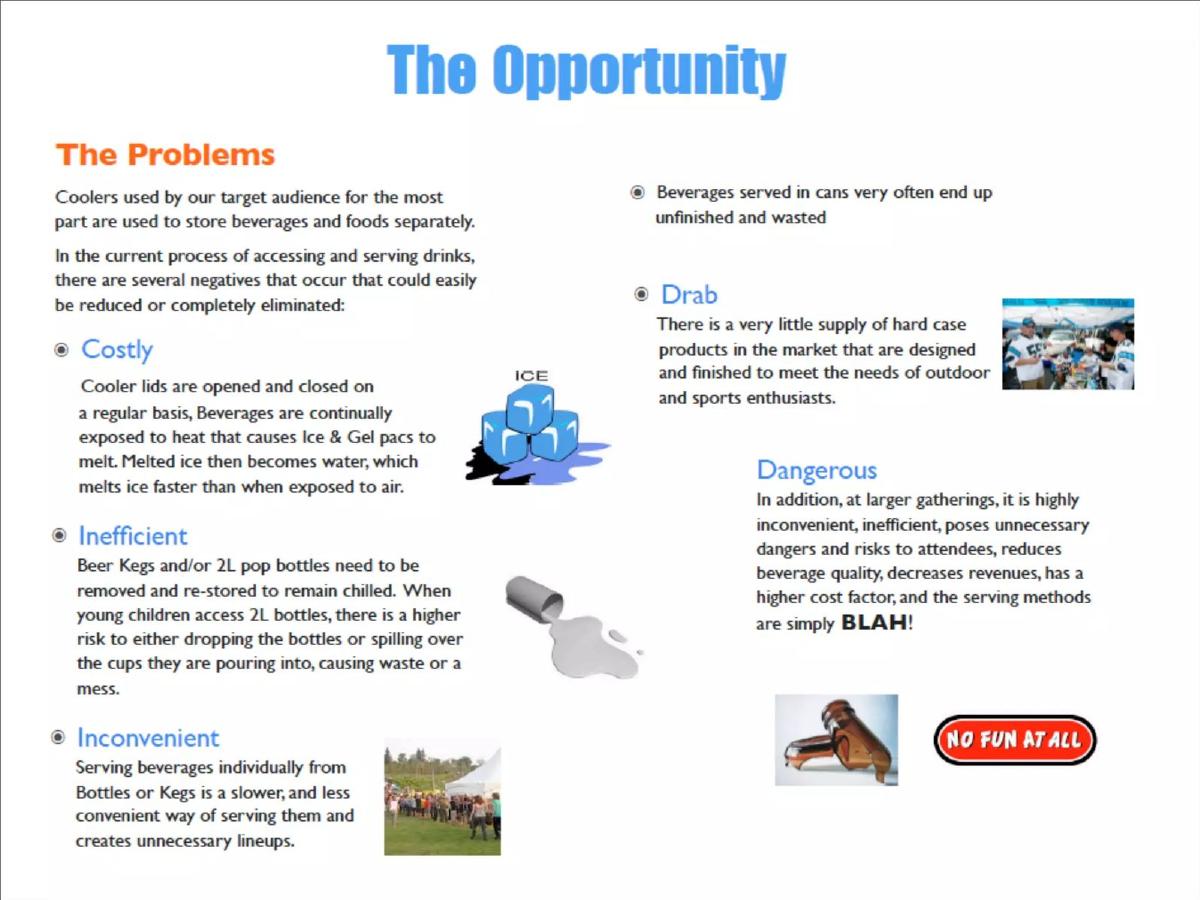
The deck identifies five pain points with current cooler usage: Costly (ice melts due to lid opening), Inefficient (handling large bottles/kegs), Inconvenient (slow serving lines), Drab (lack of specialized design), and Dangerous (risks at large gatherings). It uses the phrase "simply BLAH!" to describe current serving methods, emphasizing a lack of innovation in the existing market.
Slide 6: The Resolutions
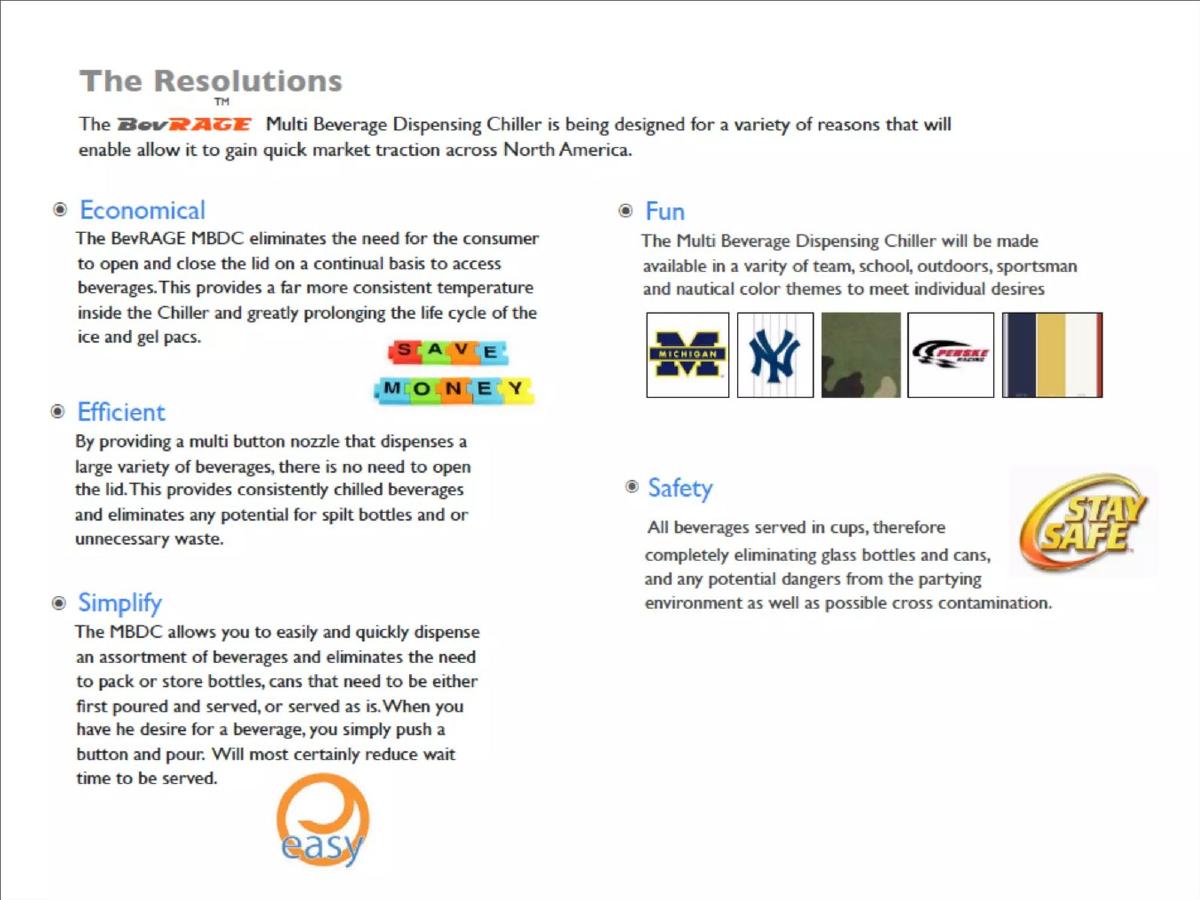
The solution is the Bev rage Multi Beverage Dispensing Chiller (MBDC). The resolutions correspond to the problems: Economical (closed lid prolongs ice life), Efficient (multi-button nozzle), Simplify (no need to pack individual cans), Fun (team and school color themes), and Safety (eliminates glass and cans at parties). The slide introduces the "push a button and pour" concept.
Slide 7: The Products
This slide provides photographic evidence of the "Garage Model" prototype. It shows the cooler mounted on a vehicle hitch next to a grill, being wheeled like luggage, and dispensing liquid through a handheld nozzle. It specifies that the units are available in both Ice Cooled and Thermo Cooled (Electric & 12V) versions.
Slide 8: Possible Colors For Retail & Athletic Series
To emphasize the licensing strategy, this slide displays the cooler with various logos, including the San Francisco 49ers, Michigan Wolverines, New York Yankees, and Boston Celtics. It categorizes these into Hunting, Outdoors, Nautical, and various sports segments, suggesting a wide range of aesthetic customization.
Slide 9: Sneak Peek
The company shows a conceptual rendering of a future model. This version includes a "sun roof sliding panel with solar charging station for phones" and integrated dry/semi-dry cool storage. This slide is intended to show the product roadmap and technical evolution beyond the current prototype.
The Team and Operations
Slide 10: The Players (Part 1)
The leadership team is introduced with detailed biographies. CEO Alain Arnould is highlighted for his 28 years of Federal Government service as a Contracting Officer handling major weapons systems for the US Army and Navy. Carl Pion, Director of Global Operations, is credited with 30+ years in the private sector, including experience in uniform manufacturing and nano-technology energy saving solutions.
Slide 11: The Players (Part 2)
The team slide continues with David J. Fire (President and inventor), John Holt Jr. (Business Manager), and Wayne Utz (Head of Product Development). Utz’s profile is particularly detailed, noting 15+ years in product engineering, 10+ utility patents, and previous experience at Humminbird. This slide aims to establish technical and manufacturing credibility.
Slide 12: The Business Model
A linear flow chart describes the business model: Sales & Marketing -> Order Booking -> Production -> Inventory -> Distribution -> Customer Service. Below the flow, three pillars are listed: Brand Recognition, High Quality, and Profits. This is a standard hardware operational model but lacks specific details on manufacturing partners or margins.
Slide 13: Sales and Marketing Overview
This slide uses a hub-and-spoke diagram to show the relationship between the sales force, distributors (like Dick’s Sporting Goods and Bass Pro Shops), and end-user locations (stadiums and stores). The marketing spoke includes social media, web, news, and blogs.
Slide 14: Marketing Strategy
The deck breaks down marketing into six categories: Online (SEO/Adwords), Social (Twitter/Facebook/Instagram), Newsletter (MailChimp), Blog (targeting TechCrunch and Mashable), Offline (Expos/TV/Radio), and Other (Viral/Forum). It is a comprehensive list of channels, though it does not specify the budget allocation for each.
Slide 15: Sales Strategy
The sales strategy is explicitly focused on North American distribution through mid-sized and large retailers. Logos shown include Cabela's, Camping World, SAIL, L.L. Bean, Canadian Tire, and Meijer. The second point reiterates the target of Pro and Semi-Pro sports stadiums and college campuses.
Financials and Ask
Slide 16: Current Status
A timeline shows the company's progress. Completed milestones include "Over $80,000 Skin In Game," social media launches, and "Partial Market Validation." Pending milestones (marked with an X) include raising seed capital, building the official prototype, and securing Round I capital. The slide lists the funding goals, including finalizing engineered schematics and securing a distribution center.
Slide 17: Status and Use of Funds
This slide provides the specific financial ask. The company needs $50,000 in Seed Capital for official prototypes ($35,000) and marketing ($15,000). Following this, they estimate a requirement of $3,150,000 for Round I Capital to build the team, secure facilities, and purchase inventory. The terms are listed as "Major Equity Stake + Royalties (TBD)."
Slide 18: Get In Touch
The final slide provides contact information for David J. Fire and Carl Pion, including phone numbers and email prompts. It notes that Bev rage is a trademarked logo of Bev rage International, based in Atlanta, GA.
What Bev rage Does Well
Market Specificity: The deck does an excellent job of identifying a very specific sub-culture (tailgaters) and quantifying their spending habits ($35B on supplies). · Founder Commitment: Explicitly stating that the founders have $80,000 of "skin in the game" (Slide 16) builds immediate trust with investors. · Technical Depth: The inclusion of Wayne Utz (Slide 11) with his patent history and engineering background provides necessary weight to a hardware pitch. · Conservative Projections: By using a conversion rate of less than 0.20% (Slide 4), the revenue projections feel more grounded than typical "hockey stick" graphs.
What Is Missing from the Bev rage Deck
Unit Economics: The deck never mentions the Bill of Materials (BOM), the target retail price, or the gross margins per unit. For a hardware company, this is a significant omission. · Competitive Landscape: There is no mention of incumbents like Yeti, Igloo, or Coleman. Investors need to know how Bev rage will defend against established brands with massive distribution. · Intellectual Property Status: While Wayne Utz has patents, the deck does not explicitly state if the MBDC technology itself is patented or patent-pending. · Manufacturing Partners: The deck mentions "Production" and "Distribution Centers" but does not identify where the units will be made or if they have existing manufacturing agreements.
Founder Takeaways: What to Copy
The "Problem" Slide Structure: Slide 5 uses clear, bold headers (Costly, Inefficient, Inconvenient) that directly map to the solution. This is a best practice for clarity. · Licensing as a Multiplier: Showing the product with team logos (Slide 8) helps investors visualize the "viral" and emotional appeal of the product beyond its utility. · Tiered Funding Ask: Breaking the ask into a small seed round for prototyping and a larger round for scaling (Slide 17) shows a disciplined approach to capital allocation. · Detailed Team Bios: Instead of just logos of past employers, the detailed text on Slides 10 and 11 explains why the team's specific experience (e.g., government contracting, patent engineering) is relevant to this venture.
Frequently asked questions
- What is the primary problem Bev rage is solving?
- According to slide 5, the company addresses the inefficiencies of traditional coolers. Specifically, opening lids melts ice faster, serving from large bottles is messy for children, and individual serving creates long lines at events. Their solution is a closed-lid dispensing system that maintains temperature and increases serving speed.
- How much money is the company seeking to raise?
- Slide 17 outlines a two-part requirement: $50,000 in seed capital to develop official prototypes and begin marketing, followed by $3,150,000 in Round I capital to build the team, secure a distribution facility, and purchase inventory for booked orders.
- What are the projected financial outcomes?
- Slide 4 projects total revenues over $82,000,000 within five years. This is based on a projected conversion rate of under 0.20% of the annual attendance in tailgating, camping, and recreational markets.
- Who are the key members of the leadership team?
- The team is led by CEO Alain Arnould, a former government contracting officer, and Carl Pion, Director of Global Operations. David J. Fire serves as President and inventor, while Wayne Utz leads product development with experience at Humminbird and 10+ utility patents (Slides 10-11).
- What is the company's go-to-market strategy?
- Bev rage plans to target major retailers like Bass Pro Shops, Cabela's, and Dick's Sporting Goods (Slide 15). They also intend to leverage licensing with the NFL, NCAA, and MLB to offer team-branded coolers to fans at stadiums and campuses.