BidAway’s 2012 pitch deck is a concise 11-slide presentation that successfully secured $2.9M in funding. The company positions itself as a luxury marketplace that solves the 'perishable inventory' problem for 4 and 5-star hotels. By utilizing a real-time auction model, BidAway allows providers to fill empty rooms without diluting their brand through public price drops, as winning bids are not indexed by Google. The deck leans heavily on its established partnerships in Europe—specifically claiming access to 52% of Spain’s luxury hotels. While it lacks traditional financial projections or a spe…
Key takeaways
- The company claims exclusive partnership agreements with providers representing 52% of Spain's 4 and 5-star hotels (Slide 3).
- BidAway operates a dual auction model: 'Excess Capacity' for unsold inventory and 'Excess Demand' for high-value VIP packages (Slides 6 and 7).
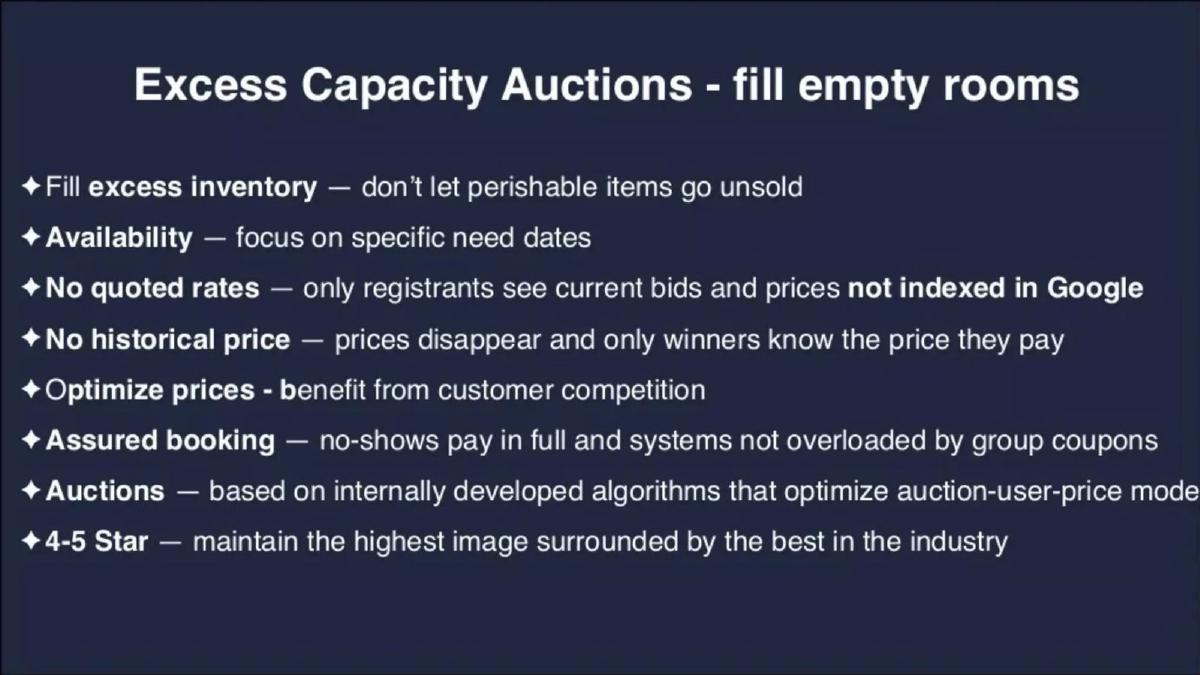
- The platform protects luxury brand integrity by ensuring auction prices are not indexed in Google and only visible to registrants (Slide 6).
- A key product feature is the 'Onsite widget,' which allows partners to host auctions directly on their own websites (Slide 8).
- The marketplace focuses exclusively on high-end inventory, specifically 4-5 star products (Slide 2).
- The founding team is presented as an international group from Spain, Italy, and the US, with affiliations to IESE Business School and 500 Startups (Slide 10).
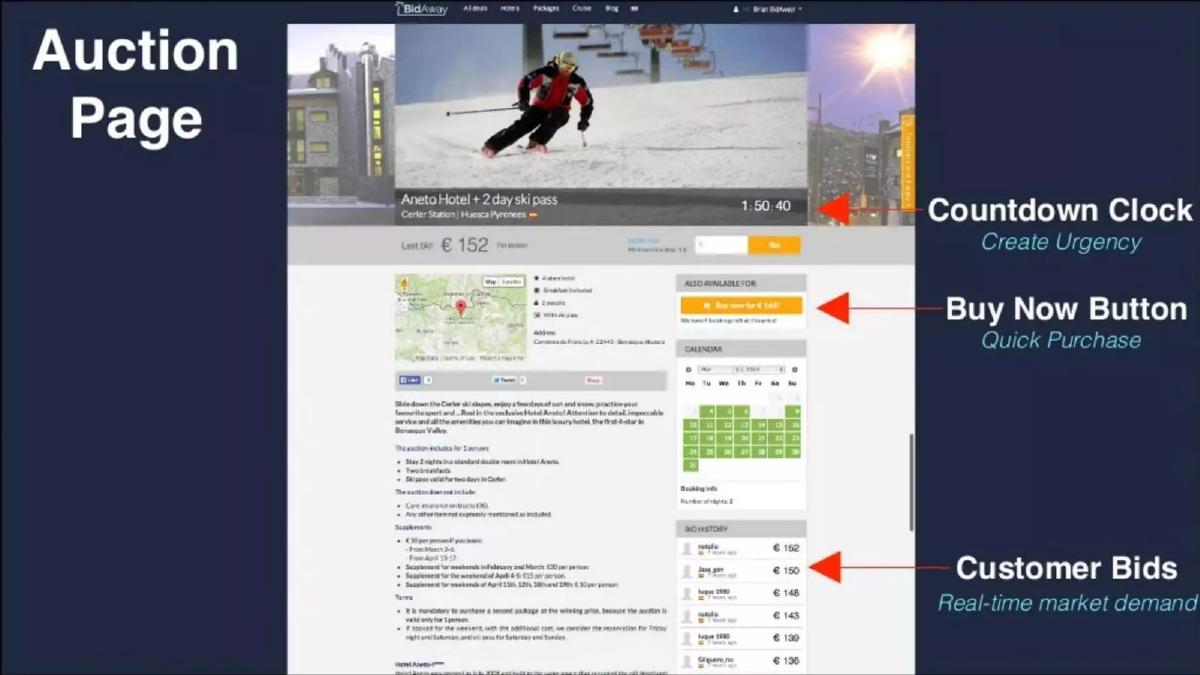
- The deck highlights a 'Buy Now' feature alongside auctions to capture immediate market demand (Slide 4).
- The business model addresses the problem of 'perishable items' in the travel industry, ensuring revenue from inventory that would otherwise go to waste (Slide 6).
The Pitch Deck Overview
BidAway’s 11-slide deck is a masterclass in simplicity, focusing on a single, high-value problem: perishable inventory in the luxury travel sector. In 2012, the 'daily deal' craze was evolving into more sophisticated marketplace models. BidAway positioned itself not as a discount site, but as an 'efficient marketplace for unsold items.' The deck uses a dark, premium aesthetic to align with its 4-5 star hotel focus and relies on partnership logos to establish immediate credibility.
Slide 1: Title and Vision
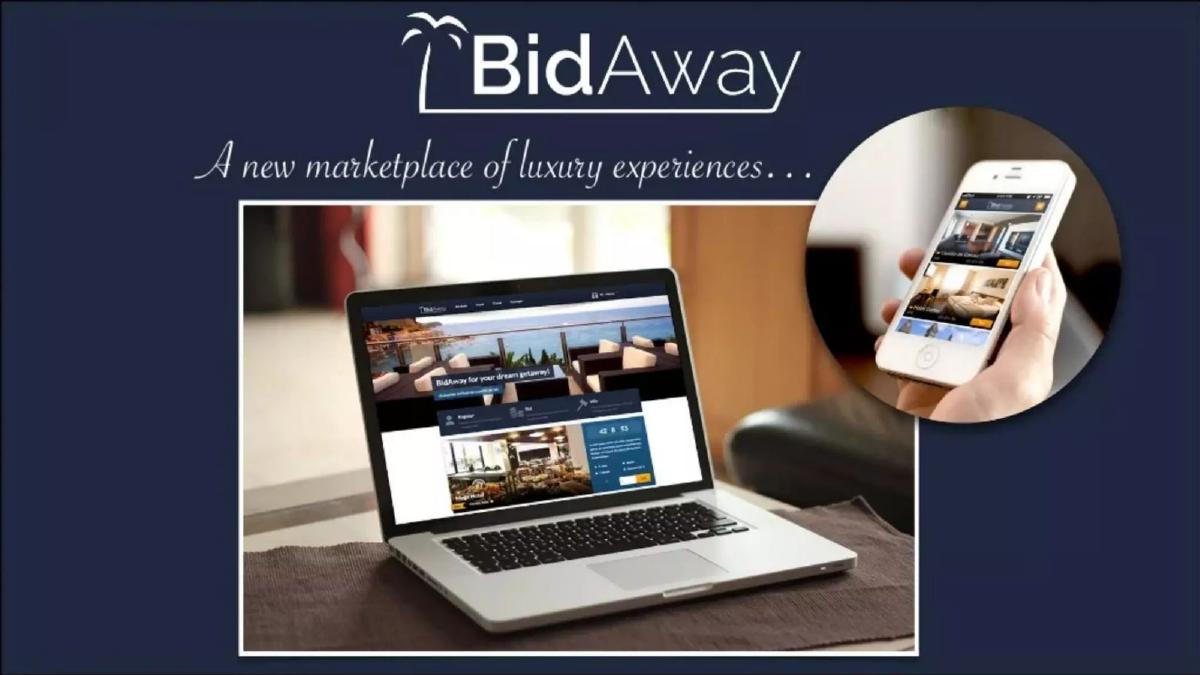
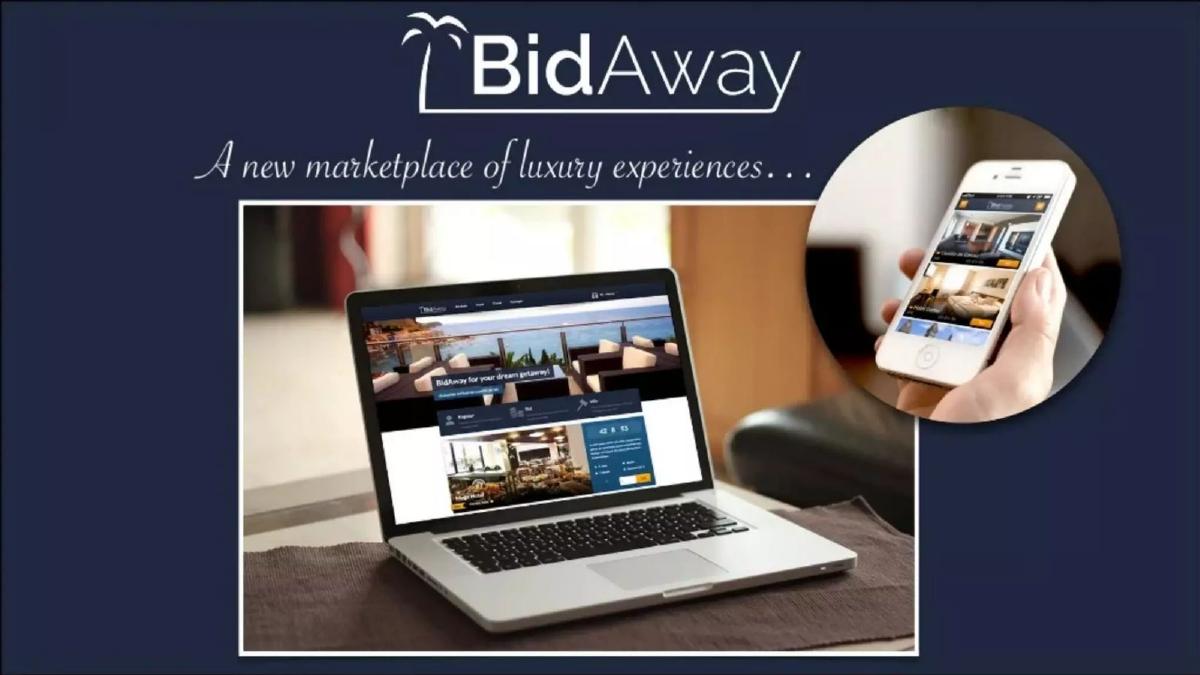
The cover slide introduces BidAway as "A new marketplace of luxury experiences." It features a clean logo with a palm tree motif and displays the product across both a laptop and a mobile device. This immediately signals a multi-platform approach, which was a standard requirement for travel tech in 2012. There is no mention of the founders or the specific funding round on this slide.
Slide 2: The Value Proposition
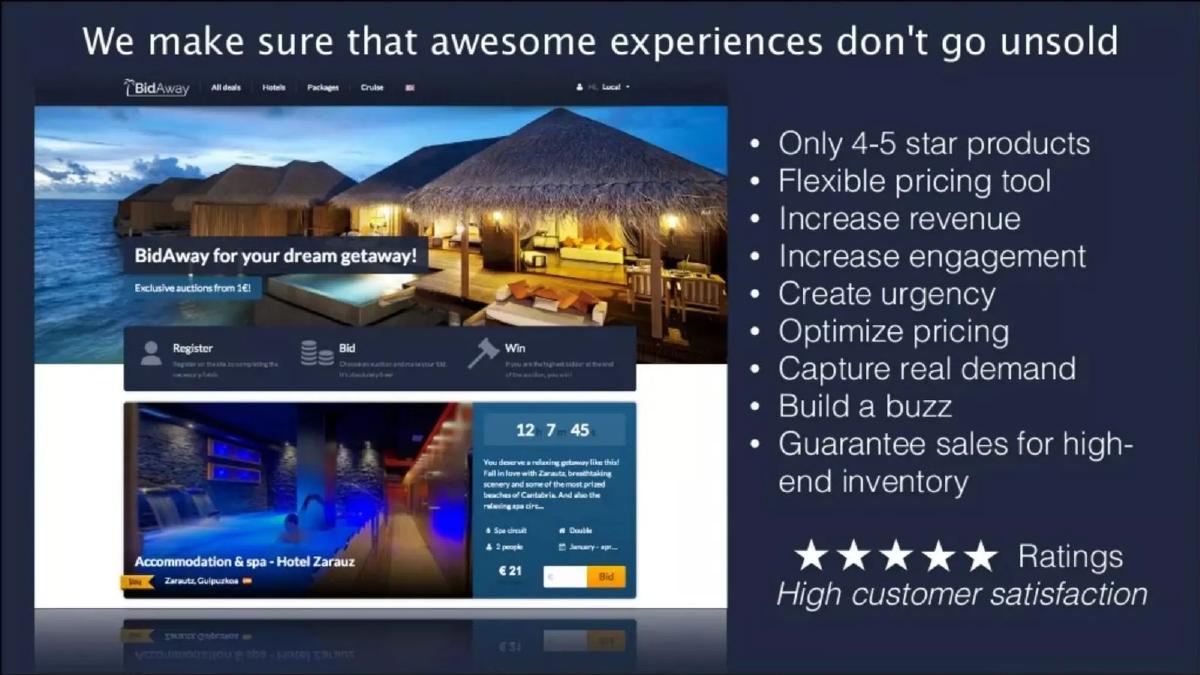
Slide 2 serves as a summary of the platform's benefits. The headline, "We make sure that awesome experiences don't go unsold," identifies the core pain point for luxury providers. Key features listed include "Only 4-5 star products," "Flexible pricing tool," and the ability to "Capture real demand." It also includes a five-star rating graphic with the text "High customer satisfaction," though it does not cite a specific source for this rating (e.g., Trustpilot or internal surveys).
Slide 3: Market Penetration and Partnerships
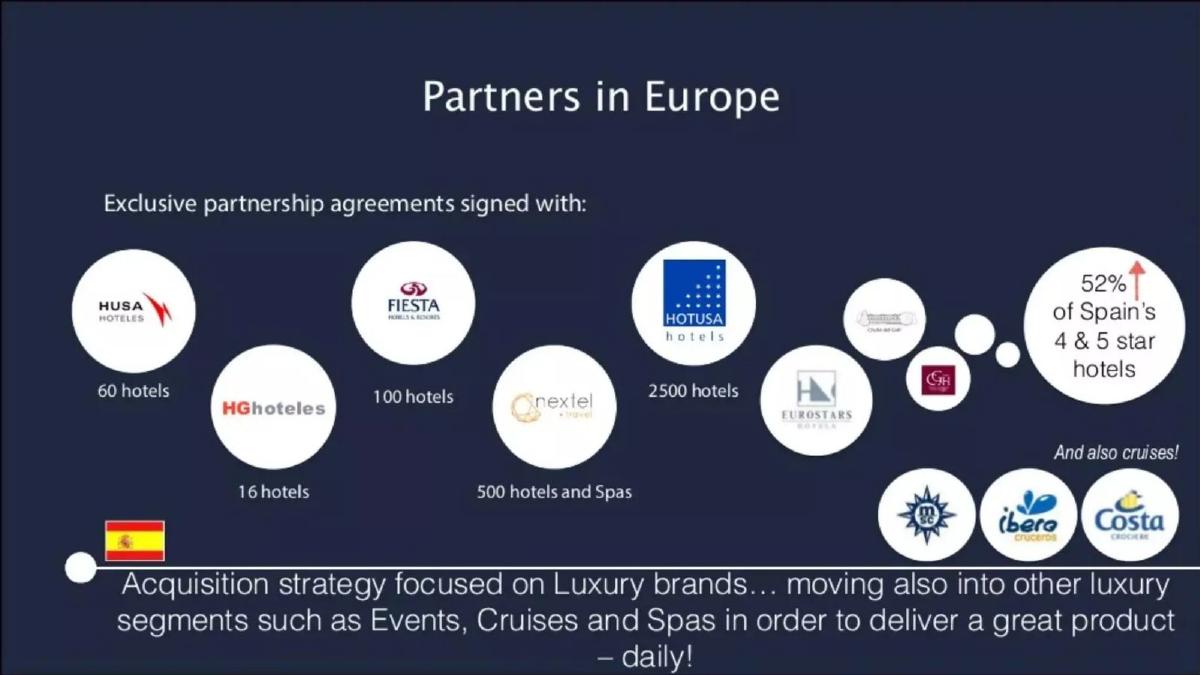
This is arguably the strongest slide in the deck. Titled "Partners in Europe," it displays logos for major hotel chains including HUSA (60 hotels), Fiesta (100 hotels), and HOTUSA (2,500 hotels). A prominent callout states that they have captured "52% of Spain's 4 & 5 star hotels." This slide proves supply-side traction, which is the hardest hurdle for any two-sided marketplace. It also notes an expansion strategy into "Events, Cruises and Spas."
Slide 4: Product Deep Dive - The Auction Page
Slide 4 provides a screenshot of the "Auction Page." It uses red arrows to highlight three key UI elements: a "Countdown Clock" to create urgency, a "Buy Now Button" for quick purchases, and a "Customer Bids" list to show real-time market demand. This slide demonstrates that the platform is functional and incorporates standard e-commerce psychological triggers.
Slide 5 & 6: Solving Excess Capacity
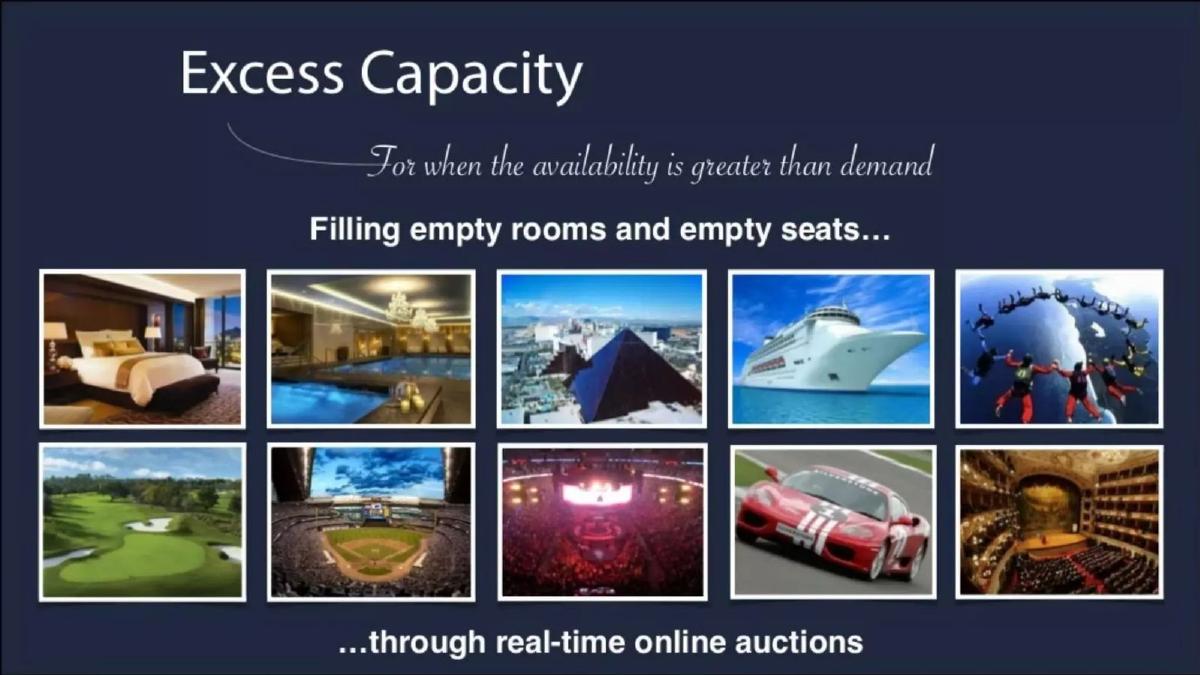
Slide 5 uses a collage of luxury imagery (hotel rooms, cruise ships, skydiving, racing) to define "Excess Capacity" as "when the availability is greater than demand." Slide 6 then details the mechanics of these auctions. Crucially, it mentions that prices are "not indexed in Google" and there is "no historical price" visible to the public. This is a vital B2B selling point: it allows hotels to liquidate rooms without permanently lowering their perceived market value or violating rate parity agreements.
Slide 7: Optimizing Revenue via Excess Demand
BidAway distinguishes itself from simple liquidation sites by introducing "Excess Demand Auctions." This slide targets high-demand VIP packages where demand exceeds availability. The goal here is "Optimizing prices to capture true willingness to pay," suggesting that for rare experiences, the auction model can actually drive prices above the standard market rate.
Slide 8 & 9: The B2B Widget Strategy
These slides introduce the "Onsite widget." Slide 8 shows a visual of the widget embedded on a third-party site (a cycling event page), while Slide 9 lists the benefits: "Create a buzz with onsite auction," "Fully customizable," and "New gamification aspect to leisure purchases." This indicates a white-label or API-driven revenue stream, allowing BidAway to act as a technology provider for brands that want to keep users on their own domains.
Slide 10: The Founding Team
The team slide features three founders: Albert (Spain), Luca (Italy), and Brian (USA). The slide emphasizes their "International Team" status and their roots in Barcelona. It prominently features the logos for IESE Business School and 500 Startups. This provides the necessary institutional validation, signaling that the founders have been vetted by a top-tier accelerator and a leading European business school.
Slide 11: Closing
The final slide is a simple repetition of the logo on a dark background. It lacks a call to action, contact information, or a summary of the investment 'ask.'
What Works
Supply-Side Proof: Claiming 52% of a specific market segment (Slide 3) is a powerful way to demonstrate a competitive moat. · Brand Protection: The explicit mention of not being indexed by Google (Slide 6) addresses the primary fear of luxury brand managers: price erosion. · Dual Utility: Showing how the platform handles both unsold inventory (Slide 6) and high-demand VIP items (Slide 7) makes the business model feel more robust and less like a 'discount' site. · Visual Clarity: The use of actual product screenshots (Slide 4 and 8) removes ambiguity about what the company has actually built.
What is Missing
Financial Data: There are no figures regarding Gross Merchandise Volume (GMV), revenue, or take rates. For a 'Later' stage deck (as categorized), this is a significant omission. · The Ask: The deck does not state how much money is being raised or how the funds will be allocated. · Unit Economics: There is no information on Customer Acquisition Cost (CAC) or Lifetime Value (LTV), which are critical for marketplace businesses. · Competition: The deck ignores competitors like Luxury Escapes, Secret Escapes, or Jetsetter, which were active during this period. · User Traction: While the supply side is well-documented, there is no data on the number of registered bidders or successful auctions completed.
What a Founder Should Copy
The 'Widget' Strategy: If you are building a marketplace, showing how your tech can be embedded into your partners' sites is a great way to prove you are a partner, not just a middleman. · Addressing Industry-Specific Fears: BidAway knew that luxury hotels hate public discounts. By explicitly stating that their prices are hidden from Google, they solved a B2B objection before it was even raised. · Clear Segmentation: Don't just say you sell 'travel.' BidAway specifically targeted '4-5 star' and 'Luxury,' which allows for higher margins and a clearer brand identity. · Leveraging Accelerator Pedigree: If you have been through a program like 500 Startups, the logo should be prominent. It acts as a shorthand for 'this team has been trained and vetted.'
Frequently asked questions
- How does BidAway protect the brand of luxury hotels?
- BidAway uses a 'closed' auction system. According to slide 6, current bids and final prices are not indexed in Google, and only registered users can see the bidding activity. This prevents the public perception of 'discounting' that often harms luxury brands on traditional travel sites.
- What is the difference between their two auction types?
- Slide 6 describes 'Excess Capacity Auctions' designed to fill empty rooms when availability exceeds demand. Slide 7 introduces 'Excess Demand Auctions' for VIP specialty packages, where bidding starts at market price to capture the customer's maximum willingness to pay.
- What is BidAway's primary market traction?
- The deck focuses heavily on the Spanish market. Slide 3 notes that they have signed exclusive agreements with partners like HOTUSA (2,500 hotels) and HUSA (60 hotels), covering over half of the luxury hotel inventory in Spain.
- Does the deck include financial projections?
- No. The 11-slide deck completely omits financial forecasts, revenue history, or unit economics. It focuses almost entirely on the product mechanics, the problem of unsold inventory, and the strength of their supply-side partnerships.
- What is the 'Widget' mentioned in the deck?
- The widget is a B2B tool shown on slides 8 and 9. It allows hotels or event organizers to embed BidAway's auction technology directly onto their own websites, creating 'double-sided traffic' and allowing brands to host auctions under their own banner.