B Great's 2020 Seed deck is a masterclass in applying traditional Consumer Packaged Goods (CPG) fundraising logic to the then-nascent CBD industry. By raising $2.5M, the company demonstrated that investors were hungry for professionalized brands in a fragmented market. The deck leans heavily on 'transparency' as a competitive moat, showcasing lab reports and traceability as a solution to consumer confusion. It also utilizes aggressive valuation comps, citing Lord Jones' $300MM exit at an 8.6x multiple to justify its own potential. While the deck lacks granular unit economics or a detailed cap…
Key takeaways
- The deck uses high-profile exits like Lord Jones ($300MM sale) to anchor investor expectations for CBD brand valuations (Slide 11).
- Transparency is framed as the primary product feature, with a dedicated 'Traceability Tab' and public Certificates of Analysis (Slide 7).
- The funding request was for $1M via a convertible note with a 20% discount and a $4MM cap (Slide 13).
- Manufacturing is a core pillar of the pitch, emphasizing a 125,000 sq. ft. FDA-registered facility in Nashville (Slide 25).
- The product lineup is diverse, ranging from $5.88 energy shots to $61.60 hemp lotions (Slide 15).
- The deck includes a specific COVID-19 strategy slide, addressing inventory availability and expense reduction during the 2020 pandemic (Slide 29).
- Marketing strategy is heavily localized, utilizing geo-targeted ads and emails surrounding specific retail locations (Slide 27).
- The team slide highlights deep CPG and advertising experience, including a Creative Advisor with 35 years of experience at agencies like DDB and Havas (Slide 23).
Introduction: The Professionalization of CBD
The B Great pitch deck, used for their 2020 Seed round, arrived at a pivotal moment for the hemp and CBD industry. Following the 2018 Farm Bill, the market was flooded with new entrants, many of which lacked the branding sophistication or supply chain reliability of traditional CPG companies. B Great’s deck is a strategic attempt to position the company as the 'adult in the room.' By focusing on manufacturing scale, legal compliance, and transparent lab testing, the founders sought to de-risk the investment for Seed-stage backers who might be wary of the sector's regulatory gray areas.
Slides 1-3: Setting the Stage and the 'Why'
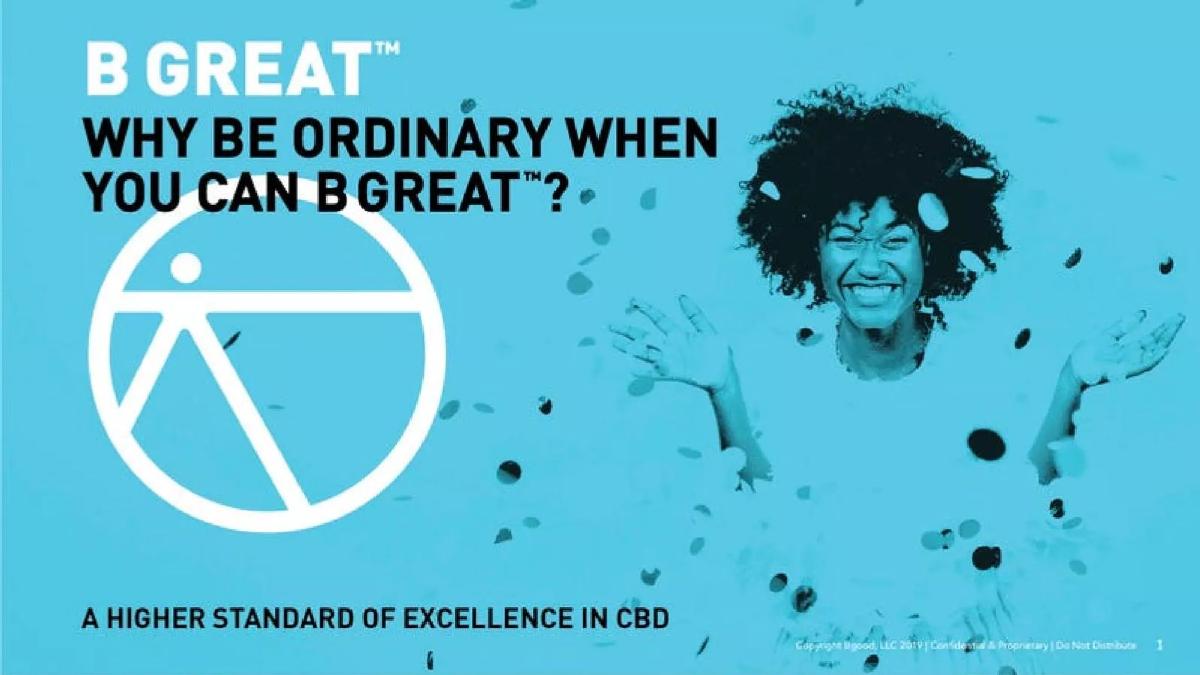
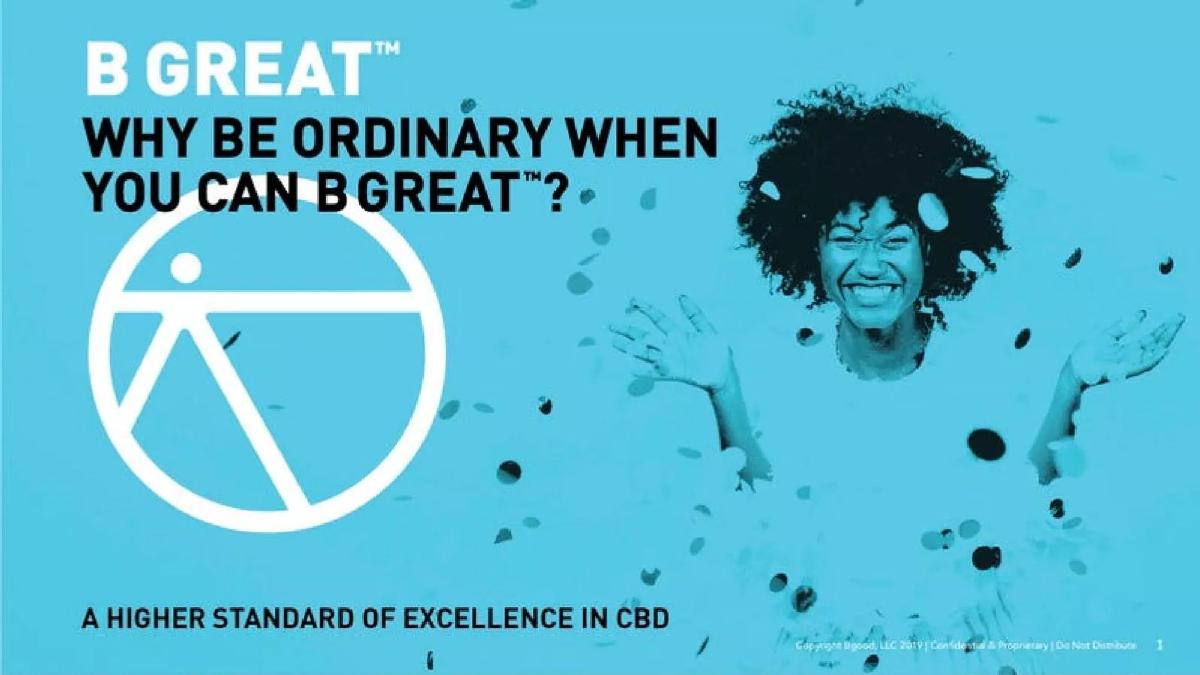
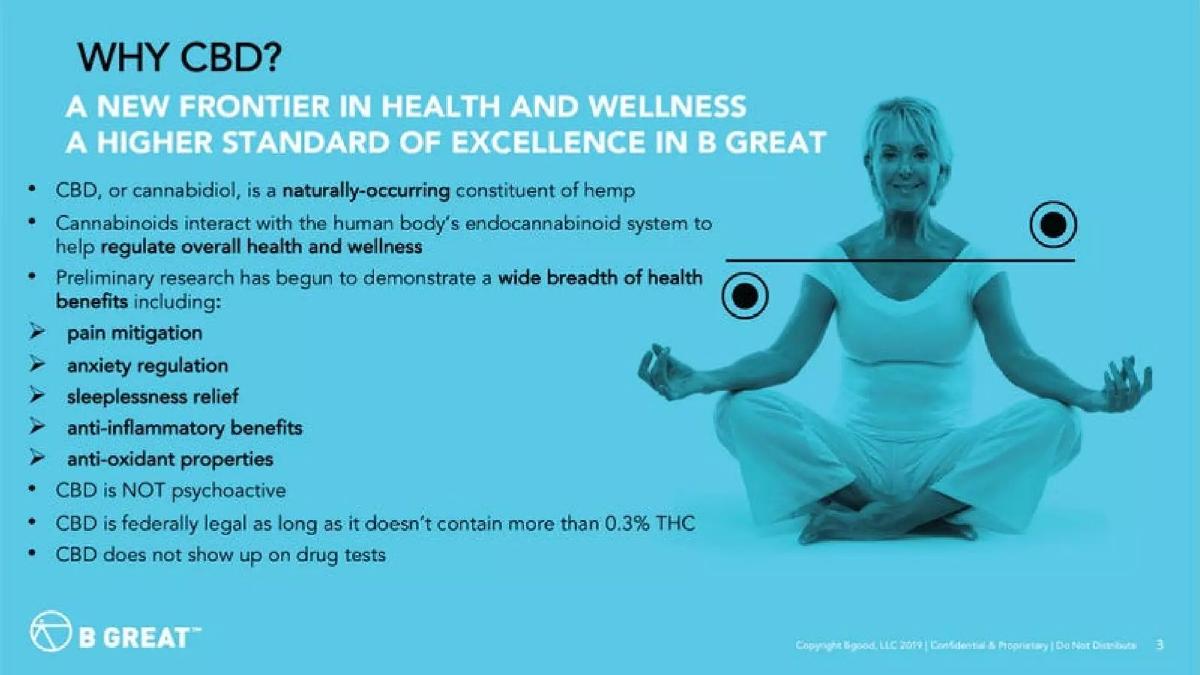
Slide 1 introduces the brand with a high-energy lifestyle image and the tagline 'A Higher Standard of Excellence in CBD.' The branding is clean and professional, avoiding the stereotypical 'stoner' aesthetic often associated with cannabis-adjacent products. Slide 3 addresses the fundamental 'Why CBD?' question. It lists benefits such as pain mitigation, anxiety regulation, and anti-inflammatory properties. Crucially, it includes a legal disclaimer: 'CBD is federally legal as long as it doesn’t contain more than 0.3% THC.' This is a necessary inclusion for any cannabis-related deck in 2020 to immediately address the legality hurdle.
Slides 5-7: The Solution and Transparency Moat
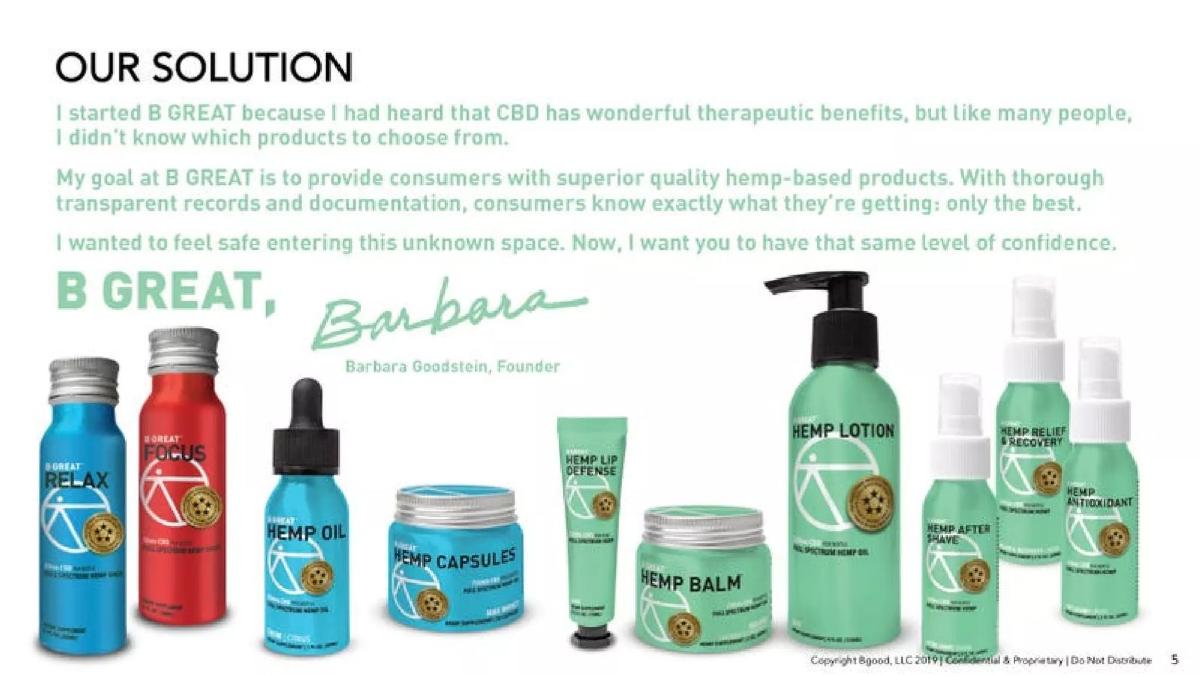
Slide 5 introduces the founder, Barbara Goodstein, and the product lineup. The narrative is personal: the founder wanted to feel safe entering an 'unknown space' and created B Great to provide that confidence to others. The visual shows a wide array of products, including oils, capsules, balms, and lotions. Slide 7 is perhaps the most important for building investor trust. It details the 'Traceability Tab' on their website, which allows consumers to view a 'Certificate of Analysis' (COA) for every product by entering a lot number. In a market plagued by mislabeled products, framing transparency as a core brand pillar is a smart defensive strategy.
Slides 9-11: Market Validation and Comps
After a lifestyle transition slide (Slide 9), the deck moves into hard numbers. Slide 11, titled 'Valuations of Competitors are High,' is a classic anchoring technique. It lists three major players: Charlotte's Web, Abacus Health Products, and Lord Jones. The slide highlights that Lord Jones was sold for $300MM at an 8.6x TTM revenue multiple. By showing these high multiples, B Great is telling investors that the exit potential in this category is significantly higher than in traditional food or beverage categories, justifying a higher Seed-stage valuation.
Slides 13-15: The Ask and Product Details
Slide 13 contains the 'Funding Request.' The company was raising $1M in a convertible note with a 20% discount and a $4MM cap. This is a very specific ask, which is helpful for investors to understand the deal structure immediately. Slide 15 provides a product breakdown with retail prices. The pricing is premium: $42.00 for anti-aging cream and $61.60 for hemp lotion. This suggests a high-margin business model targeting an affluent demographic, rather than a race-to-the-bottom commodity play.
Slides 17-19: Targeting and Retail Strategy
Slide 17 uses a matrix to show how their products fit into different consumer lives, from 'Busy Moms' to 'Weekend Warriors.' While broad, it shows they have considered the specific use cases for each SKU. Slide 19 focuses on the 'Focus' and 'Relax' shots, which are designed for point-of-purchase retail displays. The mention of a '40% trade margin' is a vital detail for investors who understand that retail success depends on the margins offered to distributors and store owners.
Slides 21-23: Traction and Team
Slide 21 showcases press coverage from Rolling Stone, Newsweek, and Forbes. For a Seed-stage company, this third-party validation is crucial for proving brand resonance. Slide 23 introduces the team, specifically the advisors and partners. Lee Garfinkel, the Creative Advisor, is highlighted for his 35 years of experience at major ad agencies. This reinforces the 'world-class marketing' claim made earlier in the deck. The inclusion of a manufacturing partner, Perry Malik-Samueli, further emphasizes that the supply chain is managed by industry veterans.
Slides 25-27: Operations and Marketing
Slide 25 dives into the manufacturing details. The partnership with Samueli Naturals provides B Great with access to a 125,000 sq. ft. facility and 42,000 acres of hemp fields in Kentucky and Tennessee. This 'seed-to-shelf' story is a major selling point. Slide 27 outlines a '360-degree' marketing approach, focusing on geo-targeted digital and radio ads. This suggests a disciplined spend strategy—only advertising in areas where their products are physically available on shelves.
Slide 29: The COVID-19 Pivot
Slide 29 is a 'COVID19 Strategy' slide. Given the deck was used in 2020, this was a mandatory addition. It addresses supply chain resilience ('Our inventory is produced, and it is immediately accessible') and market demand ('Consumers are looking for ways to calm down'). It shows the company was agile and prepared for the macroeconomic shocks of the pandemic.
What Works in This Deck
Supply Chain Authority: The manufacturing slide (Slide 25) is exceptionally strong. It moves the company away from being a 'white-label' brand and positions it as a vertically integrated powerhouse with massive capacity. Valuation Anchoring: Using the Lord Jones exit (Slide 11) provides a clear 'north star' for the investment's potential return. Transparency as a Feature: By making lab results a central part of the pitch (Slide 7), they address the biggest consumer pain point in the CBD industry: trust.
What Is Missing
Unit Economics: While retail prices and trade margins are mentioned, there is no mention of Customer Acquisition Cost (CAC) for their DTC channel or the Lifetime Value (LTV) of their customers. Financial Projections: The deck lacks a forward-looking P&L or a breakdown of how the $1M in funding will be allocated across specific departments (e.g., how much for inventory vs. marketing). Cap Table: There is no mention of existing investors or the current ownership structure, which is often requested by Seed investors.
What a Founder Should Copy
The Persona Matrix: Slide 17 is an excellent way to show a broad product line's relevance to multiple market segments without confusing the reader. The Legal/Compliance Slide: If you are in a regulated industry (cannabis, fintech, healthcare), having a slide that explicitly addresses how you stay compliant is non-negotiable. Specific Funding Terms: Don't just ask for money; state the instrument (convertible note) and the terms (cap and discount) as seen on Slide 13. It saves time and shows you are prepared for the transaction.
Conclusion
B Great’s deck is a professional, CPG-focused pitch that successfully navigates the complexities of the CBD market in 2020. It prioritizes trust and scale over raw growth metrics, which was a winning strategy for securing a $2.5M Seed round during a period of market uncertainty. For founders in emerging industries, this deck serves as a blueprint for how to use traditional business fundamentals to legitimize a new category.
Frequently asked questions
- What was the specific funding ask in the B Great deck?
- On slide 13, B Great explicitly requested $1M in a convertible note. The terms offered included a 20% discount and a $4MM valuation cap. According to catalogue data, the company eventually raised a total of $2.5M for this Seed round in 2020, suggesting they were oversubscribed or increased the round size after this version of the deck was circulated.
- How did B Great differentiate itself from other CBD brands?
- B Great focused on 'The Higher Standard of Excellence.' Slide 7 details their commitment to transparency, including a 'Traceability Tab' on their website where consumers enter lot numbers to see lab results. They also emphasized legal compliance by retaining a top-tier CBD legal team to ensure all brand communications were accurate and federally compliant.
- What were the projected retail margins for B Great products?
- Slide 19 highlights the pricing strategy for their 'Focus' and 'Relax' shots. The targeted retail price was set at $5.99 per bottle, with an anticipated trade margin of 40%. This slide demonstrates a clear understanding of retail distribution requirements, which is essential for CPG startups looking to move beyond Direct-to-Consumer (DTC) sales.
- Who is the target audience for B Great's products?
- Slide 17 provides a detailed 'Category Disrupting Innovation' matrix. It maps their product line against seven distinct personas: Millennials, Weekend Warriors & Fitness Fans, Beauty Lovers, Busy Moms, Women Over 50, Great for Men, and Travel Essentials. This indicates a broad market approach rather than a niche focus.
- What manufacturing capabilities did the company claim?
- Slide 25 showcases a partnership with Samueli Naturals. The facility is described as a 125,000 sq. ft. FDA-registered and GMP-certified establishment in Nashville, TN. It features 10 filling lines with a capacity of 3 million units per month, signaling to investors that the company could handle significant retail scale immediately.