Cannabis Startup Problem Slide: Pitch Deck Examples
How cannabis and CBD startups present the problem in a pitch deck: name the consumer, grower or dispensary.
Cannabis Startup Problem Slide: Real Pitch Deck Examples
Eight problem slides from cannabis and CBD startups (consumer products, cultivation, dispensary software, pharmaceuticals and marketing), shown in full, compare whether each slide names who struggles, what goes wrong, and gives evidence.
TL;DR
A cannabis problem slide has to name one customer — a consumer, a grower, a dispensary — and say what fails them, not just that the industry is growing or regulated. Cann does this with a chart of customer types and their own words: "Canna-Casual" consumers say "Too strong!" and "The brands don't really speak to me"; "Canna-Curious" say "I'm too scared" and "I'm not a stoner." Alaf adds numbers: over "6,000 properly licensed California operators scrambling for grow space", with "The average cost to launch a grow operation... between $300,000-$500,000." Ethnobotanica describes its own company's losses instead of a customer's problem, the weaker pattern.
Cannabis problem slides from real pitch decks
Each example shows the exact stored slide above its analysis and links to the full teardown. Claims are as shown on the slides; we have not verified them.
Cann problem slide — slide 2
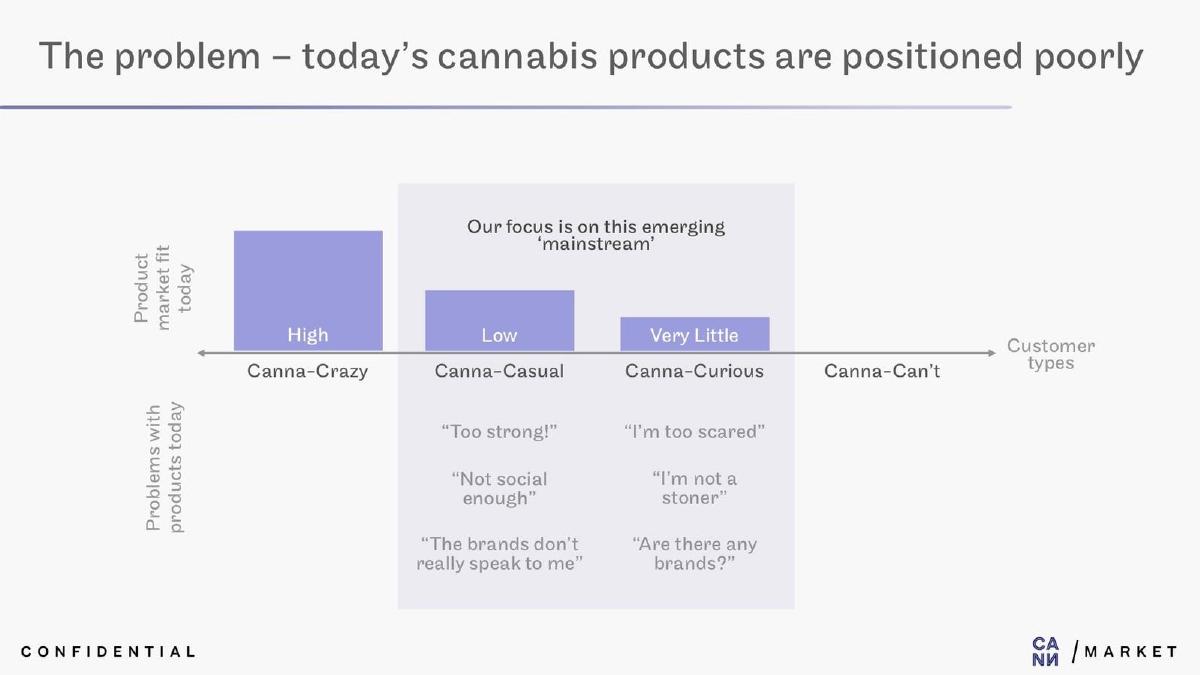
Low-dose cannabis drinks. A chart of four customer types with quotes under each.
Cann deck, slide 2. Exact stored slide matched to this analysis.
Our analysis: The strongest example here: it picks which consumers are poorly served and lets them say why.
Evidence and limitation: Customer quotes; no figures.
What a founder can adapt: Segment your customers by how well today's products serve them, and quote the gap.
Supporting analysis
What the deck claims: "The problem – today's cannabis products are positioned poorly." Customer types: "Canna-Crazy" (product fit today "High"), "Canna-Casual" ("Low"), "Canna-Curious" ("Very Little"), "Canna-Can't". "Our focus is on this emerging 'mainstream'." Casual: "Too strong!", "Not social enough", "The brands don't really speak to me". Curious: "I'm too scared", "I'm not a stoner", "Are there any brands?"
Presentation choice: "Too strong!" and "I'm not a stoner" set up a mild, social product without describing it.
When it does not fit: Say how many people are in each segment.
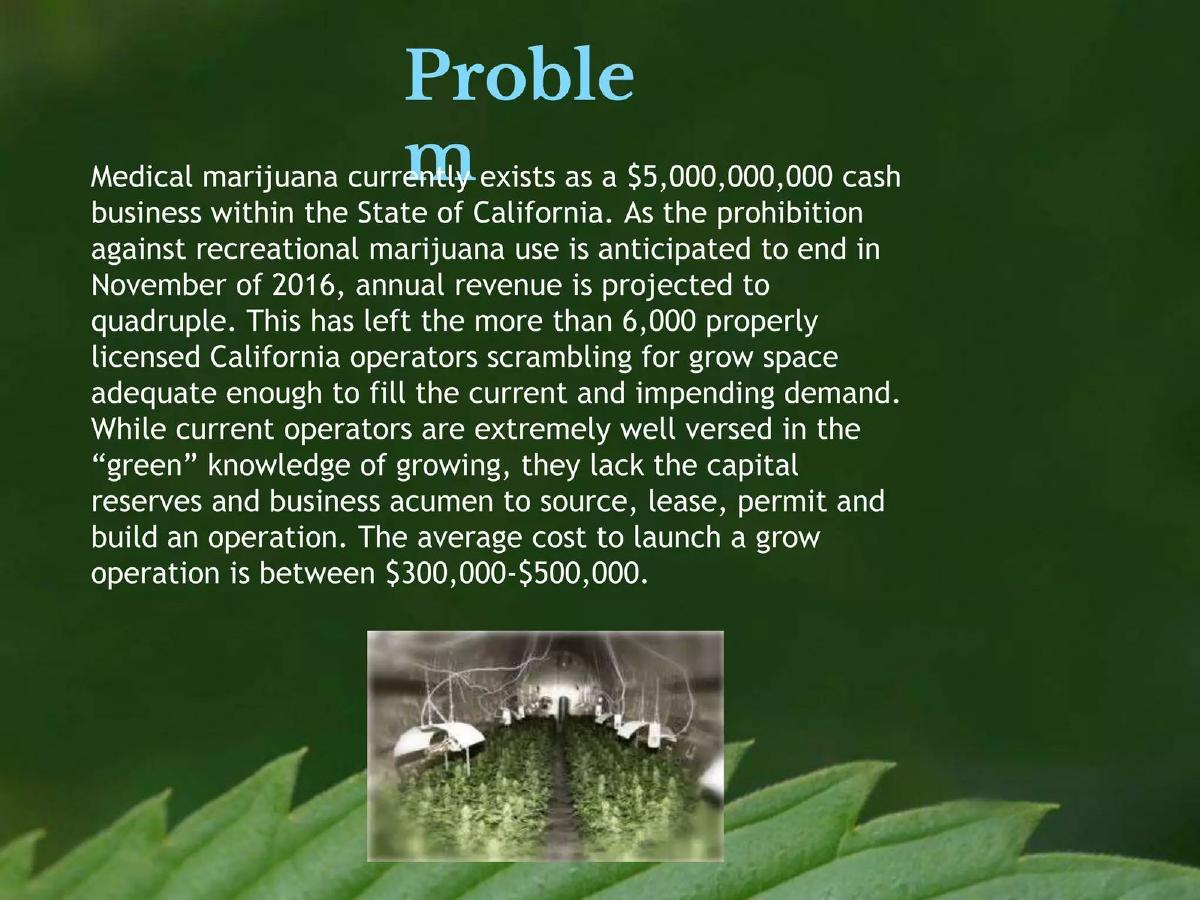
Grow-space development for licensed California operators (2016). A paragraph over a greenhouse photo.
Alaf deck, slide 3. Exact stored slide matched to this analysis.
Our analysis: It names the customer, the shortage (grow space), why they can't fix it, and what fixing it costs.
Evidence and limitation: Market size, operator count and launch cost; no sources.
What a founder can adapt: Give the cost your customer faces doing it themselves.
Supporting analysis
What the deck claims: "Medical marijuana currently exists as a $5,000,000,000 cash business within the State of California." Revenue "is projected to quadruple" after legalisation. "This has left the more than 6,000 properly licensed California operators scrambling for grow space adequate enough to fill the current and impending demand." They "lack the capital reserves and business acumen to source, lease, permit and build an operation. The average cost to launch a grow operation is between $300,000-$500,000."
Presentation choice: The $300,000–$500,000 figure shows why operators would pay someone else to build.
When it does not fit: One dense paragraph; split it into who, what and cost.
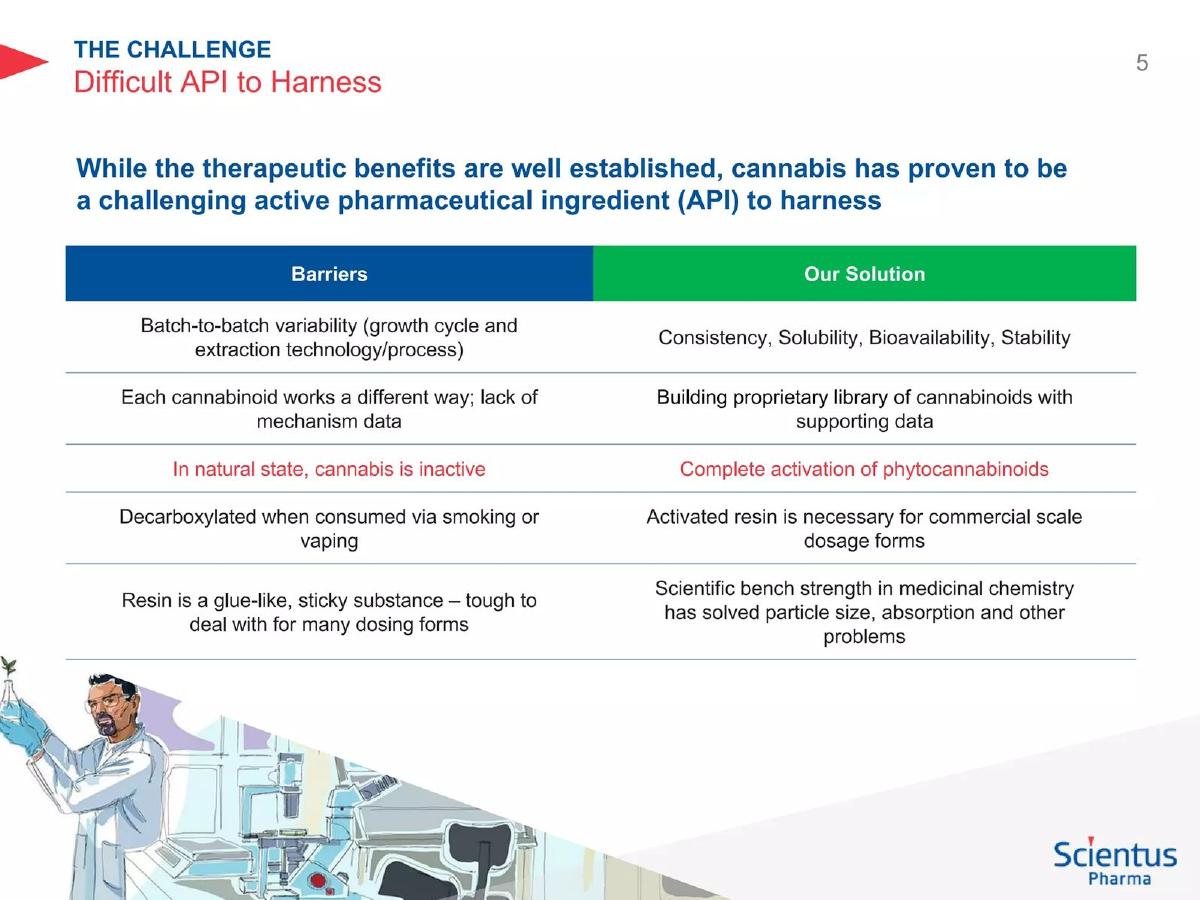
Pharmaceutical cannabinoids. A barriers-and-solutions table.
Scientus Pharma deck, slide 5. Exact stored slide matched to this analysis.
Our analysis: It explains why the product is hard to make, and pairs each barrier with an answer.
Evidence and limitation: Technical barriers; no figures.
What a founder can adapt: List the technical barriers in plain words, one line each.
Supporting analysis
What the deck claims: "The Challenge: Difficult API to Harness." "While the therapeutic benefits are well established, cannabis has proven to be a challenging active pharmaceutical ingredient (API) to harness." Barriers: "Batch-to-batch variability (growth cycle and extraction technology/process)"; "Each cannabinoid works a different way; lack of mechanism data"; "In natural state, cannabis is inactive"; "Resin is a glue-like, sticky substance – tough to deal with for many dosing forms." Each is paired with "Our Solution".
Presentation choice: For a science-led company, the technical barrier is the problem an investor needs to understand.
When it does not fit: Mixing the solution into the problem slide leaves nothing for the next slide.
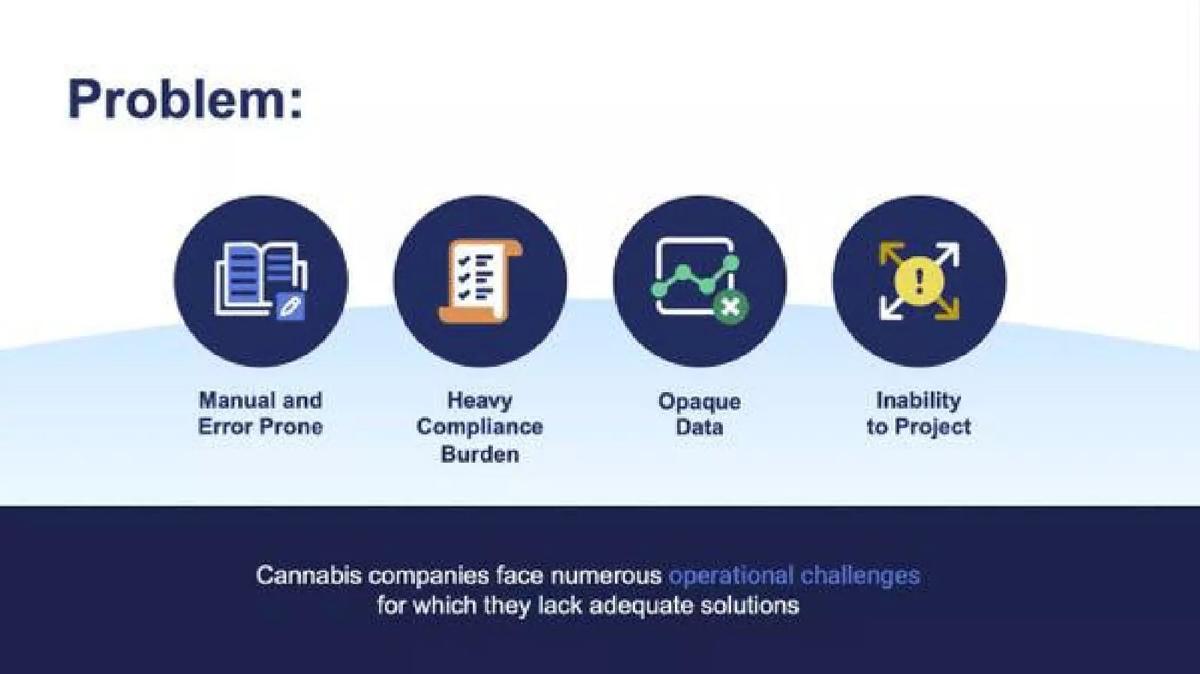
Operations and compliance software for cannabis companies. Four icons and a line.
Canix deck, slide 2. Exact stored slide matched to this analysis.
Our analysis: Four clear labels, but no person or example of what goes wrong.
Evidence and limitation: No figures.
What a founder can adapt: Pick one label and give an example: hours spent on compliance reports each week.
Supporting analysis
What the deck claims: "Problem:" "Manual and Error Prone", "Heavy Compliance Burden", "Opaque Data", "Inability to Project". "Cannabis companies face numerous operational challenges for which they lack adequate solutions."
Presentation choice: The labels map to what the software does.
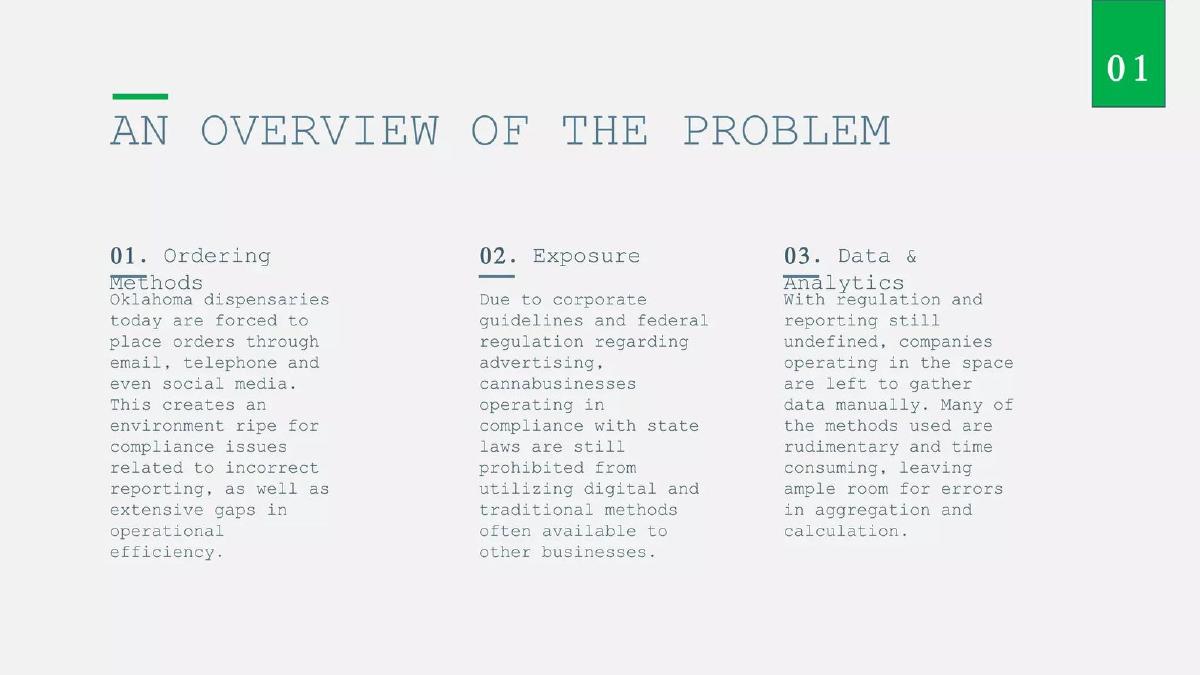
Wholesale ordering for Oklahoma dispensaries. Three numbered columns.
Go-Go Cannabiz deck, slide 2. Exact stored slide matched to this analysis.
Our analysis: It names the customer and the exact workaround (email, phone, social media).
Evidence and limitation: No figures.
What a founder can adapt: Say what your customer does today and where it breaks.
Supporting analysis
What the deck claims: "An overview of the problem." "01. Ordering Methods: Oklahoma dispensaries today are forced to place orders through email, telephone and even social media. This creates an environment ripe for compliance issues related to incorrect reporting..." "02. Exposure: Due to corporate guidelines and federal regulation regarding advertising, cannabusinesses... are still prohibited from utilizing digital and traditional methods often available to other businesses." "03. Data & Analytics: ...companies... are left to gather data manually."
Presentation choice: Describing today's workaround makes the problem easy to picture.
When it does not fit: Very small type; the first column alone would carry the slide.
Marketing services for dispensaries. Four bullets.
Team Maryjane deck, slide 3. Exact stored slide matched to this analysis.
Our analysis: Partial: a clear customer, but the problem is what they lack, not what it costs them.
Evidence and limitation: No figures.
What a founder can adapt: Say what dispensaries lose: customers, fines, ad accounts shut down.
Supporting analysis
What the deck claims: "Market Challenge." "Historically we have seen that dispensaries lack: marketing expertise, marketing experience, regulatory expertise, the time it takes to market effectively." "All of which are essential to compete, present, grow and sustain their businesses."
Presentation choice: Kept to show the "customers lack X" pattern, which describes the solution in reverse.
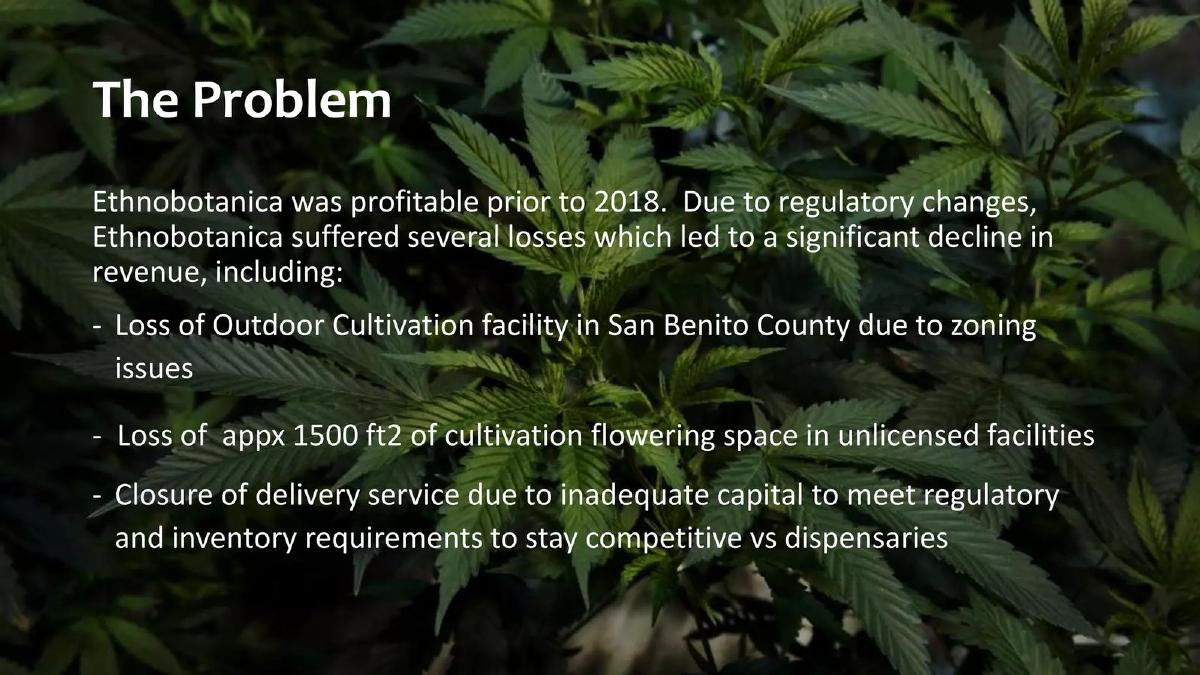
California cultivator and delivery business. Bullets over a leaf photo.
Ethnobotanica deck, slide 4. Exact stored slide matched to this analysis.
Our analysis: Weak on purpose: it describes the company's own losses, not a problem customers have.
Evidence and limitation: Company history; no customer.
What a founder can adapt: If regulation hurt you, say who else it hurt and what they need now.
Supporting analysis
What the deck claims: "The Problem." "Ethnobotanica was profitable prior to 2018. Due to regulatory changes, Ethnobotanica suffered several losses which led to a significant decline in revenue, including: Loss of Outdoor Cultivation facility in San Benito County due to zoning issues; Loss of appx 1500 ft2 of cultivation flowering space in unlicensed facilities; Closure of delivery service due to inadequate capital to meet regulatory and inventory requirements."
Presentation choice: Kept as a contrast; compare Alaf, which describes the same regulatory shift from the customer's side.
When it does not fit: Using the problem slide to explain your own decline.
Whether each slide names who struggles, what goes wrong, and gives evidence.
Example
Who
What goes wrong
Evidence
Cann
Yes (consumer segments)
Yes (quotes)
Partly (quotes)
Alaf
Yes (licensed operators)
Yes (grow space)
Yes (count, cost)
Scientus Pharma
Partly
Yes (technical)
No
B Great
Partly (consumers)
Yes (safety)
No
Canix
Partly (companies)
Partly (labels)
No
Go-Go Cannabiz
Yes (dispensaries)
Yes (workaround)
No
Team Maryjane
Yes (dispensaries)
Partly (what they lack)
No
Ethnobotanica
No (the company)
Own losses
No
Key Takeaways
Name the customer: new consumer, medical patient, licensed grower, dispensary manager.
Regulation is context; the problem is what it costs your customer.
Consumers' own words ("Too strong!") make a product problem concrete.
Give one figure: operators, cost to launch, share of products mislabelled.
A problem slide is about the customer, not your company's past losses.
Build your cannabis problem slide
One customer, what fails them, one figure.
Who. Consumer segment, patient, grower, processor or dispensary?
What fails. Trust, dose, compliance, ordering, space, capital?
Figure. One number with a source: cost, hours, share mislabelled.
Today. What do they do now: email orders, spreadsheets, avoid the product?
Copyable framework: [Customer] [struggles with] because [cause]. [Figure] ([source]). Today they [workaround].
Illustrative example 1 — written by us
Before: Cannabis companies face numerous operational challenges.
After: A dispensary manager spends about 9 hours a week reconciling sales with the state tracking system by hand; one mismatch can mean a fine. (Figures from our interviews with 25 managers.)
What improved: Our illustrative rewrite; the figures are invented for the example. It names the person, the task, the time and the risk.
What this guide adds
No other guide in the library covers cannabis. None of these eight slides appears elsewhere; the testimonial guide uses Canix slide 5, not its problem slide.
Cannabis problems usually fall into three kinds: consumers who don't trust or enjoy the product, businesses buried in compliance and manual work, and growers or dispensaries short of space, capital or expertise.
Three things a cannabis problem slide proves
Who: "Canna-Casual" and "Canna-Curious" consumers (Cann), "6,000 properly licensed California operators" (Alaf), "Oklahoma dispensaries" (Go-Go Cannabiz).
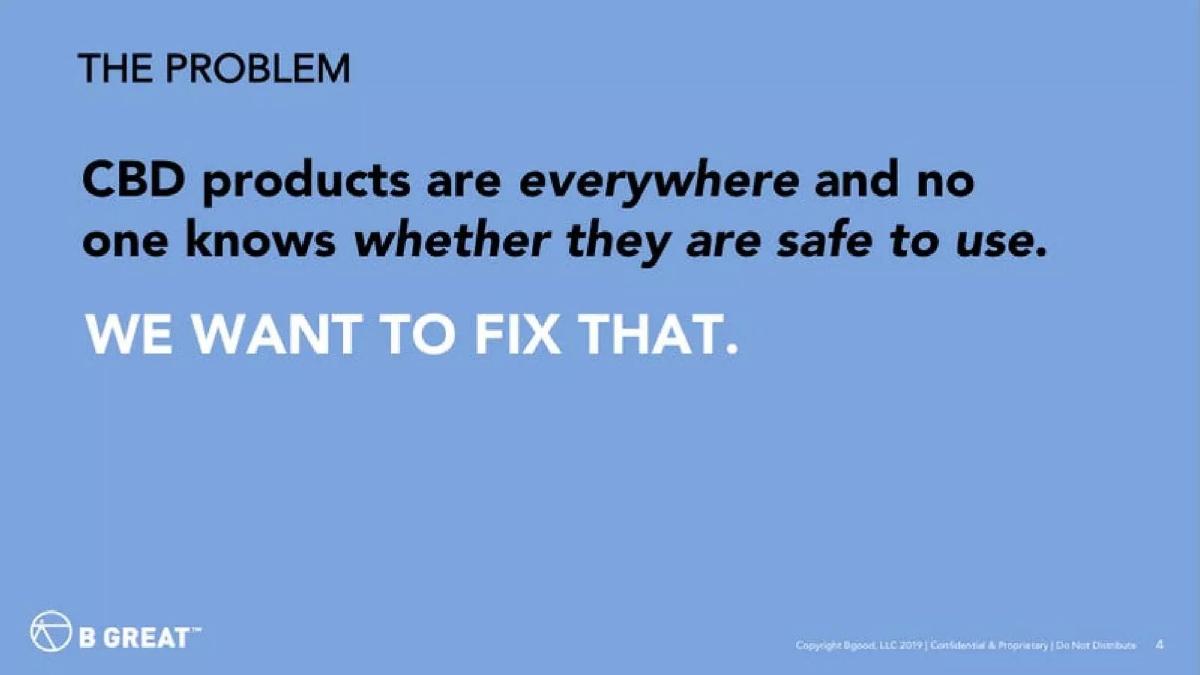
What goes wrong: "no one knows whether they are safe to use" (B Great); orders placed "through email, telephone and even social media" (Go-Go Cannabiz); "Batch-to-batch variability" (Scientus Pharma).
Evidence: "$5,000,000,000 cash business", "$300,000-$500,000" to launch a grow (Alaf).
Common mistakes
Regulation as the problem. Say what the rule costs your customer.
Your company's history. The problem slide is about customers.
"They lack what we sell". Say what the gap costs them.
Icons without a customer. Name who has each problem.
Market size in place of a problem. A $5 billion market isn't a pain.
Diagnostic checklist
It names one customer.
It says what fails them.
It gives one figure with a source.
It says what they do today.
It describes the customer's problem, not yours.
Frequently asked questions
How we chose these examples
Corpus: published pitch deck teardowns on StartupFundraising.com. Founder-uploaded private decks are excluded.
Selection (2026-09-25): we searched slides 2–5 for problem slides mentioning cannabis, marijuana, dispensaries, hemp or CBD. Nine stored images were inspected. Fundanna slide 3 (access to investment capital) was left out to keep investment-product decks out of this guide; Holy Grail, Green Flower Media and CanniMed slides were left out as opportunity or overview slides. Team Maryjane is marked partial; Ethnobotanica is kept as a weaker contrast.
Overlap check: none of these eight slides appears in another guide. The testimonial guide uses Canix slide 5, not its problem slide.
Review: all eight stored slide images were inspected on 2026-09-25 and matched to company, deck and slide number (editorial model review). No person has yet completed an editorial review of this page.
Claims are as shown on the slides; we have not verified them. We make no claim that any slide caused a fundraising outcome. Cannabis laws vary by jurisdiction; nothing here is legal advice.