GO GO CANNABIZ is a B2B marketplace and data analytics platform designed specifically for the cannabis industry, with an initial focus on the Oklahoma market. The deck, dated August 2019, highlights the inefficiency of manual ordering methods and the lack of digital exposure for cannabis brands due to federal regulations. By September 2015, the company reported 202 retail buyer accounts and 36 active brands on its platform. The company sought to raise over $1MM to scale sales, support operations, and expand into a secondary state by Q3 2020. The deck relies heavily on Oklahoma's status as a t…
Key takeaways
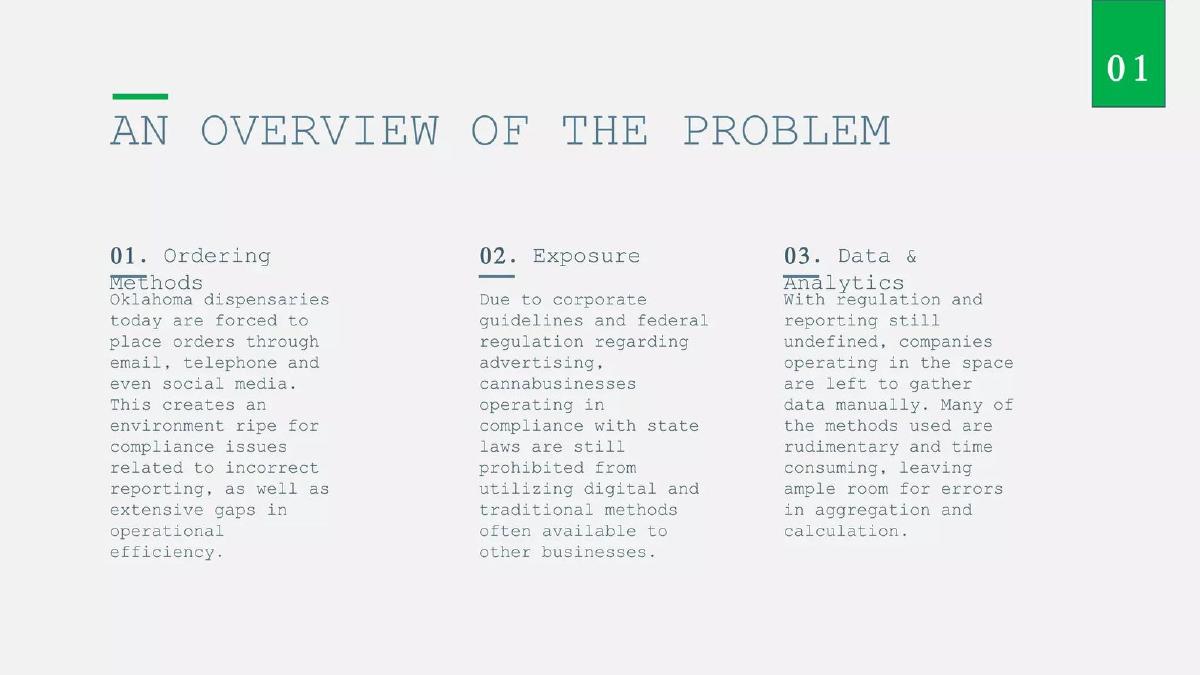
- The company identifies a specific pain point in Oklahoma where dispensaries are forced to order via email, phone, and social media (Slide 1).
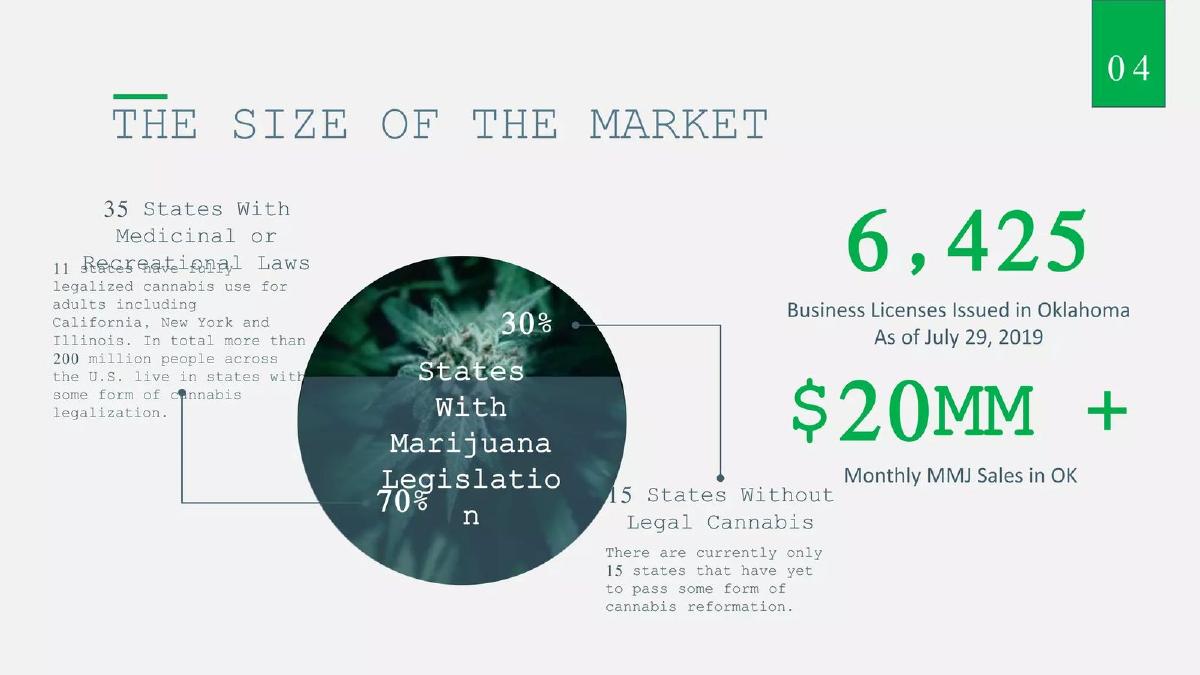
- Oklahoma is positioned as the primary proof-of-concept market, citing 6,425 business licenses issued as of July 29, 2019 (Slide 4).
- The platform reported 202 retail buyer accounts and 36 active brands as of September 15, 2019 (Slide 11).
- The Year 1 achievement goal is $250,000 in annual recurring revenue from 400 Oklahoma businesses (Slide 6).
- The revenue model is diversified across brand subscriptions, retail subscriptions, in-app ads, and supply chain management (Slide 8).
- The funding ask is for more than $1MM over the next 8-12 months to facilitate expansion into a second state (Slide 9).
- Budget allocation is heavily weighted toward Direct Sales (40%) and Ongoing Development (33%) (Slide 10).
- The team includes a serial entrepreneur and a Director of Strategy with experience in Dell enterprise software and SaaS marketplaces (Slide 12).
Executive Summary: The Oklahoma Beachhead
The GO GO CANNABIZ pitch deck, dated August 2019, presents a classic "beachhead" strategy. By focusing intensely on the rapidly expanding Oklahoma medical marijuana market, the company attempts to solve the logistical and compliance headaches inherent in a fragmented, highly regulated industry. The deck is structured to move from the specific local problem to a broader national opportunity, supported by early traction metrics and a multi-faceted revenue model.
Slide 1: An Overview of the Problem
The deck opens by identifying three critical friction points in the cannabis supply chain. First, it highlights that Oklahoma dispensaries are currently using "rudimentary" ordering methods like email, telephone, and social media, which leads to compliance risks and operational gaps. Second, it notes the "Exposure" problem: federal regulations prevent cannabis businesses from using traditional digital advertising. Third, it points out that data and analytics are still gathered manually, increasing the margin for error in regulatory reporting. This slide effectively establishes a need for a centralized, digital B2B platform.
Slide 2: Our Solution
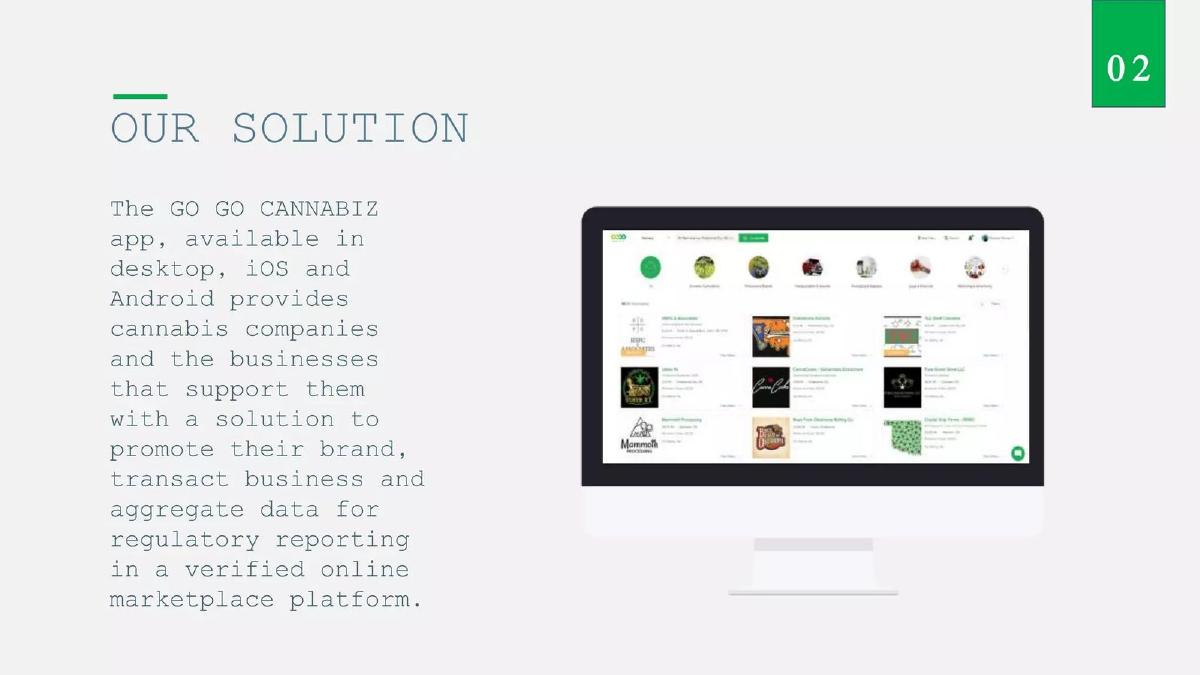
The solution is presented as the GO GO CANNABIZ app, available on desktop, iOS, and Android. It is described as a "verified online marketplace platform" that allows companies to promote their brands, transact business, and aggregate data for regulatory reporting. A single screenshot of a desktop dashboard is provided, showing a grid of various cannabis brands and categories, suggesting a functional UI already exists.
Slide 3: GO GO ON THE GO
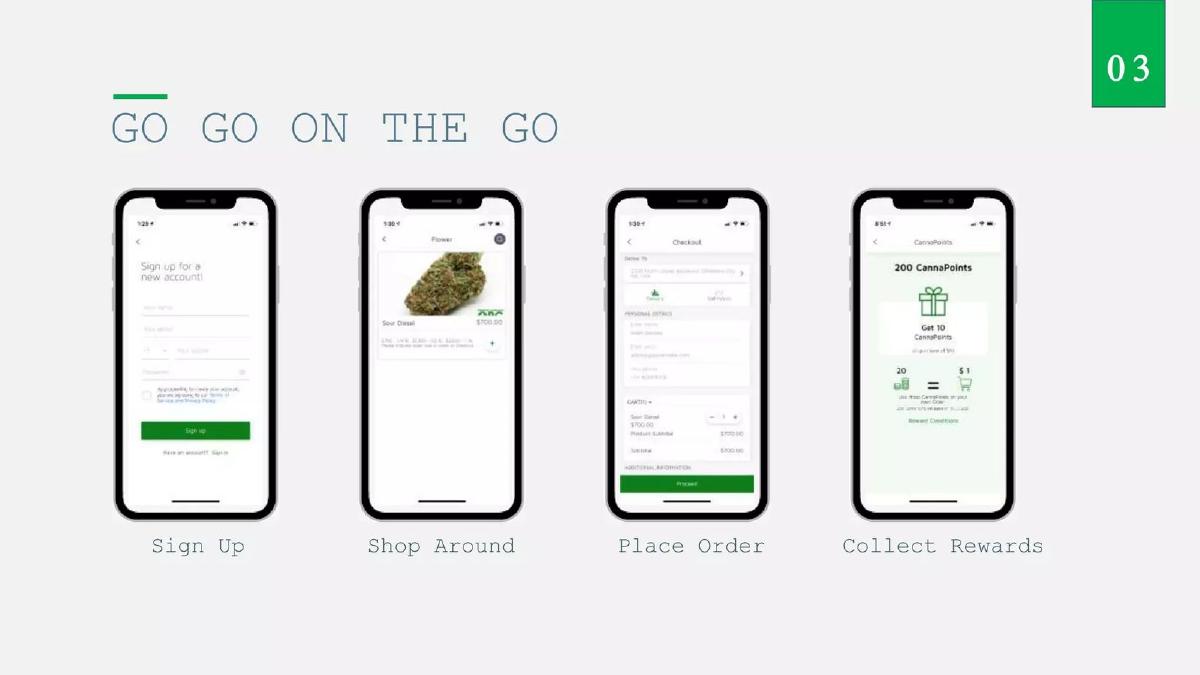
This slide focuses on the mobile user experience. It displays four iPhone mockups illustrating the user journey: Sign Up, Shop Around, Place Order, and Collect Rewards. The inclusion of a "CannaPoints" rewards system (shown as 200 CannaPoints = $1) suggests the platform aims to build user loyalty through gamification, a feature often found in B2C apps but applied here to a B2B context.
Slide 4: The Size of the Market
The company provides a macro and micro view of the market. Nationally, it notes 35 states with medicinal or recreational laws and over 200 million people living in states with some form of legalization. However, the most compelling data is local: 6,425 business licenses issued in Oklahoma as of July 29, 2019, and over $20MM in monthly medical marijuana sales in the state. This justifies the company's decision to start in Oklahoma.
Slide 5: Keen to be Green
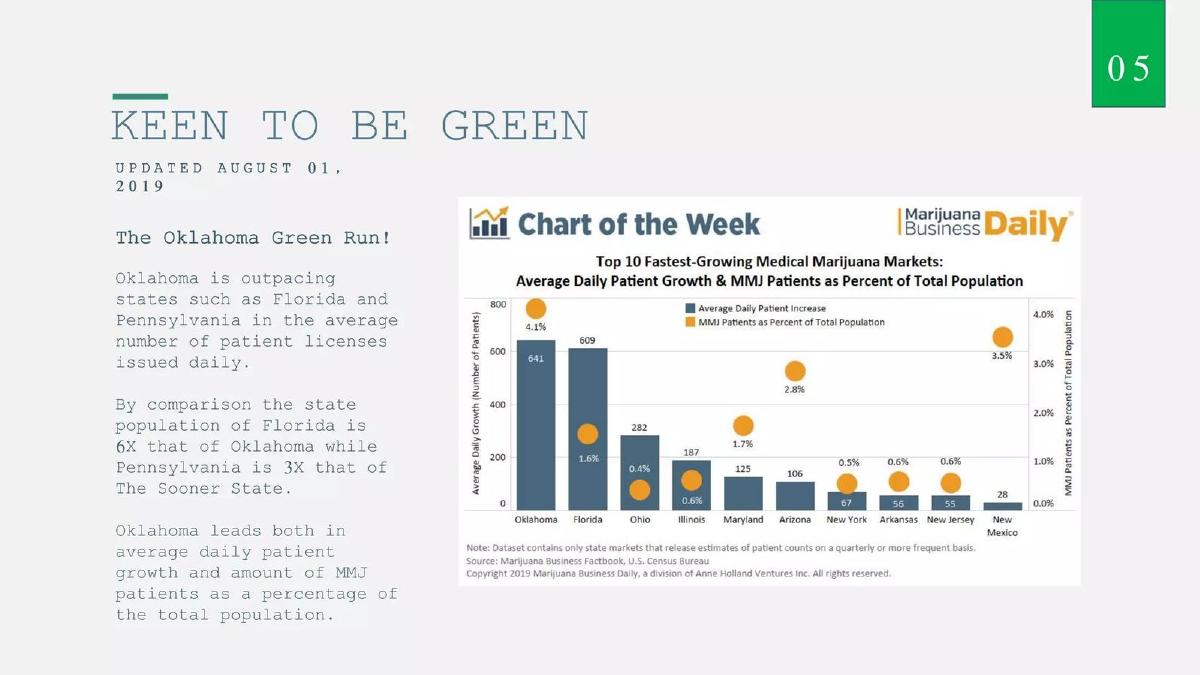
Using a "Chart of the Week" from Marijuana Business Daily, this slide reinforces the Oklahoma opportunity. It shows Oklahoma as the fastest-growing medical marijuana market in terms of average daily patient growth (641 patients per day) and MMJ patients as a percentage of the total population (4.1%). The slide notes that Oklahoma's growth outpaces much larger states like Florida and Pennsylvania, positioning the "Sooner State" as the ideal testing ground for the platform.
Slide 6: Achievement Goals Year 1
The company sets specific targets for its first year of full operations starting May 2020. The primary goal is $250,000 in annual recurring revenue (ARR) derived from 400 Oklahoma business subscribers. Additionally, the company aims to launch in one additional state (Missouri) by Q3 2020. This slide provides clear, measurable milestones for potential investors to track.
Slide 7: Go To Market Strategy
The GTM strategy is a mix of digital and traditional outreach. It includes automated email campaigns for new sign-ups, managed social media, direct outbound sales to licensed businesses, and presence at tradeshows. The strategy emphasizes Oklahoma as the initial proof of concept before scaling, which aligns with the previous slides' data.
Slide 8: Projected Revenue Sources
This is one of the most detailed slides in the deck, outlining six distinct revenue streams:
Brand Subscriptions: Tiered feature sets for brands on the marketplace. · Retail Subscriptions: An Amazon Prime-style membership for retailers including loyalty incentives like "Cannabux." · In-App & Newsletter Ads: Customizable banner ads for licensed and supporting businesses. · Order Management: Low monthly subscriptions for brands to accept online orders. · Custom Orders: Revenue from products not listed by subscribing brands, fulfilled by contracted brokers. · Supply Chain Management: Revenue sharing with third-party logistics or direct fulfillment services.
Slide 9: Our Ask
The company seeks to raise "more than $1MM" in equity and/or debt financing over the next 8-12 months. The stated purpose of the funds is to scale sales and client support, continue software development, and provide a runway for deployment into new markets. The slide does not specify a valuation or a precise dollar amount beyond the $1MM floor.
Slide 10: How Funds Will Be Deployed
The $1MM ask is broken down by percentage: 40% for Direct Sales (training an experienced sales force), 33% for Ongoing Development (UX and feature enhancement), 17% for Marketing (social media and tradeshows), and 10% for Operations & Support. Interestingly, it notes that hosting costs are currently estimated at only $1,000 - $1,500 per month, suggesting a lean technical operation.
Slide 11: By The Numbers
Updated as of September 15, 2019, this slide provides the most recent traction data. It lists 202 retail buyer accounts, 36 active brands, 100+ connections made daily, and 120+ products on the marketplace. It also mentions that over $50,000 worth of wholesale cannabis SKUs are available, providing a snapshot of the platform's early liquidity.
Slide 12: Meet Our Talented Team
The team slide features two named individuals and two corporate partners. Zach Williams is the Founder/President and is described as a serial entrepreneur. Adam Belusko is the Director of Strategy, with a background in selling Dell enterprise software and developing a SaaS marketplace for the U.S. blood industry. The slide also lists "DEV Partners" and "Strategic Partnerships" with Canna Solutions and Blue Woods Technology, which reportedly provide investment and resources.
Slide 13 & 14: Contact and Closing
The deck concludes with contact information, including a website, email, and phone number based in Oklahoma City, OK. The background imagery of a greenhouse reinforces the industry focus.
What Works in This Deck
Hyper-Local Focus: By leaning into Oklahoma's specific regulatory environment and growth metrics, the founders make a strong case for why they are starting there. They don't just say the cannabis market is big; they prove that the Oklahoma market is uniquely underserved and growing faster than its peers.
Clear Traction: Slide 11 provides hard numbers that show the platform is already live and facilitating business. Having 202 retail accounts and 36 brands before a major raise is a significant validator for a B2B marketplace.
Diversified Revenue: The revenue model on Slide 8 is sophisticated. It moves beyond simple subscriptions to include advertising, logistics, and brokerage, suggesting the founders have thought deeply about how to capture value at multiple points in the supply chain.
What is Missing or Weak
Competitive Landscape: The deck completely omits a competitor slide. In 2019, companies like LeafLink were already established players in the B2B cannabis marketplace space. Failing to address how GO GO CANNABIZ differentiates itself from national incumbents is a major oversight.
Unit Economics: While the deck mentions a $250k ARR goal from 400 businesses, it doesn't break down the Customer Acquisition Cost (CAC) or the Lifetime Value (LTV). Given that 40% of the raise is going to direct sales, investors would want to know the efficiency of that spend.
Technical Depth: The "DEV Partners" section is vague. For a software-led marketplace, not having a named CTO or a clear internal engineering team can be a red flag for investors worried about technical debt or platform scalability.
Founder Takeaways
Use Local Data to Build a Global Case: If you are starting in a specific geography, don't just use national TAM (Total Addressable Market) figures. Follow this deck's lead by showing why your specific starting point is the most efficient place to build a proof of concept.
Quantify the "Manual" Pain: Slide 1 does a great job of explaining exactly how business is currently done (email, phone, social media). When you can point to specific, inefficient behaviors, your solution feels much more necessary.
Be Specific with the Ask: While the $1MM figure is a bit vague, the percentage breakdown of how that money will be spent (Slide 10) is helpful. It tells the investor exactly what kind of company you are building—in this case, a sales-heavy organization.
Frequently asked questions
- What is the core problem GO GO CANNABIZ solves?
- According to slide 1, the company addresses three main issues: inefficient ordering methods (email/phone), lack of digital exposure for brands due to federal advertising regulations, and rudimentary manual data gathering for regulatory reporting. They aim to digitize these processes to improve operational efficiency and compliance accuracy for Oklahoma-based dispensaries and growers.
- How does the company plan to generate revenue?
- Slide 8 outlines six projected revenue sources: brand subscriptions based on tiered features, retail subscriptions similar to Amazon Prime, in-app and newsletter banner ads, order management fees, fulfillment of custom orders via brokers, and supply chain management fees through logistics partnerships or direct fulfillment services.
- What traction did the company have at the time of the deck?
- Slide 11, updated September 15, 2019, shows the platform had 202 retail buyer accounts, 36 active brands, and over 120 products on the marketplace. It also notes that more than $50,000 worth of wholesale Oklahoma cannabis SKUs were available on the platform for delivery or pickup.
- What is the geographic expansion strategy?
- The deck focuses almost entirely on Oklahoma as the initial proof of concept. Slide 6 and 7 indicate a goal to reach 400 Oklahoma business subscriptions by May 2020 before launching into a second state, specifically targeting Missouri (indicated by the 'MO' icon) by Q3 2020.
- How is the requested $1MM investment intended to be used?
- Slide 10 breaks down the deployment of funds: 40% for Direct Sales (hiring and training a sales force), 33% for Ongoing Development (software features and UX), 17% for Marketing (social media, tradeshows, email), and 10% for Operations & Support (estimated at $1,000 - $1,500 per month for hosting).