Glyphic AI’s pre-seed deck is a masterclass in visual simplicity, focusing almost entirely on the product experience and its place within the existing sales tech stack. By raising $5.5M in 2024, the London-based startup demonstrated that a clear vision for AI integration can outweigh the need for dense financial slides in early-stage rounds. The deck emphasizes three core pillars: call preparation, effective follow-ups, and CRM data synchronization. While it lacks traditional slides for team, market size, and competition, it compensates with high-fidelity UI mockups and a clear integration ma…
Key takeaways
- The deck focuses heavily on the product workflow, specifically highlighting call preparation and CRM syncing on slide 4.
- Glyphic identifies as an 'AI Copilot' that provides users with information when they need it, as stated on slide 2.
- The company positions itself as a solution to data silos by integrating with eight major platforms including Salesforce, HubSpot, and Slack on slide 5.
- The deck omits a dedicated team slide, suggesting the founders may have relied on external reputation or supplementary materials.
- There is no explicit 'Ask' slide detailing the $5.5M raise or how the funds will be allocated.
- The visual narrative centers on making sales teams 'superhuman' by automating manual data entry, according to slide 1.
- The presentation lacks market sizing (TAM/SAM/SOM) and competitive analysis slides.
- Product utility is demonstrated through three specific use cases: Prep sheets, follow-up messages, and CRM insights on slide 4.
The Product-First Pre-Seed Strategy
Glyphic AI’s pre-seed deck is a lean, 11-slide presentation that prioritizes product utility over market theory. In an era where AI startups are often criticized for being 'wrappers' around LLMs, Glyphic uses its deck to demonstrate deep workflow integration. As reported by Business Insider, the company raised $5.5M in 2024, a significant sum for a pre-seed round in the European market. The deck’s design is minimalist, utilizing a dark theme with high-contrast accents to guide the investor’s eye toward the software interface.
Slide 1: The Hook
The title slide introduces the brand and the core mission: 'Make your sales team superhuman.' It clearly labels itself as a 'Pre-Seed Deck' and includes a LinkedIn social link. The subtitle, 'YOUR AI COPILOT,' immediately categorizes the product within the emerging generative AI landscape. The visual language—a stylized gear logo—suggests mechanics, efficiency, and integration.
Slide 2: The Thesis
Slide 2 presents the company’s underlying philosophy: 'AI fundamentally changes the way we work with software and data.' This is a high-level vision slide meant to align the investor with the founder's worldview. It makes a specific prediction: 'AI copilots will provide users with the information they need when they need it.' This sets the stage for a product that is proactive rather than reactive.
Slide 3: The Value Proposition
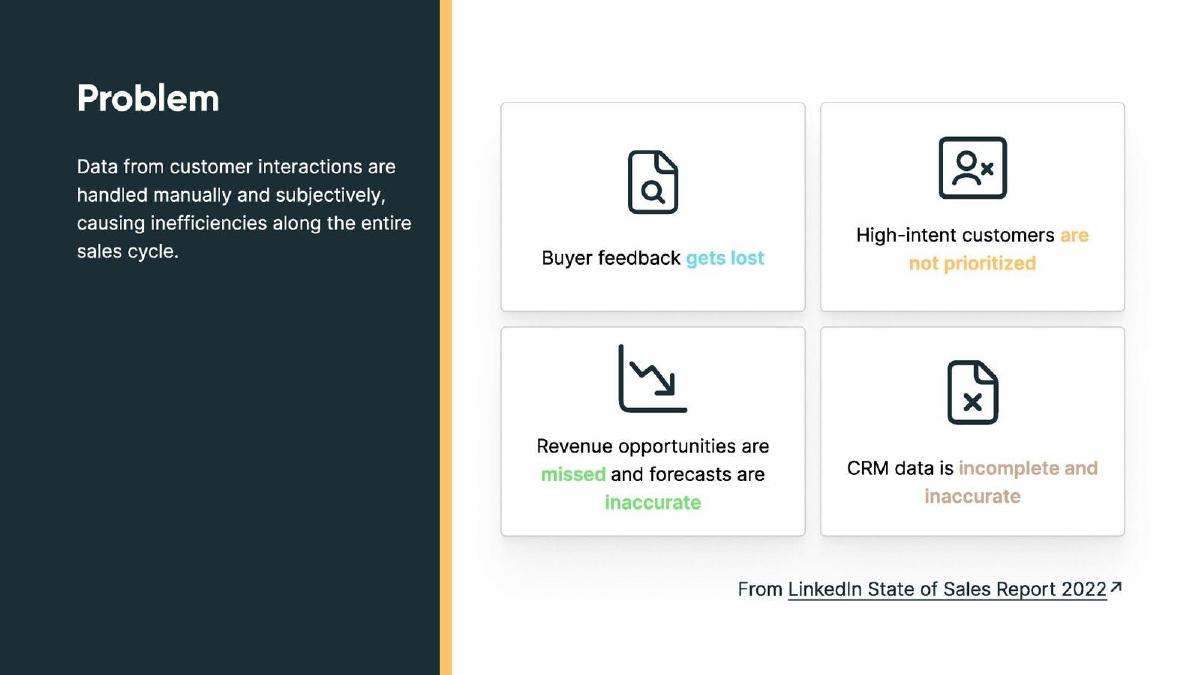
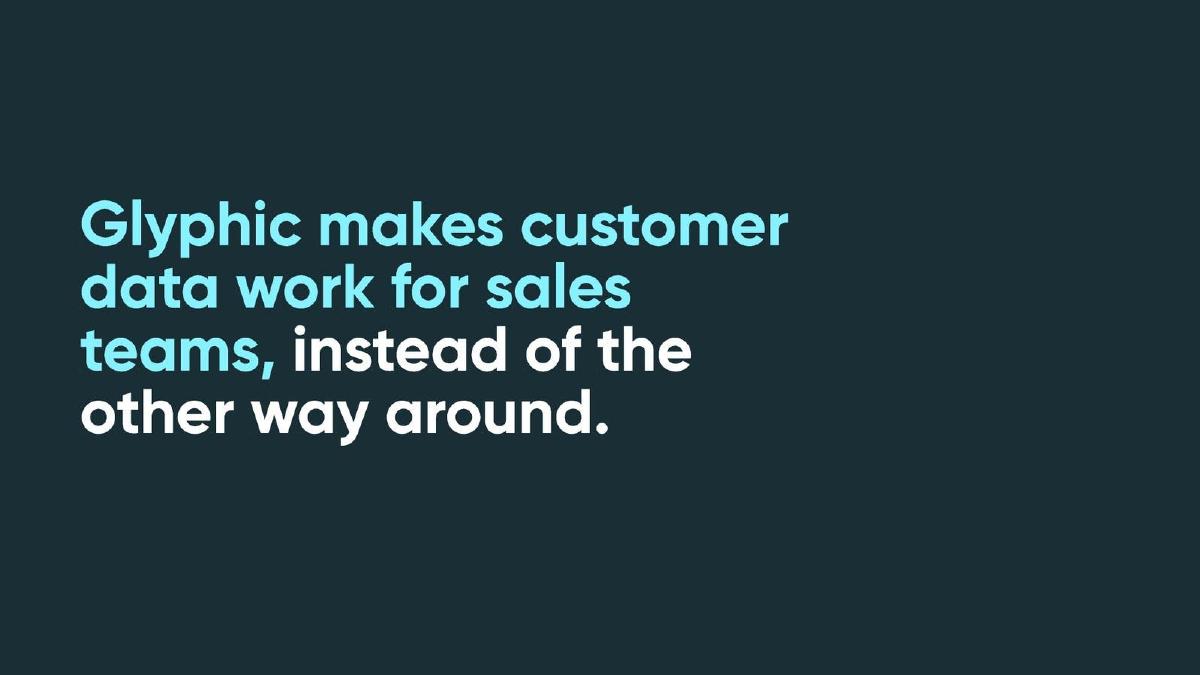
This slide delivers the 'flip'—the core benefit of the technology. It states, 'Glyphic makes customer data work for sales teams, instead of the other way around.' This addresses a common pain point in sales: the administrative burden of CRM maintenance and data retrieval. It promises a shift from manual labor to automated insight.
Slide 4: The Product Workflow
Slide 4 is the most information-dense slide in the deck. It breaks the sales cycle into three distinct phases, each accompanied by a UI mockup. First is 'Call Preparation,' showing a 'prep sheet' in a Gmail-like interface that includes 'Things to remember' and 'Relevant Case Study.' Second is 'Effective Follow-ups,' which highlights an 'Auto Generate Follow Up Message' button and a timeline of the discovery call. Third is 'Data is key,' showing a 'Send to CRM' interface that captures buyer questions, needs, and next steps. This slide proves the product isn't just a concept; it has a defined user interface and specific touchpoints in the salesperson's day.
Slide 5: The Ecosystem and Integration
To be a 'copilot,' a tool must live where the work happens. Slide 5 addresses the technical feasibility and utility of Glyphic by showing its integrations. The slide claims to 'eliminate data silos' by connecting with Salesforce, HubSpot, Pipedrive, Slack, Outlook, Gong, Google, Zoom, and Microsoft Teams. The text explains that their Generative AI identifies 'unique insights about your process, buyers, and team' by capturing data from all these sources simultaneously.
Slide 6: The Conclusion
The final visible slide is a simple 'Thank you!' with a contact email (hello@glyphic.ai) and a LinkedIn icon. It maintains the brand’s minimalist aesthetic, using the gear logo as a background graphic. While the deck continues for five more slides (labeled 'g' in the provided text), the core narrative is established in these first six frames.
What Glyphic AI Does Well
Visual Clarity: The deck avoids the 'wall of text' trap. By using large headers and clear UI mockups, it allows investors to grasp the product's function in seconds. The use of actual software screenshots (or high-fidelity mockups) on slide 4 provides a sense of 'realness' that abstract diagrams lack.
Workflow Integration: Instead of pitching 'AI for sales,' Glyphic pitches a specific improvement to the sales workflow. By breaking it down into Prep, Follow-up, and CRM Sync, they show they understand the daily life of a Sales Development Representative (SDR) or Account Executive (AE).
The Integration Map: Slide 5 is a powerful credibility builder. By showing the logos of established giants like Salesforce and Zoom, Glyphic positions itself as a necessary layer on top of an expensive, existing tech stack rather than a replacement that requires a difficult 'rip and replace' sales cycle.
What is Missing from the Deck
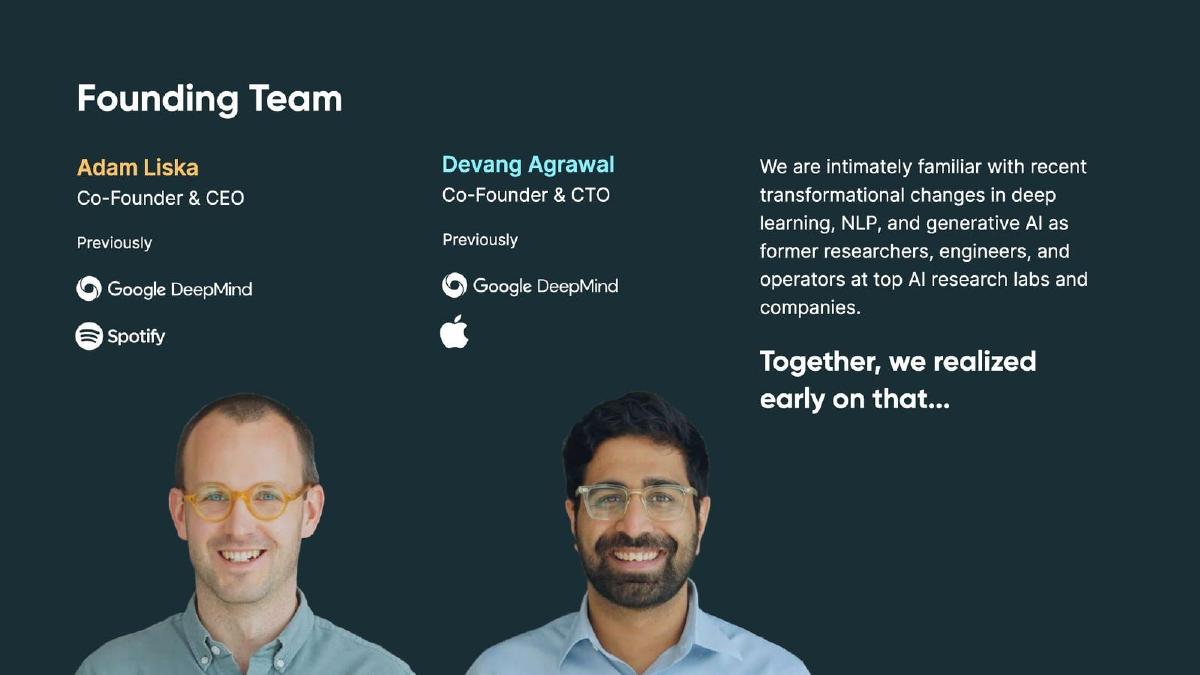
The Team Slide: The most glaring omission in the provided slides is the team. In a $5.5M pre-seed round, the founders' backgrounds are usually the primary reason for the investment. Without seeing the team slide, we don't know if the founders come from Google, DeepMind, or a successful sales background, which would be critical context for this raise.
Market Size and Competition: There is no slide addressing the Total Addressable Market (TAM) or how Glyphic differentiates itself from competitors like Gong, Chorus, or other AI sales tools. While the product looks sleek, the sales tech space is incredibly crowded, and a professional investor would want to see how Glyphic intends to win.
Business Model and Ask: The deck does not explain how Glyphic makes money (SaaS seats, usage-based, etc.) or how much they are raising. While the publisher reports a $5.5M raise, the deck itself remains silent on the financial requirements and the milestones the company intends to hit with that capital.
Founder Takeaways
Show, Don't Just Tell: If you are building an AI tool, show the specific interface where the AI interacts with the user. Glyphic’s slide 4 is a perfect example of how to visualize a multi-step process. · Focus on 'Data Silos': In the enterprise space, 'data silos' is a perennial pain point. Positioning your AI as the bridge between existing tools (as seen on slide 5) is a more effective strategy than trying to replace the entire stack. · Keep the Vision Simple: Slide 2 and 3 use very few words to establish a massive vision. Founders should aim for one 'thesis' statement per slide to ensure the message isn't lost in the details. · Design Matters: The consistent use of brand colors, professional typography, and high-quality graphics suggests a level of polish and attention to detail that investors associate with high-quality engineering.
Frequently asked questions
- How much did Glyphic AI raise with this deck?
- According to publisher-reported facts from Business Insider, Glyphic AI raised $5.5M in a pre-seed round in 2024. Interestingly, the deck itself does not mention the specific dollar amount or the terms of the raise, which is common for decks intended for initial pitches where the 'ask' is discussed in person.
- What is the primary problem Glyphic AI claims to solve?
- Based on slide 5, the primary problem is 'data silos.' The deck argues that sales teams are currently working for their data rather than the data working for them. Glyphic aims to solve this by capturing data from all sources to identify unique insights about buyers and processes.
- Which integrations does Glyphic AI support?
- Slide 5 displays logos for eight major integrations: Salesforce, HubSpot, Pipedrive, Slack, Outlook, Gong, Google (G-Suite), Zoom, and Microsoft Teams. This suggests the product is designed to sit on top of the existing sales and communication stack rather than replacing it.
- Does the deck include a team slide?
- No, the provided 11-slide deck does not include a team slide. While the publisher notes the company is London-based, the deck relies entirely on product value propositions and UI mockups. In a pre-seed round, this usually indicates the founders have a strong enough pedigree that the product vision takes center stage.
- What are the three main features highlighted in the deck?
- Slide 4 outlines the core workflow: 1. Call Preparation (data-driven sales playbooks), 2. Effective Follow-ups (suggesting collateral and auto-generating messages), and 3. Data Syncing (magically syncing insights from calls directly into the CRM system).