Glyde presents a bold vision for the private aviation market, aiming to offer flights starting at just $99 via a streamlined mobile application. The deck relies heavily on high-level market statistics from Forbes and a simple 30% commission business model. While the team includes a pilot with eight years of experience and a high-profile marketing lead in Bryant McKinnie, the presentation lacks critical financial depth. Specifically, the deck fails to explain how a $99 price point covers the immense overhead of private jet operations, nor does it provide a clear roadmap for customer acquisitio…
Key takeaways
- The company claims a starting price point of $99 for private jet bookings, as stated on Slide 1.
- The business model relies on a 30% commission per transaction with a projected $50 average fee, according to Slide 4.
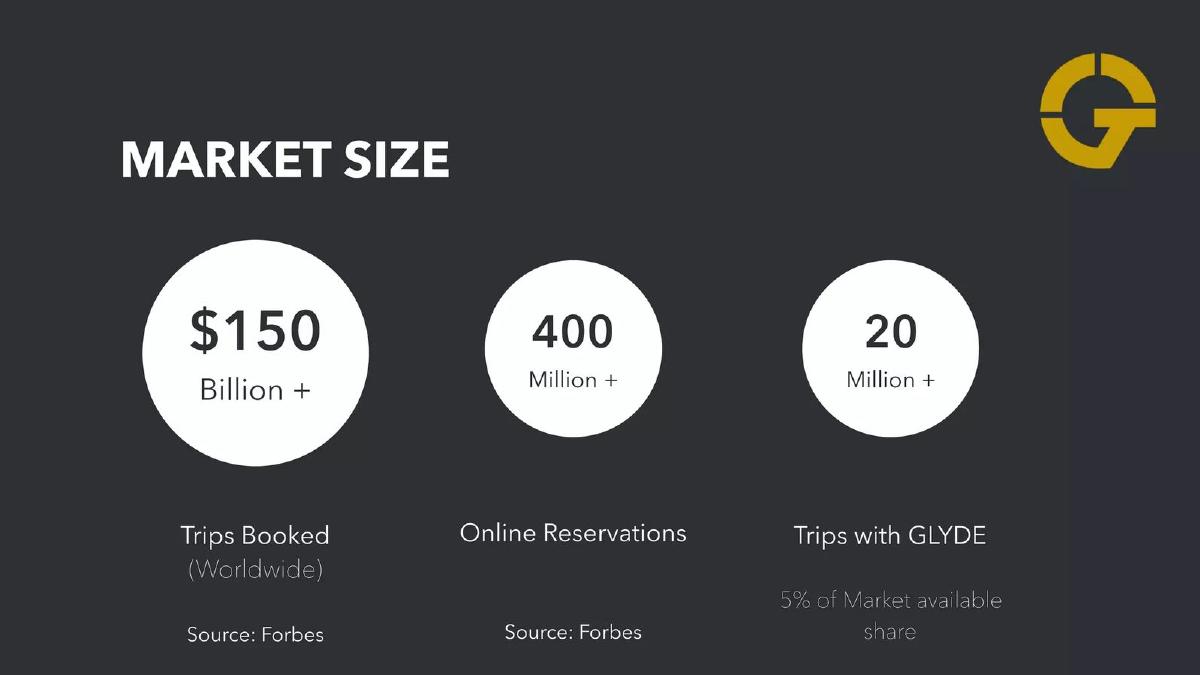
- Glyde targets a $150 Billion+ worldwide market for booked trips, citing Forbes on Slide 3.
- The revenue goal is set at $10M by 2021, though the deck lacks a starting date or current revenue figures (Slide 4).
- The team features Bryant McKinnie, a Super Bowl XLVII champion, to lead marketing efforts (Slide 6).
- Founder Angelo Senat brings 8 years of aviation management experience and holds a trademark for 'Royal Jets' (Slide 6).
- The deck omits a formal 'Ask' slide, leaving investors unaware of the capital requirements or valuation expectations.
- User testimonials on Slide 7 refer to 'Royal Jets' rather than Glyde, indicating potential brand inconsistency or a recent pivot.
Slide-by-Slide Analysis
Slide 1: Title Slide
The cover slide introduces the company name, GLYDE , accompanied by a gold 'G' logo. The value proposition is stated clearly: 'Book private jet starting at $99 in 3 clicks.' This is a high-impact hook, as $99 is an exceptionally low price point for private aviation, which typically costs thousands of dollars per hour. The '3 clicks' promise emphasizes a frictionless user experience.
Slide 2: Solution
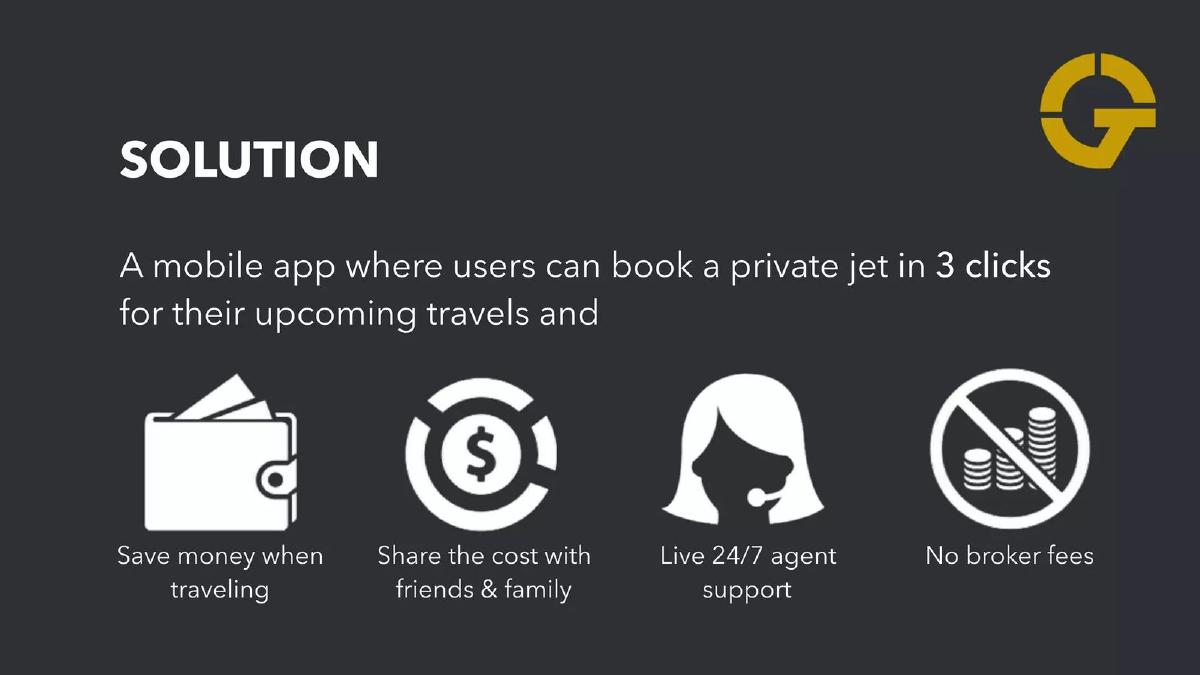
This slide defines the product as a mobile app. It lists four key benefits: Save money when traveling , Share the cost with friends & family , Live 24/7 agent support , and No broker fees . The mention of sharing costs suggests a 'seat-sharing' or 'shuttle' model rather than chartering an entire aircraft, which explains the $99 starting price mentioned on the title slide. The 'No broker fees' claim is interesting given that the business model slide later mentions a commission.
Slide 3: Market Size
Glyde uses three circles to represent their market opportunity. They cite Forbes as the source for a $150 Billion+ total market for worldwide trips and 400 Million+ online reservations. The third circle represents their target: 20 Million+ 'Trips with GLYDE,' which they define as a 5% share of the available market. This slide is quite broad; it uses general travel data rather than specific private aviation or luxury travel segment data, which may lead to an overestimation of the serviceable addressable market (SAM).
Slide 4: Business Model
The revenue strategy is straightforward: 'We take a 30% commission on each transaction.' The slide lists three key figures: 400,000 Trips with GLYDE , a $50 Average Fee , and $10M Revenue by 2021 . There is a mathematical disconnect here: 400,000 trips multiplied by a $50 fee equals $20 million, not $10 million. Furthermore, if the average fee is $50 and that represents a 30% commission, the average transaction value would be approximately $166. This aligns with the '$99 starting at' hook but raises questions about the profitability for the aircraft operators.
Slide 5: Competition
The competitive landscape is mapped on a 2x2 grid. The Y-axis ranges from 'Expensive' to 'Affordable,' and the X-axis ranges from 'Offline Transaction' to 'Online Transaction.' Glyde places itself in the 'Affordable/Online' quadrant. Competitors like Blade and JetSuite are marked as online but less affordable. Victor and Jumpjet are placed toward the 'Expensive' bottom, while Share-A-Jet is categorized as an offline, expensive service. The deck does not explain why Glyde is more affordable than these established players.
Slide 6: Team
The team slide features four individuals. Angelo Senat is the lead, noted as a pilot with 8 years of aviation management experience. Bianca Alexis brings public relations and business development experience from Royal Jets, Inc. Kristina Rudoman is credited with 6+ years of startup managerial experience. The most notable name is Bryant McKinnie , a Super Bowl Champion (XLVII) who represents over 200 NFL and NBA athletes. McKinnie’s inclusion suggests a clear 'go-to-market' strategy targeting high-net-worth individuals and professional athletes.
Slide 7: User Testimonials
Two testimonials are provided. One is from team member Bryan McKinnie (spelled differently than on the team slide), and the other is from Ramsey Chardon . Both quotes praise 'Royal Jets' rather than Glyde. McKinnie mentions it makes 'juggling my multifaceted business responsibilities... easy,' while Chardon thanks the staff for helping with a marriage proposal. The use of testimonials for a different company name (Royal Jets) indicates that Glyde is likely the new tech-enabled face of an existing traditional brokerage.
What Works
The Hook: The $99 price point is an immediate attention-grabber. In a sector known for high barriers to entry, promising a double-digit entry price is a bold way to signal market disruption. · Team Credibility: Having a licensed pilot (Senat) and a high-profile influencer with a direct line to the target demographic (McKinnie) provides a mix of operational knowledge and marketing reach. · Simplicity: The deck is not cluttered. Each slide focuses on a single concept, making it easy to digest in a first pass.
What is Missing
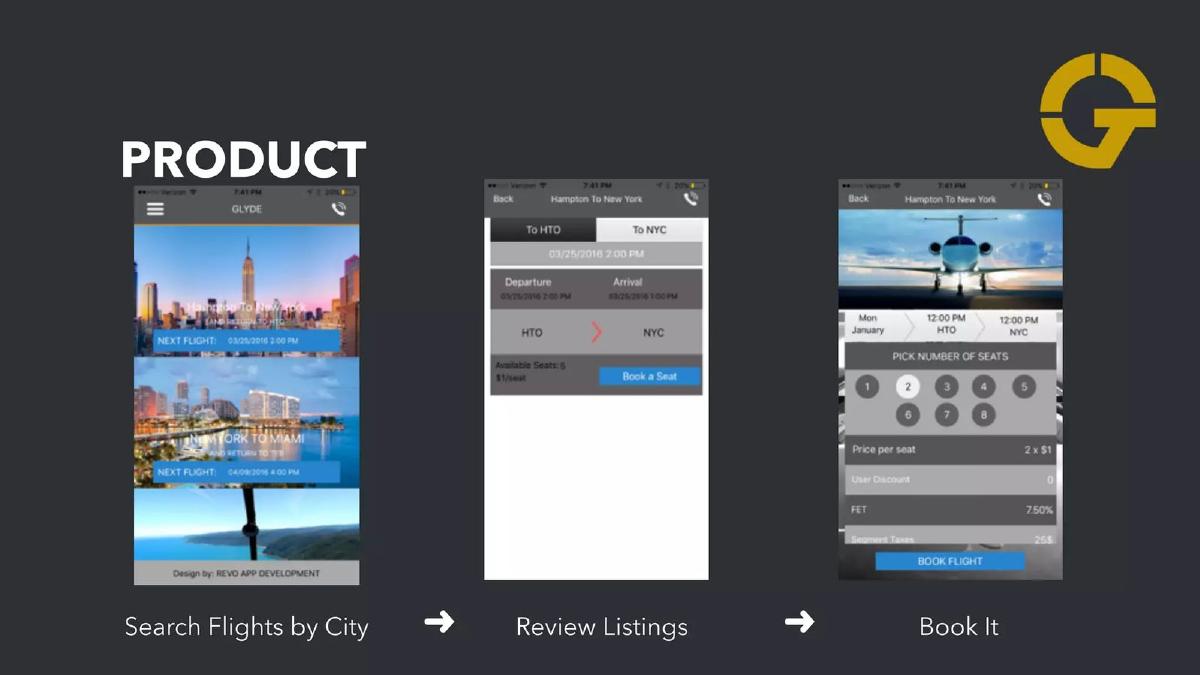
Unit Economics: There is no explanation of how a $99 flight is sustainable. Private jets have high fuel, maintenance, and crew costs. Without a breakdown of how seats are filled or how operators are compensated, the model feels speculative. · The Ask: The deck ends without a request for capital. Investors need to know how much is being raised, at what valuation, and what the specific milestones are for the next 12-18 months. · Traction: While there are testimonials, they are for 'Royal Jets.' There is no data on app downloads, active users, or completed flights under the Glyde brand. · Product Screenshots: For a '3-click' app, the absence of a mobile UI mockup is a significant oversight. Investors want to see the user journey. · Partnerships: The deck does not mention which carriers or fleet owners are providing the aircraft. A marketplace is only as good as its supply side.
Founder Takeaways
Align Your Brand: If you are rebranding from 'Royal Jets' to 'Glyde,' ensure all testimonials and references are updated or clearly explained as 'formerly Royal Jets.' Inconsistency creates doubt about the product's maturity. · Check Your Math: The discrepancy on Slide 4 ($50 fee x 400k trips vs. $10M revenue) is a red flag for detail-oriented investors. Always double-check your projections. · Define the 'How': When proposing a price point that is 90% lower than the industry average, you must dedicate a slide to the 'secret sauce'—whether it is proprietary routing algorithms, deadhead leg utilization, or a specific seat-sharing technology. · Include an Ask: Never distribute a pitch deck without a clear call to action. Specify the round size and the intended use of funds.
Frequently asked questions
- How does Glyde plan to make money?
- According to Slide 4, Glyde operates on a marketplace model, taking a 30% commission on each transaction. They estimate an average fee of $50 per booking. The deck projects reaching $10M in revenue by 2021 by facilitating approximately 400,000 trips. However, the deck does not detail how it will achieve this volume or the specific cost structure of the flights themselves.
- Who are the primary competitors identified by Glyde?
- Slide 5 uses a 2x2 matrix to position Glyde against competitors like Blade, JetSuite, Victor, Jumpjet, and Share-A-Jet. Glyde positions itself in the top-right quadrant, defining its unique value proposition as being both 'Affordable' and focused on 'Online Transactions,' whereas competitors are labeled as either 'Expensive' or reliant on 'Offline Transactions.'
- What is the background of the founding team?
- The team, shown on Slide 6, includes Angelo Senat (Pilot with 8 years of aviation management), Bianca Alexis (Co-founder of Royal Jets, Inc.), Kristina Rudoman (6+ years in startup management), and Bryant McKinnie (Super Bowl Champion and founder of B Major Marketing). The team combines technical aviation expertise with high-level sports and entertainment marketing connections.
- What is the 'Royal Jets' connection mentioned in the deck?
- Slide 6 and Slide 7 frequently reference 'Royal Jets.' Founder Angelo Senat holds the trademark for it, and the user testimonials are specifically for Royal Jets. This suggests that Glyde is likely a mobile-first rebranding or a new technology layer built on top of an existing charter brokerage or aviation service previously operated by the founders.
- Is there a clear investment ask in the deck?
- No. The provided slides do not include a funding request, use of proceeds, or a cap table. While the deck outlines a revenue goal of $10M by 2021 on Slide 4, it fails to specify how much capital is required to reach that milestone or what milestones have been achieved to date.