Gluwa utilizes a high-signal, low-noise deck to present its case for a decentralized banking API. The deck is notably short at only 9 slides, skipping traditional sections like a formal 'Ask,' detailed market competition, or a roadmap. Instead, it relies on a dramatic revenue chart showing a jump from $56,000 in December to $87,000 in January (Slide 2) and a team slide featuring logos from Microsoft, EA Sports, and Carnegie Mellon (Slide 8). The narrative focuses on the failure of traditional banks to serve large industries, suggesting a $2 trillion gap (Slide 3) that Gluwa fills by equating…
Key takeaways
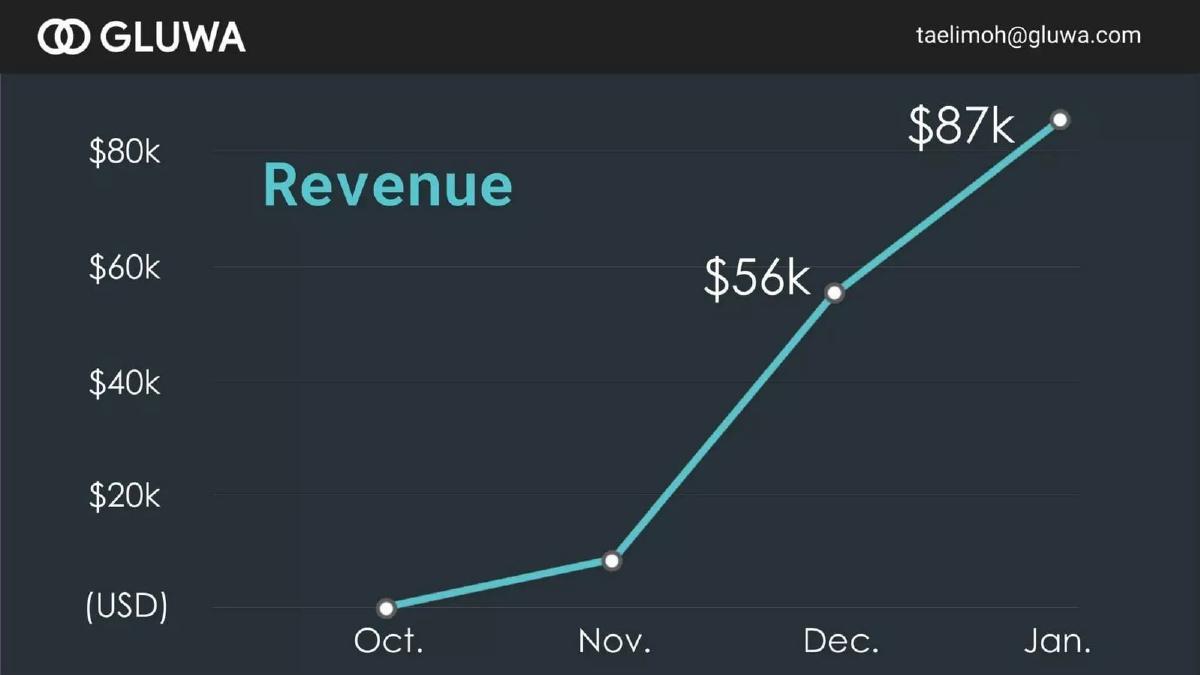
- Revenue grew significantly over a four-month period, reaching $87k in January (Slide 2).
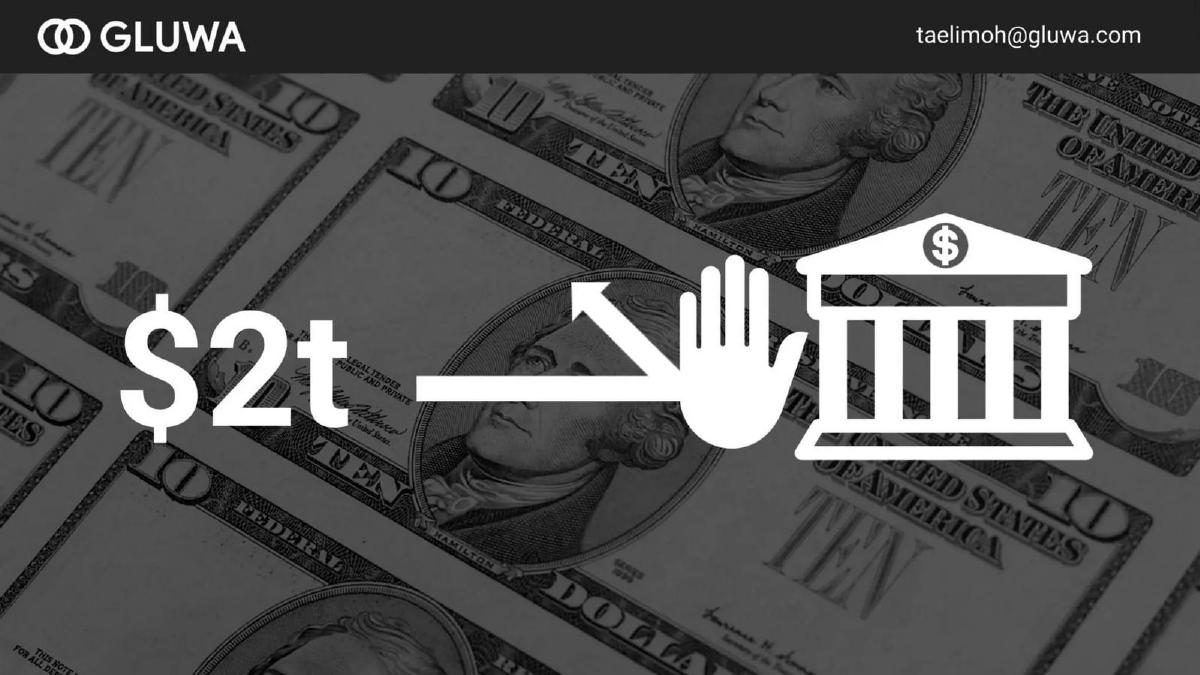
- The company identifies a $2 trillion market opportunity where traditional banks refuse to serve specific large industries (Slide 3).
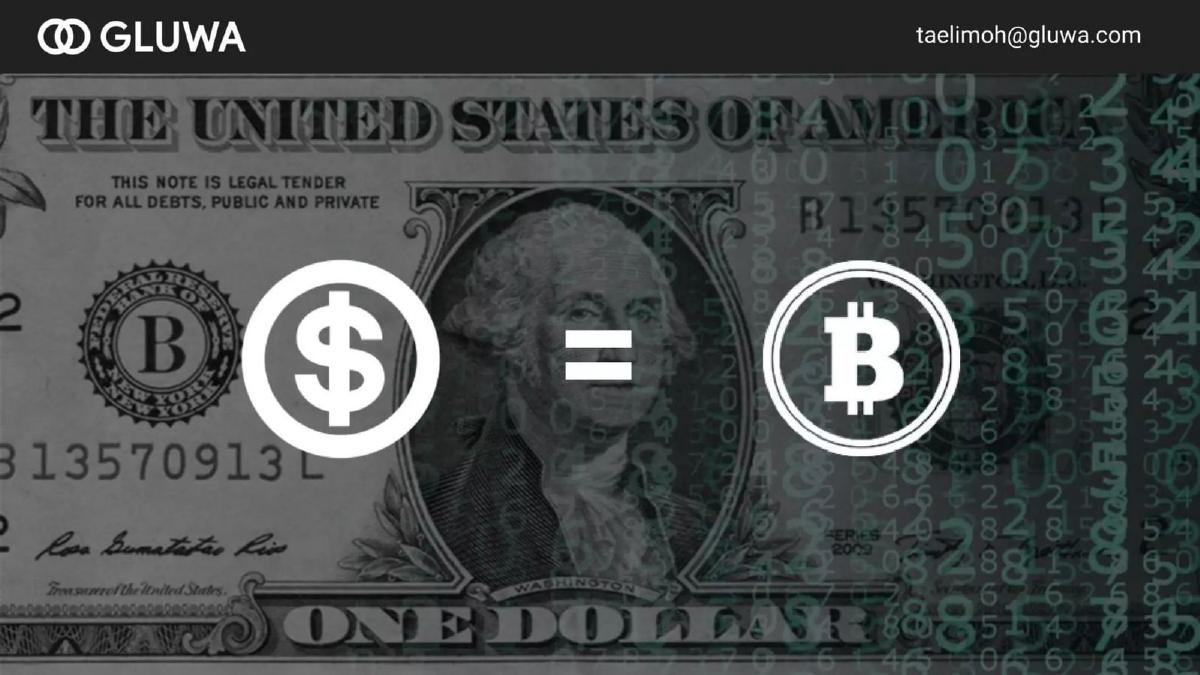
- Gluwa's core value proposition is the seamless integration of fiat and cryptocurrency, visualized as USD equaling Bitcoin (Slide 5).
- The business model relies on a dual fee structure: a transaction fee capped at 0.1% or $3, and a 5% payment fee (Slide 7).
- The team possesses significant enterprise and gaming experience, with backgrounds at Microsoft, EA Sports, and Georgia Tech (Slide 8).
- The platform handles over $1 million in daily transaction volume, resulting in over $80,000 in monthly revenue (Slide 9).
- The deck completely omits a funding 'Ask' or a breakdown of how capital will be deployed.
- There is no mention of specific competitors or a defensive moat beyond the team's technical pedigree.
The High-Traction Teaser: Analyzing Gluwa's 9-Slide Deck
Gluwa’s pitch deck is an exercise in minimalism. In an era where decks often stretch to 20 or 30 slides filled with complex ecosystem maps, Gluwa opts for a high-impact, visual-heavy approach. The deck relies on three pillars: a massive perceived market gap, rapid revenue growth, and a high-pedigree technical team. It does not spend time explaining the underlying blockchain technology in depth, choosing instead to focus on the financial outcomes of that technology.
The Hook and the Growth Curve
Slide 1: Title Slide The deck opens with a bold statement overlaid on a close-up of a hundred-dollar bill: "Banks do not serve some large industries. We DO." This immediately identifies the company as a disruptor in the fintech space, specifically targeting the 'unbanked' or 'underbanked' corporate sectors. It sets a tone of utility over theory.
Slide 2: Revenue Traction Gluwa moves immediately to its strongest evidence. The second slide is a line graph showing monthly revenue in USD. The growth is aggressive: from a negligible amount in October to $56k in December, peaking at $87k in January. By placing this slide second, Gluwa answers the 'does this work?' question before the investor even knows exactly what the product is. This is a tactic often used by companies with strong product-market fit to bypass skepticism.
The Problem and the $2 Trillion Gap
Slide 3: Market Friction This slide uses a large "$2t" figure and a hand icon stopping a flow of money into a bank building. It visualizes the thesis that $2 trillion in capital is being blocked or underserved by traditional financial institutions. While the slide doesn't cite the source for this figure, it establishes the scale of the opportunity.
Slide 4: Security and Fraud The deck uses iconography—a masked thief, a gun, a padlock, and a 'FAKE' stamp on a bill—to highlight the risks of current financial systems. It suggests that the industries Gluwa serves are plagued by security issues and counterfeit risks, positioning Gluwa’s digital infrastructure as the secure alternative.
The Solution and Product Interface
Slide 5: The Value Proposition This is the most conceptual slide in the deck. It shows a US Dollar sign equaling a Bitcoin sign. This effectively communicates that Gluwa’s platform treats digital currency with the same stability and utility as fiat currency. It implies a bridge between the two worlds, which is the core of their API offering.
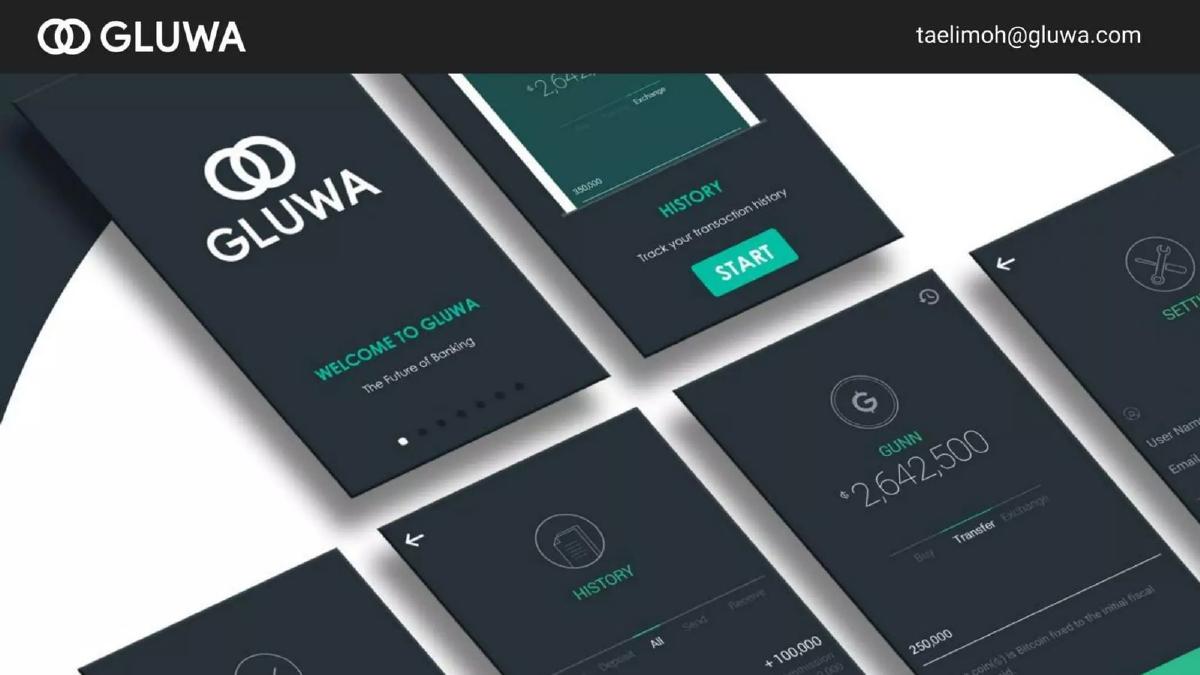
Slide 6: Product UI Gluwa provides a glimpse of their mobile interface. The screens show a dark-themed UI with features like "Track your transaction history," "Deposit," "Send," and "Receive." One screen shows a balance of "$2,642,500" in a currency labeled "GUNN," which the fine print identifies as "Bitcoin fixed to the initial fiscal [value]." This slide proves the product is live and functional, rather than just a concept.
Economics and Team Pedigree
Slide 7: Business Model The revenue model is straightforward. Gluwa lists two primary fees: a Transaction Fee (Max of 0.1% and $3) and a Payment Fee (5%). This suggests they are targeting both large-scale institutional transfers (where the $3 cap is attractive) and smaller retail or merchant payments (where the 5% fee generates higher margins).
Slide 8: Team The team slide is a significant credibility booster. It features four key members: Taelim Oh (CEO), Pope Kim (CTO), Gunyoung Park (COO), and Chris Yoon (Software Engineer). The logos at the bottom are the real story here: University of British Columbia, Carnegie Mellon, and Georgia Tech for education; and Halo, FIFA, Microsoft, EA Sports, Costco, and Staples for professional experience. This suggests a team capable of building high-scale, secure enterprise software.
Slide 9: The Summary Metric The final slide distills the business into a single flow: $1m+ in daily transaction volume leads to $80k+ in monthly revenue. It’s a clean, memorable closing that reinforces the traction shown on Slide 2. It leaves the investor with the impression of a high-velocity machine.
What Works in the Gluwa Deck
Traction First: Leading with an $87k revenue month (Slide 2) is a powerful way to command attention. It shifts the conversation from "if" the company can make money to "how fast" it can scale. For a seed-stage company in 2012, these numbers were particularly impressive.
Visual Simplicity: The deck avoids walls of text. By using icons and large numbers, it ensures that the core message—$2 trillion market, $87k revenue, 5% fees—is impossible to miss, even during a 30-second flip-through.
Team Credibility: The inclusion of major gaming franchises like Halo and FIFA (Slide 8) is a clever way to signal technical competence in handling high-concurrency, real-time data environments, which is essential for a banking API.
What is Missing
The 'Ask': There is no slide indicating how much money Gluwa is raising or what the valuation expectations are. While this might be handled in a follow-up email, its absence in the deck leaves the 'call to action' unclear.
Industry Specifics: The deck mentions "some large industries" (Slide 1) but never names them. Are they serving the gambling industry, cannabis, international remittances, or adult entertainment? Investors need to know which industries are being 'blocked' by banks to assess regulatory risk.
Competitive Landscape: There is no mention of other crypto-fiat bridges or traditional API competitors like Stripe or Plaid. The deck assumes a vacuum that likely didn't exist, even in 2012.
What a Founder Should Copy
The Traction Slide: If you have revenue growth that looks like Slide 2, put it at the front. Don't bury your success on Slide 10. High growth is the best antidote to a lack of detailed market data.
The 1-to-1 Value Prop: Slide 5 (USD = BTC) is a perfect example of how to explain a complex technical bridge in a single image. Founders should strive for this level of clarity in their core solution slide.
The Unit Economics Summary: Slide 9 is an excellent way to end a deck. It connects the 'input' (transaction volume) to the 'output' (revenue) in a way that makes the business model feel inevitable and easy to understand.
Frequently asked questions
- What is Gluwa's primary business model?
- According to slide 7, Gluwa generates revenue through two primary streams. First, it charges a transaction fee that is a maximum of 0.1% or $3. Second, it implements a 5% payment fee. This suggests a focus on both high-volume transfers and smaller consumer-facing payments.
- How much revenue was Gluwa making at the time of this deck?
- Slide 2 shows a clear growth trajectory: starting near zero in October, rising to approximately $10k in November, $56k in December, and hitting $87k in January. Slide 9 reinforces this by stating they generate $80k+ per month.
- What specific problem is Gluwa solving?
- The deck argues that traditional banks do not serve certain large industries (Slide 1), leading to a $2 trillion gap (Slide 3). It also uses iconography on Slide 4 to imply that current systems are vulnerable to theft, locking of funds, and fraud ('FAKE' currency).
- Who are the founders of Gluwa?
- The leadership team includes Taelim Oh (CEO), Pope Kim (CTO), Gunyoung Park (COO), and Chris Yoon (Software Engineer). Their collective experience includes work on major franchises like Halo and FIFA, and education from institutions like Carnegie Mellon and Georgia Tech (Slide 8).
- What is missing from the Gluwa pitch deck?
- The deck is missing several standard components: a specific funding ask, a competitive landscape analysis, a product roadmap, and a detailed breakdown of the 'large industries' they claim to serve. It functions more as a high-level teaser than a comprehensive business plan.