PVcase, a solar design software provider, raised a $100M Series B in 2023 led by Highland Europe, Energize VC, and Elephant VC. The 10-slide deck is a lean, metric-heavy presentation that prioritizes market tailwinds and product efficiency over complex narrative. By highlighting a 30x reduction in design time and a projected 4x growth in PV installations by 2029, the company positioned itself as the essential infrastructure layer for the global energy transition. The deck successfully balances high-level macro trends, such as the $369B U.S. Inflation Reduction Act, with granular product benef…
Key takeaways
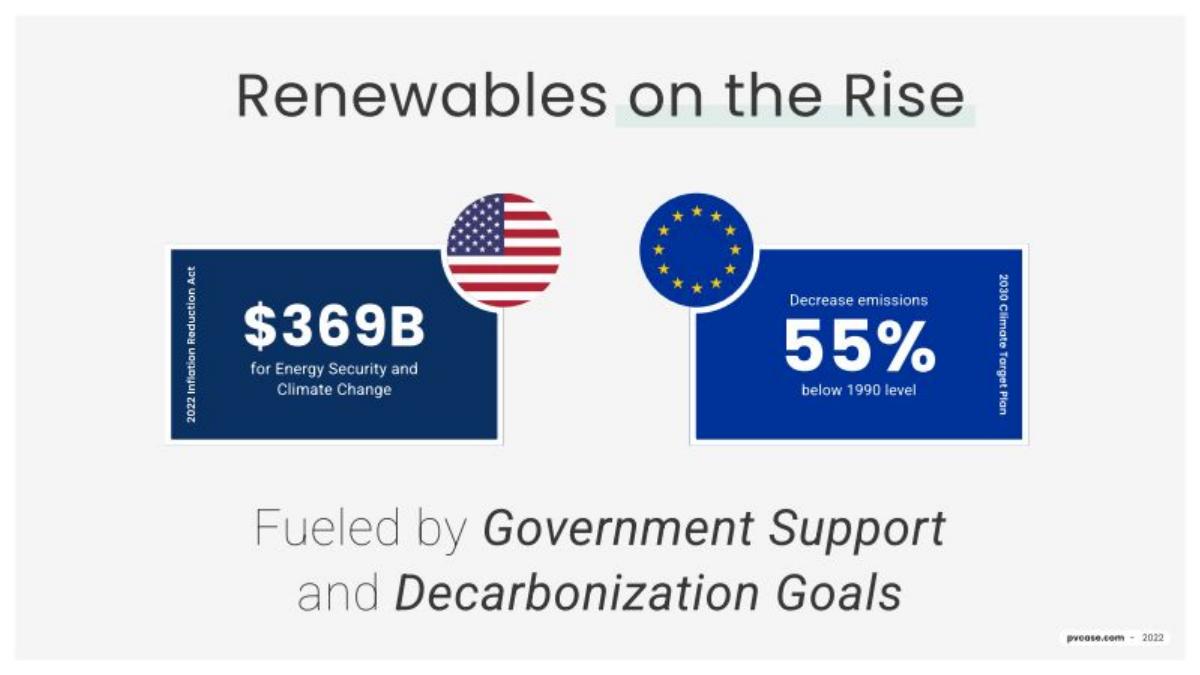
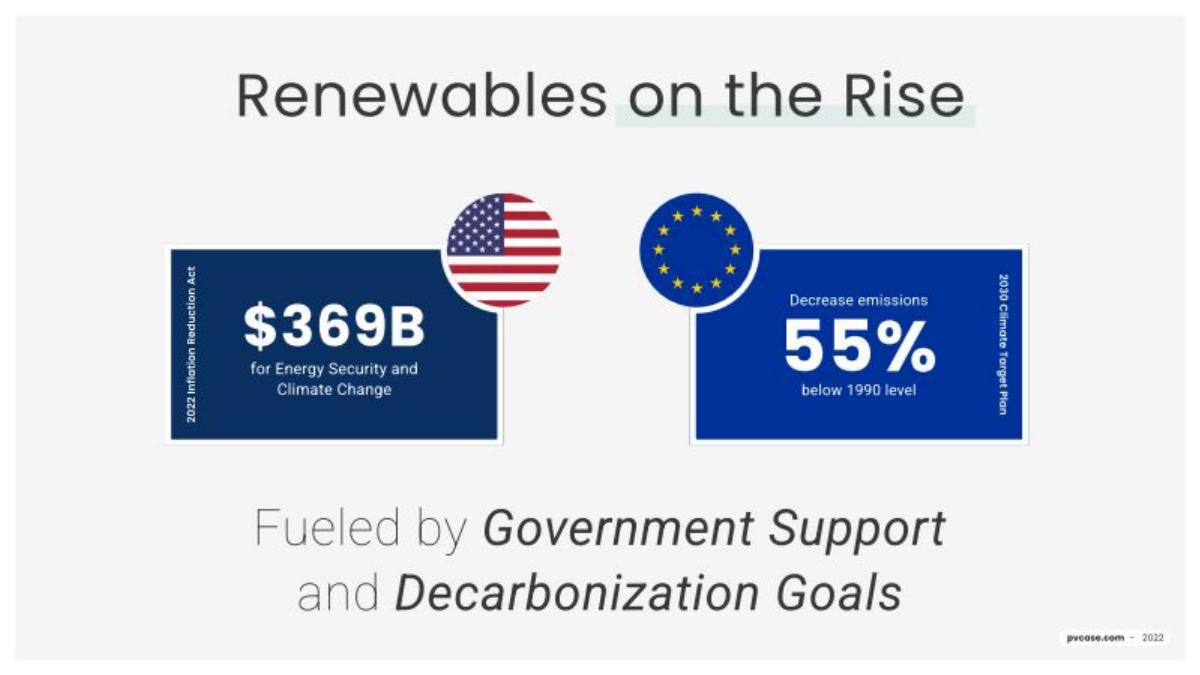
- The deck leverages massive regulatory tailwinds, citing the $369B U.S. Inflation Reduction Act and the EU's goal to decrease emissions 55% below 1990 levels (Slide 1).
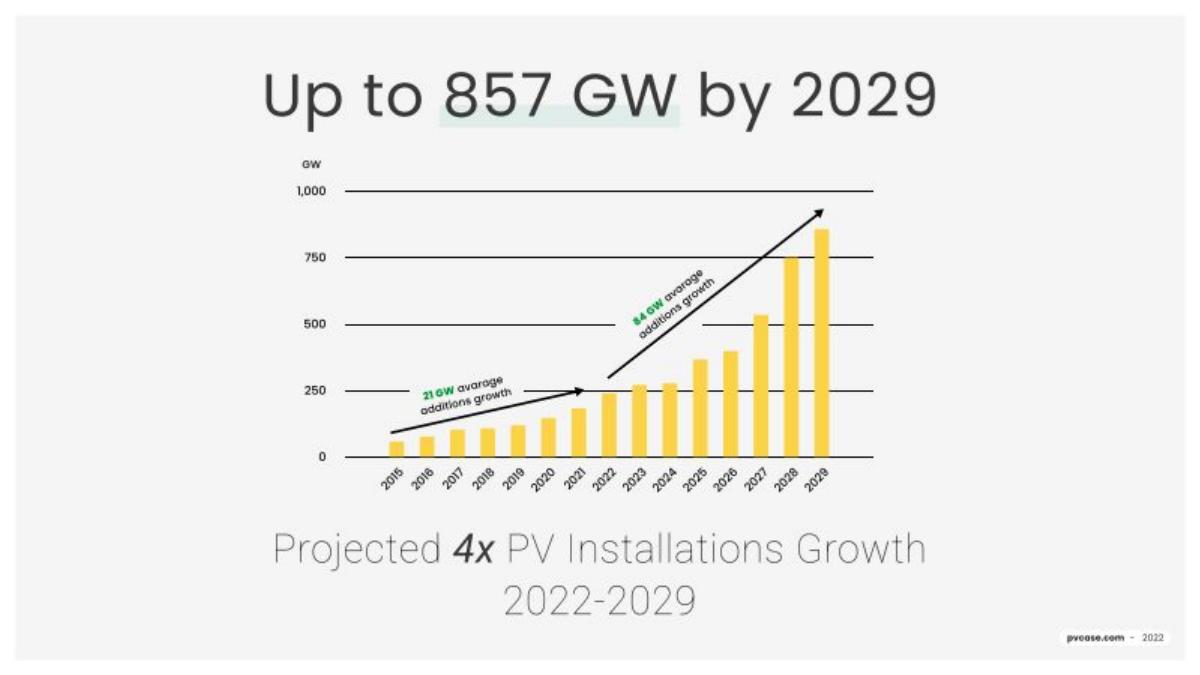
- PVcase projects a 4x growth in PV installations between 2022 and 2029, reaching up to 857 GW (Slide 2).
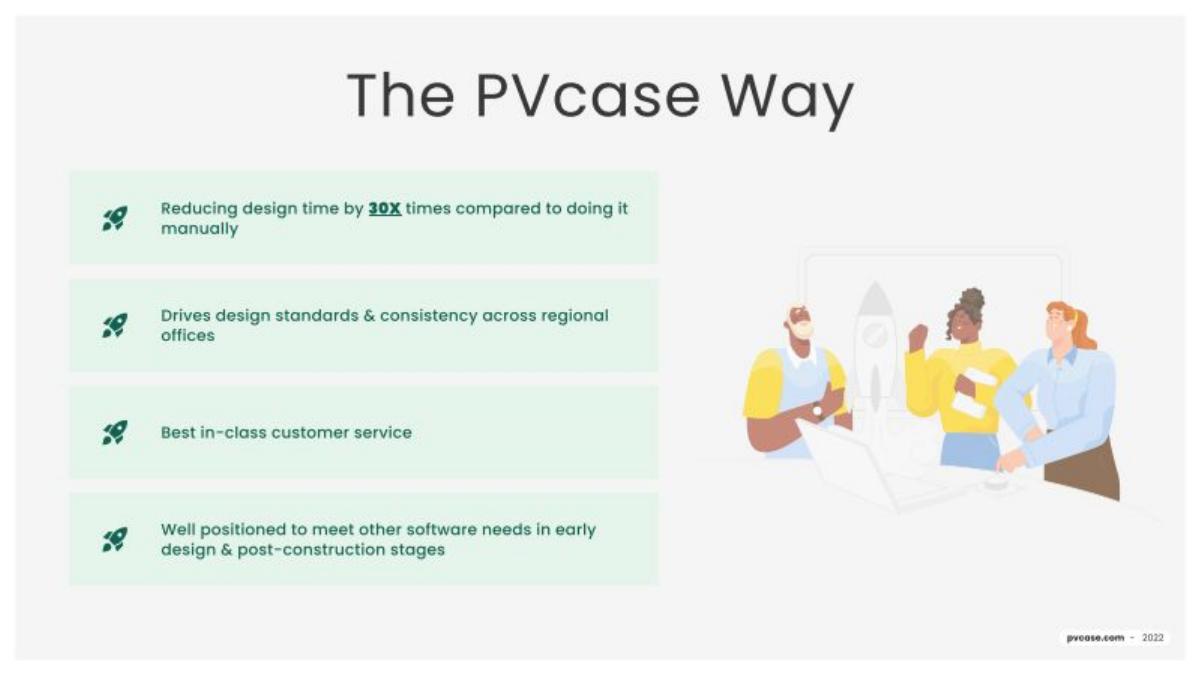
- The core value proposition is a 30x reduction in design time compared to manual processes (Slide 4).
- Product performance metrics are specific, claiming an 11% increase in capacity and a 13% increase in energy production (Slide 5).
- The company demonstrates global scale, stating they are operating in over 60 countries (Slide 5).
- The leadership team features deep domain expertise, including a CEO with 10+ years of solar engineering experience and a repeat founder background (Slide 9).
- The deck completely omits financial history, revenue figures, and a specific funding 'ask' or use of proceeds.
- The software suite is segmented into three distinct products: Ground Mount, Roof Mount, and Yield (Slides 5, 7, 8).
The 10-Slide Efficiency Play: A PVcase Teardown
PVcase represents a classic example of Vertical SaaS: software built for a highly specific, technically demanding industry. In this case, the industry is solar engineering. Their Series B deck is remarkably short at only 10 slides, yet it managed to anchor a $100M round. This teardown examines how they used brevity to their advantage by focusing on massive macro trends and undeniable efficiency metrics.
Slide 1: The Macro Catalyst
The deck opens not with the product, but with the political and economic environment. Slide 1, titled Renewables on the Rise , highlights two massive government initiatives: the 2022 Inflation Reduction Act in the U.S. providing $369B for Energy Security and Climate Change , and the EU's 2030 Climate Target Plan to decrease emissions 55% below 1990 levels . By starting here, PVcase establishes that their market is not just growing—it is being actively subsidized and mandated by the world's largest economies.
Slide 2: The Market Opportunity
Slide 2 quantifies the growth mentioned in the opener. It shows a bar chart of PV installations from 2015 to 2029. The key takeaway is a Projected 4x PV Installations Growth 2022-2029 , reaching Up to 857 GW by 2029 . The slide notes that average annual additions are jumping from 21 GW to 84 GW. This creates a sense of urgency for investors; the 'pipe' of projects is expanding faster than the current workforce can handle.
Slide 3: The Industry Struggle
Slide 3 identifies the bottleneck. Titled The Industry Struggles to keep up , it lists five pain points using 'thumbs down' icons: Slow manual process , Inaccurate, not fit for construction designs , Fragmented industry , Projects built differently in different offices , and Poor customer service . This slide sets the stage for the 'hero'—the software—to solve these specific, tangible problems.
Slide 4: The PVcase Solution
Slide 4 introduces The PVcase Way . It directly counters the pain points from the previous slide. The standout metric here is Reducing design time by 30X times compared to doing it manually . It also promises design standards, consistency, and a position to meet software needs in both early design and post-construction stages. This is the 'Value Prop' slide, and it is clear, concise, and focused on ROI.
Slide 5: Ground Mount Product Deep-Dive
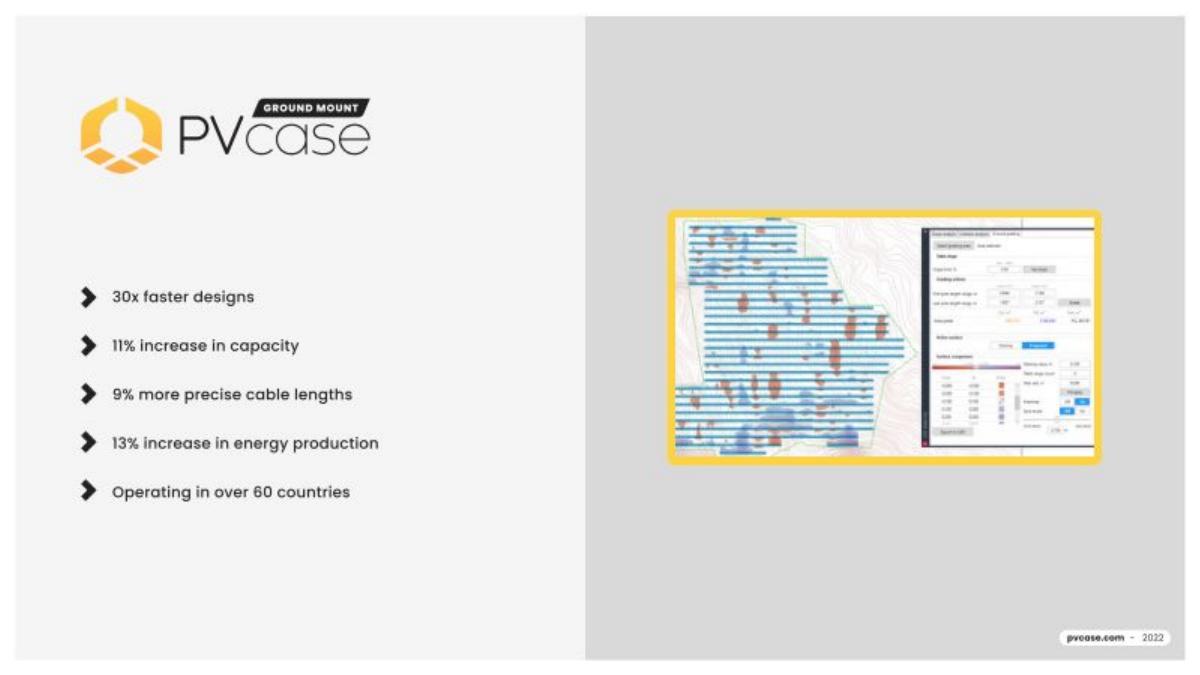
Slide 5 focuses on the PVcase Ground Mount product. It moves from general benefits to specific engineering outcomes. The slide claims: 30x faster designs , 11% increase in capacity , 9% more precise cable lengths , and a 13% increase in energy production . It also notes that they are Operating in over 60 countries , proving that the product has global product-market fit. A screenshot of the software interface is included to show the technical nature of the tool.
Slide 6: Social Proof
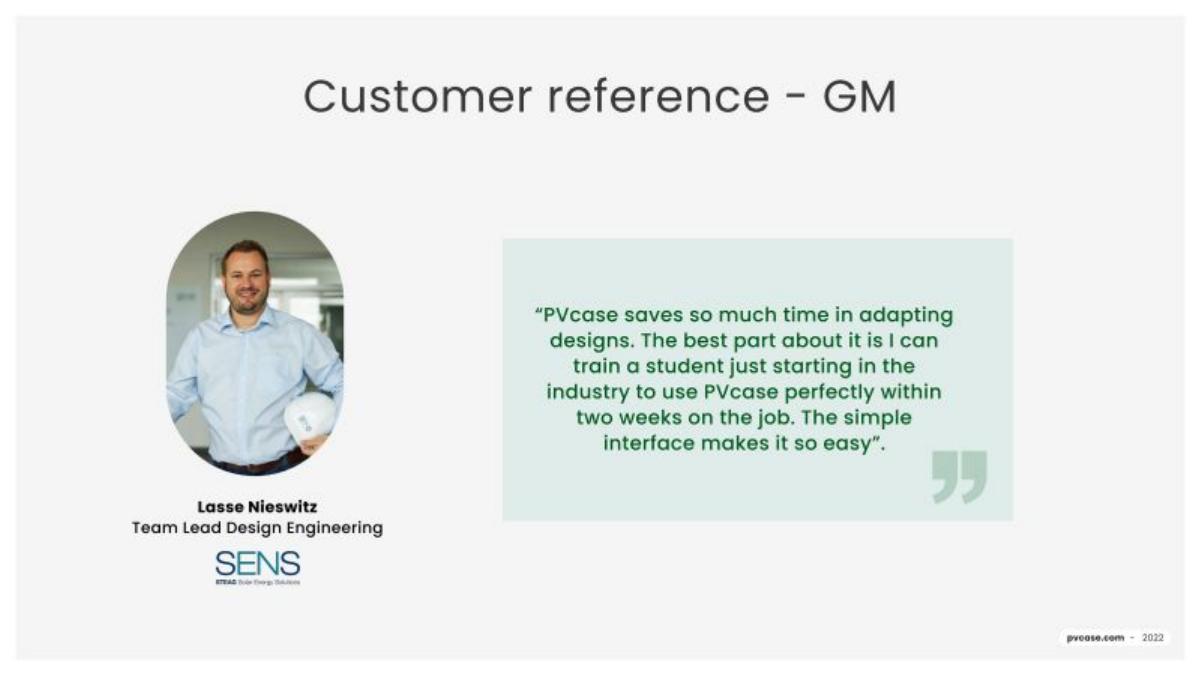
Slide 6 provides a Customer reference from Lasse Nieswitz, Team Lead Design Engineering at SENS. The quote emphasizes the ease of use: "I can train a student just starting in the industry to use PVcase perfectly within two weeks on the job." This is a powerful testimonial because it addresses the labor shortage mentioned in the market growth slides; if the software makes junior staff as productive as seniors, it solves a massive hiring problem for solar developers.
Slide 7: Roof Mount Product
Slide 7 introduces the PVcase Roof Mount . It lists features like Automatic layout generation , Rapid 3D building preparation , and Accurate shade loss modelling . Like the Ground Mount slide, it includes a software screenshot, this time showing a 3D rooftop model with trees and obstructions. This demonstrates the breadth of their platform beyond just open-field utility-scale projects.
Slide 8: Yield and R&D
Slide 8 covers PVcase Yield , their cloud-based simulation tool. It highlights Over 10 years of R&D experience and Physics-based simulation support for bifacial and HSAT systems . This slide is intended to show technical defensibility—that this isn't just a pretty UI, but a tool backed by a decade of engineering research and complex physics simulations.
Slide 9: The Leadership Team
Slide 9 introduces the four key executives. David Trainavicius (CEO) is highlighted as a Repeat founder with 10+ years of solar engineering experience . Douglas Geist (CSO) brings 15+ years of senior sales leadership . Toma Dile (COO) and Adam Pazarauskas (CPO) round out the team with expertise in HR/Ops and solar product management, respectively. The emphasis here is on domain expertise rather than just 'tech' experience.
Slide 10: The Vision
The final slide is a simple brand statement: Fighting Climate Change Through Software . It includes social media handles and the company website. It serves as a clean wrap-up that ties the technical product back to the high-level mission established in Slide 1.
What Works in the PVcase Deck
Specific Engineering Metrics: Unlike many SaaS decks that stick to vague terms like 'efficiency' or 'optimization,' PVcase uses hard numbers. Claiming "9% more precise cable lengths" (Slide 5) is a detail that only someone who understands the industry would include, and it signals to investors that the product provides real, measurable value to engineers.
Macro-Micro Alignment: The deck does a great job of connecting global government spending (Slide 1) to the day-to-day work of a junior engineer (Slide 6). It shows that PVcase is the tool that will allow the industry to actually spend the billions of dollars being allocated to it.
Product Breadth: By showing Ground Mount, Roof Mount, and Yield, the deck argues that PVcase is becoming a platform rather than a single-point solution. This supports a higher valuation and a larger Series B round.
What is Missing from the PVcase Deck
Financials and Traction: There are no revenue figures, ARR growth charts, or NRR (Net Revenue Retention) metrics. For a Series B, these are usually mandatory. Their absence suggests this version of the deck may have been a 'teaser' or a high-level overview used for initial meetings, or that the company relied on a separate data room for all financial disclosures.
The Ask: The deck does not state how much money is being raised or what the 'Use of Proceeds' will be. While the catalogue facts state $100M was raised, a founder using this as a template should remember to include a slide on what they plan to do with the capital (e.g., geographic expansion, new product lines).
Competitive Landscape: There is no mention of other solar design tools like Helioscope or Aurora Solar. While PVcase focuses more on the 'utility-scale' and 'engineering' side, investors generally want to see how a company differentiates itself from other well-funded incumbents.
What Founders Should Copy
The 'Problem/Solution' Mirror: Slide 3 and Slide 4 are perfectly mirrored. Every 'thumb down' in the problem slide is addressed by a 'rocket' icon in the solution slide. This is a simple but highly effective way to structure a pitch.
The 'Student' Testimonial: The customer quote on Slide 6 is excellent. It doesn't just say "the software is good"; it says the software reduces the training time for a new hire to two weeks. In a fast-growing industry, the ability to onboard talent quickly is a massive selling point.
Clean Visual Hierarchy: The deck uses a very consistent layout—text on the left, visual/screenshot on the right. This makes it easy for an investor to skim the deck in under two minutes and still walk away with the core message: 30x faster solar design in a market growing 4x.
Conclusion PVcase's deck is a masterclass in 'less is more.' By focusing on the massive tailwinds of the energy transition and the specific, quantifiable ROI of their software, they made a $100M investment seem like a logical necessity rather than a risky bet. For founders in technical fields, the lesson is clear: lead with the market, prove the efficiency with hard numbers, and show that your product is the only way to meet the coming demand.
Frequently asked questions
- How much did PVcase raise with this deck?
- According to the catalogue facts, PVcase raised $100M in a Series B round in 2023. The investors included Highland Europe, Energize VC, and Elephant VC. Interestingly, the deck itself does not mention the dollar amount being sought or the specific terms of the round, which is common for late-stage decks intended for a broad audience or leaked after the round closes.
- What are the primary pain points PVcase addresses?
- Slide 3 outlines five industry struggles: slow manual processes, inaccuracy in construction designs, a fragmented industry where software cannot be used for the entire lifecycle, regional inconsistencies in project builds, and poor customer service. PVcase positions its 'Way' as the solution to these specific inefficiencies.
- What specific products does PVcase offer?
- The deck highlights three main product areas: PVcase Ground Mount (Slide 5), which focuses on large-scale site design; PVcase Roof Mount (Slide 7), for rooftop system modeling and layout generation; and PVcase Yield (Slide 8), a cloud-based simulation tool for energy production modeling.
- Is there a competitive analysis in the deck?
- No. The deck completely omits a competitor slide or a 'magic quadrant' style comparison. Instead, it focuses on the contrast between using PVcase and 'doing it manually' or using 'fragmented' legacy tools. This suggests the company views the status quo of manual engineering as its primary competition.
- What is the background of the leadership team?
- The team (Slide 9) is led by CEO David Trainavicius, a repeat founder with 10+ years in solar engineering. The executive suite includes Douglas Geist (CSO) with 15+ years in sales, Toma Dile (COO) with 10+ years in HR/Ops, and Adam Pazarauskas (CPO) with 7+ years in solar engineering and product management.