Puzzlium's 2014 seed deck is characterized by extreme minimalism, relying on large-font metrics and product screenshots rather than dense text. The company successfully raised $425,000 by positioning itself as the '1st puzzle social network.' The deck leans heavily on traction, citing 47,000 users and 52,000 puzzles created to demonstrate a self-sustaining content loop. While it lacks traditional slides for market size, competitive landscape, and a specific financial ask, it compensates with social proof from Facebook and Apple. The teardown explores how the team leveraged high-frequency enga…
Key takeaways
- The deck positions the company as the '1st puzzle social network' on Slide 1, establishing a clear category-first narrative.
- The team slide (Slide 2) emphasizes experience, claiming 25 years in the industry and 20 million players across previous products.
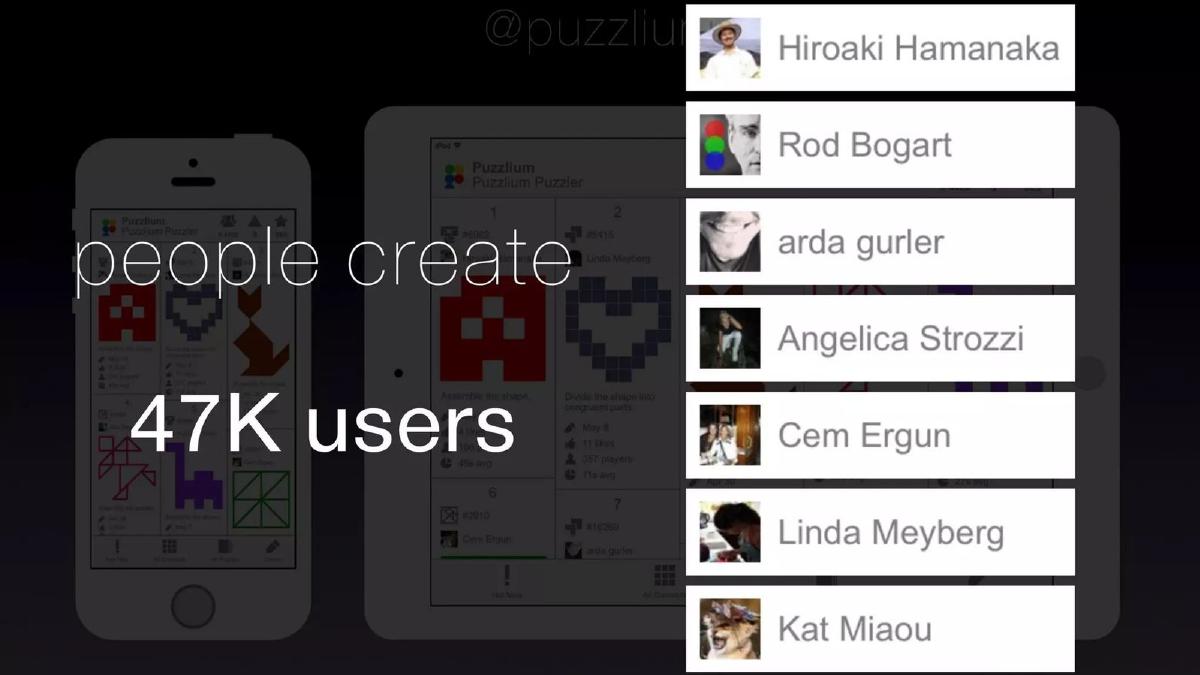
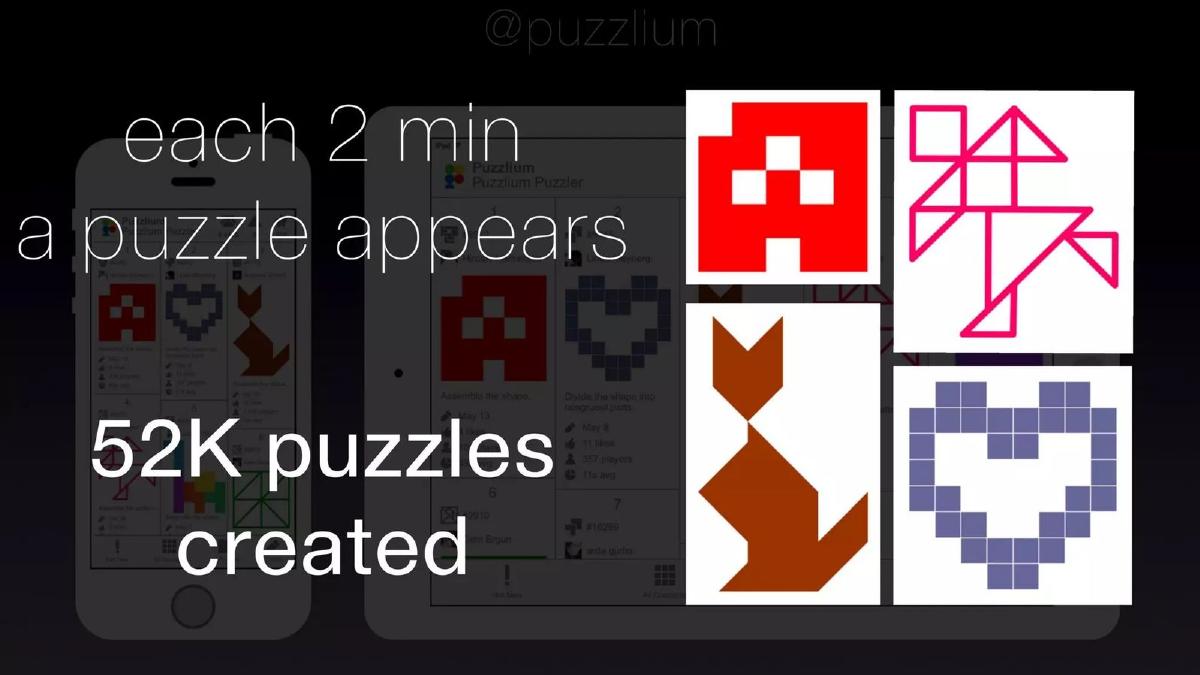
- Traction is the deck's core strength, reporting 47,000 users (Slide 4) and 52,000 puzzles created (Slide 5).
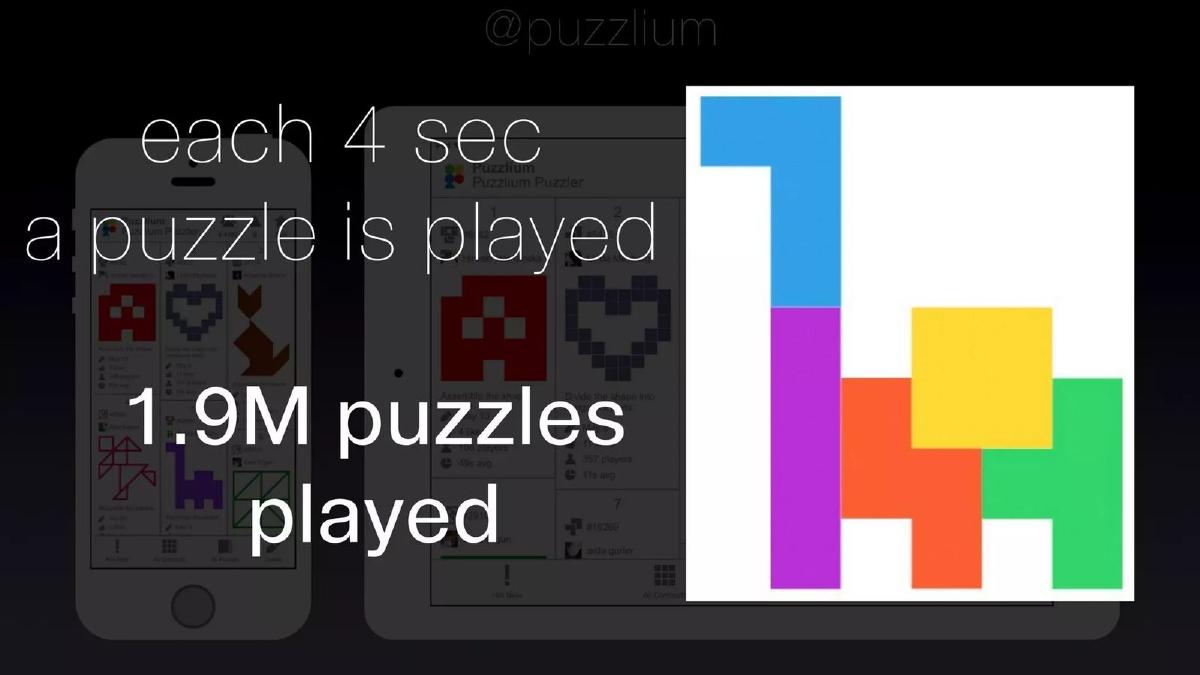
- Engagement velocity is quantified on Slide 6, stating a puzzle is played every 4 seconds, totaling 1.9 million plays.
- The business model is hinted at via '3.7M nano-transactions' and a 'no ads' policy on Slide 10, though specific revenue figures are omitted.
- Social proof is established through acceptance into the FbStart Accelerator and being featured by Apple in Educational Games (Slide 12).
- The deck completely omits a 'Market Size' slide, a 'Competitor' slide, and a specific 'Fundraising Ask' slide.
- Future expansion plans are illustrated through 'interactive tables, floors, and walls' on Slide 13, suggesting a move into physical spaces.
The Minimalist Traction Play
Puzzlium’s pitch deck is a product of its time (2014) but remains a relevant example of how to lead with traction when your product is live and growing. With only 14 slides and very few words per slide, the deck relies on the investor's ability to see the 'velocity' of the platform. By focusing on how often users interact with the app, the founders argue for the addictive nature of their social network without needing to use the word 'addictive' more than once in their external descriptions.
Slides 1-2: The Hook and the Pedigree
Slide 1 serves as the title card. It features the Puzzlium logo—a grid of colorful circles—and the bold claim: "1st puzzle social network." This is a strategic positioning move. By calling it a 'social network' rather than a 'mobile game,' the founders are aiming for a higher valuation multiple associated with platforms and network effects rather than the hit-driven, fickle nature of gaming.
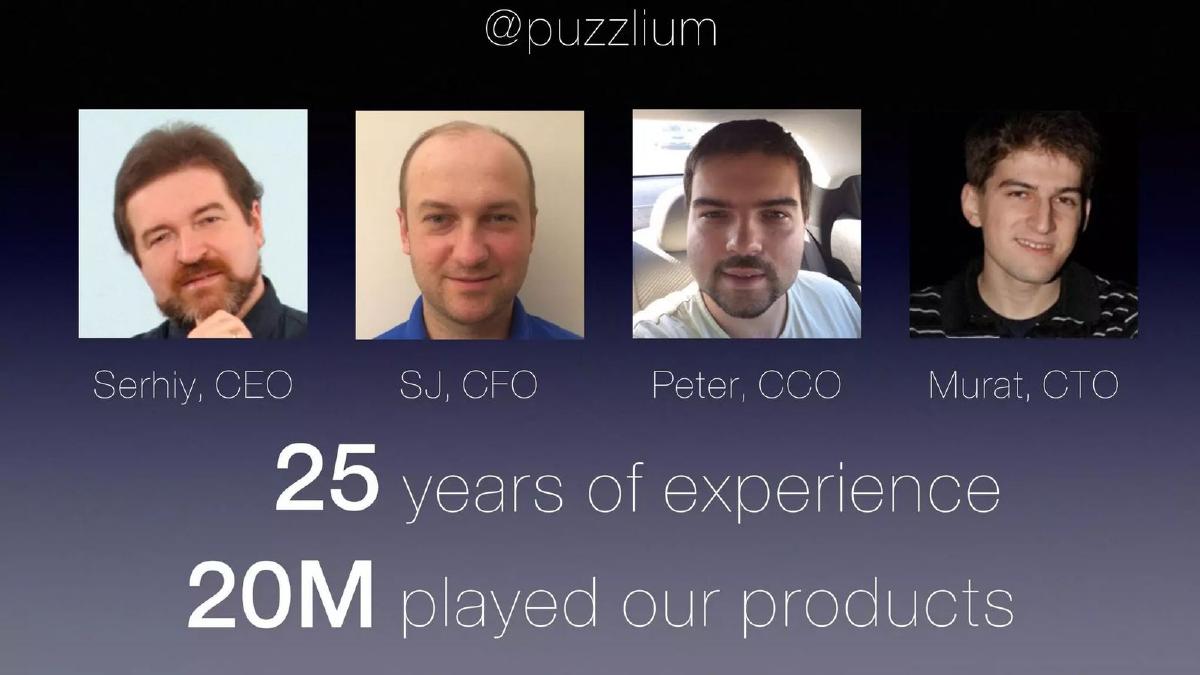
Slide 2 introduces the team: Serhiy (CEO), SJ (CFO), Peter (CCO), and Murat (CTO). The slide is light on resumes but heavy on aggregate impact. It states "25 years of experience" and "20M played our products." For a seed round, these two numbers are doing all the heavy lifting. They tell the investor that this isn't the team's first rodeo and that they know how to scale a user base to millions.
Slides 3-6: The Traction Engine
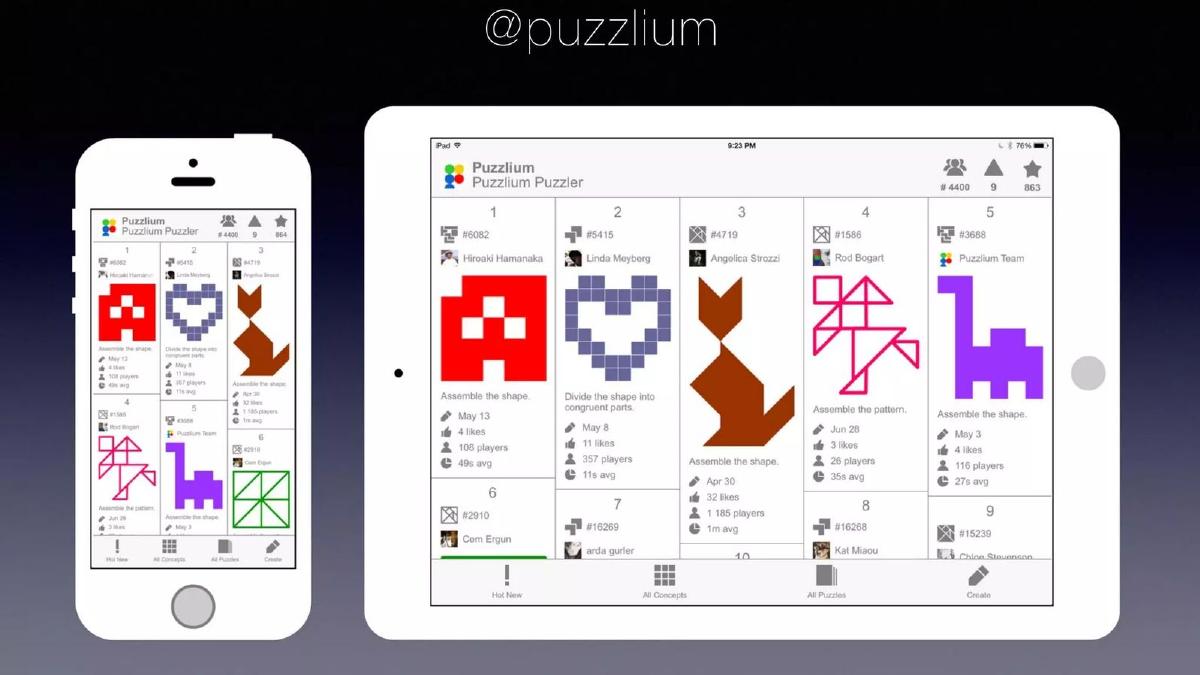
Slide 3 is a simple product showcase, displaying the app on both an iPhone and an iPad. The UI is clean, showing a grid of various puzzles. This slide establishes that the product is not just a concept—it is fully built and functional across devices.
Slide 4 introduces the first major metric: "47K users." The slide also features a list of user names like Hiroaki Hamanaka and Angelica Strozzi, reinforcing the 'global' and 'social' nature of the platform. By showing real people, the deck makes the 47,000 figure feel tangible.
Slide 5 shifts the focus to the content loop. It states "52K puzzles created" and notes that "each 2 min a puzzle appears." This is a critical slide because it proves the platform's scalability. If users are creating content at this rate, Puzzlium doesn't need a massive internal team of level designers. The users are the engine.
Slide 6 provides the 'wow' metric for engagement: "1.9M puzzles played" and "each 4 sec a puzzle is played." This velocity metric is a classic fundraising tactic. It suggests a high-frequency habit and a platform that is 'always on.' For an investor, a play every four seconds indicates high retention and a very active daily user base.
Slides 7-9: Product Mechanics and Competition
Slide 7, 8, and 9 walk through the user experience: "play simply," "publish instantly," and "compete globally." Slide 7 shows a minimalist 'Cut by Painting' puzzle. Slide 8 shows the creation interface, which appears to be a drag-and-drop tetromino builder. Slide 9 shows the leaderboard, where a user can see their rank in specific categories like Sudoku (#1) or Wire Tangram (#395). These slides confirm the 'Solve, Create, Compete' loop described in the company's self-description.
Slides 10-12: Business Model and Social Proof
Slide 10 is the closest the deck gets to a financial slide. It lists "3.7M nano-transactions" and "no ads." This is a bold statement. In 2014, many games were moving toward heavy ad integration. Puzzlium’s choice to focus on 'nano-transactions' suggests a high volume of very small payments, which aligns with the high play frequency mentioned earlier. However, the deck does not state the total revenue generated by these 3.7 million transactions.
Slide 11 uses the logos of The New York Times and History. The text "create and publish your own puzzles" under the NYT logo and "really rewarding social interaction" under the History logo suggests potential B2B partnerships or a content standard they aim to reach. It’s a bit vague, acting more as a mood board for the brand's prestige than a concrete partnership announcement.
Slide 12 provides the 'de-risking' information. It notes Puzzlium was "accepted into FbStart Accelerator" and "featured in Educational Games" by Apple. For a seed-stage startup, validation from the two biggest gatekeepers in the mobile ecosystem (Facebook and Apple) is often more persuasive than any internal projection.
Slides 13-14: Future Vision and Conclusion
Slide 13 looks toward the future, illustrating "interactive tables," "interactive floors," and "interactive walls." This suggests that Puzzlium didn't see itself as just a mobile app, but as a logic/puzzle framework that could be applied to physical hardware or 'smart' environments. It’s a 'vision' slide intended to show the potential for a much larger TAM (Total Addressable Market).
Slide 14 is a closing slide featuring a mosaic of dozens of different puzzle icons, reinforcing the variety and depth of the platform's content library.
What Works in This Deck
Metric Velocity: Instead of just saying "we have a lot of plays," the deck says "a puzzle is played every 4 seconds." This creates a sense of momentum that static numbers cannot match. · Founder-Market Fit: Slide 2 effectively uses aggregate numbers (20M players) to prove the team can handle the scale they are pitching. · Visual Proof: The deck is almost entirely visual. Investors can see exactly what the product looks like, how the puzzles are built, and how the leaderboard works without reading a single paragraph of 'feature' text. · Social Proof: The inclusion of the FbStart and Apple Featured badges provides immediate third-party validation, which is crucial for a consumer app.
What is Missing
The Ask: There is no slide stating how much money the company is raising, what the valuation is, or what the 'use of proceeds' will be. While this might have been handled in a verbal pitch, its absence in the deck makes it an incomplete fundraising document. · Market Size (TAM): The deck assumes the investor already knows the puzzle market is big. It doesn't provide any data on the global gaming market or the specific niche of 'social puzzles.' · Unit Economics: While "3.7M nano-transactions" sounds impressive, without knowing the cost of user acquisition (CAC) or the lifetime value (LTV) of a user, an investor cannot determine if the business is actually profitable or just busy. · Competition: The deck ignores other puzzle giants (like King or Zynga). A slide explaining why Puzzlium’s 'social' approach is a defensible moat against these incumbents would have been beneficial.
What a Founder Should Copy
The 'Every X Seconds' Metric: If your startup has high-frequency actions (transactions, messages, plays), express them in time intervals. It is much more memorable than a large, static total. · Minimalist Design: Puzzlium uses a consistent, dark, professional aesthetic. It doesn't clutter slides with bullet points. It lets the screenshots and the big numbers speak. · Focus on the Content Loop: If your platform relies on User Generated Content (UGC), you must prove that users are actually creating. Slide 5 ("each 2 min a puzzle appears") is the perfect way to show a healthy UGC ecosystem. · Aggregate Team Success: If your team has worked on various projects, aggregating your total reach (e.g., "20M users reached across all past projects") is a powerful way to show experience without listing every single job title.
Frequently asked questions
- How much did Puzzlium raise with this deck?
- According to catalogue facts from pitchdeckhunt.com, Puzzlium raised $425,000 in a Seed round in 2014. Interestingly, the deck itself does not contain a slide specifying the amount they were seeking or the terms of the round, which is a common omission in decks used for verbal presentations or those following a 'teaser' format.
- What is the primary business model mentioned in the deck?
- The deck mentions '3.7M nano-transactions' and explicitly states 'no ads' on Slide 10. This suggests a micro-transaction model where users likely pay small amounts for hints, specific puzzle packs, or creator-related features. However, the deck does not provide a breakdown of Average Revenue Per User (ARPU) or the specific cost of these transactions.
- Who are the founders and what is their background?
- Slide 2 introduces the leadership team: Serhiy (CEO), SJ (CFO), Peter (CCO), and Murat (CTO). While it doesn't list specific past companies, it claims a collective 25 years of experience and a track record of reaching 20 million players with their previous products, providing significant 'founder-market fit' credibility.
- Does the deck address competition?
- No. There is no competitive matrix or list of rivals. Instead, Slide 11 uses the logos of The New York Times and History (Channel) to suggest the types of high-quality content or partnerships they aim to emulate or facilitate, rather than directly comparing features with other mobile puzzle games.
- What is the 'social' aspect of this puzzle app?
- The 'social' element is driven by user-generated content. Slide 4 and 5 highlight that users are the creators, with 52,000 puzzles built by the community. Slide 9 shows a global ranking system across different concepts like Sudoku and Tangram, indicating a competitive, community-driven environment rather than a solo play experience.